
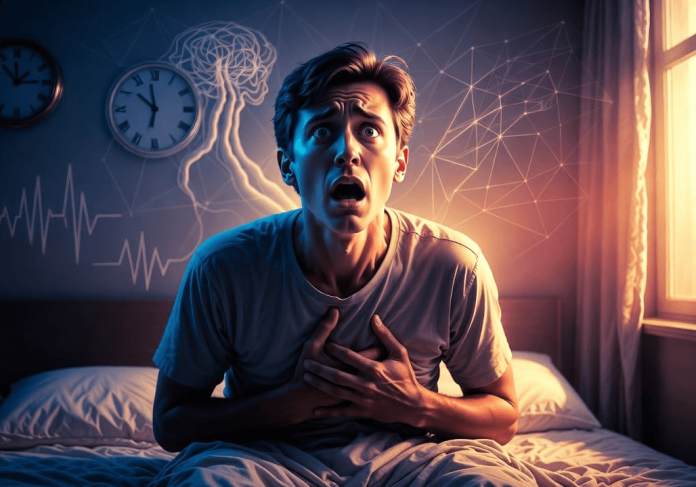
If you’ve ever experienced a panic attack, you know the terror. Your heart races. Your chest tightens. You can’t breathe. Your hands tingle. The room spins. And in that moment, convinced something is catastrophically wrong, your mind screams one thing: I’m dying.
I’m here to tell you something important: You’re not.
What you’re experiencing is terrifying, yes. But it’s not dangerous. It’s your body’s ancient alarm system — the one that kept our ancestors alive — misfiring in modern circumstances. The “impending doom” you feel isn’t a prediction. It’s a symptom.
And once you understand why your body does this, you can start to work with it instead of against it.
What Actually Happens During a Panic Attack
A panic attack is essentially a false alarm. Your body thinks it’s in danger when it isn’t.
Here’s what happens:
Your amygdala — the brain’s threat detection center — senses something it interprets as danger. Maybe it’s a tight space. Maybe it’s a thought that spiraled. Maybe it’s nothing identifiable at all. But regardless of the trigger, your amygdala activates your sympathetic nervous system, also known as the “fight or flight” response.
Suddenly, your adrenal glands dump adrenaline into your bloodstream. Your heart rate spikes. Your breathing quickens. Your blood pressure rises. Your pupils dilate. Your body is preparing to either fight a predator or run from one.
The problem? There’s no predator. There’s no actual danger. But your body doesn’t know that.
So you’re left with all these intense physical sensations — and no context for them. Your brain, searching for an explanation, settles on the worst-case scenario: Something is wrong. I’m dying.
That’s why anxiety feels like dying. Not because you are — but because your body is preparing you for a threat that doesn’t exist.
Why It Feels So Real
One of the most frightening aspects of panic attacks is how real they feel. The symptoms mimic serious medical conditions:
- Chest tightness and heart palpitations → Feels like a heart attack
- Difficulty breathing → Feels like you’re suffocating
- Dizziness and lightheadedness → Feels like you’re going to faint
- Tingling in extremities → Feels like something is seriously wrong with your circulation
- Feeling detached from reality → Feels like you’re losing your mind
This is called “catastrophizing” — your anxious brain interprets normal (or slightly elevated) physical sensations as signs of catastrophe.
The cruel irony? The more you fear these sensations, the more intense they become. Fear amplifies the physical response, which increases fear, which amplifies the physical response. It’s a feedback loop.
But here’s the truth: Every single symptom of a panic attack is your body protecting you. Nothing is malfunctioning. Everything is working exactly as designed — it’s just responding to the wrong signal.
Panic Attacks vs. Medical Emergencies
Here’s what complicates things: Some symptoms of panic attacks can indicate actual medical problems. If you haven’t been evaluated by a doctor, please do that first.
That said, here are some distinctions:
| Panic Attack | Heart Attack |
|---|---|
| Symptoms build gradually | Symptoms often sudden |
| Triggered by stress or no clear cause | Often triggered by exertion |
| Racing heart but regular rhythm | Irregular heartbeat possible |
| Tingling in hands/feet around mouth | Pain radiating to arm/jaw |
| Feeling of dread, not pain | Crushing chest pain |
| Symptoms peak in 10 minutes | Pain persists and worsens |
When in doubt, seek medical attention. But once you’ve been cleared by a doctor, trust that your panic attacks — however terrifying — are not physically dangerous.
How to Stop a Panic Attack: Practical Techniques
Understanding the physiology helps. But what do you do in the moment?
Here are evidence-based techniques to interrupt the panic cycle:
1. The 4-7-8 Breathing Method
Breathing is the fastest way to signal safety to your nervous system.
- Inhale through your nose for 4 counts
- Hold for 7 counts
- Exhale through your mouth for 8 counts
- Repeat 4-5 times
This activates your parasympathetic nervous system — the “rest and digest” response that counteracts fight or flight.
2. The 5-4-3-2-1 Grounding Technique
This engages your senses and pulls you out of the spiral:
- Name 5 things you can see
- 4 things you can touch
- 3 things you can hear
- 2 things you can smell
- 1 thing you can taste
3. Cold Water Shock
Splash cold water on your face — or hold ice cubes in your hands. The mammalian dive reflex kicks in, slowing your heart rate and signaling to your brain that you’re safe.
4. Label It
Say out loud: “This is a panic attack. I am not dying. This will pass.“
Naming the experience takes away its power. You’re observing it rather than being consumed by it.
5. Movement
If you can, move. Go for a walk. Shake your body. Physical movement burns off adrenaline and interrupts the cycle.
The Key: Don’t Fight It
Here’s what took me years to learn: Resisting a panic attack makes it worse.
The more you fight, the more your body thinks there’s something to fight. The tighter you hold, the tighter everything feels.
Instead, practice acceptance. Tell yourself: “This is uncomfortable, but it’s not dangerous. I’ve been through this before, and I got through it. I’ll get through it again.“
Let the wave come. Let it crest. Let it pass. You don’t have to swim harder — you just have to stay afloat.
When to Seek Help
If panic attacks are frequent, predictable, or interfering with your life, consider:
- Therapy: Cognitive Behavioral Therapy (CBT) is highly effective for panic disorder
- Medication: Anti-anxiety medications can help in the short term
- Lifestyle changes: Reducing caffeine, alcohol, and sleep deprivation can decrease frequency
There’s no shame in getting help. Anxiety is one of the most treatable mental health conditions.
Final Thoughts
If you’re reading this from the depths of anxiety, feeling like you’re dying right now: pause. Take a breath.
You are not dying. Your body is confused, not broken. This feeling — as awful as it is — has a ceiling. It will pass. It always does.
I’ve been where you are. The terror feels endless. But it’s not. And the fact that you’re reading this, looking for answers, means you’ve already taken the first step.
You are not alone. And this is not the end of your story.