
Why Your Body Feels “Broken” After a Health Scare
A Health Scare can change the way you see your body. Before the Health Scare, you may have moved through your day without thinking much about your heart, back, legs, breathing, balance, strength, or energy. Then something happens. You get sick. You are injured. A test comes back with a result you did not expect. You need surgery. You spend time in the hospital. Or you live through a long period of pain, stress, or fear.
After that Health Scare, normal things can feel different.
You may notice every ache. You may stop trusting a tired feeling. A strange sensation that you once would have ignored can suddenly feel like a warning. You may wonder if your body is still strong enough to do what it used to do.
That does not mean you are weak.
It also does not mean every new feeling is dangerous. Your body may truly have changed after a Health Scare, and those changes deserve proper medical care. At the same time, the experience of being sick or hurt can change your thoughts, habits, confidence, and sense of safety.
This is one reason recovery can feel harder than expected.
A Health Scare can leave you caught between two thoughts:
“I know I need to move forward.”
and
“What if something happens again?”
Both thoughts can exist at the same time.
Research on injury recovery has found that anxiety connected directly to recovery can be common after injury. One study of adults with mild to moderate upper-limb injuries found that recovery-related anxiety was more strongly linked with disability than general anxiety symptoms in that group.
That does not mean fear causes every recovery problem. It means the emotional side of recovery deserves attention, too.
The goal after a Health Scare is not to pretend nothing happened. The goal is to learn what your body can do now, follow appropriate medical guidance, and slowly rebuild trust.
That is the idea behind STRONG AGAIN – Your Body Is Not Broken. The book is built around the idea that rebuilding strength is not only about muscles. It is also about rebuilding confidence in the body you have today.
You do not have to become the person you were before the Health Scare overnight.
You can start where you are.
Physical Changes vs. Perceived Damage
One of the hardest parts of a Health Scare is figuring out the difference between a real physical change and the fear that something is wrong.
Sometimes the answer is simple. An injury can reduce strength. Surgery can limit movement for a period of time. An illness can leave you tired. Long periods of inactivity can make everyday activities feel harder. Your doctor or physical therapist may give you clear limits while your body heals.
Those changes are real.
But the story your mind tells you about those changes can become much bigger.
You might think:
- “I will never be strong again.”
- “My body cannot handle anything.”
- “If I feel pain, I must be hurting myself.”
- “I was better before this happened.”
- “I have to be careful about everything now.”
- “One bad day means I am getting worse.”
After a Health Scare, those thoughts can feel like facts. They are not always facts.
This does not mean you should ignore pain or other symptoms. It means you should learn to separate a medical warning from a fearful prediction. If something is new, severe, worsening, or concerning, talk with your healthcare professional rather than trying to diagnose yourself.
The National Institute of Neurological Disorders and Stroke explains that fear and avoidance can sometimes protect us from danger, but they can also interfere with recovery when they continue after the body is ready for appropriate activity.
That difference matters.
Imagine someone injures a knee. At first, avoiding certain movements may be exactly what the medical team recommends. Later, after healing and proper clearance, the person may still feel afraid to use the knee. That fear can lead to less movement, which can make daily life harder.
This is why recovery after a Health Scare should not be based on fear alone.
It should be based on information.
Your healthcare team can help you understand what is safe. A physical therapist can help you rebuild movement and strength when therapy is appropriate. A mental health professional can help when fear, anxiety, or stress becomes difficult to manage. The National Institute of Arthritis and Musculoskeletal and Skin Diseases notes that rehabilitation may be used after an injury to rebuild strength and range of motion and help people return to activity.
The important point is this: needing recovery does not mean your body has failed.
A Health Scare may change what “strong” looks like for a while. That is different from saying you cannot become strong again.
You may need to walk for five minutes instead of thirty. You may need to use a chair during an activity. You may need more rest. You may need to rebuild one movement at a time.
That still counts.
Strength is not only measured by how much weight you can lift or how far you can walk.
Sometimes strength is getting up and trying again.
Sometimes it is following the doctor’s instructions.
Sometimes it is admitting that you need help.
And sometimes, after a Health Scare, strength means learning to stop treating every sensation as proof that your body is falling apart.
Fear, Uncertainty, and Loss of Trust
A Health Scare can take away something that is easy to overlook: trust.
Before the Health Scare, you may have trusted your body without thinking about it. You woke up, stood up, walked across the room, climbed stairs, carried groceries, worked, played with your family, or went to bed.
Then something happened that made your body feel unpredictable.
Now you may watch it closely.
You may check your pulse. You may notice every muscle twitch. You may worry about dizziness. You may wonder whether a sore spot is normal. You may think about what happened the last time you felt something similar.
That can become exhausting.
A Health Scare can also create uncertainty because recovery rarely moves in a straight line. You can have a good day followed by a difficult day. You can feel stronger one morning and tired that evening. You can make progress for several weeks and then need to slow down.
That does not automatically mean you are back at the beginning.
Real recovery can have ups and downs.
Stress can make this even harder. The American Psychological Association explains that long-term stress affects many body systems, and ongoing stress can keep muscles tense and contribute to physical symptoms.
That creates a difficult cycle after a Health Scare.
You feel something.
You worry about it.
Your body becomes more tense.
You notice the sensation even more.
You become more worried.
Then you may avoid activity because you are afraid of making things worse.
This does not mean the symptoms are imaginary. The sensations can be real. The fear can be real. The physical condition can also be real. The point is that the body and mind do not operate as two completely separate machines.
A Health Scare can affect both.
Recent research involving people recovering from cardiac events also found that health anxiety, mental defeat, and fear of illness recurrence or progression were important parts of the adjustment process. The researchers also found that these factors did not show a simple relationship with rehabilitation adherence or outcomes, which is a good reminder that recovery is complicated and cannot be reduced to one mental factor.
That matters because you do not need to blame yourself for having fear.
Fear after a Health Scare is understandable.
The goal is not to yell at yourself for being afraid. The goal is to learn how to respond to fear without allowing it to make every decision.
Try asking a different question.
Instead of:
“What if something goes wrong?”
ask:
“What do I actually know right now?”
Then separate the facts from the fear.
For example:
| What I Know | What I Fear |
|---|---|
| My doctor cleared me for certain activity. | I might hurt myself anyway. |
| I walked for five minutes without a problem. | Maybe tomorrow I will suddenly get worse. |
| I am tired today. | Maybe I will never feel better. |
| I have a follow-up appointment scheduled. | Maybe the results will be terrible. |
| I need more time to recover. | Maybe I will never recover. |
This simple difference can help you see what is known and what is being predicted.
A Health Scare can make the future feel certain when it is not.
You do not need to know exactly how you will feel six months from now.
You only need to know the next safe step.
That is where rebuilding body trust begins.
Rebuilding Trust in the Body
After a Health Scare, rebuilding trust does not mean pretending your body is exactly the same as it was before.
Your body may have scars.
It may have less strength.
It may have a medical condition that needs ongoing care.
It may need medication, therapy, rehabilitation, rest, or changes to your normal routine.
You can accept those facts without deciding that your body is broken.
The difference is important.
Your body is not required to return to an old version of itself before you are allowed to feel strong.
A Health Scare may force you to redefine strength.
Before the Health Scare, strength might have meant lifting heavy things, working long hours, running, exercising hard, or never needing help.
After the Health Scare, strength may mean following your treatment plan. It may mean walking when you would rather stay on the couch. It may mean doing a small exercise that your healthcare professional has approved. It may mean resting instead of pushing through warning signs. It may mean asking someone to help you.
None of those things are failures.
They are choices.
And repeated choices can rebuild confidence.
The book STRONG AGAIN – Your Body Is Not Broken focuses on that process: moving away from the idea that one health event defines your entire body and your entire future.
If you want to explore the book itself, you can find STRONG AGAIN – Your Body Is Not Broken on Amazon.
The first goal after a Health Scare does not have to be becoming “strong again” in the old sense.
The first goal can simply be becoming comfortable with your body again.
That might start with one small action.
Sit up.
Stand up.
Walk across the room.
Stretch gently if you have been cleared to do so.
Take a few slow breaths.
Complete the movement your healthcare professional gave you.
Write down one thing your body did today that it could not do before.
Then stop.
You do not have to turn one small win into a huge workout.
Small wins matter because they give you real information.
“I did this.”
“My body handled this.”
“I followed my plan.”
“I rested when I needed to.”
“I noticed a problem and called my doctor.”
Those statements are much more useful than telling yourself, “I should be back to normal by now.”
A Health Scare can make you look backward all the time.
Recovery asks you to look at today.
The body you have today is the body you are learning to trust.
And that trust is not built in one dramatic moment.
It is built through hundreds of small experiences.
One safe choice.
One honest check-in.
One day at a time.
That is how you begin to feel strong again without pretending the Health Scare never happened.
The Mind-Body Connection in Recovery
Recovery after a Health Scare is not only about what happens to your body. It is also about what happens in your thoughts, emotions, habits, and daily choices.
That can be easy to miss.
When something serious happens to your health, the first concern is usually the physical problem. You want to know what happened, what treatment you need, how long recovery will take, and what you can safely do. Those questions matter. Medical care should come first when a medical problem needs attention.
But there is another part of recovery that deserves a place at the table.
It is the way the Health Scare changes how you think about your body.
Before a Health Scare, you may not have spent much time thinking about your heartbeat, breathing, balance, strength, pain, energy, or movement. Afterward, you may notice all of it.
A small ache can feel important.
A tired day can feel like a warning.
A difficult movement can make you wonder if you have damaged yourself.
You may even begin to think of your body as something that cannot be trusted.
That reaction is understandable. It does not mean the physical problem is imaginary. It means the experience of a Health Scare can affect both your physical life and your emotional life.
The National Institute of Neurological Disorders and Stroke describes pain as a biopsychosocial experience. In simple terms, biological factors, psychological factors, and social factors can all affect the experience of pain, and those factors can affect one another.
That is why rebuilding after a Health Scare may require more than simply waiting for an injury or illness to improve.
You may also need to rebuild confidence.
You may need to change the way you talk to yourself.
You may need to learn when caution protects you and when fear is keeping you from doing something you have already been cleared to do.
And you may need to give yourself permission to recover at a slower pace than you expected.
This is not about pretending everything is fine.
It is about seeing the whole picture.
How Stress and Fear Affect Healing
Stress is a normal response to a difficult situation. Your body has systems designed to respond when you believe there is danger. The National Center for Complementary and Integrative Health explains that the stress response can increase heart rate, breathing rate, blood pressure, muscle tension, and sweating.
That response can be useful when you need to react to an immediate threat.
A Health Scare can create a different problem.
The danger may have passed, but your mind may still be watching for it.
You may keep asking:
“What if it happens again?”
That question can become part of everyday life.
You might avoid stairs because you are afraid of falling. You might stop exercising because you are afraid of getting hurt. You might avoid a movement that reminds you of an old injury. You might stay in bed because you are afraid that being active will make your symptoms worse.
Sometimes caution is exactly what you need.
If your doctor tells you not to lift, you should not lift.
If your surgeon gives you movement restrictions, follow them.
If your physical therapist gives you a specific rehabilitation plan, that plan matters.
But there can come a point when fear continues even after you have been medically cleared for appropriate activity.
The National Institute of Neurological Disorders and Stroke gives an example of this fear-avoidance cycle. A person may be told to avoid heavy lifting while an injury heals, but continue avoiding activity after being cleared. That avoidance can interfere with daily life and may contribute to weakness and other problems.
That is an important difference.
Protection and avoidance are not always the same thing.
Protection says:
“My body needs time to heal, so I will follow the plan.”
Avoidance says:
“I am afraid something might happen, so I will never try.”
After a Health Scare, it can be hard to tell which one is driving your choices.
One useful question is:
“Is this something my healthcare team told me to avoid, or is this something I am avoiding because I am afraid?”
That question does not tell you what you should do physically. Your medical team needs to answer that part.
It simply helps you notice the difference between medical guidance and fear.
Stress can also affect how you experience symptoms. Research on chronic stress and pain has described connections between stress responses, fear, and pain.
Again, this does not mean pain is “all in your head.”
Pain is real.
Fatigue is real.
Weakness is real.
Anxiety is real.
The point is that the brain and body communicate constantly.
That is why recovery after a Health Scare should make room for both.
A practical recovery plan may include medical treatment, physical rehabilitation, sleep, appropriate activity, social support, and attention to stress and emotional health.
You do not have to pick body or mind.
Recovery can involve both.
| What You Notice | A Helpful Question |
|---|---|
| Pain or discomfort | What has my healthcare provider told me about this symptom? |
| Fear of movement | Am I medically restricted, or am I afraid to move? |
| Low energy | What level of activity is appropriate for me right now? |
| Worry about relapse | What do I actually know today? |
| Frustration | What is one thing I can still do? |
| A bad recovery day | What changed, and what can I learn from it? |
The goal is not to force yourself through fear.
The goal is to understand it.
The Role of Identity: “Sick” vs. “Recovering”
A Health Scare can also change the way you see yourself.
You may go from thinking:
“I am healthy.”
to:
“I am sick.”
That change can happen quickly.
Maybe you start using medical words to describe yourself. Maybe every conversation becomes about symptoms, appointments, tests, medication, or restrictions. Maybe your family starts treating you differently because they are worried.
Sometimes that is necessary.
When you are dealing with a serious medical problem, your health deserves attention.
But there is a difference between having a health problem and making the health problem your entire identity.
You can be recovering and still be you.
You can have an injury and still be a parent, spouse, worker, friend, creator, student, or whatever other roles matter in your life.
You can have a chronic condition and still have goals.
You can have limitations and still make progress.
You can need help and still be strong.
That change in thinking matters because recovery is not always a straight line.
The National Institute of Diabetes and Digestive and Kidney Diseases explains that behavior change happens in stages. People can move through thinking about change, preparing, taking action, and maintaining a new routine. It also notes that roadblocks and setbacks can happen along the way.
That gives us a better way to think about recovery.
You do not have to wake up one morning and suddenly become a completely different person.
You can move through stages.
At first, you may simply become aware of what happened.
Then you may start thinking about what you can safely change.
Then you may try one small action.
Eventually, that action may become part of your routine.
This is why the word recovering can be useful.
“Recovering” does not mean you are pretending to be healthy.
It means you are in a process.
You are learning.
You are adjusting.
You are rebuilding.
You are following medical advice while also looking for the things you can control.
A Health Scare may have changed your body, but it does not have to write the rest of your story.
That does not mean you should deny limitations. In fact, honest acceptance can be part of rebuilding.
Maybe you cannot do what you did five years ago.
Maybe you cannot do what you did five months ago.
Maybe you cannot do what you did before the Health Scare.
That hurts.
It is okay to admit that.
But the next question is not:
“How do I become my old self again?”
A better question may be:
“What can I build from where I am now?”
That question leaves room for reality.
It also leaves room for hope.
Why Small Wins Matter More Than Big Leaps
After a Health Scare, many people want a big sign that they are getting better.
They want to walk farther.
Lift more.
Work longer.
Exercise harder.
Return to everything they used to do.
That desire makes sense.
But a big jump is not always the best way to rebuild confidence.
Sometimes the most important progress is almost boring.
You walk a little.
You complete a rehabilitation exercise.
You get through a normal morning.
You take a shower without needing to stop.
You prepare a meal.
You sit outside.
You stretch within the limits you have been given.
You go to an appointment.
You sleep a little better.
You notice that something which frightened you last month does not frighten you quite as much today.
Those things may not look impressive from the outside.
They can still matter.
The NIDDK recommends starting with small changes when building healthier habits and gives a short walking goal as an example. It also explains that setbacks happen and that people can regroup and return to their goals.
That is useful after a Health Scare because small actions are easier to repeat.
And repetition matters.
Imagine two recovery plans.
Plan A: “I am going to become strong again immediately.”
Plan B: “I am going to do one safe thing today that supports my recovery.”
Plan A sounds powerful.
Plan B is easier to live with.
If Plan A becomes too difficult, you may feel like you failed.
If Plan B becomes difficult, you can adjust it.
That difference can change how you see yourself.
A small win gives you evidence.
I did something.
I handled it.
I followed my plan.
I learned something.
I can try again.
Over time, those experiences can help rebuild confidence.
That does not mean every small action will produce a dramatic physical improvement. It does not mean you should ignore symptoms or push through medical restrictions.
It means you can measure recovery by more than one giant milestone.
Try looking for these smaller signs:
- You understand your limits better.
- You know which activities are safe for you.
- You are following your treatment plan.
- You are less afraid to ask questions.
- You recover more calmly after a difficult day.
- You notice what your body can do instead of only what it cannot do.
- You are making choices based on information instead of fear.
- You are building routines that you can actually maintain.
Those are not imaginary victories.
They are part of learning how to live in your body again.
The National Institute of Mental Health also recommends realistic goals and focusing on what you can manage when coping with difficult experiences.
That idea fits recovery well.
Do not make today’s goal something that belongs six months from now.
Make today’s goal belong to today.
Maybe your goal is five minutes.
Maybe it is one exercise.
Maybe it is making the phone call you have been putting off.
Maybe it is resting without feeling guilty.
Maybe it is writing down what you noticed.
Maybe it is simply getting out of bed and beginning the day.
Your small win does not have to impress anybody else.
It only has to be real.
Rebuilding the Mind and Body Together
The mind-body connection is not a reason to blame yourself for symptoms after a Health Scare.
It is a reason to give the whole recovery process more attention.
Your medical care matters.
Your physical condition matters.
Your emotional health matters.
Your habits matter.
Your support system matters.
And your sense of confidence matters.
These pieces can affect one another.
The National Center for Complementary and Integrative Health notes that practices such as relaxation techniques, mindfulness, yoga, and tai chi have been studied for stress and other health concerns, although safety and usefulness can vary by person and condition. Such approaches should not be treated as replacements for needed medical care.
The safest approach is simple:
Use what is appropriate for you.
If you have a medical condition, injury, or recent procedure, ask your healthcare professional what activity is appropriate before starting something new.
Recovery is not a contest.
You do not have to prove that you are tough.
You do not have to punish yourself for needing time.
And you do not have to wait until you feel completely fearless before you begin rebuilding your confidence.
The purpose of STRONG AGAIN – Your Body Is Not Broken is to go deeper into that process of rebuilding strength, confidence, and trust after life has knocked you off course.
The message is simple:
Your Health Scare is something that happened to you.
It does not have to become everything you are.
You can learn.
You can adjust.
You can rebuild.
You can have a hard day without calling your entire recovery a failure.
And sometimes the road back starts with something so small that nobody else would notice.
But you notice.
You did it.
And tomorrow, you can build from there.
6 Steps to Rebuild Strength and Trust After a Health Scare
A Health Scare can leave you wondering what to do next.
You may know that you want to get stronger. You may even know what you used to do to stay active. But after an illness, injury, surgery, long period of stress, or other health problem, the old plan may not fit anymore.
That can be frustrating.
You may try to do too much because you want your old life back. Then you may feel exhausted or sore and decide you cannot do anything at all. Neither extreme has to be your answer.
Rebuilding after a Health Scare is often about finding the middle ground.
You learn what is safe for your situation. You start small. You pay attention to what happens. You adjust when something does not work. You keep going when you can. You ask for help when you need it.
The Centers for Disease Control and Prevention recommends starting slowly when becoming more physically active and notes that people with chronic health conditions should talk with a healthcare professional about the types and amounts of activity that are right for them.
That is an important point for anyone coming back from a Health Scare.
The goal is not to prove how much you can handle.
The goal is to build a routine you can safely repeat.
Here are six practical steps that can help you think about that process.
Step 1: Redefine “Strong” for Your Current Season
Before a Health Scare, you may have had your own definition of strong.
Maybe strong meant lifting heavy weights.
Maybe it meant working ten hours without slowing down.
Maybe it meant running, playing sports, hiking, doing yard work, or keeping up with everyone else.
Maybe it simply meant never needing help.
Then the Health Scare happened.
Suddenly, those old measurements may not make sense.
That can create a painful thought:
“If I cannot do what I used to do, I am not strong anymore.”
That thought can make recovery harder than it needs to be.
Strength is not one fixed number.
Your body changes with age, illness, injury, training, rest, stress, and many other factors. What you can safely do today may be different from what you could do before your Health Scare.
That does not erase the strength you had before.
It means you are measuring something different now.
Try replacing the question “How strong was I?” with “What does strength look like today?”
Today, strength might mean following your treatment plan.
It might mean taking a short walk because your healthcare professional has cleared you for that activity.
It might mean doing your physical therapy exercises.
It might mean getting enough rest instead of trying to prove something.
It might mean saying, “I need help with that.”
It might mean showing up for an appointment you would rather avoid.
It might mean starting over.
That last one matters.
Starting over can feel embarrassing, especially if you remember how much you used to be able to do. But there is no prize for pretending you are farther along than you really are.
After a Health Scare, honesty is useful.
Ask yourself:
- What can I safely do now?
- What has my healthcare provider told me to avoid?
- What activities have I been cleared to do?
- What feels difficult because of my physical condition?
- What feels difficult because I am afraid?
- What is one reasonable thing I can work on?
Those questions can help you build a new definition of strong.
And that definition can change again later.
You do not have to decide what “strong” means for the rest of your life.
You only need a definition that fits the season you are in.
Step 2: Start With Safe, Tiny Movements
After a Health Scare, movement can feel like a trap.
You may think you need to exercise to get stronger, but you may also be afraid that exercise will make something worse.
That is where medical guidance matters.
If you have a recent injury, surgery, heart condition, chronic illness, significant pain, or another medical concern, do not use a general exercise plan as a substitute for advice from your healthcare professional.
Your safe starting point depends on your health.
For some people, a short walk may be reasonable. For another person, the right starting point may be a supervised rehabilitation exercise. Someone else may need to begin with very limited movement.
The CDC says people with chronic health conditions should consult a healthcare professional about the appropriate types and amounts of physical activity.
Once you know what is appropriate for you, think smaller than your mind may be telling you to think.
Do not worry about a perfect workout.
Think about a safe movement you can repeat.
That might be:
- Standing up and sitting down as instructed.
- Taking a short walk.
- Moving your arms through an approved range.
- Completing a physical therapy exercise.
- Stretching in a way your healthcare professional has approved.
- Walking around your home for a short period.
- Doing another movement that fits your personal medical plan.
The point is not that these activities are right for everyone.
The point is that tiny can be useful.
The CDC specifically advises people who are becoming more active to start slowly and build up over time.
That approach can be especially helpful after a Health Scare because your confidence may need rebuilding along with your physical ability.
A tiny movement gives you information.
You tried it.
You noticed how you felt.
You recorded what happened if tracking is useful for you.
Then you decide what comes next based on your medical guidance and your response.
That is very different from saying, “I need to get back in shape this week.”
There is another benefit to starting small.
You remove some of the pressure.
If your goal is “be as strong as I was before,” almost every day can feel like failure.
If your goal is “complete today’s safe activity,” success becomes much easier to recognize.
That does not make the goal meaningless.
It makes it measurable.
And measurable progress can help rebuild trust.
Step 3: Track Progress Without Fixation
Tracking can be useful after a Health Scare.
It can also become another source of stress.
There is a difference between noticing progress and watching your body every minute.
A simple record may help you remember what you did and how you responded. It can also give you something useful to discuss with your healthcare provider.
You might record:
| What to Track | Simple Example |
|---|---|
| Activity | 5-minute walk |
| Energy | Low / okay / good |
| Symptoms | Mild soreness |
| Recovery | Felt better after resting |
| Mood | Nervous before, calmer afterward |
| Notes | Stopped when tired |
You do not need a complicated spreadsheet.
You do not need to measure everything.
You do not need to turn recovery into a competition with yourself.
The goal is to notice patterns.
Maybe you discover that you do better earlier in the day.
Maybe you notice that you need more recovery time after certain activities.
Maybe you find that you become more anxious when you constantly check every sensation.
Maybe you see that your walking distance has slowly increased over several weeks.
Those are useful observations.
But remember that one difficult day does not erase several good days.
A Health Scare can make people look at one bad day and decide that everything is getting worse.
That is not always what the evidence shows.
Recovery can move up and down.
Instead of asking, “Am I better today?”, sometimes ask:
“What have I learned over the last two weeks?”
That wider view can be much more useful.
Step 4: Reframe Setbacks as Data, Not Failure
A setback after a Health Scare can hit hard.
You may have a good week and then have a bad day.
You may think you are finally getting somewhere and then discover that an activity was too much.
You may become tired.
You may have pain.
You may need to cancel plans.
You may need another appointment.
It is easy to say:
“I failed.”
Try a different approach.
Ask:
“What does this tell me?”
Maybe you increased your activity too quickly.
Maybe you did not rest enough.
Maybe something unrelated affected your energy.
Maybe your symptoms need medical attention.
Maybe the plan needs to change.
A setback does not automatically tell you why it happened. It gives you something to investigate.
Do not guess about serious symptoms. If something concerns you, contact your healthcare professional.
But for ordinary changes in a recovery routine, looking at the situation as information can keep one difficult day from becoming an attack on your confidence.
The NIDDK notes that setbacks can happen when people are changing habits and encourages people to regroup and return to their goals rather than treating the setback as the end of the process.
That idea works well here.
A Health Scare may already have taken enough confidence from you.
You do not need to take more away by calling every setback a failure.
Instead, try:
“That did not work today. What can I learn from it?”
Then make the next reasonable choice.
Sometimes the answer is to slow down.
Sometimes it is to ask a professional.
Sometimes it is to rest.
Sometimes it is simply to try again tomorrow.
Step 5: Rebuild Confidence Through Daily Choices
Confidence after a Health Scare is not always something you think your way into.
Sometimes you build it by collecting evidence.
Every day gives you opportunities to make small choices.
You take the medication you were prescribed.
You attend your appointment.
You follow the activity limits you were given.
You make time for sleep.
You eat in a way that fits your medical needs.
You move when you are able.
You rest when rest is needed.
You ask questions when you are unsure.
You tell someone when you are struggling.
None of these choices may feel dramatic.
Together, they can change how you see yourself.
Instead of seeing yourself only as someone who became sick or injured, you begin seeing yourself as someone actively taking part in recovery.
That shift matters.
You are not simply waiting for your body to decide what happens next.
You are making choices within the limits of your condition and medical advice.
That is not the same thing as controlling everything.
You cannot control every symptom.
You cannot control every test result.
You cannot control every part of a chronic condition.
But you may have control over some daily choices.
Focus there.
A simple question can help:
“What is one thing I can do today that supports the person I want to become?”
The answer may be physical.
It may be emotional.
It may be practical.
It may even be asking for help.
The important part is that it is something you can actually do.
Step 6: Know When to Get Medical or Therapeutic Support
One of the strongest things you can do after a Health Scare is recognize when you need professional help.
There is no shame in that.
Medical support is not a sign that you failed at recovery. It is part of recovery.
If you develop a new or worsening physical symptom, follow the instructions from your healthcare team and seek appropriate medical attention.
Mental health deserves the same respect.
After a Health Scare, you may experience fear, worry, sadness, anger, frustration, or trouble adjusting. Those feelings can happen without meaning that you have a mental health disorder.
But if fear or anxiety starts controlling your life, it is worth talking with a professional.
The National Institute of Mental Health says anxiety becomes a concern when it does not go away and begins interfering with daily activities.
NIMH also explains that psychotherapy can help people deal with troubling emotions, thoughts, and behaviors and can be used alongside medication and other treatment when appropriate.
Consider talking with a healthcare or mental health professional if you are:
- Avoiding normal activities because of fear.
- Constantly worrying about your health.
- Having trouble sleeping because of health fears.
- Struggling to complete normal daily tasks.
- Feeling persistently hopeless or overwhelmed.
- Having anxiety that interferes with work, family, or relationships.
- Finding that fear of another illness or injury is controlling your choices.
You do not need to wait until everything falls apart.
As NIMH explains, professional help can be appropriate when symptoms are severe, distressing, or interfering with daily life.
Putting the Six Steps Together
A Health Scare can make recovery seem like one enormous task.
You do not have to handle it that way.
Break it down.
| Step | What It Means |
|---|---|
| Redefine strength | Measure yourself by what is appropriate now |
| Start small | Begin with safe activity approved for your condition |
| Track wisely | Notice patterns without obsessing over every detail |
| Learn from setbacks | Ask what happened instead of calling yourself a failure |
| Make daily choices | Build confidence through actions you can control |
| Get support | Use medical and mental health professionals when needed |
These steps are not a promise that recovery will be fast.
They are not a replacement for medical treatment.
They are a way to think about rebuilding.
The larger idea behind STRONG AGAIN – Your Body Is Not Broken is that being knocked down does not mean your story has ended.
Your body may need something different now.
Your routine may need to change.
Your definition of strength may need to change.
That is okay.
You do not have to become who you were before the Health Scare before you can feel proud of who you are becoming.
You can start with one safe choice.
Then another.
Then another.
That is how strength gets rebuilt.
Not all at once.
One decision at a time.
Real Stories of Rebuilding After Health Crises
A Health Scare does not always end when the test is over, the cast comes off, the surgery is finished, or the illness is gone.
Sometimes that is when a different part of recovery begins.
You may look better to everyone else, but you may not feel like yourself. You may be stronger than you were a few weeks ago and still wonder if your body can be trusted. You may have returned to work but still feel tired. You may be walking again but still think about the injury every time you take a step.
That part of recovery can be hard to explain.
It is also why real recovery stories matter.
The examples in this section are composite examples, not claims about one named person’s private medical history. They combine common recovery problems discussed in medical research and patient care so the lessons can be understood without pretending that a fictional story is a documented personal account.
Every Health Scare is different. A person recovering from an infection may face a very different problem from someone recovering from a broken bone. Someone living with a chronic condition may never have a simple “before and after” point. Someone recovering from surgery may have a clear physical goal but still struggle with fear.
There is no single recovery story.
There are patterns.
One of those patterns is that physical healing and confidence do not always move at the same speed.
Research on injury recovery has found that fear of reinjury can affect rehabilitation and physical activity. A clinical review published in Sports Health found that fear of reinjury can have physical and psychological effects and may interfere with rehabilitation outcomes in injured athletes.
That finding is important even if you are not an athlete.
A person does not have to play sports to fear getting hurt again.
You can fear falling again.
You can fear another surgery.
You can fear another bad test.
You can fear becoming sick again.
You can fear feeling the same symptom that started your Health Scare in the first place.
The body may be healing while the mind is still waiting for the next problem.
That is where rebuilding trust becomes part of recovery.
Example: Post-Illness Fatigue and Fear
Imagine a person we will call Mark.
Before his illness, Mark was used to being busy. He worked, handled things around the house, ran errands, and rarely thought twice about whether he had enough energy to get through the day.
Then he became seriously ill.
The illness passed, but his energy did not come back as quickly as he expected.
At first, Mark assumed he simply needed a little time.
Then weeks went by.
Some mornings were better. Other days were rough.
He would wake up feeling almost normal and decide to catch up on everything he had missed. He would clean the house, run several errands, and stay busy for hours.
Then he would pay for it later.
The next day, he felt exhausted.
That made Mark nervous.
He began thinking, “Something must still be wrong.”
He started checking every feeling.
Was he tired because he had done too much?
Was he getting sick again?
Was the illness coming back?
Should he stop exercising?
Should he stay home?
The more frightened he became, the harder it was to tell what was normal recovery and what needed medical attention.
This is where a real medical evaluation matters. Fatigue after illness can have many causes, and no general recovery plan can tell one person what their symptoms mean.
For example, the CDC explains that people with Long COVID can experience fatigue and post-exertional malaise, in which symptoms may worsen after physical or mental activity. The CDC says post-exertional malaise can begin 12 to 48 hours after activity and may last for days or weeks.
That is one reason a person should not assume that simply “pushing through” fatigue is always the right answer.
Mark eventually stopped trying to win back his old routine in one week.
Instead, he began keeping a simple record of his activity and symptoms. He talked with his healthcare provider about what he was experiencing. He learned which activities were appropriate for his situation and which signs meant he should stop and seek advice.
The biggest change was not that he suddenly became energetic.
It was that he stopped treating every difficult day as proof that he was broken.
His new questions were more practical:
- What did I do today?
- How did I feel afterward?
- Did my symptoms change later?
- What does my healthcare provider recommend?
- What can I safely do tomorrow?
- What do I need to change?
That gave him something he had lost during the Health Scare: a sense of direction.
His recovery was no longer based on guessing.
It was based on observation, medical guidance, and small adjustments.
That is an important lesson.
A Health Scare can make you want certainty immediately. Recovery may not give you that.
Sometimes the better goal is to build a process for dealing with uncertainty.
What Mark’s story teaches
| Before | After the Shift |
|---|---|
| “I need to get back to normal.” | “I need to understand what my body can handle now.” |
| “A bad day means I am getting worse.” | “A bad day gives me something to examine.” |
| “I should push harder.” | “I should follow appropriate guidance.” |
| “I cannot trust my body.” | “I can learn more about my body’s limits.” |
| “I have to fix everything.” | “I can work on one thing at a time.” |
The CDC’s guidance for Long COVID also points to comprehensive rehabilitation, symptom management, and patient diaries or calendars as tools that can help document changes.
That does not mean everyone with post-illness fatigue needs the same plan.
It means recovery can become easier to understand when you stop treating every symptom as a mystery and start gathering useful information with the help of the right professionals.
Example: Injury Recovery and Self-Doubt
Now imagine Lisa.
Lisa injured her knee.
The physical injury was only part of the problem.
The first few weeks were clear. She followed her treatment plan. She went through rehabilitation. She slowly regained movement.
Then something unexpected happened.
Her knee began working better, but Lisa became more afraid of using it.
The injury had taught her that one wrong movement could cause real pain.
So every time she walked down the stairs, she thought about it.
When she stepped outside, she watched the ground.
When she exercised, she held back.
When someone told her, “You look fine,” she did not feel fine.
That was frustrating because she knew she had made progress.
Her doctor and rehabilitation team had given her a plan, but her confidence had not caught up with her physical progress.
Lisa was not lazy.
She was afraid.
Research has found that fear of reinjury can be a meaningful part of rehabilitation. A review of sports injury research found that fear can affect physical function, rehabilitation, and return to activity.
A more recent study of people recovering from Achilles tendon rupture also found a relationship between reported fear of reinjury and poorer self-reported recovery and lower physical activity after the injury.
Those studies do not prove that fear causes poor recovery in every person.
They do show why fear should not simply be dismissed.
Lisa’s turning point came when she stopped asking herself whether she was “over” the injury.
Instead, she asked:
“What part of recovery am I struggling with right now?”
The answer was confidence.
Her physical rehabilitation had one job.
She also needed to work on trusting herself again.
That did not mean ignoring her knee.
It meant following the plan instead of adding extra restrictions because of fear.
She began noticing small things.
She could stand longer.
She could walk farther.
She could complete exercises that once seemed impossible.
She still had nervous moments.
But the nervous moments were no longer the only thing she noticed.
Her attention slowly moved from “What if I get hurt?” to “What does my rehabilitation plan say I can do?”
That is a major difference.
The first question is built around a future nobody can fully predict.
The second question is built around information she could actually use.
What Shifted Their Mindset and Routine
Mark and Lisa had different problems.
One struggled with fatigue after illness.
The other struggled with fear after injury.
Neither needed the same recovery plan.
But both needed something beyond the idea of simply “trying harder.”
They needed a way to understand what was happening.
They also needed to stop measuring every day against their old selves.
That may be one of the hardest lessons after a Health Scare.
Your old body becomes the measuring stick.
You remember how far you could walk.
How much you could lift.
How quickly you recovered.
How much energy you had.
How little you worried.
Then you compare that person with yourself today.
The comparison can feel brutal.
A better comparison may be:
Where was I two weeks ago?
Or:
What can I do now that I could not do after the Health Scare?
That does not mean you must be satisfied with every limitation forever.
It simply gives you a fairer way to notice change.
Research involving people recovering from ACL reconstruction has found that some patients experience uncertainty about recovery and lack confidence about returning to previous activity, with psychological barriers sometimes feeling greater than physical barriers.
That helps explain something many people discover:
Healing is not only about fixing tissue.
It is also about learning how to use the body again.
For one person, that may mean learning to walk without fear.
For another, it may mean learning how much activity they can handle.
For another, it may mean accepting that a chronic condition requires a different routine.
For another, it may mean getting mental health support after a frightening medical event.
The shift usually starts with a few practical changes.
Stop treating every setback as a verdict
A difficult day does not automatically mean your recovery has failed.
Stop demanding your old body back immediately
Your body may need time.
Stop guessing when professional advice is available
Ask questions.
Stop confusing caution with permanent avoidance
Follow your medical restrictions, but do not create extra rules based only on fear.
Start noticing evidence
Look for what you can do.
Start building routines you can repeat
A plan that you can follow is often more useful than a perfect plan that you abandon.
Start talking about the emotional part
Fear, frustration, sadness, and uncertainty are not signs that you are weak.
They are part of the experience for some people after a major health event.
That does not mean everyone needs therapy.
It does mean mental health should not be treated as irrelevant.
The National Institute of Mental Health notes that mental health symptoms deserve attention when they become severe, distressing, or interfere with daily life.
If that happens, professional support can be part of a complete recovery plan.
The Common Thread After a Health Scare
The stories are different, but the lesson is simple.
A Health Scare can change how you see your body.
It can make you afraid of movement.
It can make you question normal sensations.
It can make you compare every day with the person you were before.
It can make one setback feel like the end.
But recovery can also become a process of learning.
You learn your limits.
You learn your warning signs.
You learn what your medical team wants you to do.
You learn what activities are appropriate.
You learn when rest is useful.
You learn when fear is making the decision for you.
And, slowly, you learn that your body is not something you have to fight.
It is something you have to understand.
That idea is at the heart of STRONG AGAIN – Your Body Is Not Broken.
The book is about rebuilding strength and confidence after life changes the way you see yourself. It is not a promise that every condition can be fixed or that every person will return to their old level of ability.
It is about something more practical.
You can begin again from where you are.
You can make today’s choices based on today’s reality.
You can take small steps.
You can ask for help.
You can learn from setbacks.
And you can build a new relationship with the body you have now.
For more information about the book, you can get STRONG AGAIN – Your Body Is Not Broken on Amazon.
Your recovery story may not look like Mark’s.
It may not look like Lisa’s.
It may be slower.
It may be more complicated.
It may include good months and bad months.
It may include a chronic condition that requires ongoing care.
That does not make your story less important.
A Health Scare can become a dividing line in your life: before it happened and after it happened.
But “after” does not have to mean “finished.”
Sometimes it means you are learning a different way forward.
And sometimes rebuilding starts when you finally stop asking, “Why can’t I be who I was?”
and start asking:
“What can I build from here?”
Mistakes That Slow Recovery After a Health Scare
A Health Scare can make you want to get your life back as fast as possible.
That feeling is understandable.
You may be tired of appointments. You may be tired of thinking about symptoms. You may be tired of asking whether something is safe. You may simply want to wake up one morning and feel like yourself again.
So you push.
You do more than you were doing yesterday. You try to catch up on everything you missed. You decide that being tired means you need to work harder. You tell yourself that pain is something you just have to get through.
Then your body says, “Not so fast.”
You feel worse.
Now you are frustrated.
Maybe you stop completely.
That cycle can make recovery harder.
The same thing can happen in the opposite direction. After a Health Scare, you may become so afraid of another problem that you stop moving altogether. You avoid activities that have already been approved. You compare every feeling with the worst thing that happened before. You spend so much time watching your body that you no longer know what normal feels like.
Neither extreme is helpful.
The goal is not to rush recovery.
The goal is not to hide from recovery.
The goal is to learn how to move forward in a way that fits your health, your medical advice, and your actual life.
The CDC advises people who are starting physical activity to begin slowly and build up over time. It also recommends that people with chronic health conditions talk with a healthcare professional about the types and amounts of activity that are right for them. (cdc.gov)
That advice is especially important after a Health Scare.
Your recovery is not a race against the calendar.
Pushing Too Hard, Too Soon
One of the easiest mistakes after a Health Scare is doing too much because you finally feel a little better.
You have a good day.
Your energy is up.
Your pain is lower.
You think, “Maybe I am finally back.”
So you go for the long walk.
You clean the whole house.
You exercise harder.
You lift something heavy.
You spend the entire day catching up.
Then the next day arrives.
You are exhausted.
Something hurts.
Your energy crashes.
Now you are wondering whether you have gone backward.
The problem is not that wanting to do more is bad.
The problem is assuming that one good day means your body is ready for everything you used to do.
A Health Scare can change your starting point.
That starting point may be temporary. It may last a few weeks. It may last longer. If you have a chronic condition, there may not be a simple return to the old baseline at all.
That is why your healthcare team matters.
For people recovering from an injury, the National Institute of Arthritis and Musculoskeletal and Skin Diseases explains that rehabilitation may be needed to rebuild strength and range of motion and help a person return to activity. It also recommends gradually increasing activity and choosing activity appropriate to your fitness level. (niams.nih.gov)
The word gradually is important.
Recovery often works better when you give your body time to adjust.
That does not mean doing nothing.
It means not turning one good day into a test of everything you can possibly do.
The “I feel good, so I can do everything” trap
| Thought | Better Question |
|---|---|
| “I feel great today.” | “What activity fits my current plan?” |
| “I need to catch up.” | “What actually needs to be done today?” |
| “I can handle more.” | “Have I been cleared for more?” |
| “I should push through.” | “What does my healthcare team recommend?” |
| “I was fine yesterday.” | “Does one good day change my recovery plan?” |
This matters because a Health Scare can create impatience.
You remember your old routine.
You want it back.
But your body does not care about your old schedule.
It responds to what is happening now.
If your doctor, physical therapist, or other healthcare professional has given you activity limits, those limits should guide your recovery. General advice from a blog cannot replace that plan.
There is another reason to avoid the push-too-hard cycle.
When you repeatedly overdo things, you may become afraid to try again.
You think:
“Last time I tried, I felt terrible.”
So you stop.
That is how pushing too hard can lead to avoiding activity altogether.
A better approach is to find a level that is appropriate for your condition and that you can repeat.
Small does not mean useless.
Small can be the beginning.
The CDC specifically encourages people who are getting more active to start slowly and work up over time. (cdc.gov)
That gives you room to learn.
You can find out what your body tolerates.
You can notice patterns.
You can make changes with professional guidance.
You can build confidence without making every activity a test.
After a Health Scare, that can be a much better way to rebuild.
Comparing Your Body to Your “Old Self”
Another mistake is constantly comparing yourself with the person you were before the Health Scare.
This one can hurt in a different way.
Maybe you used to walk five miles.
Now you can walk half a mile.
Maybe you used to lift heavy boxes.
Now you need help.
Maybe you could work all day without thinking about your energy.
Now you need breaks.
Maybe you never thought about your body.
Now you notice everything.
The comparison can make every improvement look small.
That is a problem.
Suppose you could walk for five minutes after your Health Scare, and now you can walk for fifteen.
That is progress.
But if you only think about the five miles you used to walk, fifteen minutes may feel like failure.
The numbers have not changed.
The meaning has.
This is why your “old self” can become an unfair measuring stick.
Your old body had a different starting point.
Your current body has a different starting point.
That does not mean you have to give up on improvement. It means you need a better way to measure it.
Try comparing:
Today with last week.
Instead of:
Today with five years ago.
Ask questions such as:
- Can I do something now that I could not do a month ago?
- Do I understand my limits better?
- Am I following my treatment plan more consistently?
- Do I recover more easily from normal activity?
- Am I less afraid of movement?
- Have I learned something useful about my symptoms?
- Am I asking for help sooner when I need it?
Those questions can show progress that a simple strength or distance number cannot.
A Health Scare can also change your definition of success.
Before, success may have meant doing more.
Now, success may mean doing the right amount.
That is not weakness.
It is judgment.
Someone recovering from an injury may need rehabilitation before returning to the activity that caused the injury. NIAMS explains that rehabilitation can help rebuild strength and range of motion and may help reduce the chance of reinjury. (niams.nih.gov)
The point is not to become obsessed with avoiding every possible injury.
The point is to respect the process.
Your body may need a different path back.
Sometimes there is no path back to exactly what you did before.
That can be painful to accept.
It can also be freeing.
If you stop demanding that your current body behave exactly like your old body, you have room to discover what your current body can do.
That is where confidence can start growing again.
A better way to compare progress
| Instead of asking… | Try asking… |
|---|---|
| “Why can’t I do what I used to?” | “What can I do now?” |
| “Why am I still limited?” | “What has improved?” |
| “Why is recovery taking so long?” | “What does my care plan say about my timeline?” |
| “Why am I not back to normal?” | “What does my current normal look like?” |
| “What did I lose?” | “What am I rebuilding?” |
You do not have to pretend that you are happy about every change.
You are allowed to miss your old abilities.
You are allowed to be angry.
You are allowed to wish the Health Scare had never happened.
But you do not have to use those feelings as proof that your future is already decided.
Ignoring Emotional and Mental Health
A Health Scare can leave a physical mark.
It can also leave an emotional one.
That part is sometimes ignored.
People may ask:
“Are you healed?”
They may mean your injury.
They may mean your test results.
They may mean whether you are back at work.
But they may not ask:
“Are you scared?”
“Are you sleeping?”
“Are you still thinking about what happened?”
“Do you feel like yourself?”
Those questions matter.
NIMH explains that mental health symptoms deserve attention when they are severe or distressing, last for a significant period, or interfere with normal activities. It also notes that talking with a healthcare provider can be a useful first step when you are concerned about your mental health. (nimh.nih.gov)
A Health Scare does not automatically mean you will develop a mental health disorder.
But it can be a difficult experience.
You may feel:
- Afraid something will happen again.
- Angry about losing abilities.
- Sad about changes in your routine.
- Frustrated by slow progress.
- Embarrassed about needing help.
- Worried about medical appointments.
- Nervous about returning to normal activities.
- Tired of talking about your health.
- Isolated because other people do not understand.
Those feelings deserve attention.
You do not have to diagnose yourself.
You do not have to decide that every emotional reaction means something is seriously wrong.
But you should not automatically ignore emotional distress either.
NIMH notes that stress and anxiety can affect both mind and body and can interfere with everyday life when they become persistent or difficult to manage. (nimh.nih.gov)
That gives you a useful test:
Is this affecting my life?
Are you avoiding normal activities because of fear?
Are you unable to sleep?
Are you struggling to work?
Are you pulling away from family and friends?
Are you having trouble caring for yourself?
Are you constantly worrying about your health?
Those are reasons to talk with a healthcare professional.
Psychotherapy can also be used alongside other treatment when appropriate. NIMH explains that psychotherapy can help with difficult emotions, thoughts, fears, and problems coping with situations in daily life. (nimh.nih.gov)
Getting help does not mean your recovery is failing.
It means you are treating the whole problem.
The Three Mistakes Often Work Together
The biggest problem is that these mistakes do not always happen alone.
They can form a cycle.
You have a Health Scare.
You want your old life back.
You push too hard.
You feel worse.
You become frightened.
You stop doing things.
You lose confidence.
You compare yourself with your old body.
You feel like you are failing.
You become discouraged.
You ignore the emotional part.
Then you try to push hard again because you are tired of feeling stuck.
And the cycle starts over.
Breaking that cycle does not require one giant decision.
It can start with noticing what is happening.
| The Cycle | A Different Response |
|---|---|
| Push too hard | Follow your appropriate activity plan |
| Feel worse | Pay attention and seek advice when needed |
| Become afraid | Separate medical guidance from fear |
| Stop everything | Ask what activity is actually safe |
| Compare with your old self | Compare current progress with recent progress |
| Feel like a failure | Treat setbacks as information |
| Ignore emotional distress | Talk with a healthcare or mental health professional |
This is not about making recovery perfect.
There will still be difficult days.
There may be symptoms.
There may be appointments you do not want.
There may be things you cannot do.
The point is to stop adding unnecessary pressure to an already difficult situation.
Recovery Does Not Have to Be a Fight
A Health Scare can make you feel as if your body has become your enemy.
Every ache becomes a question.
Every tired day becomes a worry.
Every setback becomes evidence.
Every limitation becomes a reminder of what you lost.
But recovery does not have to be a fight between you and your body.
You can listen to it.
You can work with your medical team.
You can make changes.
You can rest.
You can move when appropriate.
You can ask questions.
You can learn.
And you can build strength without demanding that your body prove something every day.
That is part of the message behind STRONG AGAIN – Your Body Is Not Broken.
The idea is not that a Health Scare does not matter.
It matters.
The injury matters.
The illness matters.
The recovery matters.
Your fear matters.
But none of those things have to become a permanent definition of who you are.
If you want to explore that idea further, you can find STRONG AGAIN – Your Body Is Not Broken on Amazon.
You do not need to rush back to the person you were.
You do not need to punish yourself for needing time.
You do not need to compare every day with your old life.
And you do not need to ignore the emotional side of recovery.
Instead, start with the next reasonable step.
Then another.
Recovery may not happen as quickly as you want.
But slow does not automatically mean stuck.
Sometimes the strongest thing you can do after a Health Scare is stop fighting the process long enough to learn how to work with it.
Simple Tools and Routines for Rebuilding After a Health Scare
After a Health Scare, it is easy to make recovery more complicated than it needs to be.
You may have a list of appointments, medications, exercises, restrictions, questions, symptoms, and things you are supposed to remember. Then someone tells you to “take care of yourself,” as if that is one simple thing.
It is not.
When your body has been through something difficult, even basic routines can feel like work.
That is why simple tools can help.
The goal is not to create another full-time job out of recovery. The goal is to have a few easy ways to notice what your body is doing, follow the plan you have been given, and slowly rebuild confidence after a Health Scare.
These tools are not medical treatment. They are not meant to replace your doctor, physical therapist, or other healthcare professional. Your personal medical condition should always determine what activity is safe for you.
Think of these ideas as a framework.
You decide what fits.
A Gentle Daily Movement Checklist
Movement after a Health Scare needs to be personal.
There is no single exercise that is safe for every person. Someone recovering from surgery may have different limits from someone recovering from an illness. Someone with a chronic condition may need a very different routine from someone recovering from an injury.
The CDC recommends that adults with chronic health conditions talk with a healthcare professional about the types and amounts of physical activity that are appropriate for them. It also recommends starting slowly and building up over time.
So before using a movement checklist, start with one question:
“What has my healthcare team said is safe for me?”
That answer comes first.
Once you know your limits, your checklist can stay very simple.
Before You Move
- Check how you feel today.
- Remember any movement restrictions you have been given.
- Choose an activity that fits your current medical plan.
- Do not use yesterday’s good day as permission to ignore today’s limits.
- Have water or other needed supplies available.
- Give yourself enough time so you do not feel rushed.
Then choose the movement that fits your plan.
That could be a short walk.
It could be a rehabilitation exercise.
It could be gentle movement while sitting.
It could be another activity recommended by your healthcare professional.
The checklist is not telling you which movement to choose.
It is helping you approach the movement you have already been told is appropriate in a calmer way.
During Movement
Pay attention without becoming obsessed.
There is a difference between awareness and constant checking.
Awareness sounds like:
“I notice how I feel.”
Constant checking sounds like:
“Is that feeling dangerous? What about that one? What about that?”
After a Health Scare, the second pattern can become exhausting.
You want enough awareness to follow your medical plan and recognize when something is wrong. You do not need to spend every second analyzing your body.
If your healthcare professional has given you specific warning signs or instructions for stopping activity, follow those instructions.
Otherwise, keep the goal simple:
Do what is appropriate. Notice how you respond. Stop when your plan says to stop.
After Movement
Give yourself a few minutes to notice what happened.
You might ask:
- How did the activity feel?
- Did anything unusual happen?
- How was my energy afterward?
- Did I need more rest?
- Did I feel calmer?
- Is there anything I should tell my healthcare provider?
You do not need to write a novel.
A few words are enough.
For example:
“Walked for 5 minutes. Felt okay. Needed a short rest afterward.”
That is useful information.
Another day might say:
“Same activity. More tired afterward.”
That is also information.
If you notice a concerning or worsening symptom, do not use a journal to diagnose yourself. Contact the appropriate healthcare professional.
The purpose of the checklist is not to turn you into your own doctor.
It is to help you become a better observer of your own recovery.
| Part of the Day | Simple Question |
|---|---|
| Before | What is appropriate for me today? |
| During | Am I following my activity plan? |
| After | How did I respond? |
| Later | Is there anything important to report? |
That is enough.
You do not need a perfect routine.
You need a routine you can actually use.
A Three-Line Body-Trust Journaling Prompt
One of the hardest things after a Health Scare can be trusting your body again.
You may remember the moment everything changed.
You may remember the symptom.
You may remember the diagnosis.
You may remember the emergency room, hospital, surgery, injury, test, or frightening phone call.
Your mind can keep returning to that moment.
A short journal can give your attention somewhere else to go.
This is not about writing pages every night.
It is three lines.
Line One: What Did My Body Do Today?
Write one thing your body did.
It can be very small.
Examples:
- “I walked to the mailbox.”
- “I got dressed without stopping.”
- “I completed my approved exercise.”
- “I made dinner.”
- “I rested when I needed to.”
- “I went to my appointment.”
The point is to notice action.
After a Health Scare, your brain may spend a lot of time listing what your body cannot do.
This line asks you to notice what it did.
Line Two: What Did I Learn?
This is where you record information.
Maybe you learned that a certain activity was harder than expected.
Maybe you learned that you need more rest.
Maybe you learned that you are less afraid of a movement than you were last week.
Maybe you learned that you need to ask your doctor a question.
There is no requirement for the answer to be positive.
A useful lesson can be uncomfortable.
For example:
“I learned that doing too much in one day leaves me exhausted.”
That is useful.
You can take that information into the next day.
Line Three: What Is One Reasonable Choice for Tomorrow?
This is the most important line.
Keep it small.
Do not write:
“Tomorrow I will get my old life back.”
Write:
“Tomorrow I will follow my activity plan.”
Or:
“Tomorrow I will ask about this symptom.”
Or:
“Tomorrow I will take a short walk if it is within my medical plan.”
Or:
“Tomorrow I will rest instead of feeling guilty about resting.”
That gives you something you can actually do.
A three-line journal can look like this:
| Prompt | Example |
|---|---|
| What did my body do today? | I walked around the house for a few minutes. |
| What did I learn? | I felt better when I moved slowly. |
| What is one reasonable choice tomorrow? | I will follow the activity plan I was given. |
This kind of journal should not become another way to obsess over symptoms.
If writing about your body makes your anxiety worse, stop using the exercise and discuss your concerns with a healthcare or mental health professional.
The goal is body trust.
Not body surveillance.
That distinction matters.
A Simple Stress Reset
A Health Scare can leave your body feeling tense even after the immediate crisis has passed.
Stress is a physical and emotional response. The National Center for Complementary and Integrative Health explains that stress can cause changes such as increased heart rate, faster breathing, higher blood pressure, muscle tension, and sweating.
That does not mean every symptom you experience is caused by stress.
It means stress is real and can affect the body.
A simple relaxation practice may be useful for some people.
NCCIH describes relaxation techniques such as slow breathing, progressive muscle relaxation, guided imagery, and biofeedback. It notes that these approaches are generally safe for healthy people but can have unwanted effects for some people, and they should not replace conventional medical care.
So keep this simple, too.
If slow breathing is appropriate for you, sit comfortably.
Relax your shoulders if you can.
Take a slow breath.
Then breathe out slowly.
Do not force your breathing.
Do not hold your breath if doing so makes you uncomfortable.
Do it for a short period.
Then stop.
You are not trying to “fix” your health with breathing.
You are giving yourself a quiet moment.
Some people may prefer another relaxation method. NCCIH lists meditation, mindfulness, yoga, tai chi, and other mind-body practices, while also noting that safety depends on the person and the specific practice.
After a Health Scare, that matters.
A practice that feels calming for one person may not feel right for another.
There is no prize for forcing yourself to meditate, stretch, breathe, or exercise in a way that does not fit your situation.
Choose what is appropriate.
How the Book Goes Deeper on Each Step
The simple tools above are meant to give you something practical to use.
But rebuilding after a Health Scare is bigger than a checklist.
That is where STRONG AGAIN – Your Body Is Not Broken goes deeper.
The book is centered on the idea of rebuilding strength and confidence after your relationship with your body has changed.
That does not mean pretending that illness or injury did not happen.
It does not mean telling yourself that everything is fine.
It does not mean ignoring symptoms.
It does not mean replacing medical care with positive thinking.
Instead, the focus is on the process of rebuilding.
That process can include questions like:
What does strong mean now?
How do I start again without trying to do everything at once?
How do I stop treating every setback like failure?
How do I build confidence when my body feels different?
How do I move forward without pretending the Health Scare never happened?
Those questions matter because physical recovery and confidence can move at different speeds.
You may be physically able to do something but afraid to do it.
You may feel mentally ready but still have physical limits.
You may have a chronic condition that means “recovery” does not mean returning to your old body.
You may simply need time.
There is no single answer for everyone.
The National Center for Complementary and Integrative Health says mind-body approaches may be useful for some people as part of care, but also stresses that they should not be used to delay needed medical treatment.
That fits the larger idea behind this book.
Use the tools that help.
Keep the tools that fit.
Change the ones that do not.
And keep appropriate medical care at the center when you need it.
If you want to explore the full book, you can read more about STRONG AGAIN – Your Body Is Not Broken on Ray McNally’s official site.
You can also find STRONG AGAIN – Your Body Is Not Broken on Amazon.
Keep Recovery Simple Enough to Live With
The best routine is not necessarily the longest one.
After a Health Scare, you may already have enough on your plate.
You may have appointments.
You may have treatment.
You may have work.
You may have family responsibilities.
You may have pain, fatigue, fear, or other changes to deal with.
You do not need to add a complicated recovery system on top of everything else.
Start with three things:
Move appropriately.
Notice honestly.
Choose the next reasonable step.
That can be enough for today.
Tomorrow, you can do it again.
Over time, those small actions can become part of a larger process.
Your body may not return to exactly what it was before the Health Scare.
Your life may not look exactly the same.
But that does not mean you have nothing left to build.
You can build a new routine.
You can build better awareness.
You can build confidence.
You can learn your limits.
You can learn when to ask for help.
And you can start seeing your body as something you are working with rather than something you are constantly fighting.
Sometimes rebuilding begins with something very small.
A short walk.
A few approved movements.
Three lines in a notebook.
A question for your doctor.
A few quiet minutes.
One choice that says:
“I am still here, and I am still moving forward.”
FAQ: Health Scare — How to Rebuild Strength and Trust Your Body
A Health Scare can leave you with more questions than answers.
Even after the immediate problem has passed, you may still wonder what your body can handle. You may worry about another injury, another illness, or another trip to the hospital. You may wonder if you will ever feel normal again.
Those questions are common parts of rebuilding.
The important thing is not to expect one simple answer to fit every Health Scare. Recovery depends on the illness, injury, treatment, age, health history, and many other factors.
The questions below are meant to give you a starting point.
They are not a replacement for medical care. If you have questions about your own condition, treatment, symptoms, or activity level, talk with your healthcare professional.
What If My Condition Is Chronic or Ongoing?
A Health Scare does not always have a clear ending.
Some people recover from an illness or injury and eventually return to their normal routine. Others learn that they are dealing with a chronic condition that needs ongoing care.
That can change what the word “recovery” means.
If your condition is ongoing, recovery may not mean getting back to exactly where you were before the Health Scare.
It may mean learning how to live well with your current condition.
It may mean becoming stronger within your limits.
It may mean finding ways to manage symptoms.
It may mean getting better at recognizing what your body needs.
It may mean having a treatment plan and learning how to follow it.
The CDC says people living with chronic conditions should follow their treatment plans, stay active when able, and work with their healthcare team to set activity goals that match their abilities. The CDC also notes that some activity is better than none for people who cannot meet standard activity targets.
That is an important point after a Health Scare.
You do not have to compare yourself with someone who has a different body, condition, or recovery path.
Your starting point is your starting point.
| Instead of thinking… | Try asking… |
|---|---|
| “Why can’t I do what I used to do?” | “What can I safely work toward now?” |
| “When will I be normal again?” | “What does a better day look like for me?” |
| “Why is this taking so long?” | “What can I learn from where I am today?” |
| “My body has failed me.” | “What does my body need from me now?” |
Living with an ongoing condition does not mean giving up on strength or confidence.
It may simply mean defining both in a different way.
Can These Ideas Work Alongside Medical Treatment?
Yes. The ideas in this article are meant to support healthy habits and a better relationship with your body. They are not meant to replace medical treatment.
That difference matters.
After a Health Scare, it can be tempting to search for one perfect exercise, supplement, diet, breathing method, or mindset trick.
Real recovery is usually more complicated.
Your healthcare team may recommend medication, physical therapy, surgery, rehabilitation, counseling, lifestyle changes, monitoring, or a combination of treatments.
Your job is not to replace those recommendations with something you read online.
Your job is to understand your treatment and take an active role in your recovery.
The CDC recommends that people with chronic health conditions talk with a healthcare professional about the types and amounts of physical activity that are right for them.
That means a simple walk may be appropriate for one person but not for another.
A strength exercise may be useful for one person but need to be changed for someone recovering from surgery.
Even a movement that looks easy may not be right for every Health Scare.
This is where patience matters.
Ask questions.
Write down instructions.
Bring a list of concerns to your appointments.
If you are unsure whether something is safe, ask before doing it.
And remember that getting professional help is not a sign that you failed.
It is part of rebuilding.
How Do I Handle Fear of Re-Injury or Relapse?
Fear can hang around long after the physical problem improves.
You may hesitate before doing something that once felt completely normal.
You may remember the moment you were hurt.
You may notice a small ache and immediately wonder if the original problem is coming back.
You may avoid an activity because you are afraid of what could happen.
After a Health Scare, that fear deserves attention.
It should not simply be ignored.
But fear also does not have to make every decision for you.
One useful approach is to separate a real warning from a fearful prediction.
For example:
“My doctor told me not to lift more than a certain amount.”
That is a medical restriction.
Compare that with:
“I lifted something small, and now I am afraid I will permanently damage myself.”
That is a fear that may need to be discussed, checked, and put into context.
The two are not automatically the same thing.
For injury recovery, rehabilitation can help rebuild strength and range of motion. The National Institute of Arthritis and Musculoskeletal and Skin Diseases notes that rehabilitation can also help people return to activity and reduce the chance of reinjury. It recommends gradually increasing activity rather than rushing back.
So instead of demanding that yourself to “stop being afraid,” try asking:
- What has my healthcare professional cleared me to do?
- What activity am I actually afraid of?
- What part of that activity concerns me?
- Can the activity be modified?
- What would a small, safe step look like?
- Do I need to ask my healthcare team about this fear?
Confidence often grows from experience.
You do something appropriate.
You get through it.
You learn from it.
Then you take the next step.
That is different from forcing yourself to prove that you are no longer afraid.
What If Progress Is Very Slow?
This may be one of the hardest questions after a Health Scare.
What if you are doing everything you can and still feel like you are barely moving?
First, slow progress is still information.
Recovery is not a race.
Some conditions take longer than others. Some people have setbacks. Some people improve in ways that are difficult to notice from one day to the next.
Think about learning to walk a long distance.
If you measure only the distance between Monday and Tuesday, you may see almost no difference.
Look back over several weeks, however, and the picture may be different.
That is why it can help to track useful changes without turning tracking into an obsession.
You might notice:
- You need fewer breaks.
- A normal task feels easier.
- You recover faster after activity.
- You are less afraid of movement.
- You understand your limits better.
- You are sleeping better.
- You are asking for help sooner.
- You are following your treatment plan more consistently.
Not every improvement will show up on a scale or stopwatch.
Sometimes the biggest change is confidence.
And sometimes there really is no improvement, or symptoms are getting worse.
That is different.
If something is not improving, is worsening, or is interfering with normal life, bring it to your healthcare professional.
Do not assume that every setback is simply part of recovery.
A Health Scare can make people afraid to complain because they think they should be grateful that things are not worse.
You are allowed to ask questions.
You are allowed to say something does not feel right.
You are allowed to need more help.
Is This Suitable for All Ages and Conditions?
The general ideas in this article—patience, realistic goals, self-awareness, appropriate movement, emotional support, and asking for help—can be useful concepts for many people.
But the actual exercises, activity levels, recovery goals, and treatment decisions are not one-size-fits-all.
That is especially important after a Health Scare.
Children and teenagers have different needs from adults.
Older adults may have different balance, strength, medication, or mobility concerns.
Someone recovering from surgery may have restrictions that another person does not.
Someone with heart disease, diabetes, arthritis, a neurological condition, an injury, or another chronic condition may need a personalized activity plan.
The CDC specifically advises people with chronic health conditions or disabilities to talk with a healthcare professional or physical activity specialist about appropriate types and amounts of activity.
So do not copy someone else’s recovery routine simply because it worked for them.
Borrow the idea, not the prescription.
Your body is yours.
Your medical history is yours.
Your recovery is yours.
There is also an emotional side to this.
A Health Scare can affect your mood, sleep, concentration, confidence, and interest in normal activities. Those changes deserve attention just like physical changes do.
The National Institute of Mental Health says people should consider professional help when severe or distressing mental health symptoms last two weeks or more or interfere with normal activities.
That does not mean every worried person needs therapy.
It means you do not have to wait until you are completely overwhelmed before asking for help.
When a Health Scare Changes More Than Your Body
Sometimes the hardest part of a Health Scare is what happens in your head afterward.
You may start thinking of yourself as fragile.
You may stop trusting your body.
You may avoid things you used to enjoy.
You may constantly wait for something else to go wrong.
That is why rebuilding should include more than physical strength.
It should include confidence, patience, and a willingness to see yourself as a person who is still moving forward.
That is the larger idea behind STRONG AGAIN – Your Body Is Not Broken.
The goal is not to pretend the Health Scare never happened.
The goal is to stop letting that experience become the only story you tell about your body.
You may have limits.
You may need treatment.
You may need rest.
You may need help.
You may need to start very small.
None of those things mean you cannot rebuild.
They simply mean your next step needs to fit the body and life you have today.
And sometimes that is where real strength begins.
4-Week Body-Trust Rebuild Plan After a Health Scare
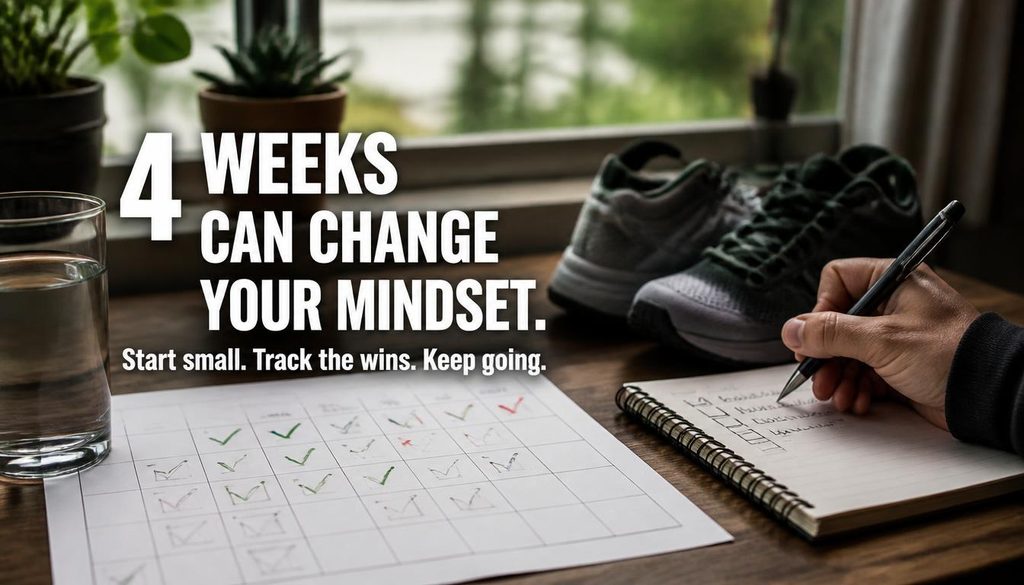
A Health Scare can change the way you look at your body.
Before the scare, you may not have thought much about simple things like walking across the room, climbing stairs, getting out of a chair, carrying groceries, or taking a shower. Afterward, those same things can suddenly feel like tests.
You may wonder:
“Can I do this?”
“What if something happens again?”
“Am I pushing too hard?”
“Will I ever feel like myself again?”
Those questions can make recovery feel much bigger than it needs to be.
A four-week plan can help give you some structure without turning recovery into another source of stress. The goal is not to “fix” your body in 28 days. That would be unrealistic for many people after a Health Scare.
The goal is much simpler:
Notice where you are. Learn what works. Take small steps. Review what you learn. Then decide what comes next.
Your plan should always fit your medical situation. If you have an injury, chronic condition, recent surgery, or other health concern, ask your healthcare professional what types and amounts of activity are appropriate for you. The CDC specifically recommends that people with chronic health conditions talk with a healthcare professional about physical activity that fits their needs. It also recommends starting slowly and building up over time.
This plan is about rebuilding trust, not proving how strong you are.
Week One: Awareness and Redefinition
The first week is not about doing more.
It is about seeing where you are now.
After a Health Scare, people often compare their current body with the body they remember from before the problem. That comparison can make every limitation feel like failure.
Instead, start with a clean page.
Ask yourself:
“What can my body do today?”
Not six months ago.
Not five years ago.
Not before the injury.
Today.
That does not mean giving up on improvement. It means starting from reality instead of memory.
Make a Simple Baseline
At the beginning of the week, write down a few things.
| Area | What to Notice |
|---|---|
| Movement | What movements are comfortable and approved for you? |
| Energy | When do you usually have the most energy? |
| Confidence | What activities make you nervous? |
| Daily life | What normal tasks feel harder now? |
| Support | Who can help when you need it? |
| Questions | What do you need to ask your healthcare team? |
Do not turn this into a test.
There is no score.
You are simply collecting information.
You might discover that one part of your day is easier than another. You might notice that you feel better after rest. You might find that fear is stopping you from doing something you have already been cleared to do.
That information matters.
The CDC also recommends setting aside specific times for physical activity and starting slowly rather than trying to jump into a demanding routine.
During Week One, redefine what strong means.
Strong might mean asking for help.
Strong might mean following your treatment plan.
Strong might mean resting when you need rest.
Strong might mean taking a few approved steps instead of forcing yourself to take a hundred.
Strong might mean admitting that you are scared.
A Health Scare can make strength seem like something you either have or do not have.
Real life is usually not that simple.
Strength can be rebuilt.
Weeks Two and Three: Small Movements and Tracking
Once you understand your starting point, Weeks Two and Three are about gentle progress.
The key word is small.
Do not decide that you are going to make up for lost time.
Do not turn one good day into a reason to double your workload the next day.
And do not copy somebody else’s exercise routine just because it worked for them.
Your activity needs to match your health and abilities.
The CDC notes that adults with chronic health conditions or disabilities can benefit from physical activity, while also advising them to work with a healthcare professional or physical activity specialist to determine the appropriate type and amount.
Pick One Area to Work On
Choose one area.
For example:
- Walking
- Approved rehabilitation exercises
- Gentle mobility
- Getting up and moving more often
- Completing a normal household task
- Improving your confidence with an activity you have already been cleared to do
Do not try to rebuild everything at once.
You are building trust.
Trust grows when your actions match your abilities.
Use a Simple Tracking Method
You do not need a complicated app or spreadsheet.
A notebook can work.
Write down:
What I did:
A short description.
How I felt:
A few words.
What I learned:
One useful observation.
For example:
What I did: Took my approved short walk.
How I felt: A little tired afterward.
What I learned: I may need more rest before doing another activity.
Another day might look like:
What I did: Completed my approved exercise routine.
How I felt: More comfortable than last week.
What I learned: The movement does not feel as frightening now.
That last line is important.
Sometimes progress is physical.
Sometimes progress is emotional.
After a Health Scare, being less afraid can be a major change even when the activity itself has not changed much.
Look for Patterns, Not Perfection
At the end of each week, look back.
Ask:
- What became easier?
- What stayed the same?
- What became harder?
- What made me feel more confident?
- What caused extra fatigue or discomfort?
- What questions should I ask my healthcare professional?
- What is one thing I should keep doing?
You are not trying to create a perfect chart.
You are looking for patterns.
And if you have a setback, write it down without turning it into a personal judgment.
“That was harder than expected” is information.
“I failed” is a judgment.
Those are not the same thing.
Week Four: Review, Adjust, and Plan the Next Month
By Week Four, stop and look at the bigger picture.
A Health Scare can make you focus so closely on today’s symptoms that you miss the changes happening over several weeks.
This is your chance to step back.
Look at your notes.
Look at your activity.
Look at your confidence.
Look at the things that worried you four weeks ago.
Then ask:
“What is different now?”
The answer does not have to be dramatic.
Maybe you are moving a little more.
Maybe you are less afraid.
Maybe you have learned what your limits are.
Maybe you discovered that mornings are easier than evenings.
Maybe you learned that trying to do too much leaves you exhausted.
Maybe you learned that you need more professional support.
All of those are useful discoveries.
Use a Four-Question Review
| Question | Your Answer |
|---|---|
| What improved? | |
| What remained difficult? | |
| What did I learn about my body? | |
| What is my next reasonable goal? |
Then make your next month’s plan smaller than your ego wants and realistic enough that you can actually follow it.
That may mean continuing the same routine.
It may mean slowly increasing activity if your healthcare professional agrees.
It may mean changing the type of activity.
It may mean adding rehabilitation or professional support.
It may mean taking a step back.
There is no rule saying every month has to show a bigger number.
Know When the Plan Needs to Change
A body-trust plan should never become a reason to ignore problems.
If symptoms are worsening, interfering with normal activities, or causing serious concern, contact an appropriate healthcare professional.
The same is true for emotional health.
After a Health Scare, fear, sadness, stress, and frustration can become part of the recovery process. But if distressing symptoms last two weeks or more or begin interfering with normal activities, the National Institute of Mental Health recommends seeking professional help.
That is not failure.
It is another form of taking care of yourself.
NIMH also notes that stress and anxiety can affect both the mind and body, and that professional help can be useful when symptoms do not go away or begin interfering with everyday life.
Your Next Month Does Not Need to Look Like Your Last Month
The biggest mistake you can make after a Health Scare is believing that progress has to look a certain way.
Maybe your old goal was running.
Your new goal might be walking.
Maybe your old goal was lifting heavy weights.
Your new goal might be rebuilding basic strength.
Maybe your old goal was doing everything yourself.
Your new goal might be learning when to accept help.
Maybe your old goal was never thinking about your body.
Your new goal might be listening to it without being afraid of every sensation.
That is still progress.
The purpose of this four-week plan is not to promise that a Health Scare will be behind you after four weeks.
It is to give you a starting point.
You notice.
You redefine.
You move appropriately.
You track.
You learn.
You adjust.
Then you keep going.
That is the idea behind STRONG AGAIN – Your Body Is Not Broken.
The book goes beyond a four-week checklist and looks at the bigger process of rebuilding strength, confidence, and trust when your relationship with your body has changed.
If you want to continue that work, you can learn more about STRONG AGAIN – Your Body Is Not Broken or find the book on Amazon.
You do not have to rebuild everything today.
You only need to know what the next reasonable step is.
Then take that step.
Next Step and Resources After a Health Scare
After a Health Scare, it is easy to think about recovery as one huge job.
You want your strength back.
You want your confidence back.
You want to stop worrying.
You want to trust your body again.
You want life to feel normal.
That is a lot to carry at once.
So instead of asking, “How do I fix everything?”, ask a smaller question:
“What is one healthy, reasonable thing I can do today?”
That question changes the way you look at recovery.
A Health Scare can make the future feel uncertain. A small next step gives you something real to work with right now.
Your next step does not need to be impressive.
It does not need to make a dramatic difference.
It does not need to prove that you are strong.
It simply needs to move you in a helpful direction.
One Tiny Movement or Choice to Make Today
Start by choosing something that fits your current situation.
If you have been given activity restrictions, follow them. If you are unsure what movement is safe, ask your healthcare professional before starting something new.
For one person, the next step might be a short walk that has already been approved.
For another person, it might be completing a rehabilitation exercise.
For someone else, the right choice might be rest.
Yes, rest can be a choice.
After a Health Scare, people sometimes feel guilty when they are not doing something physical. But recovery is not about staying busy every minute of the day.
The right action depends on the person.
The CDC recommends that adults with chronic health conditions talk with a healthcare professional about appropriate physical activity. It also recommends starting slowly and increasing activity over time rather than trying to do too much at once. (cdc.gov)
So make today’s goal small enough that you can understand it.
Try one of these questions:
- What is one movement I have already been told is safe?
- What is one daily task I can complete without rushing?
- What is one question I need to ask my doctor?
- What is one healthy habit I can repeat today?
- What is one thing I can stop doing because it makes recovery harder?
- What is one way I can give myself permission to rest?
- What is one fear I can write down instead of carrying it around all day?
Then choose one.
Not ten.
One.
That may sound too simple.
It is not.
After a Health Scare, simple is often useful because you are already dealing with enough uncertainty.
A Tiny-Step Example
Imagine someone who used to walk several miles but now feels nervous after an illness.
Their first goal does not have to be several miles.
Their goal might be:
“I will follow the walking plan my healthcare professional gave me today and pay attention to how I respond.”
That is a complete goal.
It has a clear action.
It respects medical guidance.
It does not demand a perfect outcome.
And it gives the person something they can repeat.
The next day may go differently.
That is okay.
Recovery is not a straight line for everyone.
Some days will feel easier.
Some days may feel harder.
A Health Scare can make a hard day feel like proof that nothing is working. Instead, look at the bigger picture.
Ask:
“What can I learn from today?”
That question leaves room for progress without pretending setbacks do not happen.
How STRONG AGAIN Fits Into the Process
A Health Scare can change more than your physical ability.
It can change the way you see yourself.
You may start thinking of yourself as weak.
You may feel fragile.
You may stop doing things because you are afraid.
You may constantly compare your current body with the person you were before the Health Scare.
That is where rebuilding trust becomes important.
STRONG AGAIN – Your Body Is Not Broken was written around that larger idea.
The goal is not to pretend that illness, injury, pain, aging, or physical limitations do not exist.
The goal is to look at what happens after your confidence has taken a hit and begin working forward from there.
You can learn more about STRONG AGAIN – Your Body Is Not Broken on the official Ray McNally website.
The book can be another resource as you think about strength, confidence, and the way you relate to your body after a Health Scare.
You can also find STRONG AGAIN – Your Body Is Not Broken on Amazon.
The book should not replace your healthcare team.
It should not replace prescribed treatment.
It should not be used as a reason to ignore symptoms or push beyond medical limits.
Think of it as another tool for the mental and practical side of rebuilding.
Keep the Bigger Picture in Mind
Your body may not be exactly the same after a Health Scare.
That can be hard to accept.
Maybe you have a scar.
Maybe you lost strength.
Maybe you have a new limitation.
Maybe you need medication.
Maybe you need regular appointments.
Maybe an activity you once did easily now takes more effort.
None of that changes the fact that you can still have goals.
Your goals may simply need to change.
| Before the Health Scare | During Recovery | A New Goal |
|---|---|---|
| “I need to be as strong as possible.” | “I need to respect my limits.” | “I want to build appropriate strength.” |
| “I never needed help.” | “I need support right now.” | “I will ask for help when needed.” |
| “I can push through anything.” | “Pushing too hard hurts my progress.” | “I will learn my limits.” |
| “I have to get back to exactly who I was.” | “My body has changed.” | “I will build from where I am.” |
That last change can be especially important.
You do not have to become your old self to become strong again.
Sometimes the goal is not going backward.
Sometimes the goal is building something new.
Related Resources and Continued Support
Recovery rarely ends with one article.
You may want to learn more about movement.
You may want to understand stress.
You may want to work on confidence.
You may simply want to hear from someone who understands what it feels like when your body no longer feels familiar.
Keep your resources practical.
Look for information from trustworthy medical and health organizations when you need facts about a condition or treatment.
For example, the CDC’s physical activity guidance provides general information about physical activity and health. For injury-related questions, the National Institute of Arthritis and Musculoskeletal and Skin Diseases provides information about injury treatment and rehabilitation.
For the emotional side of a Health Scare, the National Institute of Mental Health offers information about mental health and when professional help may be useful.
You do not have to read everything.
You do not have to become an expert in your own condition.
Use information to help you ask better questions and make informed choices with the professionals caring for you.
And be careful with online advice.
A story about someone else’s recovery is not automatically a treatment plan for you.
A workout that helped one person may be wrong for another.
A supplement someone praises online may not be appropriate for you.
A symptom discussed in a social media post may have many possible causes.
Your own healthcare team knows details that a general article does not.
Stay Connected for More Support
Sometimes rebuilding is easier when you do not feel like you are doing it alone.
If you want more articles, book updates, practical ideas, and new content from Ray McNally, you can visit the official Ray McNally website and explore the latest posts.
You can also follow Ray on Facebook, Instagram, or YouTube for additional content.
The point is not to fill your day with health information.
That can become overwhelming after a Health Scare.
The point is to have useful information available when you need it.
Your Next Step Starts Small
You have made it through a lot already.
Maybe the Health Scare happened yesterday.
Maybe it happened months ago.
Maybe you are still dealing with it.
Maybe you are living with a condition that will always require some level of care.
Wherever you are, you do not need to solve the rest of your life today.
Pick one reasonable step.
Follow your medical plan.
Take the approved movement.
Write down the question you have been putting off.
Rest when rest is needed.
Ask for help.
Notice one thing your body did today instead of focusing only on what it cannot do.
Then do it again tomorrow.
That is how a huge recovery can become a series of smaller choices.
A Health Scare may have changed your story.
It does not have to be the end of it.
You are not required to become the person you were before.
You can learn your body again.
You can rebuild confidence.
You can find a new definition of strength.
And you can take the next step from exactly where you are.
You do not have to rebuild everything today.
Just start with what you can do today.