
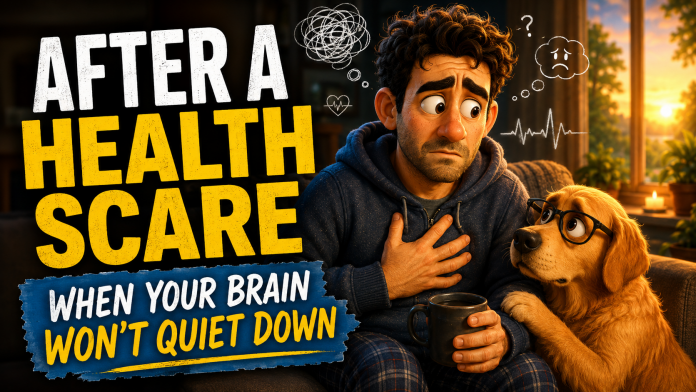
The emotional aftermath of surviving something that changes how you see life forever.
What Nobody Tells You After a Health Scare
A health scare does not always end when the doctor says, “You’re okay.”
Sometimes that is where the second part begins.
You go home. The machines are gone. The nurses are gone. The beeping stops. Everyone else thinks the hard part is over because you survived it, got treated, got cleared, or at least got sent home with a plan.
But inside your head, nothing feels over.
Your body may be back in your living room, but your mind is still in the hospital room. It is still hearing the words you never wanted to hear. It is still replaying the moment everything changed. It is still asking, “What if it happens again?”
That is one of the hardest parts of a serious health scare. You can look fine on the outside and still feel shaken on the inside.
People may say things like:
- “At least you’re okay.”
- “Try not to worry.”
- “You made it through.”
- “Just be grateful.”
- “Don’t think about it so much.”
They usually mean well.
But those words can feel lonely when your brain is still loud.
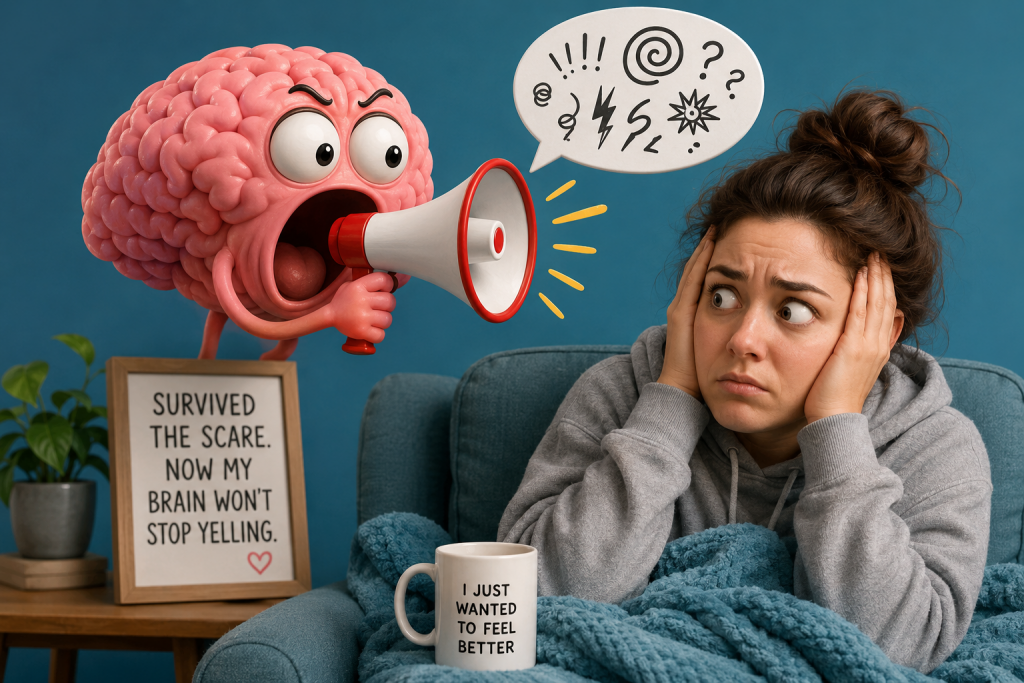
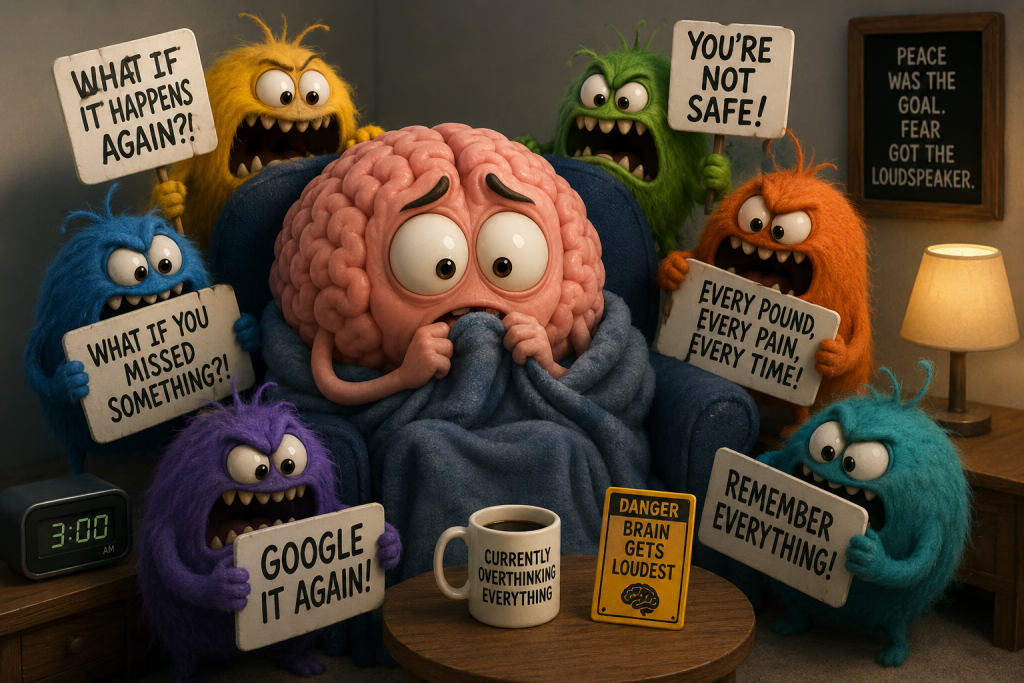
That is why the phrase Brain Gets Loudest fits so well here. After a health scare, your brain can get loud in the quietest moments. It can get loud at bedtime. It can get loud in the shower. It can get loud when you feel one small pain, one skipped heartbeat, one dizzy spell, or one weird sensation you would have ignored before.
A health scare can teach your brain that your body is not always safe. Even when you are healing, your mind may still be standing guard.
Medical trauma is real. It can happen after illness, emergency care, surgery, a frightening diagnosis, a near-death feeling, or any moment where you felt trapped, helpless, or unsure if you were going to be okay. The National Institute of Mental Health explains PTSD as something that can happen after a shocking, scary, or dangerous event. A person may keep feeling stressed or afraid even when the danger is no longer happening.
That does not mean every person after a health scare has PTSD.
It does mean the emotional impact can be serious.
You are not being dramatic. You are not weak. You are not “milking it.” Your nervous system went through something scary, and now it is trying to protect you from ever being blindsided again.
The problem is that protection can start to feel like a prison.
You may find yourself checking your pulse. Googling symptoms. Reading old test results. Watching your breathing. Asking family if you look okay. Wondering if one small ache means something bad is starting again.
This is where many people get stuck.
They survived the event, but now they have to survive the fear that came after it.
That part deserves care too.
| What People See | What You May Feel Inside |
|---|---|
| You are home | Your mind is still in emergency mode |
| You are smiling | You are scared to say how afraid you are |
| You are working again | You are checking every symptom |
| You got medical clearance | You still do not feel safe |
| You look normal | You feel changed |
This is also why writing, talking, therapy, support, and honest stories matter. They help people feel less alone in the hidden part of healing. For more honest writing about fear, survival, and the mind after medical stress, you can read more from Ray McNally at OfficialRayMcNally.com.
Healing is not just getting your bloodwork back to normal.
Healing is also learning how to live in your body again without feeling like every day is a warning sign.
Surviving Is Only the Beginning
When something scary happens to your health, the first goal is simple.
Stay alive.
Get through the test. Get through the pain. Get through the ambulance ride. Get through the scan. Get through the surgery. Get through the waiting room. Get through the words coming out of the doctor’s mouth.
In those moments, your whole world can shrink down to one thing: survive this.
Then, somehow, you do.
Maybe you get answers. Maybe you do not. Maybe you get medicine. Maybe you get a diagnosis. Maybe you get told, “Everything looks okay right now.” Maybe you get told, “We need to watch this.”
Either way, you leave with something you did not have before.
A memory.
A before-and-after line.
There is the person you were before the scare, and then there is the person who knows how fast life can change.
That can mess with you.
Before the health scare, you may have walked around without thinking much about your body. Your heart beat, your lungs breathed, your stomach made noise, your head hurt once in a while, and you moved on.
After the scare, everything can feel like a signal.
A tight chest is no longer just stress.
A headache is no longer just a headache.
A flutter is no longer just a flutter.
A bad night of sleep is no longer just a bad night of sleep.
Your mind starts building stories around every feeling. It is trying to help, but it can make you feel trapped in your own skin.
The strange part is that people around you may expect you to feel happy right away.
And yes, you may feel grateful.
But you can be grateful and scared at the same time.
You can be thankful to be alive and still feel angry that it happened.
You can love your family and still feel alone in your fear.
You can hear good news from a doctor and still feel like your body betrayed you.
That does not make you ungrateful.
It makes you human.
The Cleveland Clinic notes that PTSD can bring flashbacks, mood changes, sleep issues, and avoidance after trauma. Again, not everyone after a health scare has PTSD, but many people do feel pieces of that stress response. They may avoid places, conversations, foods, activities, or even sleep because those things remind them of what happened.
For example, someone who had a heart scare may avoid exercise because a faster heartbeat now feels dangerous.
Someone who had a choking scare may avoid eating alone.
Someone who had a bad reaction to medicine may panic before taking anything new.
Someone who spent time in the hospital may feel sick just smelling hand sanitizer.
None of that is “crazy.”
It is the brain connecting dots.
The trouble is that the brain can connect too many dots.
It can turn normal life into a threat map.
That is why surviving is only the beginning. The body may need rest, medicine, checkups, or rehab. But the mind also needs a place to put what happened.
It needs time to understand:
- I was scared.
- I did not feel in control.
- I may still be safe now.
- My body can feel weird without it always meaning danger.
- I can get help without living in fear all day.
That last one matters.
Because after a health scare, many people do not want to bother anyone. They do not want to scare their family. They do not want to look needy. They do not want to be “that person” who keeps talking about it.
So they hold it in.
And the fear grows in private.
This is why honest conversations are so important. When people tell the truth about the emotional side of health scares, it gives others permission to breathe.
It says, “You are not the only one who feels this way.”
It says, “You can be alive and still be healing.”
It says, “Medical clearance is not the same thing as emotional peace.”
That is the part nobody tells you.
Surviving gets you back to life.
Healing helps you feel safe living it.

The Emotional Crash Afterwards
The emotional crash after a health scare can feel confusing because it may not happen right away.
During the scare, you may be focused. You may be calm in a strange way. You may do what you are told. You may answer questions, sign forms, take medicine, call family, and act like you are handling it.
Then, later, when things quiet down, you fall apart.
This can happen because your body was running on stress.
Stress can keep you moving when you are in danger. Your body releases chemicals that help you react. Your heart may race. Your muscles may tighten. Your mind may become sharp and alert.
That response can be helpful during the emergency.
But when the danger passes, your body may still be full of that alarm.
That is when the crash can come.
You may cry out of nowhere. You may feel numb. You may feel angry. You may feel tired in a way sleep does not fix. You may feel like everyone else has moved on while you are still stuck in the worst moment.
You may even feel worse after getting good news.
That surprises people.
They think, “Why am I scared now? I should be happy.”
But your nervous system may not care that the doctor used a calm voice. It remembers how scared you were. It remembers the pain, the uncertainty, the waiting, the fear in your family’s eyes, or the moment you thought, “This could be it.”
That kind of fear does not always leave politely.
It can hang around.
The Mayo Clinic explains that panic attacks can include a sense of doom, fast heartbeat, chest pain, dizziness, nausea, and fear of dying. Those symptoms can feel very close to a medical emergency, which is why panic after a health scare can be so frightening.
You are not just scared of fear.
You are scared because fear feels like the thing that scared you in the first place.
That can create a painful loop.
You feel something in your body.
Then you worry.
Then worry makes your body louder.
Then the louder body feeling scares you more.
Then the fear grows.
That loop can make a normal Tuesday feel like a crisis.
Here is what the crash may look like in real life:
| Emotional Crash Sign | What It Can Feel Like |
|---|---|
| Sudden crying | “Why am I breaking down now?” |
| Numbness | “I know it was serious, but I feel nothing.” |
| Anger | “I hate that this happened to me.” |
| Fear at night | “What if something happens while I’m asleep?” |
| Body checking | “I need to make sure I’m okay.” |
| Avoidance | “I can’t go back to that place.” |
| Exhaustion | “I’m tired even after resting.” |
One of the hardest parts is that you may not know how to explain it.
How do you tell someone, “I’m safe, but I don’t feel safe”?
How do you say, “The test was normal, but my brain does not believe it yet”?
How do you admit, “I’m scared of my own body now”?
That is a heavy thing to carry.
And because it is hard to explain, many people smile and say, “I’m fine.”
Then they go home and check their pulse ten times.
The emotional crash is not a failure.
It is often the delayed sound of what you went through.
Your mind may finally have enough room to feel the fear it could not fully feel during the event.
This is why rest matters, but not just physical rest.
You may need quiet time. You may need someone safe to talk to. You may need therapy. You may need a support group. You may need to write it down. You may need follow-up care that includes your mental health, not just your lab numbers.
You may also need to stop judging yourself for not bouncing back fast enough.
People love comeback stories.
They love the part where someone survives, smiles, and says life is beautiful.
And yes, life can become beautiful again.
But first, you may have to sit with the mess.
You may have to admit that you are scared.
You may have to accept that healing is not neat.
The emotional crash does not mean you are going backward.
It may mean your body and mind are finally trying to process what happened.
Why It Can Feel Hard to “Just Move On”
“Just move on” sounds simple when you are not the one who got scared.
It is much harder when your body was the place where the scary thing happened.
If your car breaks down, you can get out of the car.
If your house scares you, you can leave the house.
But when your body scares you, you still have to live inside it.
That is why moving on after a health scare can be so hard.
You cannot just walk away from the reminder. Your heartbeat is with you. Your breathing is with you. Your aches, pains, stomach, nerves, scars, pills, appointments, and test results may all become part of your daily life.
Even when things improve, the reminder is close.
You may be having a good day, then one strange feeling pulls you right back.
A small pain can become a whole story.
A skipped beat can become a night of panic.
A follow-up appointment can ruin the whole week before it even happens.
That is not because you want attention.
It is because your brain learned that health can change fast.
Now it is trying to stay ahead of danger.
The problem is that life cannot feel peaceful when your brain treats every body signal like breaking news.
This is where the focus keyword Brain Gets Loudest becomes more than a phrase. It describes that moment when nothing is actually happening, but your mind starts yelling anyway.
You may be lying in bed thinking:
- What if the doctor missed something?
- What if this symptom matters?
- What if I should go back to the ER?
- What if I do not wake up?
- What if my family has to watch me go through it again?
Those thoughts are painful because they are not random.
They are tied to something real that happened.
That is what makes health fear different from everyday worry. Your brain has evidence now. It says, “See? Bad things can happen.”
And yes, bad things can happen.
But that does not mean every feeling is a warning.
It does not mean every day is unsafe.
It does not mean your body is your enemy.
Moving on does not mean pretending it did not happen. It means learning how to carry the memory without letting it run your whole life.
That takes time.
It also takes practice.
Some people may need help from a licensed therapist, especially if fear is hurting sleep, work, relationships, or daily life. The American Psychological Association explains that trauma can affect thoughts, feelings, and the body, and support can help people process what happened in a healthier way.
Moving on may look small at first.
It may mean taking a short walk without checking your pulse the whole time.
It may mean going to bed without reading symptoms online.
It may mean keeping a doctor appointment but not spending three days imagining the worst.
It may mean saying, “I am scared,” instead of pretending you are fine.
It may mean reading something that makes you feel less alone, like This Is Anxiety, Not Death, especially if fear has started to feel like danger in your body.
Moving on is not one big brave moment.
It is many small moments where you remind yourself:
“My fear is real, but it is not always right.”
That sentence matters.
Fear can be real without being correct.
Your body can feel strange without being in crisis.
Your mind can remember danger without danger being present.
That is the work after a health scare.
Not forgetting.
Not forcing.
Not acting tough.
Learning how to live again while being kind to the part of you that is still scared.
When Relief Turns Into Fear
Relief after a health scare can be real.
You may feel it when the doctor says the scan is clear. You may feel it when the pain stops. You may feel it when you get home and sit on your own couch. You may feel it when you hug your family and think, “I made it.”
But relief can be strange.
Sometimes it only lasts a little while.
Then fear sneaks in behind it.
At first, you may think, “That was close.”
Then your mind says, “Too close.”
Then it says, “What if it happens again?”
That is how relief can turn into fear.
It does not mean the relief was fake. It means your brain is trying to protect you from being surprised again.
After a health scare, the mind may become a full-time security guard. It watches your body, your food, your sleep, your stress, your medicine, your appointments, and your future.
Some awareness is helpful.
You should listen to medical advice. You should take real symptoms seriously. You should follow up with your doctor. You should not ignore warning signs that need care.
But fear can take a healthy habit and stretch it too far.
Checking once becomes checking all day.
Reading one trusted medical page becomes three hours online.
Asking one question becomes needing the same answer again and again.
Avoiding one risky thing becomes avoiding life.
That is when fear stops helping and starts taking over.
The Cleveland Clinic’s page on stress lists physical signs like chest pain, dizziness, shaking, and a racing heart. That matters because stress can create body feelings that seem scary, especially after a health event.
This can become very confusing.
You feel a symptom.
The symptom causes fear.
The fear causes more symptoms.
Then you think the new symptoms prove something is wrong.
That loop can make relief feel unsafe.
You may think, “I should relax, but what if relaxing makes me miss something?”
So you stay alert.
You watch everything.
You wait for the next problem.
And slowly, your life gets smaller.
That is why support matters after a health scare. Not just medical support, but emotional support too.
You need space to say the thing many people are afraid to say:
“I survived, but I am scared now.”
That sentence should not be shameful.
It should be normal.
Because many people feel it.
They feel scared in the grocery store.
They feel scared driving past the hospital.
They feel scared before bed.
They feel scared when they are alone.
They feel scared when everyone else thinks they should be back to normal.
This is not weakness.
This is your nervous system asking, “Are we safe yet?”
The answer may not come all at once.
It may come slowly.
It may come through steady routines, honest talks, good medical care, therapy, breathing skills, less symptom searching, and more trust built over time.
Relief becomes more stable when you stop demanding that fear disappear overnight.
Instead, you can say:
“I am relieved, and I am still healing.”
Both can be true.
You can be thankful and shaken.
You can be strong and tired.
You can be alive and still need help feeling safe.
That is the part nobody tells you after a health scare.
The fear after the fear can be its own battle.
But it can get better.
Your brain may be loud right now, but loud does not mean permanent. It means something inside you is asking for care, patience, and proof that life can feel safe again.
Why Fear Lingers After Medical Trauma
Fear after a health scare can feel rude.
You already went through the scary part. You already did the test, the hospital visit, the waiting, the pain, the bad news, the good news, or the “we need to keep an eye on this” news.
So why is fear still sitting there like an unwanted guest eating chips on your couch?
Because your brain is not only reacting to what happened.
It is reacting to what could happen next.
That is the strange thing about medical trauma. The event may be over, but the meaning of it can stay. Your mind may start seeing life in a new way. Before the scare, health may have felt like something that just worked in the background. After the scare, it can feel like something you have to watch, manage, guard, and double-check.
That is when the Brain Gets Loudest.
It gets loud because silence now feels suspicious.
It gets loud because a normal body feeling no longer feels normal.
It gets loud because your mind keeps trying to prevent surprise.
A serious health scare can leave your nervous system stuck in “watch mode.” You may be home, safe, and medically stable, but your body may still act like the alarm is on. This does not mean you are broken. It means your mind learned something scary, and now it is trying to protect you from going through it again.
The National Institute of Mental Health explains that after traumatic events, people can feel anxious, sad, angry, have trouble sleeping, have trouble focusing, or keep thinking about what happened. Most people improve over time, but some need extra support.
That matters because a health scare can be more than a medical event.
It can become an emotional event.
It can change how you hear your heartbeat. It can change how you sit in a doctor’s office. It can change how you read a test result. It can change how you feel when you wake up at 3 a.m. and notice your chest, stomach, head, or breathing.
You may not be afraid every second.
But the fear can wait in the background.
Then one small thing wakes it up.
A pain. A flutter. A cough. A dizzy moment. A smell from the hospital. A medical bill. A follow-up appointment. A family member asking, “Are you okay?”
Suddenly, your mind is back there.
Not because you want to be.
Because fear remembers.
| Why Fear Stays | What It Can Sound Like |
|---|---|
| Your brain remembers danger | “This happened once, so it can happen again.” |
| Your body feels less predictable | “What if I miss a warning sign?” |
| You lost trust in normal sensations | “That ache might mean something.” |
| You want certainty | “I need to know I’m 100% safe.” |
| You replay the event | “What if I had waited longer?” |
| You avoid reminders | “I can’t go near that place again.” |
Fear lingers because your brain is trying to build a safety system.
The problem is that it may build one too big.
It may not only warn you about real danger. It may warn you about life itself.
That is where healing has to be gentle and honest. You do not beat this fear by yelling at yourself. You do not heal it by pretending nothing happened. You heal it by learning the difference between care and control.
Care says, “I will follow my doctor’s advice.”
Control says, “I must check every feeling all day.”
Care says, “I will get help if something is clearly wrong.”
Control says, “I cannot relax unless I feel perfect.”
Care helps you live.
Control makes you scared to live.
The goal is not to ignore your body. The goal is to stop treating your body like a crime scene.
That takes time.
And it starts with understanding why the fear is there in the first place.
Fear of It Happening Again
The fear of it happening again may be the loudest fear after a health scare.
It is not always a clear thought. Sometimes it is just a feeling in your chest or stomach. You may wake up already tense. You may feel nervous before a normal day even starts. You may feel like your life has a new shadow over it.
You survived once.
Now your brain wants to know if it has to survive again.
This fear can show up in small ways.
You may avoid doing things you used to do without thinking. You may stop exercising because your heart beating faster scares you. You may avoid certain foods, long drives, being alone, sleeping deeply, or going too far from home. You may keep your phone close in case you need help. You may ask others to stay nearby even when you do not say why.
Some of this may make sense at first.
After a real health scare, it is normal to be more careful.
But fear can quietly take over the steering wheel.
It may start with, “I should be careful.”
Then it becomes, “I should not do anything that makes me nervous.”
Then it becomes, “I only feel safe if I stay small.”
That is how fear can shrink a life.
The hard part is that this fear often sounds logical. Your brain may say, “I’m not anxious. I’m being smart.” And sometimes, yes, being careful is smart. Following a treatment plan is smart. Taking medicine as prescribed is smart. Keeping follow-up appointments is smart. Calling a doctor for new or serious symptoms is smart.
But checking your body every ten minutes is not the same as health care.
It is fear care.
And fear care never feels finished.
You check once. You feel better for a minute. Then the question comes back.
“What if I missed something?”
The VA National Center for PTSD explains avoidance as staying away from reminders of trauma, including places, people, sounds, smells, thoughts, or feelings connected to what happened. After a health scare, those reminders can be medical places, body feelings, certain rooms, certain times of day, or even the clothes you wore during the event.
For some people, the reminder is not outside them.
It is inside them.
A heartbeat can be a reminder.
A tight throat can be a reminder.
A stomach flip can be a reminder.
Being tired can be a reminder.
That is why fear of it happening again can feel so hard to escape. The body itself becomes the trigger.
This does not mean your body is unsafe.
It means your brain has started treating body sensations like warning sirens.
A useful question is not, “How do I stop feeling fear forever?”
A better question is, “How do I respond when fear shows up?”
Because fear will show up sometimes.
The goal is to stop letting it make every choice.
Here is the difference:
| Fear-Based Response | Calmer Response |
|---|---|
| “I felt something. Something bad is happening.” | “I felt something. I can pause and notice it.” |
| “I need to Google this now.” | “I can use trusted medical advice, not panic searching.” |
| “I can’t do this because my body might react.” | “I can take one safe step and see how I feel.” |
| “I need someone to promise I’m okay.” | “I can ask for support without feeding the fear loop.” |
| “This feeling means danger.” | “This feeling may be stress, fatigue, healing, or something to watch.” |
There is a difference between noticing and obsessing.
Noticing says, “That is new. I will pay attention.”
Obsessing says, “I cannot think about anything else until I feel certain.”
The trouble is that certainty is hard after a health scare. You want someone to promise it will never happen again. You want a test that says, “You are safe forever.” You want a doctor, a book, a loved one, or the internet to remove all risk.
But life does not offer that kind of contract.
That is painful.
It also means recovery is not about finding perfect certainty.
It is about building enough trust to live without it.
That trust may start small. A short walk. A quiet night without symptom searching. A normal meal. A phone call with a friend. A doctor visit where you ask questions but do not spiral afterward.
Fear of it happening again may not vanish fast.
But it can lose power.
Each time you choose a calm, wise response instead of a fear-driven one, you teach your brain something new.
You teach it, “We can be careful without being trapped.”
You teach it, “We can listen to the body without fearing every sound it makes.”
You teach it, “We survived, and now we are learning how to live again.”
Living With Uncertainty
Uncertainty is one of the hardest parts of healing after medical trauma.
Most people can handle bad news better than endless unknowns. At least bad news gives the brain something to hold. You know what you are dealing with. You know the next step. You can point to the problem.
Uncertainty is different.
It leaves the mind hanging.
It says:
- Maybe it is fine.
- Maybe it is not.
- Maybe it will happen again.
- Maybe it never will.
- Maybe this symptom matters.
- Maybe it is nothing.
That “maybe” can wear a person down.
After a health scare, you may want clear answers more than ever. You may want every test to be perfect. You may want every doctor to sound fully sure. You may want every body feeling explained. You may want to know exactly what the future will bring.
That is understandable.
A health scare can make the future feel less solid.
Before, you may have planned your life like tomorrow was promised. After, you may still make plans, but now part of you whispers, “Are we sure?”
That whisper can follow you.
It can show up when booking a vacation.
It can show up when making family plans.
It can show up when buying clothes, starting a project, changing jobs, or even laughing too hard.
You may think, “Can I trust this good moment?”
That is the quiet grief of uncertainty.
It can steal joy before anything bad even happens.
And when the Brain Gets Loudest, it often tries to solve uncertainty by overthinking. It keeps turning the same questions over and over, as if one more thought will create a guarantee.
But overthinking rarely gives peace.
It usually gives more questions.
This is where many people fall into reassurance loops. They ask a loved one, “Do I seem okay?” They check a symptom. They look up numbers. They read forums. They compare stories. They search for one perfect answer that will finally settle the fear.
The relief comes.
Then it fades.
Then the loop starts again.
| The Uncertainty Question | Why It Hooks You |
|---|---|
| “What if they missed something?” | It makes you doubt safe news |
| “What if this comes back?” | It keeps your mind in the future |
| “What if this symptom is related?” | It turns normal feelings into threats |
| “What if I am not prepared?” | It makes control feel like safety |
| “What if I relax and regret it?” | It makes peace feel risky |
Living with uncertainty does not mean being careless.
It means knowing there are limits to what you can control.
You can go to appointments.
You can follow medical advice.
You can take medicine correctly.
You can improve sleep, food, movement, and stress.
You can ask good questions.
You can pay attention to real changes.
But you cannot check your way into a risk-free life.
That sentence may feel harsh at first, but it can become freeing.
Because if perfect safety is not possible, you can stop demanding it before you let yourself live.
You do not need 100% certainty to enjoy dinner with your family.
You do not need 100% certainty to take a walk.
You do not need 100% certainty to laugh, rest, create, love, or plan something good.
You need reasonable care.
You need support.
You need wisdom.
You need to know when to seek help.
But you do not need to turn every day into a courtroom where your body has to prove it is safe.
The American Psychological Association describes trauma as an emotional response to a terrible event, with shock and denial being common after it happens. Longer-term reactions may include hard emotions, flashbacks, strained relationships, and physical symptoms.
That makes sense after medical trauma.
Your mind may not only be asking, “Am I okay today?”
It may be asking, “How do I live now that I know life can change fast?”
That is a bigger question.
And it deserves kindness.
One gentle way to handle uncertainty is to separate what is known from what is imagined.
For example:
| Known | Imagined |
|---|---|
| “I have a follow-up appointment next month.” | “The appointment will be terrible.” |
| “I felt a sharp pain for two seconds.” | “Something is definitely wrong.” |
| “My doctor told me what symptoms to watch for.” | “I will miss the signs and it will be my fault.” |
| “I feel scared tonight.” | “This fear means danger is coming.” |
This does not mean you dismiss everything.
It means you stop treating every imagined fear as a fact.
Uncertainty becomes easier to live with when you give your brain a job that is not panic.
You can tell yourself:
“I do not know everything, but I know my next right step.”
That step may be resting.
It may be calling your doctor.
It may be not Googling.
It may be taking medicine.
It may be going outside.
It may be telling someone, “I am having a hard day.”
Healing after a health scare does not require you to feel certain all the time.
It asks you to keep living while certainty slowly becomes less important.
That is not easy.
But it is possible.
Feeling Unsafe in Your Own Body
One of the saddest parts after a health scare is feeling unsafe in the one place you cannot leave.
Your body.
Before the scare, your body may have felt normal, even if it had aches and problems. You lived in it without thinking about every tiny thing. You got tired, hungry, sore, dizzy, bloated, tense, sweaty, or shaky sometimes, and it did not always mean something serious.
After a health scare, those same feelings can feel loaded.
A racing heart may feel like danger.
A tight chest may feel like danger.
A weird pain may feel like danger.
A headache may feel like danger.
Even being calm can feel strange, because part of you is waiting for the next alarm.
This is not just worry.
It can feel like betrayal.
You may think, “How could my body do this to me?”
You may feel angry at it. You may feel scared of it. You may feel like it is no longer on your side. You may start seeing your body as a problem to manage instead of a home to live in.
That can be heartbreaking.
And it can also make the Brain Gets Loudest feeling stronger.
Because if you do not trust your body, every sensation becomes evidence.
The mind starts scanning.
It listens.
It checks.
It compares.
It asks, “Was that there yesterday?” “Is this worse?” “Is that normal?” “Should I worry?” “Should I call someone?” “Should I go in?”
This kind of body fear can be exhausting because the body is never silent.
Bodies make noise.
They twitch. They ache. They gurgle. They flutter. They pulse. They sweat. They chill. They get tired. They react to food, sleep, weather, stress, hormones, medicine, caffeine, movement, and age.
A body that feels things is not automatically a body in danger.
But after medical trauma, the brain may forget that.
It may start to believe that feeling anything means something is wrong.
That is a painful way to live.
The Mayo Clinic lists panic attack symptoms that can include chest pain, fast heartbeat, dizziness, nausea, trembling, shortness of breath, numbness, and fear of dying. Those are very real body feelings. The problem is that after a health scare, those feelings can seem almost impossible to separate from a true emergency without proper medical guidance.
That is why this topic needs balance.
You should not ignore serious or new symptoms.
But you also should not have to live like every sensation is a siren.
If you have been medically checked and told what signs need urgent care, that plan can help. It gives you a clear path. Instead of asking panic what to do, you follow the plan.
That might mean knowing which symptoms require emergency care, which symptoms require calling your doctor, and which symptoms can be watched calmly.
That kind of plan can lower fear because it gives your brain structure.
Without structure, fear makes its own rules.
And fear’s rules are usually terrible.
Fear says:
- Check again.
- Ask again.
- Search again.
- Avoid that.
- Do not sleep yet.
- Do not go alone.
- Do not trust calm.
- Do not trust your body.
A calmer plan says:
- Notice.
- Breathe.
- Compare with your doctor’s guidance.
- Act if needed.
- Do not feed the spiral if it is not needed.
Here is a simple way to think about it:
| Body Trust Does Not Mean | Body Trust Can Mean |
|---|---|
| Ignoring symptoms | Knowing which symptoms matter |
| Pretending you are fine | Being honest without spiraling |
| Never feeling scared | Not letting fear run every choice |
| Avoiding doctors | Using doctors wisely |
| Loving every body feeling | Learning not to fear every body feeling |
Feeling unsafe in your body can also change your identity.
You may miss the old version of yourself.
The person who could go to bed without checking symptoms.
The person who could exercise without fear.
The person who did not know so much medical language.
The person who did not feel nervous in waiting rooms.
That grief is real.
You are not only healing from the event. You are also adjusting to a new relationship with your body.
But that relationship can improve.
You can start small.
You can notice one normal sensation and not chase it.
You can take one safe walk and let your heart beat without treating it like an enemy.
You can rest without scanning.
You can say, “My body scared me, but it also carried me through.”
That sentence may not feel true every day.
But it is worth practicing.
Your body is not just the place where fear happened.
It is also the place where healing is happening.
Why Your Mind Keeps Replaying It
A health scare can turn into a movie your mind keeps playing without asking permission.
You may be washing dishes and suddenly remember the hospital room.
You may be driving and remember the moment symptoms started.
You may be lying in bed and hear the doctor’s voice again.
You may remember the look on someone’s face.
You may remember the smell of the room, the sound of a machine, the feel of the bed, the cold air, the lights, the waiting, or the exact sentence that made your stomach drop.
Your mind may replay what happened, what could have happened, what almost happened, and what might happen next.
This can feel cruel.
You may think, “Why am I doing this to myself?”
But replaying is not always a choice.
The brain often replays scary events because it is trying to understand them. It is trying to learn from them. It is trying to find the moment where control was lost so it can stop it from happening again.
The problem is that the replay does not always bring answers.
Sometimes it only brings more fear.
You may replay the event and ask:
- Did I miss a sign?
- Should I have gone sooner?
- Did someone take me seriously?
- What if I had been alone?
- What if it happens next time and I do not make it?
- What if I never feel normal again?
These questions can become mental quicksand.
The more you fight them, the deeper you can sink.
That does not mean you should let them run wild. It means you may need a different way to respond.
The National Institute of Mental Health notes that PTSD symptoms can include flashbacks, bad dreams, frightening thoughts, avoidance, being easily startled, feeling tense, and trouble sleeping. A person does not need to label themselves to recognize that scary memories can affect the mind and body after a frightening event.
After medical trauma, replaying may not look like a movie scene every time.
Sometimes it looks like research.
You keep searching the same condition.
Sometimes it looks like confession.
You keep telling the story from the beginning.
Sometimes it looks like regret.
You keep thinking about what you should have done.
Sometimes it looks like planning.
You keep imagining how to survive it if it happens again.
The mind is trying to create safety.
But the replay can keep the body in alarm.
That is where the Brain Gets Loudest. It does not replay the calm parts. It replays the worst parts. It edits the story down to the scariest scenes and then plays them at full volume when you are trying to rest.
This can happen more at night because there is less distraction. During the day, tasks may keep your mind busy. At night, the room gets quiet, the body gets still, and the thoughts walk in like they own the place.
That is why many people feel worse at bedtime after a health scare.
Not because night is dangerous.
Because night gives fear a microphone.
A helpful first step is naming the replay for what it is.
Instead of saying, “Something is wrong with me,” you can say:
“My mind is replaying a scary memory.”
That small change matters.
It creates space between you and the thought.
You are not the replay.
You are noticing the replay.
Then you can ask, “What does my mind want right now?”
Usually, the answer is safety.
It wants proof. It wants control. It wants comfort. It wants someone to say, “That was scary, and you are here now.”
You may not be able to stop every replay, but you can change what happens next.
| Replay Response That Feeds Fear | Replay Response That Builds Calm |
|---|---|
| Rechecking symptoms for an hour | Naming the memory and grounding in the room |
| Googling worst-case stories | Reading trusted medical or mental health sources only |
| Blaming yourself | Reminding yourself you did the best you could with what you knew |
| Asking for reassurance over and over | Asking for support once, then using a calming skill |
| Avoiding all reminders forever | Facing safe reminders slowly, with help if needed |
The VA National Center for PTSD describes trauma reminders as things that bring back memories or feelings connected to trauma. Those reminders can be places, sounds, smells, people, dates, body feelings, or situations.
After a health scare, the reminder may be a calendar date.
It may be a medication bottle.
It may be the road to the hospital.
It may be the word “scan.”
It may be a blood pressure cuff.
It may be waking up at the same time symptoms first happened.
Your mind may replay it because it has not filed the event as “past” yet. Part of your nervous system may still treat it like “possible now.”
This is where support can help. Therapy, trauma-informed care, journaling, safe conversations, and calming routines can help the brain process the event instead of just replaying it.
You can also remind yourself:
“That happened then. I am here now.”
Simple words can be powerful when the brain is loud.
Look around the room. Name what year it is. Feel your feet. Touch something near you. Notice one sound. Take one slow breath. Remind your mind that the memory is not the moment.
The replay may still come sometimes.
But over time, it can become less sharp.
Less bossy.
Less able to steal the whole day.
The goal is not to erase what happened.
The goal is to help your mind stop living there.
Living Hyper-Aware of Every Sensation
After a health scare, your body can start to feel like a noisy apartment with thin walls.
Every little sound gets your attention.
A heartbeat. A twitch. A pain. A stomach flip. A dizzy second. A tight muscle. A weird breath. A skipped beat. A warm face. A cold hand. A headache that shows up for no good reason and acts like it pays rent.
Before the scare, you may have noticed those things and moved on. After the scare, they can feel like clues.
That is what hyper-awareness can feel like.
It is not just “being careful.” It is living with your attention glued to your body. You may scan yourself all day without meaning to. You may wake up and check how you feel before your feet even touch the floor. You may sit quietly and listen for a symptom. You may pause mid-conversation because one sensation pulled your mind away.
This can happen because your brain is trying to keep you safe.
It learned that something serious can happen. So now it wants to catch danger early. That sounds helpful, and sometimes paying attention to your body is helpful. You should not ignore real warning signs. You should follow your doctor’s advice. You should know what symptoms need urgent care for your own health situation.
But after medical trauma, the warning system can become too sensitive.
It can start treating every body feeling like breaking news.
That is when the Brain Gets Loudest.
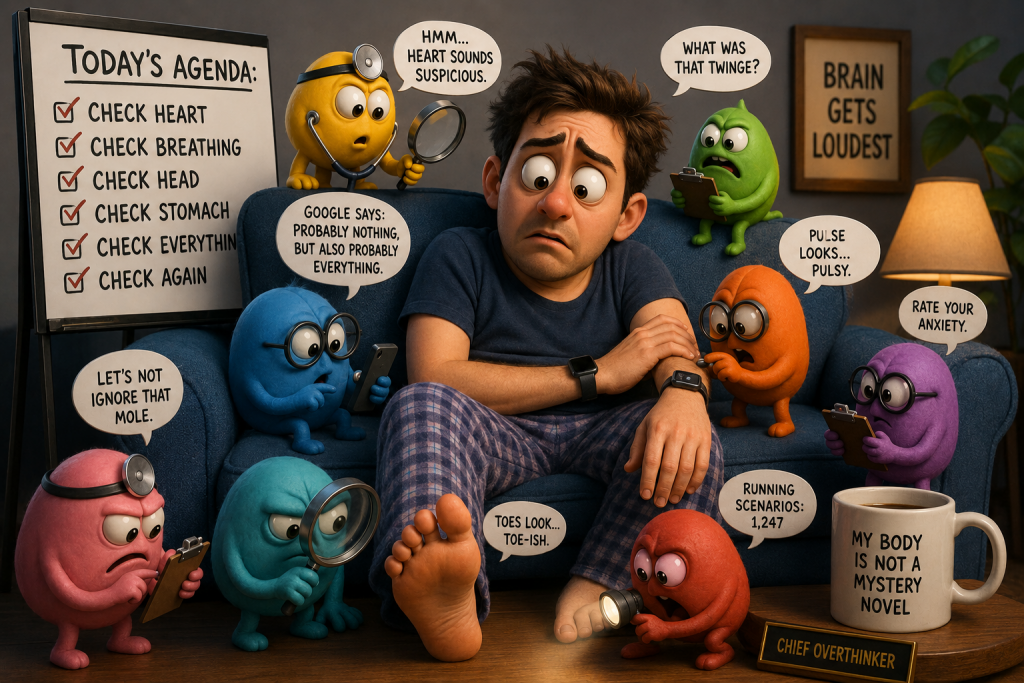
It gets loud because your mind is no longer just living in the day. It is running a full-time body patrol. It checks the chest department. Then the stomach department. Then the breathing department. Then the “what was that tiny pain in my left shoulder” department.
And none of these departments know how to clock out.
The National Institute of Mental Health explains that trauma-related arousal symptoms can include feeling tense, on guard, easily startled, having trouble focusing, and having trouble sleeping. Even when someone does not have PTSD, those “on guard” feelings can show up after a frightening medical event.
Hyper-awareness is hard because it can look responsible from the outside.
You may think, “I’m just watching my health.”
But inside, it may feel like you are trapped in a security booth staring at 47 camera screens.
One camera is your heart.
One is your breathing.
One is your head.
One is your stomach.
One is your skin.
One is the memory of the last scare.
And one is a tiny camera pointed at Google, which is almost never helpful at 1:30 in the morning.
| Normal Body Awareness | Hyper-Awareness After a Scare |
|---|---|
| “I feel a little off today.” | “Something bad may be starting.” |
| “My heart is beating faster because I walked upstairs.” | “Why is my heart doing that?” |
| “I have a headache.” | “What if this headache means something serious?” |
| “I’m tired.” | “What if this tired feeling is a warning?” |
| “I’ll keep an eye on it.” | “I cannot stop checking it.” |
The problem is not that you notice your body.
The problem is that fear starts acting like the translator.
Your body says, “I am tired.”
Fear translates it as, “Danger.”
Your body says, “I am tense.”
Fear translates it as, “Something is wrong.”
Your body says, “I had too much caffeine, bad sleep, stress, or a heavy meal.”
Fear translates it as, “Emergency meeting. Everybody panic.”
That is why hyper-awareness can become so exhausting. You are not only feeling sensations. You are also arguing with them, judging them, researching them, timing them, testing them, and imagining what they could mean.
A healthier path is not to ignore your body.
It is to build a calmer relationship with it.
That may mean learning the difference between a symptom that needs action and a sensation that needs patience. It may mean using trusted health information instead of panic searching. It may mean asking your doctor for clear guidance on what should send you to urgent care, what should lead to a call, and what can be watched.
It may also mean accepting something many anxious minds hate:
A body can feel weird and still be okay.
That sentence can feel hard to believe after a scare.
But it matters.
Bodies are not silent machines. They are living, changing, noisy things. They react to sleep, stress, food, movement, medicine, temperature, hormones, illness, healing, grief, fear, and time.
A weird feeling is not always a warning.
Sometimes it is just a body being a body.
And slowly, with care and practice, you can learn to live inside it again without treating every sensation like a siren.
Monitoring Every Heartbeat, Pain, or Symptom
Body checking can become a habit before you even realize it has taken over.
At first, it may feel like common sense.
You check your pulse because your heart scared you once. You check your breathing because shortness of breath scared you once. You check your pain because pain scared you once. You check your blood pressure, oxygen, temperature, blood sugar, or symptoms because numbers feel safer than guesses.
Some checking may be part of real medical care.
That is important to say clearly.
If your doctor told you to monitor something, follow that advice. Some people truly do need to track blood pressure, heart rhythm, oxygen, blood sugar, weight, symptoms, medicine side effects, or other health signs. That is not the same as fear-based checking.
The difference is whether the checking has a clear purpose and a stopping point.
Doctor-guided monitoring says, “Check this at these times and do this if the result is in this range.”
Fear-based monitoring says, “Check until you feel safe.”
The second one is tricky because fear does not stay satisfied.
You may check and feel better for five minutes. Then the doubt comes back.
“What if it changed?”
So you check again.
Then again.
Then again.
Now the checking is no longer calming you. It is training your brain to believe you cannot be okay unless you keep checking.
That is how a helpful tool can turn into a fear loop.
The NHS describes health anxiety as worry about being ill, or becoming ill, that starts to take over your life. It also notes that people may keep checking their body for signs of illness or keep asking people for reassurance.
That is exactly what can happen after a health scare.
You are not doing it because you enjoy it.
You are doing it because your mind is trying to lower fear.
But checking can become like scratching a bug bite. It feels good for a second, then it makes the itch stronger.
You may check:
- Your pulse while sitting still
- Your heart rate after walking
- Your breathing while lying in bed
- Your pupils in the mirror
- Your skin color
- Your temperature
- Your blood pressure
- Your oxygen level
- Your pain level
- Your old test results
- Your medicine side effects
- Your symptoms online
The hardest part is that checking can make the symptom feel louder.
If you stare at one part of the body long enough, you will usually feel something.
Try not thinking about your left foot.
Now your left foot has entered the chat.
That is how attention works. What you focus on often grows in your mind. A small twitch becomes a big deal. A mild ache becomes the center of the day. A normal heartbeat becomes a drum solo from a band nobody hired.
This does not mean the feeling is fake.
It means attention can turn up the volume.
| Checking Habit | What It Promises | What It Often Does |
|---|---|---|
| Pulse checking | “You’ll feel safe.” | Makes every beat feel important |
| Symptom Googling | “You’ll get answers.” | Often brings scarier questions |
| Re-reading test results | “You’ll feel sure.” | Can create new doubts |
| Asking others to confirm | “You’ll calm down.” | Relief fades quickly |
| Comparing symptoms online | “You’ll understand.” | Can make fear worse |
The goal is not to shame yourself for checking.
Shame only adds another problem.
The goal is to notice the pattern.
You can ask yourself:
- Am I checking because my doctor told me to?
- Am I checking because there is a new or serious symptom?
- Am I checking because I am scared and want certainty?
- Did checking help for more than a few minutes?
- Is this making my life smaller?
Those questions can help you slow down.
If you do need to monitor something for medical reasons, ask your health care provider for clear rules. You can ask:
- How often should I check this?
- What numbers or symptoms should concern me?
- What should I ignore?
- When should I call?
- When should I seek urgent help?
- What should I stop tracking?
That last question is important.
Sometimes people keep tracking things long after it is helpful.
A clear plan can protect you from both extremes. It keeps you from ignoring real concerns, and it keeps fear from turning your day into a medical dashboard.
You can also create a simple rule for yourself, with your doctor’s guidance if needed:
“I will check at planned times, not panic times.”
That one line can change the pattern.
Planned checking belongs to care.
Panic checking belongs to fear.
And you deserve care that does not make you afraid of your own body.
When Normal Body Feelings Feel Dangerous
A body is supposed to feel things.
That sounds obvious until you have been through a health scare.
Then every normal feeling can start showing up wearing a fake mustache and acting suspicious.
Your heart beats faster because you climbed stairs. Suspicious.
Your stomach feels weird because you ate fast. Suspicious.
Your chest feels tight because your shoulders have been tense all day. Very suspicious.
Your head feels foggy because you slept badly. Call the committee.
Your foot tingles because you sat weird. Clearly, the foot has betrayed the nation.
This sounds funny because it is a little funny.
But when you are living it, it does not feel funny.
It feels scary.
After medical trauma, the brain may stop sorting body feelings into normal categories. Instead, it throws too many of them into the danger pile. That can make daily life feel like a long list of false alarms.
The body has many normal sensations that can feel intense. Stress can cause tight muscles, stomach upset, sweating, shaking, headaches, and changes in breathing. The Mayo Clinic explains that anxiety symptoms can include a sense of danger or panic, increased heart rate, fast breathing, sweating, trembling, weakness, tiredness, trouble sleeping, and stomach problems.
That list matters because those symptoms are real.
Anxiety is not “just in your head.”
It is in the body too.
That is what makes it so convincing.
If fear only arrived as a thought, it might be easier to dismiss. But fear often arrives with body effects. Your heart races. Your stomach drops. Your hands shake. Your breathing changes. Your chest tightens. Your head feels strange.
Then your brain says, “See? Something is happening.”
And yes, something is happening.
But the something may be your stress response.
That does not mean you should ignore symptoms. New, severe, or concerning symptoms should be handled based on medical advice. But it does mean not every strong body feeling equals a medical emergency.
This is where health anxiety can become very hard. You are trying to decide whether a feeling is normal, stress-related, healing-related, medicine-related, or serious. That is a lot to sort through, especially when you are scared.
So the brain takes a shortcut.
It assumes danger.
That shortcut may feel protective, but it comes at a cost.
It keeps you tense.
It keeps you scanning.
It keeps you from trusting simple explanations.
It keeps the Brain Gets Loudest cycle alive.
| Normal Feeling | Fear’s Translation | Calmer Translation |
|---|---|---|
| Fast heartbeat after stairs | “My heart is failing.” | “My heart is responding to movement.” |
| Tight chest during stress | “This is dangerous.” | “My muscles and breathing may be tense.” |
| Stomach upset | “Something is very wrong.” | “Stress, food, or illness can affect digestion.” |
| Dizziness after standing | “I’m in danger.” | “I should sit, hydrate, and follow medical guidance if it continues.” |
| Headache | “This must be serious.” | “Headaches can have many causes, and I can watch for red flags.” |
A calmer translation is not the same as denial.
Denial says, “Nothing can ever be wrong.”
Calm says, “Let me look at this without panic.”
That difference matters.
You do not need to become careless to recover from hyper-awareness. You need to become less controlled by fear.
One helpful practice is to wait before building a scary story.
You might notice a sensation and say:
“I feel something. I do not have to decide what it means in the first ten seconds.”
That can be powerful.
Fear wants instant answers.
Healing often needs a pause.
During that pause, you can look at simple facts:
- Did I sleep?
- Did I eat?
- Did I drink water?
- Did I have caffeine?
- Did I move today?
- Am I stressed?
- Is this a known feeling for me?
- Is it getting worse?
- Did my doctor give me rules for this?
This does not replace medical care.
It helps you stop jumping straight to the worst story.
The body can be loud for many reasons. Some reasons need care. Some need rest. Some need food. Some need less caffeine. Some need a calmer breath. Some need a doctor. Some need time.
The goal is not to know everything.
The goal is to stop letting fear write every headline.
The Exhaustion of Always Checking Yourself
Constant body checking is tiring in a way that is hard to explain.
You can look like you are doing nothing, but inside you are working all day.
You are measuring feelings.
You are judging symptoms.
You are comparing today to yesterday.
You are remembering what the doctor said.
You are wondering if you should call.
You are trying not to scare your family.
You are trying not to look dramatic.
You are trying to act normal while your mind has a flashlight pointed at your body.
That is exhausting.
It is like having a smoke alarm that goes off every time someone makes toast.
Yes, the alarm works.
No, you do not want to live like that.
After a health scare, checking can feel like the only way to stay safe. But if the checking never ends, your nervous system never gets the message that the danger has passed. It stays braced. It stays tense. It stays ready.
The Cleveland Clinic describes hyperarousal as a fight-or-flight response that is too easily activated or stays active too long. It can include being on edge, being easily startled, trouble sleeping, and other signs of an overactive alarm system.
That is what constant checking can feed.
Every check tells your brain, “There might be danger.”
Even if the result is normal, the action still trains the habit.
Check. Relief. Doubt. Check again.
The cycle can take over quiet moments first.
You may notice it most:
- When lying in bed
- When sitting alone
- When driving
- When showering
- When trying to relax
- After eating
- After exercise
- Before appointments
- After reading health information
- When someone else talks about illness
Quiet can become hard because quiet gives the mind room to scan.
This is why people after health scares often stay busy. Being busy can feel safer because it distracts from the body. But the fear may come back when things slow down.
That can make rest feel unsafe.
And that is a cruel twist.
The thing you need most may become the thing that scares you.
You lie down to relax, then notice your heartbeat.
You sit still, then notice your breathing.
You try to sleep, then notice a pain.
You finally get quiet, and the Brain Gets Loudest.
This is not because you are failing.
It is because your brain has linked stillness with scanning.
The fix is not to avoid rest forever.
The fix is to teach your body that rest can be safe again.
That can start very small.
Maybe you sit for two minutes without checking your pulse.
Maybe you take a short walk without looking at your heart rate.
Maybe you eat dinner without searching symptoms afterward.
Maybe you put the blood pressure cuff away unless it is a planned check time.
Maybe you stop asking your spouse, “Do I seem okay?” every time fear rises.
Small changes matter because they teach the brain through experience.
Not lectures.
Experience.
| Exhausting Pattern | Gentler Replacement |
|---|---|
| Checking every time fear rises | Checking only when planned or medically needed |
| Searching symptoms at night | Saving questions for a doctor or trusted source |
| Asking for reassurance again and again | Asking once, then using a calming tool |
| Avoiding all body sensations | Letting safe sensations pass without chasing them |
| Treating rest as dangerous | Practicing short, safe moments of stillness |
There is a good quote often used in trauma recovery work by psychiatrist Bessel van der Kolk: “The body keeps the score.”
That line is also the title of his book, and it has stayed with many trauma survivors because it captures something true: hard experiences can live in the body, not just in memory.
After a health scare, your body may carry stress in ways that surprise you.
Tight shoulders.
Poor sleep.
Stomach trouble.
A racing heart.
Fatigue.
Startle reactions.
Muscle tension.
A sense that you cannot fully relax.
The goal is not to get mad at your body for this.
The goal is to understand that it has been trying to protect you.
It may just need help turning the alarm down.
If checking has started to take over your life, therapy can help. Cognitive behavioral therapy, trauma-informed therapy, and anxiety treatment can help people change fear patterns without ignoring real health needs. The NHS health anxiety guide also points people toward practical steps and support when worry starts taking over.
You do not have to fix it all at once.
Start by noticing one checking habit.
Then ask:
“Is this care, or is this fear asking for another hit of certainty?”
That question can open the door.
Not to perfect peace.
To a little more freedom.
How Hyper-Awareness Feeds Anxiety
Hyper-awareness and anxiety can become best friends in the worst way.
Anxiety tells you to watch your body.
Watching your body makes you notice more feelings.
Noticing more feelings gives anxiety more material.
Then anxiety says, “Good thing we were watching.”
It is a loop.
And it can run all day.
This is why health anxiety after a scare can feel so hard to break. You are not imagining body feelings. You may truly feel them. The problem is what your mind does next.
It turns sensations into threats.
It turns threats into fear.
It turns fear into more sensations.
Then the whole thing feeds itself.
A simple example:
You feel a small chest twinge.
Your mind says, “What if this is serious?”
Your body releases stress.
Your heart beats faster.
Your chest tightens more.
Your breathing changes.
Now you feel more symptoms.
Your mind says, “See? It’s getting worse.”
The fear grows.
The symptoms grow.
The loop gets stronger.
This is one reason panic and health anxiety can feel so real. The body reacts to fear, and then the fear reacts to the body.
The Mayo Clinic page on illness anxiety disorder explains that people may worry a lot that they are seriously ill, even when symptoms are mild or not present. It also notes that checking the body for signs of illness and seeking reassurance can be part of the pattern.
That does not mean your health scare was not real.
It means the fear that followed can create its own cycle.
That distinction matters.
You can have a real medical history and still have anxiety patterns.
You can need real medical care and still need mental health support.
You can take your health seriously without letting fear become the boss.
Hyper-awareness feeds anxiety because the brain starts looking for danger instead of living the day.
It is like opening a search engine inside your own body.
Your mind types:
“small pain after health scare what means”
Then it searches your memories, fears, symptoms, stories, past appointments, and every worst-case thing you have ever heard.
The results are not helpful.
They are mostly sponsored by panic.
The way out is not to force yourself to stop noticing. That usually makes you notice more.
Try not to notice your breathing.
Now breathing is the star of the show.
Instead, the goal is to notice without chasing.
You can say:
“There is a sensation.”
Then stop there.
Not every sensation needs a courtroom trial.
Not every body feeling needs a full investigation.
Not every anxious thought needs a meeting, a chart, and three online searches.
| Anxiety Loop | Calmer Loop |
|---|---|
| Sensation → fear → checking → more fear | Sensation → pause → wise action or let it pass |
| “What if this is dangerous?” | “What is the most reasonable next step?” |
| “I need certainty now.” | “I can handle some uncertainty.” |
| “My body is unsafe.” | “My body is loud right now, not always dangerous.” |
| “I must solve this feeling.” | “I can let some feelings pass.” |
One helpful phrase is:
“I can notice this without feeding it.”
That does not mean you ignore serious symptoms.
It means you stop giving every mild, familiar, or fear-driven sensation a feast.
Fear feeds on attention, checking, scary stories, and constant reassurance.
Calm grows through clear plans, trusted medical guidance, grounding, routine, support, and time.
The Cleveland Clinic explains hypervigilance as being in a constant state of anxiety where the fight-or-flight response goes into overdrive. After medical trauma, that overdrive may point inward. Instead of scanning the room for danger, you scan your body.
That inner scanning can become a habit.
But habits can change.
Slowly.
Kindly.
With practice.
You may begin with small “no chase” moments. You feel a mild sensation and choose not to check it for five minutes. Then ten. Then longer. You let your brain learn that the feeling can rise and fall without your full attention.
You can also give your mind other places to go.
Not fake positivity.
Real life.
A chore. A walk. A conversation. A book. A shower. Music. Work. A pet. A meal. A hobby. A quiet prayer. A short grounding exercise. A task that reminds your brain there is more happening than the symptom.
For some people, reading about anxiety in a grounded way helps them feel less alone. If fear keeps turning body feelings into emergencies, This Is Anxiety, Not Death may help put words to that terrifying “this feels dangerous” loop.
The main thing to remember is this:
Hyper-awareness feels like safety, but too much of it can keep fear alive.
You do not have to hate your brain for doing this.
It is trying to protect you.
But you can teach it a better job.
Instead of “Watch everything all the time,” the new job can be:
“Notice what matters. Follow the plan. Let life be bigger than fear.”
That is how the alarm starts to quiet.
Not all at once.
But enough for you to hear your life again.
Health Anxiety and Panic After a Health Scare
Health anxiety after a scare is not the same as “worrying too much.”
It is fear with a memory behind it.
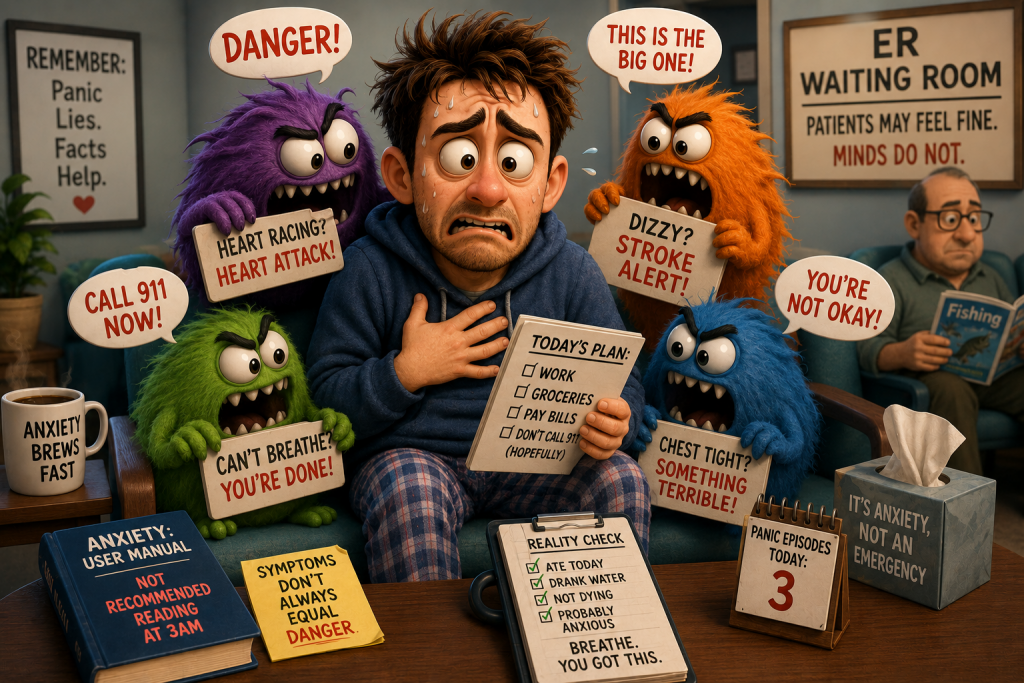
Once your body has scared you, every panic symptom can feel like a threat wearing a familiar face. Your chest tightens, and your mind goes right back to the worst day. Your heart races, and your brain says, “Here we go again.” You feel dizzy, and suddenly you are not just dizzy. You are mentally packing for the emergency room.
This is why panic after a health scare can feel so cruel.
Panic does not politely say, “Hello, I am anxiety.”
It says, “Something is wrong. Move. Fix this. Check this. Call someone. Search it. Don’t sit there.”
That is when the Brain Gets Loudest.
It gets loud because panic is not quiet fear. Panic is fear with a siren, a clipboard, and no sense of humor.
The body can react to panic in very real ways. The Mayo Clinic’s guide to panic attacks lists symptoms such as a racing heart, sweating, trembling, shortness of breath, chest pain, chills, nausea, dizziness, numbness, tingling, and fear of dying. That list matters because those symptoms are not “fake.” They are real body feelings.
That is what makes panic so believable.
If panic were only a thought, you might be able to say, “That’s just worry,” and move on.
But panic hits the body.
It can make your heart pound. It can make your breathing feel wrong. It can make your chest hurt. It can make your legs feel weak. It can make the room feel strange. It can make you feel like you are about to pass out, lose control, or die.
After a medical scare, that can be terrifying.
You are not scared because you are weak.
You are scared because panic is speaking the same body language as danger.
That is the trap.
Health anxiety after a scare often starts with a real thought: “I do not want to miss something important.”
That is fair.
Nobody wants to ignore a real problem.
But then fear stretches that thought into something much bigger: “I must treat every feeling like it could be the start of something terrible.”
That is where life gets smaller.
You may stop trusting calm days. You may avoid exercise. You may avoid sleep. You may avoid being alone. You may check symptoms before going out. You may keep asking people if you seem okay. You may read medical pages until your eyes hurt and your heart rate joins the conversation.
A little knowledge can help.
Too much panic-searching can turn into gasoline.
The NHS page on health anxiety points out that people may keep checking their body, asking for reassurance, or looking up health information. It also suggests noticing those habits and slowly reducing them.
That is not because symptoms never matter.
It is because the checking itself can become part of the anxiety.
| Panic Says | A Calmer Response Says |
|---|---|
| “This feeling means danger.” | “This feeling is scary, but I can pause.” |
| “You need certainty right now.” | “I need a clear next step, not a spiral.” |
| “Check again.” | “I already checked according to my plan.” |
| “Google it.” | “Panic-searching has not helped me.” |
| “You are not safe.” | “I am scared, and I am still here.” |
The hard truth is that panic often wants a kind of certainty nobody can give.
It wants someone to promise nothing bad will ever happen.
Doctors cannot promise that. Family cannot promise that. Google cannot promise that. Your own checking cannot promise that.
So the work becomes learning to live without chasing perfect certainty every time fear rises.
That does not mean ignoring medical advice.
It means building a wiser system.
You can still have emergency rules from your doctor. You can still take real symptoms seriously. You can still seek help when something is new, severe, or clearly concerning. But you do not have to let panic turn every body feeling into a full trial.
Health anxiety is often treated with therapy, especially cognitive behavioral therapy, and sometimes medication. The Mayo Clinic’s treatment page for panic attacks and panic disorder discusses psychotherapy and medicines as common treatment options. A licensed professional can help you sort through fear patterns while still respecting your real medical history.
That balance is important.
You do not need someone to tell you, “It is all in your head.”
You need someone to help you say, “Some of this is fear, some of this is my body, and I can learn what to do with both.”
For many people, panic after a health scare is not just fear of symptoms.
It is fear of being helpless again.
Fear of being surprised again.
Fear of not being believed.
Fear of not getting help in time.
Fear of your body turning against you.
Fear of leaving your family.
Fear of going back to that room, that test, that diagnosis, that moment.
That is deep fear.
It deserves more than “calm down.”
It deserves care.
It deserves patience.
It deserves tools.
And it deserves truth.
Panic can feel like danger without always being danger.
That one sentence can be hard to believe at first. But with time, support, and practice, it can become the sentence that helps you stay steady when fear tries to take the wheel.
When Panic Feels Like Another Medical Emergency
A panic attack after a health scare can feel almost impossible to ignore.
Your body goes loud.
Your heart may pound. Your chest may tighten. Your hands may tingle. Your stomach may flip. Your breathing may feel too fast, too shallow, or not enough. You may feel hot, cold, shaky, unreal, dizzy, or weak.
And then the thought comes:
“What if this is not panic?”
That question is the match.
Once it lights, the whole body can go up.
This is why panic after a health scare feels different from ordinary stress. You are not only scared of the panic attack. You are scared that panic is hiding a real emergency.
That fear makes sense.
If you have had a serious health event, you may have been taught to watch certain symptoms. You may have been told not to ignore chest pain, shortness of breath, fainting, weakness, severe pain, or sudden changes. That kind of instruction can save lives.
But it can also leave your brain jumpy.
Now panic and danger may feel like they are using the same costume closet.
The National Institute of Mental Health explains panic attacks as sudden periods of intense fear with physical symptoms such as a racing heart, sweating, chills, trembling, breathing trouble, dizziness, tingling, chest pain, stomach pain, nausea, and fear of losing control. It also notes that panic attacks themselves are not life-threatening, even though they are distressing.
That can be comforting, but it can also be hard to trust when you are in the middle of one.
Because in the moment, your body is not reading a calm medical page.
Your body is yelling.
And when your body yells after a medical scare, your brain may assume it knows what the yelling means.
It may not.
Panic can copy many emergency-like feelings. That is why people often seek medical care during panic attacks, especially when symptoms are new or feel different. There is no shame in that. It is better to be safe with serious symptoms.
But once a doctor has checked you and you have a plan, the next part is learning how to respond to panic without automatically treating every attack as a brand-new disaster.
That takes practice.
It also takes clear rules.
A clear medical plan is one of the best gifts you can give an anxious brain. Ask your doctor what symptoms should lead to urgent care, what symptoms should lead to a call, and what symptoms are expected or likely related to anxiety, healing, medicine, stress, or your condition.
Without clear rules, panic will make its own.
And panic’s rules are usually:
- Everything is dangerous.
- Check everything.
- Trust nothing.
- Call everyone.
- Sleep never.
- Google until sunrise.
Not great management.
| Panic Symptom | Why It Feels Scary | What Can Help |
|---|---|---|
| Racing heart | It can remind you of danger | Sit, breathe slowly, follow your medical plan |
| Chest tightness | It can feel like an emergency | Use urgent care rules from your doctor |
| Dizziness | It can make you feel unsafe | Sit down, hydrate, ground yourself, seek care if severe or new |
| Tingling | It can feel alarming | Notice breathing and panic patterns |
| Shortness of breath | It can create fear fast | Slow the exhale, get help if symptoms are severe or unusual |
The goal is not to talk yourself out of every symptom.
The goal is to avoid letting panic be the only voice in the room.
When panic hits, you can ask:
“Is this a known panic pattern for me, or is this new and clearly different?”
That question is not perfect, but it can slow the spiral.
You can also keep a simple written plan. Not a 14-page panic novel. Just a calm note written when you are not panicking.
Something like:
- These are my doctor’s red flags.
- These are my common panic symptoms.
- These are three things that help me calm down.
- This is who I call for support.
- This is when I seek urgent help.
That plan can become your anchor.
Because during panic, the thinking brain gets shoved to the back seat. You need something simple to grab.
A panic attack can make you feel like you have to solve everything at once. You do not.
Start with the body.
Sit down if you feel unsafe standing. Put both feet on the floor. Loosen tight clothing if needed. Let your shoulders drop. Try breathing out longer than you breathe in. Look around the room and name simple facts: the date, the place, the object in front of you, the sound you hear.
This does not magically delete panic.
It tells the nervous system, “We are not running right now.”
Panic may still wave its little clipboard and demand a meeting.
You do not have to attend every meeting.
A real quote often linked to fear and courage comes from Franklin D. Roosevelt’s first inaugural address: “The only thing we have to fear is fear itself.”
That line is not a cure for panic, and it should not be used to dismiss real symptoms. But it does name something important. Fear can become its own force. After a health scare, fear itself can start causing suffering even when the original danger is gone.
When panic feels like another medical emergency, you need two things at once:
You need medical wisdom.
And you need panic skills.
One without the other can leave you stuck.
Medical wisdom helps you stay safe.
Panic skills help you stop living as if every wave of fear is proof that danger has returned.
The Fear Spiral of Symptoms and Worry
The fear spiral usually starts small.
One sensation.
One thought.
One tiny “what if.”
Then it grows legs, steals your coffee, and ruins the afternoon.
You feel a pain.
Then you think, “What was that?”
Then you check.
Then you feel more afraid.
Then your body reacts to the fear.
Then the new body reaction creates more fear.
Then you search symptoms.
Then you find a scary result.
Then your body gets louder.
Then your mind says, “See? This is serious.”
That is the spiral.
It can move fast.
One minute you are folding laundry. Ten minutes later, you are reading a medical page from 2011, comparing your left eyebrow to a chart, and wondering if the dog looks worried.
The spiral feels silly later.
It does not feel silly while it is happening.
The NHS guide on anxiety, fear, and panic explains that panic symptoms can include a racing heartbeat, dizziness, feeling out of control, sweating, shaking, shortness of breath, tingling, and nausea. These are real sensations. When they happen after a health scare, they can pull your mind right back into emergency mode.
That is why the spiral is not just mental.
It is body plus thought plus memory.
Your body feels something.
Your mind gives it a scary meaning.
Your memory adds, “Remember what happened last time?”
Then the Brain Gets Loudest.
It starts building a case.
Exhibit A: chest tightness.
Exhibit B: remembered hospital smell.
Exhibit C: one random internet comment from someone named “TruthSeeker1978.”
Case closed, apparently.
But fear is not a fair judge.
Fear gathers evidence for danger and ignores evidence for calm.
For example, fear may ignore that you slept badly, had caffeine, skipped lunch, argued with someone, sat weird, walked uphill, or have felt this exact symptom during panic before.
It focuses on the worst meaning.
The spiral often has stages.
| Stage | What Happens | What It Feels Like |
|---|---|---|
| Sensation | You notice a body feeling | “What is that?” |
| Meaning | Your mind labels it dangerous | “This could be bad.” |
| Checking | You scan, touch, measure, or search | “I need to know.” |
| Body alarm | Fear creates more symptoms | “Now it feels worse.” |
| Reassurance | You ask, search, or test again | “Maybe I’m okay.” |
| Doubt returns | Relief fades | “But what if I missed something?” |
This loop can become a habit because reassurance gives quick relief.
Quick relief is powerful.
Your brain learns, “When scared, check.”
The problem is that checking does not teach your brain, “I can handle fear.”
It teaches, “I need checking to survive fear.”
That keeps the loop alive.
Breaking the spiral does not mean doing nothing. It means doing something different.
Instead of asking, “How do I make this feeling go away right now?” try asking, “What would I do if I were responding wisely, not desperately?”
That question can change the next move.
A desperate move may be Googling symptoms for an hour.
A wise move may be checking your doctor’s written instructions.
A desperate move may be asking your spouse five times if you look okay.
A wise move may be saying once, “I’m anxious and need support,” then using a grounding skill.
A desperate move may be avoiding the rest of the day.
A wise move may be taking ten quiet minutes, then doing one small normal thing.
The fear spiral shrinks when you stop feeding it at every step.
You may not be able to stop the first sensation.
You may not be able to stop the first scary thought.
But you can often change the next action.
That is where power comes back.
One useful tool is a “pause plan.”
When a symptom scares you, pause before checking or searching. Set a short timer. During that time:
- Sit down.
- Slow your breathing.
- Name what you feel without judging it.
- Ask if this matches a known panic pattern.
- Ask if it matches your doctor’s urgent-care rules.
- Do one grounding action.
- Then decide the next step.
This helps your brain learn that fear is not the same as command.
You can feel scared and still choose.
The NHS health anxiety page suggests keeping a diary of checking, reassurance-seeking, and health information searches, then slowly reducing them. That is useful because many people do not realize how often the loop is happening until they track it.
Not to shame yourself.
To see the pattern.
Once you see the pattern, you can interrupt it.
And when you interrupt it enough times, your brain starts learning a new path.
Sensation does not have to become spiral.
Worry does not have to become checking.
Fear does not have to become the boss.
Learning the Difference Between Panic and Danger
Learning the difference between panic and danger is one of the hardest parts of healing after a health scare.
It is also one of the most important.
The goal is not to become careless.
The goal is to become clear.
After a serious health event, you may feel caught between two fears. On one side, you fear ignoring something real. On the other side, you fear living every day as if something real is happening when it is not.
That is a painful place to stand.
You may think, “What if I call too much?” Then you think, “What if I don’t call and I should have?”
You may think, “What if this is panic?” Then you think, “What if I call it panic and it is danger?”
This is why people after health scares need clear medical guidance, not vague comfort.
“Don’t worry” is not a plan.
“Here are the symptoms that need urgent care, here are the ones to call about, and here are common anxiety symptoms” is much better.
If you do not have that kind of plan, ask for it.
You can ask your doctor:
- What symptoms mean I should seek emergency care?
- What symptoms mean I should call your office?
- What symptoms are common with anxiety, stress, healing, or my condition?
- What symptoms should I track?
- What symptoms should I stop tracking?
- What should I do during a panic attack?
- Could therapy help with health anxiety after this scare?
Those are reasonable questions.
You are not being annoying.
You are trying to live.
The American Heart Association gives warning signs of a heart attack, and the American Stroke Association lists stroke warning signs using F.A.S.T.. Those kinds of trusted pages can be useful because they give clear warning signs instead of endless panic fuel.
Trusted information matters.
Random symptom searching can make fear worse because it gives your brain too many scary possibilities without knowing your body, history, exam, tests, or doctor’s plan.
A good rule is:
Use trusted sources for education, not panic-searching for certainty.
There is a big difference.
Education says, “I want to understand what signs matter.”
Panic-searching says, “I need to feel safe right now, and I will keep searching until I do.”
The second one rarely ends well.
When trying to tell panic from danger, patterns help.
Panic often comes in waves. It may build quickly, peak, and slowly fade. It may come with fear of dying, fear of losing control, tingling, trembling, fast breathing, nausea, chest tightness, dizziness, and a racing heart. These symptoms are scary, but they are common in panic.
Danger may come with symptoms your doctor has told you not to ignore, symptoms that are new or severe, symptoms that do not fit your usual panic pattern, or symptoms with clear red flags.
Because every person’s health history is different, this is not something a blog post can decide for you.
That is why a personal medical plan matters.
| Panic Pattern Questions | Danger Plan Questions |
|---|---|
| Have I felt this during panic before? | Is this new, severe, or clearly different? |
| Did it start after fear or stress? | Does it match my doctor’s red flags? |
| Does it rise and fall like a wave? | Is it getting worse or not improving? |
| Does grounding lower it at all? | Do I need urgent care based on my plan? |
| Am I chasing certainty? | Am I following clear medical guidance? |
This table is not a diagnosis tool.
It is a thinking tool.
It helps you slow down enough to make a safer choice.
Panic wants you to react.
Wisdom asks you to respond.
There is a quote from Viktor Frankl often shared because it speaks to this space between feeling and action: “Between stimulus and response there is a space. In that space is our power to choose our response.”
That quote has been repeated in many places, and while its exact wording and direct source history are often debated, the meaning is useful here. The space between a symptom and your reaction matters.
You may not control the first fear.
You may not control the first body feeling.
But with practice, you can build a space before the spiral.
That space may be five seconds at first.
That still counts.
In that space, you can grab your plan. You can breathe. You can sit. You can ask if this is familiar. You can call if the plan says call. You can avoid Google if Google has become a fear machine. You can remind yourself, “I am allowed to take this seriously without panicking.”
That sentence is powerful.
Because the goal is not to become reckless.
The goal is to become steady.
You can respect your health without worshiping fear.
You can seek care without seeking constant reassurance.
You can listen to your body without letting panic translate every word.
Why Reassurance Only Helps for a Little While
Reassurance can feel like medicine.
For a minute.
Someone says, “You’re okay.”
Your doctor says the test looks good.
Your spouse says you look fine.
Your friend says, “That sounds like anxiety.”
Your blood pressure is normal.
Your oxygen is normal.
Your pulse comes down.
The medical page says panic can cause those symptoms.
And for a short time, your body relaxes.
Then the doubt creeps back in.
“But what if this time is different?”
That is why reassurance can become a trap.
It helps, but only for a little while.
Then fear asks for another dose.
This does not mean reassurance is bad. We all need comfort. After a health scare, it is normal to need extra support. A calm word from someone you trust can help you get through a scary moment.
But constant reassurance can train the brain in the wrong direction.
It can teach your mind that fear must be answered before you can move on.
It can make you depend on outside proof every time anxiety rises.
That becomes a problem because fear can always create one more question.
No reassurance is strong enough to satisfy a fear that keeps changing the rules.
You may ask, “Do I look okay?”
Someone says yes.
Then fear says, “But they are not a doctor.”
A doctor says yes.
Then fear says, “But what if they missed something?”
A test says yes.
Then fear says, “But what if it changed since then?”
That is how the loop works.
The NHS health anxiety guide directly names reassurance-seeking as a habit to notice, along with body checking and looking up health information. It suggests slowly reducing how often you do these things.
Slowly is the key word.
You do not have to rip reassurance away all at once.
If you do, fear may spike hard.
A better goal is to replace repeated reassurance with steady support and clear plans.
There is a difference.
| Reassurance Loop | Steady Support |
|---|---|
| “Tell me I’m okay again.” | “I’m anxious. Can you sit with me for a few minutes?” |
| “Check this symptom for me.” | “Help me follow my plan.” |
| “Promise nothing bad will happen.” | “Remind me I can handle this moment.” |
| “Should I Google it?” | “Help me not panic-search.” |
| “Do I look sick?” | “I need comfort, not another inspection.” |
That last line matters.
Sometimes what you need is not another answer.
Sometimes you need comfort.
A person with health anxiety may ask for facts when what they really need is safety.
But facts cannot always give emotional safety.
They can help, yes.
But if the nervous system is scared, it may need grounding, closeness, patience, breathing, therapy, and time.
You can tell loved ones what helps.
For example:
- “Please don’t tell me I’m being ridiculous.”
- “Please remind me to follow my doctor’s plan.”
- “Please sit with me while I calm down.”
- “Please don’t help me Google symptoms.”
- “Please don’t check my pulse unless there is a real reason.”
- “Please remind me that panic can feel scary and still pass.”
This can help your family support recovery instead of feeding the loop.
They may not know the difference unless you explain it.
Reassurance also loses power because it aims at the wrong target.
It tries to answer the question, “Am I safe forever?”
But the real healing question is, “Can I handle fear without needing perfect certainty?”
That is much harder.
But it is also where freedom lives.
After a health scare, you may never go back to the exact old version of yourself who never thought about risk. That is okay. You are not trying to become unaware. You are trying to become less trapped.
You can care about your health and still live.
You can ask for help and still build self-trust.
You can feel fear and still choose not to feed it.
If panic and health anxiety have been taking over your days, resources like This Is Anxiety, Not Death can help put words to the fear loop, especially when symptoms feel bigger than your ability to stay calm.
You can also keep reading grounded work on fear, anxiety, and recovery at OfficialRayMcNally.com, where the focus stays on honest healing instead of fake toughness.
Reassurance is not wrong.
It is just not enough by itself.
The deeper work is learning to tell yourself:
“I am scared, but I do not need to solve this fear every time it speaks.”
That is not easy.
At first, fear may argue.
It may get louder.
It may demand one more check, one more question, one more search.
But each time you pause, follow your plan, and let the wave pass without feeding it, you teach your brain a new lesson.
You teach it that fear can rise and fall.
You teach it that panic can feel awful and still pass.
You teach it that your body can be loud without always being in danger.
And slowly, you stop needing reassurance every few minutes because you begin building something stronger.
Trust.
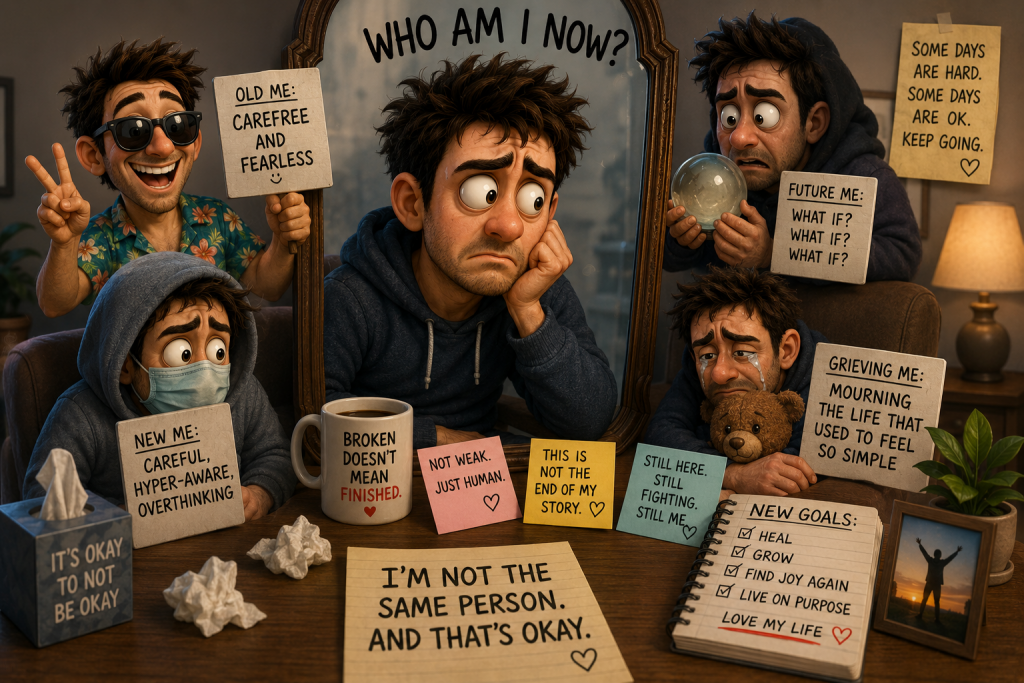
Feeling Different After Medical Trauma
One of the hardest things after medical trauma is not always the fear itself.
Sometimes it is the strange feeling that you are not the same person anymore.
You may still have the same name, same house, same family, same job, same bills, same laundry pile, and the same one sock that keeps showing up in places no sock should ever be. But inside, something feels different.
You may laugh, but not as freely.
You may rest, but not as deeply.
You may make plans, but now a quiet part of you wonders if life will let you keep them.
That is what a serious health scare can do. It can split life into “before” and “after.”
Before, you may have moved through your day without thinking about how fragile everything was. You may have complained about normal problems and meant it. Traffic, bills, bad sleep, annoying emails, loud neighbors, long lines, and the price of groceries all felt like big things.
Then a health scare happens.
Suddenly, the old problems do not look the same.
Some of them seem smaller. Some seem sharper. Some still annoy you, because being grateful does not magically make the electric bill adorable. But your view of life changes. You know something now that you cannot unknow.
Your body can scare you.
Life can change fast.
Control is not as strong as you thought.
That can leave you feeling like a different version of yourself.
This is not always a bad thing, but it can feel sad. You may miss the old version of you who did not think about danger so much. You may miss being careless in a harmless way. You may miss sleeping without checking your body. You may miss trusting tomorrow without needing proof.
After a health scare, the Brain Gets Loudest because it is not only watching for symptoms. It is also trying to understand who you are now.
Am I still strong?
Am I still safe?
Am I still me?
Can I still do the things I loved?
Will my family still see me the same way?
Will I ever stop thinking about what happened?
These questions can be heavy, especially when everyone else thinks you should be “back to normal.”
But normal may not be the right goal.
Sometimes the goal is not to become the exact same person you were before. Sometimes the goal is to become a steadier version of yourself after what happened.
That does not mean you are glad it happened.
It does not mean trauma was a gift.
It means you are allowed to grow around the wound without pretending the wound was beautiful.
The American Psychological Association explains trauma as an emotional response to a terrible event, and it can bring shock, denial, hard emotions, strained relationships, and physical symptoms. That fits what many people feel after medical trauma. It is not only the event. It is the way the event changes how you move through life.
| Before the Health Scare | After the Health Scare |
|---|---|
| “My body just does what it does.” | “I notice everything my body does.” |
| “I’ll deal with problems when they happen.” | “What if something happens again?” |
| “I can make plans easily.” | “I want to plan, but I feel unsure.” |
| “Sleep is just sleep.” | “Nighttime can feel scary.” |
| “Doctors are part of life.” | “Appointments can bring back fear.” |
| “I know who I am.” | “I feel changed, and I do not know what to do with that.” |
Feeling different does not mean you are broken.
It means something serious touched your life, and now your mind is trying to make room for it.
You may not be able to erase the “after.”
But you can learn how to live inside it with more peace.
For people who feel changed by anxiety, fear, and body panic after a scare, This Is Anxiety, Not Death may help put plain words to what can feel impossible to explain.
You are not weak because you feel different.
You went through something that mattered.
Now your healing has to matter too.
The Loss of Normalcy
Losing normalcy after a health scare can hurt more than people expect.
It is not always one big loss. It is often a hundred small losses that show up during normal days.
You miss the way you used to wake up without immediately checking how you feel. You miss eating without wondering how your body will react. You miss walking up stairs without watching your heartbeat. You miss going to bed without fear turning the pillow into a meeting room.
You miss boring.
Boring used to feel like nothing.
Now boring sounds amazing.
A boring body. A boring appointment. A boring test result. A boring day where nothing inside you feels like it needs a press conference.
That is one thing nobody tells you after medical trauma. Normal can become something you grieve.
Before the scare, normal may have felt plain. You may have wished for excitement, change, adventure, or a break from routine. Then the health scare comes along and suddenly “plain” looks like paradise with better snacks.
You may find yourself thinking, “I just want my old life back.”
That is not childish.
That is grief.
You are grieving the version of life that felt simpler.
You are grieving the ease you had before your body became something you had to watch.
You are grieving the trust you had before you learned how quickly things can change.
The Cleveland Clinic explains that grief can happen after many types of loss, not only death. That is important here. After a health scare, you may grieve your old peace, your old confidence, your old routine, or the old feeling that your body was just quietly on your side.
That grief may show up in strange ways.
You may cry over something small. You may get angry when someone says, “At least you’re okay.” You may feel jealous of people who seem carefree. You may feel annoyed at your own limits. You may feel sad when you remember how easy certain things used to be.
And then you may feel guilty for feeling sad because you survived.
That guilt can be heavy.
You may tell yourself, “Other people have it worse.”
Yes, they might.
But pain is not a contest.
Someone else having a harder story does not erase yours.
You are allowed to be grateful and still miss what changed.
| What You May Miss | Why It Hurts |
|---|---|
| Not thinking about your body | Your body now feels like a job |
| Easy sleep | Night can feel unsafe |
| Carefree plans | The future feels less certain |
| Trusting doctors without fear | Appointments can trigger memories |
| Feeling strong | You may feel fragile now |
| Being understood | Others may think it is over |
The loss of normalcy can also affect your family life. You may still show up for others, but inside you feel different. Maybe you are quieter. Maybe you get tired faster. Maybe you do not enjoy the same things the same way. Maybe you are present in the room, but your mind is checking symptoms in the background.
That can make you feel guilty too.
You may think, “I should be more fun. I should be past this. I should not still be scared.”
But “should” is not healing.
“Should” usually just adds shame.
A better question is:
“What kind of normal can I build now?”
Because sometimes the old normal does not come back exactly the same.
That sounds sad, and sometimes it is.
But it does not mean life is over.
A new normal can still have joy in it. It can still have laughter, family, purpose, work, rest, faith, creativity, food that makes you happy, music that brings you back, and quiet days that finally feel quiet again.
The new normal may include more care.
More boundaries.
More doctor visits.
More awareness.
More rest.
More respect for your body.
More honesty about fear.
That does not make it bad.
It makes it different.
The goal is not to pretend you lost nothing. The goal is to stop believing that loss means life can never feel good again.
You can miss the old version of your life and still build a life that matters now.
You can grieve the loss of normalcy and still find calm again.
You can say, “I am not who I was,” without saying, “I am ruined.”
That small shift matters.
Because healing after medical trauma is not only about getting back.
Sometimes it is about learning how to go forward.
Missing the Person You Were Before
Missing the person you were before a health scare can feel strange because that person is still you.
But also not fully.
You may look at old photos and feel a little ache. There you are, smiling before you knew. Making plans before the fear. Eating whatever, sleeping whenever, pushing through stress, joking about getting older, acting like your body was just background noise.
You may miss that version of yourself.
The version who did not Google symptoms at 2 a.m.
The version who did not know certain medical words.
The version who did not get nervous before test results.
The version who could feel a random pain and not start mentally writing a goodbye letter.
That old version may seem freer.
Lighter.
Maybe even innocent.
After medical trauma, it can feel like that innocence is gone.
You know more now.
You may know what a waiting room feels like when your whole future seems to be hanging in the air. You may know what it feels like to watch a doctor’s face. You may know what it feels like to be afraid of a machine, a number, a scan, a result, a symptom, or your own heartbeat.
That kind of knowledge changes people.
It does not always destroy them.
But it changes them.
The National Institute of Mental Health notes that people can have frightening thoughts, avoid reminders, feel tense, have trouble sleeping, and struggle after traumatic events. After a health scare, those reactions can make you feel far away from the person you used to be.
You may wonder if the old you is gone forever.
That question can hurt.
It can feel like you are grieving someone who did not die.
A version of you did end, in a way.
The version that had not been through this yet.
That does not mean the best version of you is gone.
It means the story changed.
And now you are trying to find yourself in the next chapter.
There is a real quote from C.S. Lewis in A Grief Observed: “No one ever told me that grief felt so like fear.”
That line fits here because grief after a health scare often does feel like fear. You are grieving your old self, but the grief may show up as panic, anger, checking, sadness, or a deep wish to go back.
You may not only miss what you did.
You may miss how you felt while doing it.
| What You Miss About the Old You | What May Be True Now |
|---|---|
| You felt carefree | You feel more aware |
| You trusted your body | You are rebuilding trust slowly |
| You slept without fear | You may need safer bedtime habits |
| You made plans easily | You may need smaller steps |
| You did not think about health much | You now need balance, not obsession |
| You felt simple inside | You are carrying a heavier story |
Missing the old you does not mean you hate the new you.
It means you are trying to accept a change you did not ask for.
That takes time.
Sometimes people rush this part. They want a big comeback. They want to say, “I’m stronger now,” and move on.
Maybe someday you will feel stronger.
But you do not have to force that line too early.
Some days, you may just feel tired.
Some days, you may feel angry.
Some days, you may miss being unaware.
Some days, you may feel proud that you made breakfast, answered the phone, went to work, took a walk, or did not spiral after one weird body feeling.
Those small wins count.
The new you may not be as carefree, but that does not mean the new you has nothing good.
The new you may be more honest.
More careful with time.
More aware of what matters.
More willing to say no.
More tender toward other people’s pain.
More serious about peace.
More grateful for small, boring, beautiful days.
None of that erases the loss.
But it shows that you are still becoming.
You did not stop being you when life scared you.
You became a you who now carries proof that scary things can happen.
That is heavy.
But it is not the end of your personality, your humor, your hope, or your future.
You may miss the person you were before.
But do not forget to notice the person still sitting here.
Still trying.
Still learning.
Still here.
Fear of the Future
A health scare can make the future feel like a room with bad lighting.
You can still see some of it, but not clearly enough to relax.
Before the scare, you may have assumed the future would be there. You made plans. You talked about next year. You thought about vacations, family events, home projects, birthdays, career moves, books to write, places to see, and things you would “get around to someday.”
Then the scare happened.
Now “someday” feels different.
It may feel less promised.
That can make the future scary.
You may worry about your health getting worse. You may worry about leaving people behind. You may worry about money, medical bills, family stress, future tests, another episode, or what your life will look like if you cannot do what you used to do.
Even good plans can become loaded.
A wedding invitation may bring joy, then fear.
A vacation idea may bring excitement, then “What if something happens there?”
A family birthday may bring love, then the thought, “How many more will I get?”
That is a painful way to think, but it is common after a serious scare.
Your brain is trying to protect you by looking ahead.
The problem is that it may only look ahead for danger.
That is when the Brain Gets Loudest. It starts acting like a terrible fortune-teller with no refund policy.
It says:
- What if you get sick again?
- What if the next test is bad?
- What if you cannot handle it?
- What if your family suffers?
- What if this is the start of everything getting worse?
- What if you never feel normal again?
Fear loves the phrase “what if.”
It can build a whole haunted house out of it.
But not every “what if” is useful.
Some “what if” questions help you plan wisely.
Others only punish you with a future that has not happened.
| Helpful Future Thinking | Fear-Based Future Thinking |
|---|---|
| “What follow-up care do I need?” | “What if everything falls apart?” |
| “What should I do if symptoms return?” | “What if I am never safe again?” |
| “How can I lower stress?” | “What if stress ruins my health?” |
| “What matters most to me now?” | “What if I lose everything?” |
| “How do I plan with care?” | “Why plan if something bad could happen?” |
It is important to make this distinction.
You do not need to stop thinking about the future.
You need to stop letting fear be the only voice planning it.
A health scare may mean you do need to make changes. You may need follow-up care, medicine, therapy, lifestyle changes, rest, financial planning, family conversations, or support. Those things are not fear. They are care.
But care has limits.
Care prepares.
Fear rehearses suffering.
Care says, “Let’s make a plan.”
Fear says, “Let’s imagine every terrible outcome until your stomach hurts.”
The National Cancer Institute has written about scan-related anxiety, often called “scanxiety,” which can happen before medical scans or while waiting for results. Even outside cancer care, many people understand that waiting for tests, results, or follow-ups can make the future feel frightening.
Waiting is hard because the mind fills empty space.
If you do not know what will happen, fear may write the story for you.
That does not mean the story is true.
One way to work with fear of the future is to narrow the time frame.
Instead of asking, “How will I handle the rest of my life?” ask, “What is my next right step today?”
Today may be enough.
Take the medicine.
Make the appointment.
Eat something simple.
Walk for five minutes if safe.
Rest.
Talk to someone.
Do not Google at night.
Write down the fear instead of letting it bounce around your head.
Do one normal thing.
Future fear wants you to solve a whole life at once.
You are allowed to solve the next hour.
You can also make room for future joy, not just future danger.
Ask:
- What do I still want to experience?
- Who do I want to spend more time with?
- What have I been putting off for no good reason?
- What kind of peace do I want my days to have?
- What small thing can I enjoy this week?
- What matters more now?
These questions do not erase fear.
They give the future more than fear in it.
A health scare can make life feel fragile. But fragile does not mean empty. It may mean precious. It may mean worth paying attention to. It may mean worth living more honestly.
You do not need to pretend you are never scared of the future.
You can say, “I am scared, and I am still going to make plans.”
That is brave.
Not loud brave.
Not movie-scene brave.
Real brave.
The kind where you keep living with a shaky heart and honest eyes.
Grieving a Life That Used to Feel Simple
There is a special kind of grief that comes after a health scare.
It is the grief of realizing life used to feel simpler, and you did not know it at the time.
You may think back to old complaints and almost laugh.
You were stressed about being late, the dishes, the weather, the dog barking, the internet being slow, or somebody eating the leftovers you had emotionally committed to all day.
Those things still matter in their own way.
But after medical trauma, simple problems can look different.
You may miss the days when your biggest worry was annoying, not terrifying.
This grief can feel confusing because nothing may look dramatically different from the outside. You may still go to the store. Still pay bills. Still talk to people. Still laugh at jokes. Still complain about traffic because, honestly, some traffic deserves it.
But inside, you know.
Life does not feel as simple.
You may carry a quiet sadness that other people cannot see.
A sadness for the version of life where your body did not feel like a question mark.
A sadness for the old ease.
A sadness for the days when you did not know how fear could sound inside your own chest.
That grief is real.
And it deserves respect.
The Cleveland Clinic’s information on grief explains that grief can affect emotions, thoughts, behavior, and the body. It can also come with sadness, anger, guilt, trouble sleeping, and trouble focusing. That matters because grief after a health scare may not look like grief. It may look like anxiety, irritability, tiredness, or a short temper with everyone, including the toaster.
You may not walk around saying, “I am grieving my old normal.”
You may just feel off.
You may feel easily annoyed.
You may feel like crying when someone says, “At least you’re fine now.”
You may feel distant from people who have not gone through something similar.
You may feel guilty for not being happier.
But grief does not mean you are ungrateful.
Grief means something mattered.
Your old life mattered.
Your old peace mattered.
Your old confidence mattered.
Your old simple mornings mattered.
You can be thankful to be alive and still grieve the way life changed.
Those two feelings can sit at the same table.
They may not like each other, but they can both be there.
| Grief After a Health Scare May Sound Like | What It May Really Mean |
|---|---|
| “I should be over this.” | “I need more time.” |
| “I hate feeling different.” | “I miss my old peace.” |
| “Nobody understands.” | “I need safe support.” |
| “I’m tired of being scared.” | “My nervous system needs care.” |
| “I want my life back.” | “Something important changed.” |
The danger is trying to rush grief.
People may want you to be the inspirational survivor right away. They may want the neat version where you say, “It taught me what matters,” and smile in soft lighting.
Maybe it did teach you what matters.
But maybe it also scared the life out of you.
Both can be true.
Healing is allowed to be messy.
Some days, you may feel wise and grateful. Other days, you may feel bitter that this happened at all. Other days, you may feel numb. Other days, you may feel like yourself for ten minutes and then cry because you realized you felt like yourself.
That is grief moving around.
Not failure.
Moving forward does not mean you stop missing the simple life. It means you stop punishing yourself for missing it.
You can make space for the sadness without letting it become your whole home.
You might write about what you miss. You might talk to someone who will not fix it too fast. You might let yourself say, “I am glad I survived, but I am sad too.” You might read honest work about fear and recovery at OfficialRayMcNally.com, especially when you need words that do not pretend healing is easy.
Over time, life can become simpler again.
Not because you forget.
Because your nervous system stops treating every day like a threat.
Because your body becomes less of an enemy.
Because you learn your red flags.
Because you build routines.
Because you laugh again and do not feel guilty for it.
Because you have boring days again.
And one day, a boring day may feel like a gift.
Not perfect.
Not magical.
Just quiet.
Just normal.
Just enough.
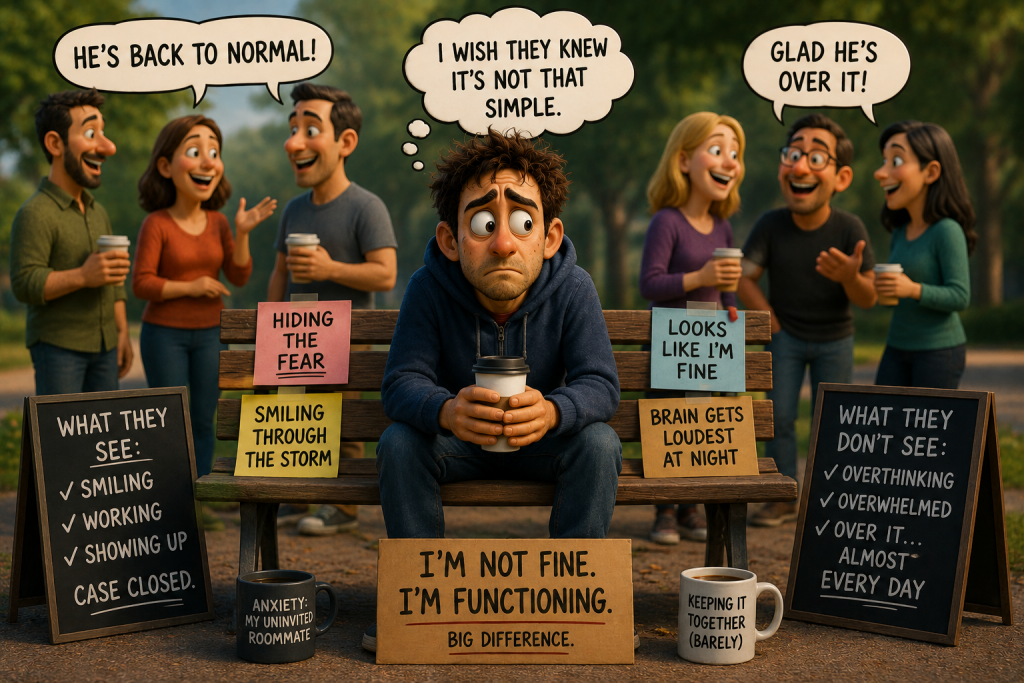
Relationships and Isolation
A health scare can change the way you feel around people.
That can be one of the loneliest parts.
You may be sitting in a room full of people who love you and still feel far away from everyone. They may be talking, laughing, making plans, complaining about dinner, or asking what you want to watch. On the outside, it may look like life is back to normal.
Inside, you may feel like you are carrying a storm nobody can see.
That is the strange thing about medical trauma. It does not always make you want to be alone because you dislike people. Sometimes it makes you feel alone because you do not know how to explain what happened inside you.
You may not even have the words for it yet.
How do you explain that you are grateful to be alive, but still scared?
How do you explain that the doctor gave good news, but your brain did not fully believe it?
How do you explain that one tiny body feeling can pull your mind back into the worst day?
How do you explain that you can smile at dinner and still be checking your pulse under the table?
That is why isolation can grow after a health scare.
It may not happen all at once. It may start small.
You stop bringing it up because you do not want to be annoying. You say “I’m fine” because it is faster than explaining. You hide panic because you do not want to scare your family. You avoid certain places because you do not want questions. You stop going out because pretending to be okay takes too much energy.
Then one day you realize you have been protecting everyone else from your fear while carrying it by yourself.
That is a heavy job.
The American Psychological Association explains trauma as an emotional response to a terrible event, and it notes that longer-term reactions can include strained relationships and physical symptoms. That matters because medical trauma does not only affect the person’s body. It can affect the way they connect, talk, trust, rest, and ask for help.
When the Brain Gets Loudest, relationships can feel harder.
You may hear someone say, “You look better,” and your brain replies, “They don’t get it.”
You may hear, “Try not to worry,” and your brain says, “If only it were that easy.”
You may hear, “At least you’re okay,” and your brain says, “Then why do I still feel scared?”
Those comments may be meant with love, but they can still land badly.
The problem is that people often know how to respond to the medical part better than the emotional part. They can understand surgery, scans, medicine, pain, and appointments. But they may not understand the fear that stays after the crisis.
That fear can be invisible.
And invisible pain is easy for others to miss.
| What People May See | What You May Be Hiding |
|---|---|
| You are working again | You are scared between tasks |
| You are smiling | You are trying not to cry |
| You are going to appointments | You dread every result |
| You are talking normally | Your mind is replaying the scare |
| You seem calm | You are holding panic in your body |
| You look fine | You feel changed inside |
This is where isolation becomes dangerous emotionally. Not because being alone is always bad. Sometimes quiet helps. Sometimes rest helps. Sometimes you need space.
But hiding everything all the time can make fear louder.
Fear grows in silence.
It starts making its own rules.
It says nobody understands. It says you are a burden. It says you should stop talking about it. It says people are tired of you. It says your fear is too much.
Fear is not always telling the truth.
You may need to choose one or two safe people and tell them plainly:
“I know I look okay, but I’m still scared.”
That one sentence can open a door.
You do not have to explain everything perfectly.
You do not have to give a speech.
You do not have to prove that your fear makes sense.
You can simply let someone know that the after-part is harder than they can see.
A real quote from Brené Brown often used in conversations about shame and connection is: “Shame cannot survive being spoken.”
That idea fits here. Fear and shame grow when they stay hidden. Speaking them to the right person can weaken their grip.
Not everyone will respond well.
That is true.
Some people will rush you. Some will try to fix you. Some will give bad advice. Some will make jokes because they are uncomfortable. Some will say, “Just be positive,” because they do not know what else to say.
But some people will stay.
Some people will listen.
Some people will say, “I do not fully understand, but I am here.”
That can matter more than perfect words.
The goal is not to tell everyone everything.
The goal is to stop believing you have to carry it completely alone.
Medical trauma can make you feel separate from the world.
Connection helps remind you that you are still part of it.
Feeling Misunderstood
Feeling misunderstood after a health scare can be deeply frustrating.
You may try to explain what you are feeling, and people may answer the wrong problem.
You say, “I’m scared.”
They say, “But the doctor said you’re okay.”
You say, “I can’t stop thinking about it.”
They say, “You need to distract yourself.”
You say, “My body feels unsafe.”
They say, “You’re probably fine.”
You say, “I feel different.”
They say, “Well, everybody gets older.”
Cool. Helpful. Let’s put that on a mug and throw it into the woods.
Most people are not trying to be cruel. They may truly love you. They may want to help. They may be relieved that you survived and may not understand why you are not relieved in the same way.
But being misunderstood can still hurt.
It can make you feel like you have to defend your fear.
It can make you stop talking.
It can make you wonder if you are being dramatic.
You are not.
After medical trauma, fear can stay even when the immediate danger is over. The National Institute of Mental Health explains that after trauma, people may have a range of reactions, and some may continue to have symptoms that affect daily life. Trauma reactions can include unwanted memories, avoidance, mood changes, and feeling tense or on edge.
That means someone can be medically stable and still emotionally shaken.
Those are not opposites.
They can happen together.
A person may be healing physically and still feel unsafe emotionally.
That is the part many loved ones miss.
They may think good news should erase fear. But fear does not always update itself that fast. Your brain may still be living by the memory of what happened, not only by the newest test result.
This is why “You’re fine” can feel so empty.
Maybe you are medically fine at that moment.
But emotionally, you may not be fine.
A better response would be:
“I’m glad you’re medically okay, but I understand that you still feel scared.”
That one sentence holds both truths.
| Unhelpful Response | More Helpful Response |
|---|---|
| “You’re fine.” | “I know you’re scared, and I’m here.” |
| “Stop thinking about it.” | “That sounds exhausting to carry.” |
| “At least it wasn’t worse.” | “That must have been really scary.” |
| “Just be grateful.” | “You can be grateful and still shaken.” |
| “You’re overreacting.” | “Tell me what part feels hardest right now.” |
Feeling misunderstood can also happen because people compare your fear to their own idea of fear.
They may think, “I had a health scare once, and I moved on.”
That may be true for them.
But every nervous system is different. Every scare is different. Every history is different. Every support system is different. Every body is different. Every doctor visit, diagnosis, emergency, surgery, symptom, and result lands differently.
There is no one-size-fits-all emotional recovery.
The Mayo Clinic notes that PTSD symptoms can include unwanted memories, emotional distress, avoidance, negative changes in thinking and mood, and changes in physical and emotional reactions. A person does not need to use the label PTSD to understand that frightening events can leave real emotional effects.
This matters because some people may try to talk you out of your fear with logic.
Logic can help sometimes.
But trauma fear is not always a logic problem.
It is often a safety problem.
Your nervous system may need repeated proof that you are safe now. It may need time. It may need support. It may need calm routines. It may need therapy. It may need someone to stop arguing and simply sit with you.
If you feel misunderstood, it may help to use simple, clear language.
Try saying:
- “I’m not asking you to fix this. I just need you to listen.”
- “I know the test was okay. My body still feels scared.”
- “Please don’t tell me to move on. I’m trying.”
- “When I talk about it, I’m not trying to be negative. I’m trying to process it.”
- “I may look fine, but I’m still healing from the fear.”
You may also need boundaries.
If someone keeps dismissing you, you do not have to keep explaining yourself to that person. You can choose safer listeners. You can speak to a therapist, support group, doctor, pastor, close friend, or family member who has the patience to hear the truth without rushing you.
Feeling misunderstood hurts because humans are built for connection.
We need people to see us.
Not just our survival.
Our struggle too.
And when someone finally says, “That makes sense,” it can feel like your shoulders drop for the first time in days.
That is the power of being understood.
It does not erase the fear.
But it makes you less alone inside it.
Hiding Your Fear From Others
Hiding fear after a health scare can become a full-time acting job.
You wake up scared, but say you are fine.
You go to work scared, but answer emails like a normal adult who definitely did not check their pulse three times before breakfast.
You sit with family scared, but smile because you do not want to ruin the mood.
You feel a symptom, but stay quiet because you do not want everyone looking at you.
You want comfort, but you do not want to seem needy.
So you hide it.
At first, hiding fear may feel like strength.
You may think, “I do not want to burden anyone.”
You may think, “They already went through enough.”
You may think, “If I keep talking about it, they’ll get tired of me.”
You may think, “I should be past this by now.”
Those thoughts are common.
But hiding fear can make the fear feel more powerful.
When fear stays hidden, it has no reality check. It does not hear another calm voice. It does not get softened by support. It just bounces around inside your head, getting louder and stranger.
That is when the Brain Gets Loudest.
It gets loud because you are trying to manage a private emergency while acting like everything is normal.
That is exhausting.
The VA National Center for PTSD explains that avoidance can include avoiding thoughts, feelings, conversations, people, places, or things that remind someone of trauma. After a health scare, hiding your fear can become a form of avoidance. You avoid talking about it because talking makes it feel real.
But it is already real.
You do not make fear bigger by speaking it to the right person.
Often, you make it less lonely.
Hiding fear can show up in many ways:
- Saying “I’m fine” when you are not
- Changing the subject when health comes up
- Hiding panic symptoms
- Avoiding follow-up talks
- Pretending appointments do not scare you
- Not telling people when nights are hard
- Laughing off serious fear
- Keeping symptom worries private
- Avoiding social plans because acting okay feels tiring
This can create a painful gap between what people see and what you live.
| Outside Version | Inside Version |
|---|---|
| “I’m good.” | “I’m scared again.” |
| “Just tired.” | “I barely slept because my brain would not stop.” |
| “I don’t want to talk about it.” | “I do, but I’m afraid you’ll dismiss me.” |
| “I’m okay to go.” | “I’m worried I’ll panic there.” |
| “No big deal.” | “It still feels like a big deal to me.” |
The problem is that people may believe the outside version.
Not because they do not care.
Because you are very good at hiding.
Then you may feel hurt that nobody notices, even though you have been working hard to make sure they do not notice.
That is a painful trap.
You do not need to tell everyone everything.
But you may need to tell someone something.
Start small.
You can say:
“I’ve been hiding how scared I still feel.”
That is enough.
You do not have to give every detail. You do not have to explain every symptom. You do not have to cry perfectly or sound calm. You can be messy. You can say, “I don’t even know how to say it.”
That still counts.
If talking feels too hard, you can write it. Send a text. Write a note. Share an article. Tell someone, “This explains it better than I can.”
A useful line might be:
“I know I seem okay, but this health scare affected me more than I’ve been saying.”
That gives people a chance to understand.
Some may still not know what to do.
That is okay.
You can tell them what helps.
- “Please just listen.”
- “Please don’t try to fix it right away.”
- “Please remind me I am not a burden.”
- “Please sit with me for a few minutes.”
- “Please don’t help me spiral by Googling symptoms with me.”
- “Please help me follow my doctor’s plan instead of panic-checking.”
Hiding fear can also block professional help. You may downplay symptoms to your doctor or therapist because you are embarrassed. You may not mention panic, poor sleep, intrusive memories, or constant checking.
But doctors and mental health professionals cannot help with what they do not know.
If fear is affecting your daily life, sleep, work, relationships, or ability to function, it is worth bringing up. The Cleveland Clinic’s PTSD overview notes that PTSD can develop after trauma and that therapy and medication may help. Even if you do not have PTSD, support can help you deal with fear after medical trauma.
Hiding fear may have helped you get through the first part.
But healing may ask for something different.
Not total exposure to everyone.
Just honesty with safe people.
You do not have to be the brave one all the time.
Sometimes bravery is saying, “I am not okay today.”
Why Loved Ones May Not Know What to Say
Loved ones can be strangely clumsy after a health scare.
They may love you deeply and still say the wrong thing.
They may want to help and still make you feel more alone.
They may be relieved you survived and forget that your mind may still be sitting in the scary moment.
This can be frustrating, but it is also human.
Most people do not get a handbook called What To Say When Someone You Love Survives Something Terrifying But Still Looks Mostly Normal. If that book existed, half the family would still leave it in a drawer under old batteries.
So they guess.
Sometimes they guess badly.
They may say, “At least it wasn’t worse.”
They may say, “Everything happens for a reason.”
They may say, “You have to stay positive.”
They may say, “Stop worrying.”
They may say nothing at all because they are afraid of saying the wrong thing.
Silence can hurt too.
You may think, “Do they not care?”
They may care very much.
They may just feel helpless.
Health scares do not only scare the person who went through them. They can scare family and close friends too. They may have imagined losing you. They may have felt powerless. They may have been strong during the emergency and then shut down afterward. They may want life to go back to normal because normal feels safer for them too.
That does not excuse dismissive comments.
But it can explain why people act awkward.
The National Institute of Mental Health notes that trauma reactions can include feeling anxious, sad, or angry, trouble sleeping, trouble concentrating, and thinking about what happened. Loved ones may not understand these reactions unless someone explains that emotional recovery can last longer than the medical event.
They may think they are helping by being positive.
But forced positivity can feel like a locked door.
If someone says, “Don’t worry,” you may hear, “Your fear is too much for me.”
If someone says, “You’re fine now,” you may hear, “Stop talking about it.”
If someone changes the subject, you may hear, “Your pain makes me uncomfortable.”
That may not be what they mean.
But it may be how it feels.
| What Loved Ones Say | What They May Mean | What You May Need |
|---|---|---|
| “At least you’re okay.” | “I’m glad you survived.” | “I know you’re still scared.” |
| “Don’t think about it.” | “I hate seeing you hurt.” | “You can talk about it safely.” |
| “Stay positive.” | “I want hope for you.” | “You can be honest too.” |
| “You look fine.” | “I’m relieved.” | “I know looks do not show everything.” |
| Silence | “I don’t know what to say.” | “I’m here with you.” |
Sometimes loved ones need coaching.
That can feel unfair because you are the one who is hurting. But clear requests can help.
You can say:
- “When I talk about this, I do not need advice right away.”
- “It helps when you say, ‘That sounds scary.’”
- “Please do not tell me to move on.”
- “Please ask how I am really doing once in a while.”
- “Please understand that good test results do not erase fear overnight.”
- “Please remind me to follow my plan, not my panic.”
Loved ones may also need to know that reassurance can become a loop. If they keep saying, “You’re okay,” every time you panic, it may help for a minute but not long-term. A better kind of support might be sitting with you while you use calming tools, helping you avoid symptom searching, or reminding you of what your doctor said.
Support is not the same as feeding fear.
Good support helps you feel less alone while still helping you move toward stability.
This is a delicate balance.
You do not want people to dismiss you.
But you also do not want everyone around you joining the panic committee.
The goal is calm connection.
That might sound like:
“I know you’re scared. Let’s look at your plan.”
Or:
“I’m here. We do not have to solve the whole thing right now.”
Or:
“You are not a burden. Let’s take one minute at a time.”
Simple words can help.
They do not have to be fancy.
They just have to be honest and kind.
A real quote often linked to Fred Rogers says: “Anything that’s human is mentionable, and anything that is mentionable can be more manageable.”
That fits this part of healing. When fear can be mentioned safely, it often becomes less sharp. It may not disappear, but it becomes something shared instead of something hidden.
Your loved ones may not always know what to say.
But the right people can learn.
And sometimes the most helpful thing they can say is not perfect at all.
It is simply:
“I’m here.”
The Loneliness of Looking Fine on the Outside
Looking fine on the outside while feeling scared on the inside is a special kind of lonely.
People see you dressed, moving, talking, working, parenting, shopping, and doing regular life. They assume the worst is over. They may even celebrate your recovery while you are still trying to understand what recovery means.
You may become very good at functioning.
Functioning is not the same as feeling okay.
That is worth repeating.
Functioning is not the same as feeling okay.
You can answer emails while scared.
You can smile while grieving.
You can run errands while replaying the hospital.
You can laugh at a joke and still feel a knot in your stomach.
You can look calm and still feel like your body is one weird sensation away from panic.
That is why looking fine can feel lonely.
People respond to what they see.
They may not see the fear.
They may not see the bedtime panic.
They may not see the symptom checking.
They may not see the way you pause before making plans.
They may not see the way your chest tightens when someone talks about illness.
They may not see the way you avoid telling the truth because you do not want to be “too much.”
This can make you feel invisible.
Not because nobody cares, but because the part that hurts most is hidden.
The Mayo Clinic describes PTSD symptoms that can include unwanted memories, avoidance, negative mood changes, feeling detached from others, trouble feeling positive emotions, and changes in physical and emotional reactions. After a health scare, those kinds of emotional changes can be hard for others to notice if you are still doing daily tasks.
That is why people may say, “You seem like yourself again.”
And you may think, “I wish I felt like myself again.”
This gap between appearance and reality can make you feel like you are acting in your own life.
You are present, but not fully.
You are smiling, but guarded.
You are talking, but part of you is scanning your body.
You are saying yes, but wondering if you can handle it.
You are showing up, but tired from the effort it takes to look normal.
| What “Fine” May Look Like | What “Fine” May Be Hiding |
|---|---|
| Going to work | Fear between meetings |
| Laughing with family | Sadness afterward |
| Saying “I’m okay” | Not knowing how to explain |
| Making plans | Worry about canceling |
| Running errands | Panic in the parking lot |
| Sleeping at night | Waking up scared at 3 a.m. |
The phrase Brain Gets Loudest fits this perfectly because the loudest parts often happen when nobody is watching.
Your brain gets loud in the car.
In bed.
In the bathroom.
In the waiting room.
During quiet moments after everyone else falls asleep.
You may hold it together all day and then fall apart when the house gets quiet.
That does not mean you were fake all day.
It means you were carrying more than people knew.
One of the hardest parts is that you may start doubting your own pain because you are still functioning. You may think, “If I can still work, maybe I’m just being dramatic.” Or, “If I can still laugh, maybe I should be over it.”
No.
Human beings are complicated.
You can function and struggle at the same time.
You can have good moments inside a hard season.
You can laugh and still need help.
You can look fine and still deserve support.
A helpful step is to stop using “fine” when it is not true.
You do not have to tell everyone the full story. But with safe people, try more honest words.
Instead of “I’m fine,” you might say:
- “I’m functioning, but I’m having a hard time.”
- “I look okay, but I’m still anxious.”
- “I’m better than I was, but not fully settled.”
- “Some days are okay. Nights are harder.”
- “I could use support, not advice.”
Those sentences help people see the hidden part.
You can also connect with people who understand trauma, anxiety, or medical recovery. That might be a therapist, a support group, a trusted doctor, a faith leader, or honest writing from people who do not make fear sound like a character flaw. You can find more grounded writing about fear, recovery, and emotional survival at OfficialRayMcNally.com.
If anxiety after a health scare has made you feel like your body is unsafe and your panic feels bigger than logic, This Is Anxiety, Not Death may also help put words to that hidden fight.
Looking fine is not proof that you are fine.
It may only prove that you are strong enough to keep going while hurting.
But strength should not become a cage.
You are allowed to be seen.
You are allowed to need help.
You are allowed to say, “I know I look okay, but I am still healing.”
That truth may be the first crack in the loneliness.
And through that crack, support can finally get in.

Rebuilding Mental Stability
Rebuilding mental stability after a health scare is not about becoming fearless.
It is about becoming steady again.
That may sound small, but after medical trauma, steady can feel like a miracle. Steady means your mind is not jumping at every body feeling. Steady means one weird sensation does not ruin the whole day. Steady means you can sit in a quiet room without your brain turning it into a crisis meeting.
After a health scare, your nervous system may stay on high alert. You may know, in your thinking mind, that the emergency is over. But your body may not feel caught up yet. It may still act like danger is close.
That is why the Brain Gets Loudest in the after-part. It is not just thinking. It is guarding. It is scanning. It is checking for trouble because it does not want you to be surprised again.
In a strange way, your fear may be trying to help.
It is just not helping very well.
Fear is like an overprotective security guard who tackles the mailman, yells at the toaster, and files a report because your stomach made a noise. The goal is not to fire the security guard overnight. The goal is to retrain it.
That retraining takes patience.
Mental stability does not usually come back from one deep breath, one good day, or one person saying, “You’re okay.” It comes from repeated safety. It comes from small daily choices that teach your body, “We are not in the emergency anymore.”
The National Institute of Mental Health explains that people with trauma symptoms may continue to feel stressed or frightened even when they are not in danger. That line matters because it shows why fear can linger after the threat has passed.
“People who have PTSD may continue to feel stressed or frightened, even though they are not in danger.”
Not every person after a health scare has PTSD. But many people understand that feeling. The body says danger even when the room is safe. The mind says check again even when you already checked. The brain says stay alert even when you are trying to rest.
Rebuilding mental stability means learning how to answer that alarm without obeying every demand it makes.
You can take fear seriously without letting it run your life.
You can care for your health without turning your whole day into a symptom hunt.
You can ask for help without asking for reassurance every five minutes.
You can learn to calm your body before your mind has all the answers.
That last part is important.
Many people wait to feel certain before they calm down. But after medical trauma, certainty may not come fast. You may need to calm your body first, then think more clearly later.
| Fear Wants | Stability Builds |
|---|---|
| Constant checking | Planned, calm monitoring only when needed |
| Fast answers | Clear next steps |
| Total certainty | Enough trust to keep going |
| Avoiding all discomfort | Slowly facing safe discomfort |
| Panic reactions | Grounded responses |
| Isolation | Safe support |
Mental stability after a health scare often comes from simple things done again and again.
Not flashy things.
Not perfect routines.
Not pretending fear is gone.
Simple things.
Eating regularly. Sleeping as best you can. Moving a little if your doctor says it is safe. Getting sunlight. Talking to someone safe. Writing down fears. Limiting symptom searches. Keeping follow-up appointments. Using breathing or grounding skills. Letting your body rest without treating rest like danger.
The NIMH stress fact sheet lists practical ways to cope with stress and anxiety, including journaling, relaxation exercises, mindfulness, exercise, regular meals, sleep routines, and reducing excess caffeine. None of these are magic. But together, they can help the nervous system settle over time.
This is not about becoming the person who never worries.
That person may not exist, and if they do, they probably also forgets where they parked.
This is about becoming someone who can feel fear without being fully controlled by it.
You may still have hard days.
You may still get triggered before appointments.
You may still wake up anxious sometimes.
You may still have moments where one symptom gets your attention.
But stability means those moments do not have to own you.
You can pause.
You can breathe.
You can follow your plan.
You can choose the next calm step.
You can remind yourself, “This is fear. This is a body alarm. I do not have to panic just because my alarm is loud.”
Healing after medical trauma is not a straight line. Some days you may feel strong. Some days you may feel like your brain is back to hosting a 3 a.m. disaster podcast nobody subscribed to.
That does not mean you failed.
It means you are still healing.
Mental stability is built by returning to yourself again and again.
Not perfectly.
Just honestly.
Grounding Techniques That Help in the Moment
Grounding is a way to bring your mind back to the present when fear pulls it into the past or future.
After a health scare, your mind may jump back to the scary event. It may replay the hospital. It may replay symptoms. It may replay test results, phone calls, or the moment you thought, “Something is wrong.”
Or it may jump ahead.
What if it happens again?
What if I miss a sign?
What if the next appointment is bad?
What if this feeling means danger?
Grounding does not erase those thoughts. It helps you come back to the room you are in right now.
That matters because panic often makes the body act like the threat is happening now, even when it is a memory, worry, or fear loop.
The VA National Center for PTSD explains that grounding can help with intrusive thoughts and flashbacks by helping a person focus on the current situation. In plain words, grounding tells the brain, “Look around. This is now. That was then.”
Grounding works best when you practice it before you are in full panic. That way, it feels more familiar when fear hits.
Think of it like a fire drill for the nervous system.
You do not want your first attempt at calming down to be when your brain is already yelling, “Everybody grab a helmet, your left eyebrow feels weird.”
Start simple.
One common grounding tool is the 5-4-3-2-1 method.
Look around and name:
- 5 things you can see
- 4 things you can feel
- 3 things you can hear
- 2 things you can smell
- 1 thing you can taste
This helps your attention move away from scary thoughts and back into the present. It gives the mind something real to hold.
You can also use touch. Press your feet into the floor. Hold a cold glass. Rub your hands together. Wrap yourself in a blanket. Touch the arm of a chair and describe it in your mind. Smooth, rough, soft, warm, cold, heavy, light.
The point is not to be poetic.
The point is to remind your brain that you are here.
Breathing can help too, but it has to be done gently. Some people with health anxiety get more scared when they focus too hard on breathing. If that is you, do not force some perfect breathing routine.
Try a soft exhale instead.
Breathe in normally.
Then breathe out a little slower.
Do that a few times.
The NHS offers a simple breathing exercise for stress, anxiety, and panic and says it can be done sitting, standing, or lying down. It also says regular practice can help.
| Grounding Tool | How It Helps |
|---|---|
| 5-4-3-2-1 senses | Brings attention back to the room |
| Feet on the floor | Helps the body feel supported |
| Slow exhale | Tells the body to lower alarm |
| Cold water or cold object | Gives the brain a clear present sensation |
| Naming facts | Separates now from then |
| Gentle movement | Releases stress energy |
Naming facts can be powerful.
You can say:
- “I am in my living room.”
- “It is today, not the day of the scare.”
- “I am sitting down.”
- “My feet are on the floor.”
- “This is a fear wave.”
- “I can take the next step.”
This may sound too simple.
But when the Brain Gets Loudest, simple is good.
Panic does not need a 12-step lecture. Panic needs short, calm signals.
You can also make a grounding card and keep it nearby. Write it when you are calm.
It might say:
- Sit down.
- Unclench your jaw.
- Drop your shoulders.
- Name five things you see.
- Breathe out slowly.
- Do not Google.
- Follow the medical plan.
- Text one safe person if needed.
That card can help because panic makes thinking harder. You do not want to invent a plan while fear is driving the bus and honking at every thought.
Grounding is not meant to replace medical care. If you have serious, new, or concerning symptoms, follow medical advice. But if you know you are in a familiar anxiety pattern, grounding can help you stay with the moment instead of feeding the spiral.
The goal is not to make fear vanish instantly.
The goal is to lower the volume enough to choose wisely.
That is a win.
Even if you are still anxious afterward, grounding can keep anxiety from becoming a full storm.
A calmer body makes room for a clearer mind.
And after a health scare, that little bit of room can feel like getting a piece of yourself back.
Creating a Calmer Daily Routine
A calm daily routine is not about becoming a perfect wellness person.
Nobody needs to wake up at 5 a.m., drink lawn-flavored juice, journal by candlelight, and whisper affirmations to a houseplant unless they truly enjoy that kind of thing.
After a health scare, a calmer routine should be simple, realistic, and kind.
The goal is to help your nervous system feel less surprised by the day.
Medical trauma can make life feel unpredictable. Your mind may not trust your body. Your body may not trust quiet. Your sleep may be off. Your thoughts may race. Your energy may come and go.
A routine gives your brain a little structure.
Not control over everything.
Just enough structure to stop the day from feeling like a pile of loose wires.
The NIMH stress fact sheet recommends habits like regular meals, exercise, sleep routines, journaling, relaxation exercises, mindfulness, and avoiding excess caffeine to help cope with stress and anxiety. These are basic, but basic is often where healing starts.
When the Brain Gets Loudest, it often does so in empty, messy, or over-stimulated spaces.
Too much caffeine.
Too little sleep.
Skipping meals.
No movement.
Too much symptom searching.
Too much news.
Too much sitting alone with fear.
Too many appointments with no emotional support.
A calmer routine does not remove all anxiety, but it can lower the background noise.
Think of it like turning down static.
You may still hear fear, but it is not blasting through every speaker.
A good routine after a health scare may include:
- A gentle morning start
- Regular meals
- Planned medicine times if needed
- Light movement if approved by your doctor
- Breaks from symptom checking
- Less caffeine if it worsens anxiety
- Time outside
- A short evening wind-down
- A no-Google rule at night
- A place to write fears down
- One safe person to contact when fear spikes
The routine should fit your real life.
If your life is messy, make the routine small.
Small routines are better than huge routines you quit by Wednesday.
| Time of Day | Calmer Habit | Why It Helps |
|---|---|---|
| Morning | Check in once, then start the day | Stops body scanning from taking over |
| Midday | Eat, hydrate, move gently | Supports mood and energy |
| Afternoon | Take a short break from screens | Lowers mental overload |
| Evening | Write worries down | Gets fear out of the head |
| Night | Avoid symptom searching | Protects sleep and prevents spirals |
One helpful practice is a “planned worry time.”
That may sound odd, but it can help. Instead of letting fear interrupt the whole day, set a short time to write down worries. Ten minutes may be enough.
Write the fear.
Write the next step, if there is one.
If there is no next step, write: “This is a fear thought, not a task.”
That matters.
Some fears are tasks.
Some fears are just noise.
For example:
| Fear | Is There a Task? | Next Step |
|---|---|---|
| “I need to schedule my follow-up.” | Yes | Call tomorrow morning |
| “What if something bad happens someday?” | No clear task | Name it as fear |
| “I forgot a medication question.” | Yes | Add it to doctor list |
| “What if I never feel normal?” | Not a task | Talk, write, ground, support |
| “I need to know warning signs.” | Yes | Ask doctor or use trusted source |
This helps your brain stop treating every worry like an emergency.
A calm routine should also include normal life.
That part matters.
After medical trauma, life can become all health, all fear, all appointments, all monitoring, all “how do I feel?” But you are more than a patient. You are more than a body under review.
You still need things that feel like you.
Music. Food. Humor. Pets. Family. Faith. Writing. Games. Movies. Work that matters. A walk. A hobby. A favorite chair. A dumb show that asks nothing from you. A friend who can talk about regular life.
Recovery needs regular life in it.
Not because regular life fixes everything.
Because it reminds your brain that there is more happening than fear.
If anxiety has been turning your body into a constant alarm system, resources like This Is Anxiety, Not Death can help put plain words to that feeling and remind you that panic can feel dangerous even when it is not always danger.
A calm daily routine is not a cure-all.
It is a container.
It holds you while your nervous system learns safety again.
You do not need to do it perfectly.
You just need to make the next day a little less chaotic than the last one.
That is rebuilding.
Reducing the Need to Constantly Check
Constant checking can feel like protection.
You check your pulse. You check your blood pressure. You check your oxygen. You check your pain. You check your breathing. You check your face in the mirror. You check your symptoms online. You check old test results. You check how scared you feel. Then, because the first round did not bring lasting peace, you check again.
At some point, checking stops being health care and starts being fear care.
That line can be hard to see.
Especially after a real health scare.
You may think, “But I have a reason to be careful.”
Yes, you may.
If your doctor told you to monitor something, that matters. Follow your medical plan. Track what you were told to track. Call when you were told to call. Seek help when symptoms match your urgent-care guidance.
But fear-based checking is different.
Medical checking has a purpose.
Fear checking wants a feeling.
It wants certainty.
And certainty does not last long when anxiety is running the show.
The NHS page on health anxiety says people with health anxiety may constantly worry about health, often check their body for signs of illness, seek reassurance, or look at health information. It also suggests slowly reducing checking and reassurance habits.
Slowly is important.
If you try to stop every check overnight, your brain may panic harder. It may act like you took away its favorite safety blanket and replaced it with a cactus.
Start with one checking habit.
Pick the one that causes the most trouble but feels possible to reduce.
Maybe it is pulse checking.
Maybe it is checking oxygen when your doctor has not told you to.
Maybe it is Googling symptoms at night.
Maybe it is asking someone, “Do I seem okay?” again and again.
Do not start with everything.
Start with one.
Then create a plan.
For example:
- “I will only check my blood pressure at the times my doctor told me.”
- “I will not Google symptoms after dinner.”
- “I will wait ten minutes before checking a familiar anxiety symptom.”
- “I will ask for support, not repeated reassurance.”
- “I will write the worry down instead of searching it.”
The goal is not to ignore your body.
The goal is to stop letting fear use your body as a search engine.
| Checking Pattern | Better Boundary |
|---|---|
| Checking whenever fear rises | Checking only at planned times |
| Googling symptoms at night | Writing questions for the doctor |
| Asking for repeated reassurance | Asking for calm support once |
| Re-reading test results daily | Keeping results for appointments |
| Scanning every body feeling | Noticing, pausing, then choosing |
One helpful method is “delay and reduce.”
If you usually check right away, delay it by two minutes.
Then five.
Then ten.
During the delay, ground yourself. Breathe gently. Do something small. Wash a cup. Step outside. Text a safe person that you are anxious, not that you need a full symptom investigation.
This teaches your brain that fear can be tolerated.
That is a big deal.
Because constant checking teaches the opposite. It teaches your brain, “I cannot handle fear unless I check.”
Reducing checking teaches, “Fear can rise and fall without me obeying it every time.”
At first, fear may get louder.
That does not mean you are doing it wrong.
When you stop feeding a fear habit, the brain may protest. It may say, “Excuse me, we had a system here.” Yes, brain, and the system was making us miserable.
You can answer fear with kindness and firmness.
Try:
“I know you want to check. We are following the plan.”
Or:
“I can be scared without checking right now.”
Or:
“If this becomes serious or matches my doctor’s red flags, I will act. If not, I will not feed the spiral.”
That last line is important.
You need both safety and boundaries.
You are not trying to become reckless.
You are trying to become free.
The Mayo Clinic explains illness anxiety disorder as excessive worry about being seriously ill even when symptoms are mild or absent, and notes that checking for signs of illness and seeking reassurance can be part of it. After a health scare, this pattern can feel extra convincing because the fear has a real event behind it.
That does not mean you are stuck with it.
Checking is a habit.
Habits can change.
Not fast.
Not perfectly.
But they can change.
A good replacement for checking is a written action plan. Ask your doctor what you truly need to watch for. Write it down. Keep it simple.
Then when fear says, “Check everything,” you can say, “No. We follow the plan.”
That is how you begin to rebuild trust.
Not by never feeling fear.
By not letting fear make every decision.
Giving Your Nervous System Time to Settle
Your nervous system may need more time than your schedule allows.
That can be frustrating.
You may want to be done with the fear. Done with the checking. Done with the bad sleep. Done with the panic. Done with feeling like your body is a haunted house with Wi-Fi.
But the nervous system does not always heal on demand.
It learns through repeated safety over time.
After a health scare, your brain and body may have been flooded with stress. Maybe there was pain. Maybe there was fear. Maybe there were tests, needles, machines, waiting rooms, emergency words, serious faces, or a feeling of losing control.
Your body remembers that.
Not because it wants to punish you.
Because it was built to learn from danger.
The problem is that after medical trauma, the alarm may stay sensitive. Small things can set it off. A smell, a sound, a symptom, a doctor’s office, a night of poor sleep, a news story, or even a quiet moment can bring the fear back.
The VA National Center for PTSD says coping with traumatic stress reactions can include relaxation methods such as breathing exercises, meditation, stretching, prayer, quiet music, and time in nature. These are not quick fixes. They are ways to help the nervous system practice settling.
Practice is the word.
You do not settle your nervous system once and call it done.
You settle it again and again.
Like putting a toddler back to bed, except the toddler is your brain and it has medical anxiety plus internet access.
The nervous system learns from patterns.
If every fear leads to checking, the pattern becomes checking.
If every weird sensation leads to panic, the pattern becomes panic.
If every night leads to symptom searching, the pattern becomes fear at night.
But new patterns can be built.
A fear rises, and you ground.
A sensation appears, and you pause.
A worry starts, and you write it down.
A night gets quiet, and you do a calming routine instead of opening search results.
A body alarm goes off, and you follow the plan instead of following panic.
That is how settling begins.
| Old Alarm Pattern | New Settling Pattern |
|---|---|
| Fear → check immediately | Fear → pause and ground |
| Symptom → worst-case story | Symptom → compare with plan |
| Night worry → Google | Night worry → write it down |
| Panic → repeated reassurance | Panic → support plus calming skill |
| Trigger → avoidance forever | Trigger → gentle, safe exposure over time |
Time matters because your body needs proof.
Not one-time proof.
Repeated proof.
It needs to learn:
I can feel anxious and still be safe.
I can have a body sensation and not spiral.
I can go to an appointment and recover afterward.
I can rest without scanning.
I can have a bad day and still be healing.
I can be scared and still keep going.
That kind of learning cannot be rushed by yelling at yourself.
Self-attack keeps the alarm on.
Kindness helps turn it down.
This does not mean you let fear run wild. Boundaries matter. Plans matter. Treatment matters. But the tone you use with yourself matters too.
If you say, “What is wrong with me? Why am I still like this?” your nervous system hears more threat.
If you say, “This is hard, and I am practicing safety,” your body may have a better chance to soften.
The American Psychological Association’s trauma resources explain that trauma reactions can affect emotions, relationships, and the body. That is why healing has to include the whole person, not just the medical chart.
You may need professional support if fear is affecting your sleep, work, relationships, or daily life. Therapy can help you process what happened and change anxiety patterns. Some people may also talk with a doctor about medication. That is not weakness. That is treatment.
You may also need less dramatic forms of support.
More sleep.
More daylight.
Less caffeine.
Regular meals.
Gentle movement.
Less isolation.
Fewer late-night searches.
More honest talks.
More time doing things that remind you you are alive, not just afraid.
For more plain-spoken writing about anxiety, fear, and healing after hard things, you can read more at OfficialRayMcNally.com.
Giving your nervous system time does not mean doing nothing.
It means doing small helpful things long enough for your body to believe them.
There will be setbacks.
A bad night does not erase progress.
A panic attack does not mean you are back at the beginning.
A scary appointment does not mean you failed.
A loud-brain day does not mean healing is not happening.
It means your nervous system is still learning.
Let it learn.
Feed it steady routines.
Give it safe support.
Stop handing it every scary search result you can find.
Let calm become familiar again.
Not perfect calm.
Not fake calm.
Real calm.
The kind that shows up quietly one day when you realize you felt a sensation, noticed it, and kept living.
That is stability returning.
That is healing in real life.
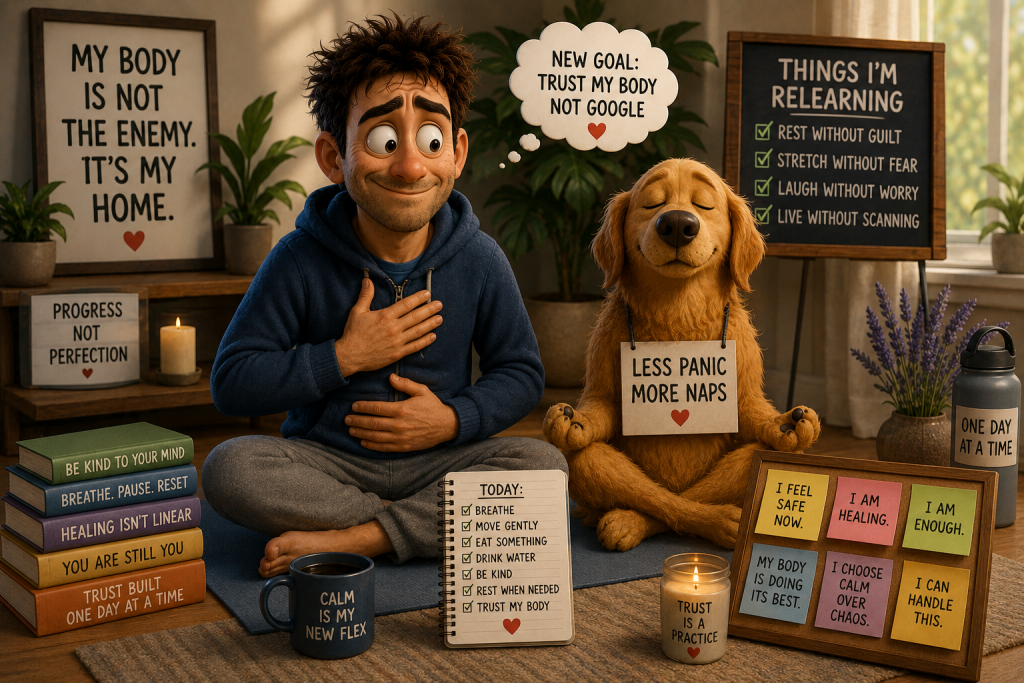
Learning to Trust Your Body Again
Learning to trust your body again after a health scare can feel strange.
Your body is the same body that carried you through the scare, but it may also feel like the body that betrayed you. That is a hard mix to live with.
You may want to trust it. You may want to feel normal again. You may want to wake up, stretch, eat, walk, work, sleep, and live without feeling like your body needs a daily performance review.
But after medical trauma, trust does not always come back just because you want it to.
Trust has to be rebuilt.
Slowly.
Kindly.
One small step at a time.
After a serious health scare, your brain may start treating your body like a risky neighborhood. It watches every corner. It notices every sound. It wants to know what every feeling means. A heartbeat is not just a heartbeat anymore. A pain is not just a pain. A tired day is not just a tired day.
Everything feels like a clue.
That is when the Brain Gets Loudest.
It gets loud because it is trying to protect you. It wants to stop another scary moment before it starts. It wants to catch danger early. It wants to make sure you never feel helpless again.
That makes sense.
But it can also make you feel trapped.
You cannot live peacefully if your body feels like the enemy.
The goal is not to ignore your body. That would not be wise. If you have real symptoms, medical conditions, follow-up care, medicine, or instructions from your doctor, those things matter. You should keep listening to sound medical advice.
But there is a difference between listening and obsessing.
Listening says, “I notice this. I will respond wisely.”
Obsessing says, “I noticed this. Now I cannot think about anything else.”
Listening helps you care for your body.
Obsessing makes you afraid of it.
The National Institute of Mental Health explains that traumatic stress can leave people feeling tense, on guard, and easily startled. Even when a person does not have PTSD, that “on guard” feeling can happen after medical trauma. Your mind may stay alert long after the event is over.
That does not mean your body cannot be trusted again.
It means your nervous system needs practice feeling safe again.
| Fear-Based Body Relationship | Trust-Based Body Relationship |
|---|---|
| “Every sensation is danger.” | “Some sensations matter. Some pass.” |
| “My body is against me.” | “My body has been through a lot.” |
| “I must check constantly.” | “I can follow a clear plan.” |
| “I cannot relax unless I feel perfect.” | “I can feel imperfect and still be okay.” |
| “My fear knows best.” | “Fear is loud, but not always right.” |
A helpful starting point is this:
Your body is not only the place where the scare happened.
It is also the place where healing is happening.
That may not feel true every day. Some days, your body may still feel scary. Some days, one symptom may pull your mind into a full investigation. Some days, you may feel angry at your body for needing care, rest, medicine, changes, or attention.
That anger does not make you bad.
It makes you human.
But you do not have to stay in a war with your body forever.
You can begin to talk to it differently.
Instead of saying, “What is wrong with you?” try saying, “What do you need?”
Instead of saying, “I hate feeling this,” try saying, “This is uncomfortable, but I can respond calmly.”
Instead of saying, “I cannot trust anything,” try saying, “I am learning what deserves attention and what I can let pass.”
That shift may sound small, but it matters.
Your body hears your fear all day.
Let it hear a little kindness too.
Rebuilding Confidence Slowly
Rebuilding body confidence after a health scare is not about making one big brave move.
It is usually about doing small safe things again and again until your brain starts to believe you.
You do not wake up one day and suddenly trust your body because you gave yourself a pep talk in the mirror. If that worked, half the world would be cured by bathroom lighting and motivational sticky notes.
Real trust comes through experience.
Your brain needs proof.
Not one giant proof.
Small proof.
Repeated proof.
A short walk where nothing terrible happens.
A calm meal.
A night where you feel a sensation and do not spiral.
A doctor visit where you ask questions and leave without reading 900 search results afterward.
A day where you notice fear, follow your plan, and keep living.
Those moments build evidence.
After medical trauma, confidence can feel broken because your old sense of safety got shaken. You may have learned that your body can surprise you. That lesson is hard to unlearn.
But you can learn a second lesson:
“My body can scare me, and I can still respond with care.”
That is a different kind of confidence.
Not the carefree confidence from before.
A wiser confidence.
A steadier confidence.
The American Psychological Association describes trauma reactions as emotional and physical responses that can last beyond the event itself. That means healing often includes helping the body and mind feel safe again, not just waiting for fear to disappear.
Start where you are.
If walking around the block feels too big, walk to the mailbox.
If sleeping without checking feels too big, delay the check by five minutes.
If going to an appointment alone feels too big, ask someone to go with you.
If eating certain foods again feels scary, ask your doctor what is safe and start slowly.
If exercise scares you, get medical guidance first and build from there.
The point is not to force yourself.
The point is to show your brain that you can take safe steps.
| Confidence Step | What It Teaches Your Brain |
|---|---|
| Walking for a few minutes | Movement can be safe |
| Eating a normal meal | The body can handle simple routines |
| Resting without scanning | Stillness does not have to mean danger |
| Asking your doctor clear questions | You can have a plan |
| Reducing one checking habit | Fear does not need to control every action |
| Going somewhere safe | Life can expand again |
Confidence grows when the steps are small enough to repeat.
That matters.
If you push too hard too fast, your nervous system may panic and confirm the fear. If you avoid everything, your world gets smaller. The middle path is gentle exposure.
That means slowly returning to safe things while giving your body support.
For example, if you fear walking because your heart beats faster, and your doctor says walking is safe, you might start with two minutes. You notice your heartbeat. You remind yourself, “This is my body working.” You stop before fear takes over. You repeat it another day.
Over time, your brain learns that a faster heartbeat is not always danger.
It can be movement.
It can be life.
It can be a body doing its job.
That is a big lesson after a scare.
The Mayo Clinic explains that regular exercise can help ease symptoms of depression and anxiety, but it is important to follow medical advice if you have health limits or concerns. For some people after a health scare, movement needs to be cleared and guided by a doctor. For others, gentle movement can become part of rebuilding trust.
Confidence also grows when you stop measuring progress by perfection.
You may still get scared.
You may still have hard days.
You may still check sometimes.
You may still need support.
That does not mean you are failing.
It means you are practicing.
A good rule is:
Do not count only the days you felt calm. Count the days you kept going while anxious.
Those days matter even more.
A person who feels calm and takes a walk is doing something good.
A person who feels afraid, follows medical guidance, takes a tiny safe walk, and does not let panic run the whole show is rebuilding trust.
That is real work.
You may not feel confident at first.
Do the small thing anyway, if it is safe.
Confidence often comes after action, not before it.
Listening Without Obsessing
Listening to your body is healthy.
Obsessing over your body is exhausting.
After a health scare, it can be hard to tell the difference.
You may ask yourself, “Am I being careful, or am I spiraling?”
That is a fair question.
Because you may have real reasons to pay attention. Maybe your doctor gave you warning signs. Maybe you have medicine to track. Maybe you need follow-up tests. Maybe certain symptoms truly matter for your condition.
That kind of listening is care.
But obsession has a different feeling.
Obsession feels urgent. It feels desperate. It wants certainty right now. It does not stop after one answer. It keeps asking, checking, searching, comparing, and replaying.
Listening gives you information.
Obsessing steals your day.
The NHS explains health anxiety as worry about being ill or becoming ill that can take over a person’s life. It also notes that people may check their body often, seek reassurance, or look up health information. Those habits can feel helpful for a moment, but they often keep anxiety alive.
This is why learning to listen without obsessing is so important after medical trauma.
You do not need to shut your body out.
You need to stop putting every sensation on trial.
A body is not quiet. It is not supposed to be. It beats, moves, digests, aches, stretches, warms, cools, twitches, tightens, relaxes, and complains like an old car on a cold morning.
Some of those feelings matter.
Many do not.
The hard part is learning the difference without letting fear be the judge.
A useful method is to use three questions:
- Is this new, severe, or clearly different?
- Does this match my doctor’s warning signs?
- Am I checking because of a plan, or because I want certainty?
Those questions slow the moment down.
They do not replace medical care. They help you stop panic from making the decision before wisdom gets a turn.
| Listening Sounds Like | Obsessing Sounds Like |
|---|---|
| “This is new. I should follow my plan.” | “What if this is the beginning of something terrible?” |
| “My doctor told me what signs matter.” | “I need to search until I feel safe.” |
| “I will check at the planned time.” | “I need to check again right now.” |
| “This feeling is uncomfortable.” | “This feeling must mean danger.” |
| “I can call if it worsens.” | “I cannot do anything until I know for sure.” |
One way to reduce obsession is to create a “body check boundary.”
That means you decide when and how you will check health signs, based on medical guidance, not fear.
For example:
- Check blood pressure only when your doctor says.
- Track symptoms once a day, not all day.
- Write down doctor questions instead of searching them at night.
- Use trusted medical sites only, not random forums.
- Avoid checking the same sensation over and over.
The MedlinePlus guide to evaluating health information can help people understand how to choose trustworthy health information online. This matters because panic-searching often leads people into scary, low-quality, or out-of-context information that makes fear worse.
A good rule is:
Search to learn, not to panic.
If you are searching because you are calm and want trusted information, that may help.
If you are searching because your heart is pounding and you need the internet to promise you are safe forever, it will probably not help.
The internet is not built to calm a scared nervous system.
It is built to keep you clicking.
That is not the same thing.
Listening without obsessing also means respecting the body’s basic needs. Sometimes the body is not sending a danger signal. It is asking for normal care.
It may need food.
Water.
Sleep.
Movement.
Less caffeine.
A break.
A laugh.
A doctor appointment.
A real conversation.
A quiet hour.
When the Brain Gets Loudest, it often skips those simple answers and goes straight to the scariest one.
You can gently bring it back.
Try saying:
“I hear you, body. I will respond with care, not panic.”
That sentence gives you both sides.
You are not ignoring.
You are not spiraling.
You are caring.
That is the goal.
Knowing When to Seek Help
Knowing when to seek help after a health scare can be tricky because fear can blur the lines.
Sometimes you may need medical help.
Sometimes you may need mental health support.
Sometimes you may need both.
That is why a clear plan matters.
After medical trauma, your brain may treat every symptom like an emergency. But you also do not want to dismiss something that truly needs care. This creates a painful middle place where you may feel unsure, ashamed, or frozen.
You may think, “What if I go in and it’s nothing?”
You may also think, “What if I don’t go in and it’s something?”
That is a hard place to live.
The best way out is not guessing. It is planning.
Ask your doctor for clear rules that fit your medical history. This is important because every person’s risk is different. A symptom that is minor for one person may matter more for someone else.
You can ask:
- What symptoms should send me to emergency care?
- What symptoms should make me call your office?
- What symptoms are common during healing?
- What symptoms can anxiety cause?
- What should I monitor at home?
- What should I stop monitoring?
- What should I do if panic feels like danger?
These questions can help you build a plan that panic does not get to rewrite at 2 a.m.
Trusted medical information can also help you understand general warning signs. For example, the American Heart Association lists heart attack warning signs, and the American Stroke Association explains stroke symptoms using F.A.S.T.. These pages are useful for general education, but your own doctor’s advice should guide your personal plan.
Seeking help is not only medical.
Mental health support matters too.
If fear after a health scare is affecting your sleep, relationships, work, daily choices, or ability to feel safe, it may be time to talk to a therapist or doctor about anxiety, panic, or trauma symptoms.
The Mayo Clinic explains that panic attacks and panic disorder can be treated with psychotherapy, medicine, or both. That matters because panic can feel like something you just have to survive, but help is available.
You may need mental health support if:
- You keep replaying the health scare.
- You avoid normal life because of fear.
- You check your body many times a day.
- You keep asking for reassurance.
- You panic often.
- You cannot sleep because of health fear.
- You feel detached, hopeless, or unlike yourself.
- You avoid appointments because they trigger fear.
- You feel like your body is unsafe all the time.
Getting help does not mean you are weak.
It means the fear has become too heavy to carry alone.
| Type of Help | When It May Be Needed |
|---|---|
| Emergency care | Symptoms match urgent warning signs or your doctor’s emergency plan |
| Doctor call | New, changing, or concerning symptoms that are not an immediate emergency |
| Follow-up appointment | Ongoing questions, medicine concerns, or recovery guidance |
| Therapy | Fear, panic, trauma memories, checking, avoidance, or sleep problems |
| Support group | Feeling alone or misunderstood after medical trauma |
| Crisis support | Feeling unsafe with yourself or unable to cope |
It is also important to seek urgent help if you feel like you may hurt yourself or cannot stay safe. In the United States, you can call or text the 988 Suicide & Crisis Lifeline for immediate crisis support. You do not have to wait until things are “bad enough.” If you feel unsafe, reach out now.
For non-crisis support, therapy can help you sort through panic, health anxiety, and trauma fear. Cognitive behavioral therapy can help with checking and reassurance loops. Trauma-informed therapy can help process the fear of what happened. Your primary doctor can also help rule out medical concerns and guide you toward the right care.
You deserve support for the mental part of recovery too.
Medical clearance is important.
But peace matters too.
If the Brain Gets Loudest every time your body feels something, you do not have to keep fighting that alone. You can build a care team. That team may include doctors, therapists, family, friends, support groups, and trusted resources.
The goal is not to run to help for every fear.
The goal is to know when help is wise.
That difference is powerful.
Fear says, “Panic or ignore.”
Wisdom says, “Follow the plan.”
A clear plan helps you stop living between those two extremes.
Letting Your Body Feel Like Home Again
Letting your body feel like home again may be one of the deepest parts of healing.
Because after a health scare, your body may not feel like home.
It may feel like a place you are stuck watching.
A place where scary things can happen.
A place you do not fully trust.
A place that keeps making noise when you just want peace.
That can be heartbreaking.
Your body is supposed to be where you live, not something you feel trapped inside.
But after medical trauma, many people feel disconnected from their bodies. They may feel afraid of sensations. They may feel angry at their limits. They may feel embarrassed by fear. They may feel like their body became a problem instead of a partner.
Healing means slowly changing that relationship.
Not with fake positivity.
Not by pretending everything is fine.
By building small moments where your body feels safe, cared for, and less like the enemy.
The Cleveland Clinic explains that trauma can affect both mental and physical health, including sleep, mood, reactions, and the body’s stress response. That matters because feeling unsafe in your body after a scare is not imaginary. Your stress system may truly be on high alert.
You can help your body feel more like home by giving it safe, repeated signals.
Warm showers.
Comfortable clothes.
Regular food.
Gentle stretching.
Rest.
Slow walks.
Safe touch.
Breathing that does not feel forced.
A calm bedtime routine.
Less symptom searching.
Kind words.
Yes, kind words count.
You may have spent months talking to your body like it is a suspect.
“What now?”
“What is wrong?”
“Why are you doing that?”
“Can you not?”
Your body may need a different tone.
Try:
“We are working together.”
“You have carried me through hard things.”
“I am learning how to listen without fear.”
“You are not perfect, but you are not my enemy.”
That may feel weird at first.
Do it anyway.
Plenty of healing feels weird before it feels helpful.
| When Your Body Feels Like the Enemy | When Your Body Feels More Like Home |
|---|---|
| You scan every feeling | You notice and respond calmly |
| You fear movement | You rebuild safe movement slowly |
| You hate your limits | You respect what needs care |
| You panic at symptoms | You follow a clear plan |
| You feel trapped inside yourself | You create comfort and safety |
| You speak harshly to yourself | You practice kindness |
Your body may also need joy.
Not just care.
Joy matters because after a health scare, the body can become a project. Appointments, medicine, tracking, symptoms, food choices, sleep, exercise, and stress management can make your body feel like a never-ending homework assignment.
But your body is also where you feel sunlight.
Where you hug your family.
Where you taste coffee.
Where you laugh until your stomach hurts.
Where you pet the dog.
Where you hear music.
Where you breathe after crying.
Where you feel warmth, comfort, love, and rest.
You need moments that remind you your body is not only a site of fear.
It is also a place where life still happens.
For grounded writing on anxiety, healing, and learning to live again after fear, you can read more at OfficialRayMcNally.com.
Letting your body feel like home again takes time.
Some days you may feel close to it.
Other days, fear may return. A symptom may scare you. An appointment may shake you. A bad night may make your brain loud again.
That does not erase progress.
Homes can have storms.
They are still homes.
Your body does not have to feel perfect to be yours.
It does not have to be silent to be safe.
It does not have to be fearless to be trusted.
You can live in your body with care, not constant suspicion.
You can listen without attacking.
You can rest without scanning.
You can move without treating every heartbeat like a warning.
You can slowly come back to yourself.
Not all at once.
Not every day.
But enough to begin feeling this truth:
Your body has been through something scary.
And it is still carrying you.
That deserves more than fear.
It deserves patience.
It deserves care.
It deserves a chance to feel like home again.
Finding Meaning in the Experience
Finding meaning after a health scare does not mean pretending the scare was good.
That matters.
Sometimes people rush to turn pain into a lesson because they are uncomfortable sitting with the pain itself. They want a clean ending. They want the story to become inspiring as fast as possible. They want the fear, grief, anger, and shock to turn into a neat little quote that fits on a coffee mug.
But real healing is not that tidy.
A health scare can be terrifying. It can shake your trust in your body. It can change your sleep, your plans, your relationships, your mood, and the way you see time. It can leave you scared in quiet moments. It can make ordinary body feelings feel dangerous. It can make the Brain Gets Loudest when everyone else thinks the worst is over.
So no, you do not have to call it a gift.
You do not have to be thankful for the scare.
You do not have to say, “Everything happens for a reason,” if that phrase makes you want to throw a pillow through a wall.
Meaning does not have to mean the bad thing was good.
Meaning can simply mean you are trying to build something honest from what happened.
It can mean you are asking better questions now.
It can mean you are paying closer attention to your life.
It can mean you are learning what matters, what drains you, what deserves your time, and what never really did.
That kind of meaning can be quiet.
It may not look like a huge life makeover. It may look like texting someone you love. Taking the walk. Going to the appointment. Asking for help. Resting without guilt. Laughing again. Saying no to things that steal your peace. Saying yes to things that make you feel alive.
The American Psychological Association explains trauma as an emotional response to a terrible event, and it can affect emotions, relationships, and the body. That means finding meaning after medical trauma is not about ignoring those effects. It is about learning how to live with the truth of what happened without letting it become the whole story.
There is a real quote from Viktor Frankl in Man’s Search for Meaning: “When we are no longer able to change a situation, we are challenged to change ourselves.”
That quote does not mean you should blame yourself. It does not mean you should accept harm without care. It means that when life changes in a way you did not choose, part of healing may involve deciding who you want to become now.
That is hard work.
It is also powerful work.
After a health scare, meaning can grow from small honest shifts.
| Before the Scare | After the Scare, Meaning May Look Like |
|---|---|
| Rushing through every day | Slowing down enough to notice your life |
| Ignoring your body | Caring for your body without obsessing |
| Saying yes to everything | Protecting your energy |
| Taking people for granted | Saying what needs to be said |
| Waiting for “someday” | Choosing one good thing today |
| Hiding fear | Speaking honestly with safe people |
Meaning is not always found quickly.
Sometimes you need to be angry first.
Sometimes you need to grieve.
Sometimes you need to panic less before you can reflect more.
Sometimes meaning shows up later, after the nervous system has settled enough to breathe.
Do not force it.
Forced meaning can feel fake.
Real meaning grows when you are ready to ask, “What now?” without using that question as a weapon against yourself.
That question can become the start of a new chapter.
Not a perfect chapter.
Not a fearless chapter.
But a real one.
A chapter where you know life is fragile, so you treat it with more care.
A chapter where fear still speaks sometimes, but it does not get to be the only voice.
A chapter where survival is not the whole story.
Living is.
Perspective Changes After a Health Scare

A health scare can change your perspective fast.
One day, you may be worried about emails, dishes, money, traffic, family drama, or whether the internet is acting personally against you again.
Then something happens with your health, and suddenly the whole room changes.
The things that felt huge may feel smaller.
The things you took for granted may feel bigger.
You may start seeing life through a different lens.
That does not mean you become calm and wise all the time. You may still get annoyed when people drive like they learned in a bumper car arena. You may still get mad at bills. You may still complain about normal things because you are human, not a walking sunset quote.
But underneath all that, something may shift.
You may realize time matters more than you thought.
You may realize your body needs more respect.
You may realize stress is not just “part of life” when it is eating you alive.
You may realize some relationships are worth protecting and others are draining the life out of you.
You may realize you have been waiting too long to do things that matter.
That change in perspective can be painful at first. It can feel like losing innocence. Before the scare, maybe life felt more open. After the scare, you may know more about risk, fear, and uncertainty than you wanted to know.
But perspective can also become a guide.
It can help you choose more honestly.
The National Institute of Mental Health notes that people can continue to feel stressed or frightened after trauma, even when they are not in danger. That is important because perspective after a health scare often comes with fear. You may see what matters more clearly, but you may also feel more anxious about losing it.
That is where balance matters.
You do not want the health scare to make you live in panic.
You want it to help you live with purpose.
Those are not the same thing.
Panic says, “Everything can go wrong, so stay scared.”
Purpose says, “Life is fragile, so pay attention.”
Panic makes your world smaller.
Purpose can make your life deeper.
When the Brain Gets Loudest, it may try to use your new perspective against you. It may say, “Because life is fragile, you should worry all the time.” But worry is not the same as love. Worry is not the same as wisdom. Worry is not the same as gratitude.
Worry can steal the very life you are trying to protect.
A healthier perspective sounds more like this:
“I know life can change. That is why I want to be present for it.”
| Fear-Based Perspective | Healing Perspective |
|---|---|
| “Something bad could happen anytime.” | “I can care for today without living in terror.” |
| “My body is unsafe.” | “My body needs support and patience.” |
| “I can’t plan anymore.” | “I can plan gently and adjust if needed.” |
| “Nothing feels normal.” | “I am building a new normal.” |
| “I lost who I was.” | “I am becoming someone shaped by what I survived.” |
A health scare can also change how you view small moments.
A quiet morning may feel more valuable.
A meal with family may feel less ordinary.
A walk outside may feel like proof you are still here.
A boring day may feel like a blessing.
This does not mean every day becomes beautiful. Some days are still hard, boring, messy, annoying, and full of things you do not feel like doing. But you may notice flashes of meaning in places you once rushed past.
The first sip of coffee.
The dog looking at you like you are the greatest human alive even though you are wearing pajama pants at noon.
A phone call from someone who cares.
Sunlight through a window.
A deep breath that does not turn into panic.
A laugh that surprises you.
These things are not small after you have been scared by life.
They are evidence.
Evidence that life is still happening.
Evidence that fear did not take everything.
Evidence that healing does not always look huge.
Sometimes it looks like noticing what is still good.
Perspective after a health scare can also help you drop fake urgency. You may start asking, “Does this really deserve my peace?” That question can save you from spending your whole life reacting to things that do not matter.
Some stress cannot be avoided. Life still has duties. Bills still come. People still need you. Problems still happen.
But you may become more careful about which fires you run toward.
Not every text needs an immediate answer.
Not every argument needs your energy.
Not every opinion needs your attention.
Not every fear needs a full investigation.
That is perspective becoming wisdom.
You cannot control everything that happens to you.
But you can decide what gets more of your time now.
That choice matters.
Slowing Down and Appreciating Life
After a health scare, slowing down can feel both beautiful and uncomfortable.
Beautiful because life may feel more precious now.
Uncomfortable because quiet can make fear louder.
You may want to slow down, but when you finally sit still, your mind may start checking your body, replaying the scare, or worrying about the future. That is why slowing down after medical trauma is not always peaceful at first.
Sometimes quiet feels like a trap.
During the day, being busy can hide fear. Work, errands, family, noise, and chores can keep your mind occupied. Then, when the world gets quiet, the Brain Gets Loudest. Your body gets still, your thoughts get louder, and suddenly slowing down does not feel like rest. It feels like an invitation for anxiety to start a PowerPoint presentation nobody asked for.
That does not mean you should avoid slowing down forever.
It means your nervous system may need to relearn calm.
Slowing down is a skill after trauma.
Not a luxury.
Not laziness.
Not weakness.
A skill.
The NIMH stress fact sheet suggests coping tools like regular exercise, relaxation, meditation, journaling, regular meals, sleep routines, and reducing excess caffeine. These are simple ideas, but simple can help a nervous system that has been living in alarm.
Slowing down does not have to mean doing nothing.
It can mean doing one thing at a time.
Eating without scrolling.
Walking without checking your heart rate every few seconds, if your doctor says movement is safe.
Talking to someone without half your mind scanning symptoms.
Resting without treating your body like a machine that must be inspected.
Watching a show without also reading medical forums.
Sitting outside for five minutes and letting the world be bigger than your fear.
That is slowing down in real life.
| Rushing Mode | Slower Healing Mode |
|---|---|
| Doing five things at once | Doing one thing with attention |
| Checking symptoms during rest | Practicing rest without scanning |
| Treating every worry as urgent | Sorting worries into tasks or fears |
| Living on caffeine and panic | Feeding, hydrating, and resting the body |
| Waiting for life to calm down | Creating small calm moments now |
Appreciating life after a health scare can also feel complicated.
People may expect you to become grateful all the time. They may expect you to say, “This taught me to appreciate every day.”
Maybe it did.
But appreciation is not always shiny.
Some days, appreciation looks like crying because you are still here.
Some days, it looks like holding someone’s hand a little longer.
Some days, it looks like being thankful for a normal test.
Some days, it looks like being grateful for a boring morning and also mad that you had to learn to value boring the hard way.
That is okay.
Gratitude does not have to be fake.
Real gratitude can be messy.
It can sit beside fear, anger, grief, and exhaustion.
You can appreciate life and still say, “This was hard.”
You can be thankful and still need help.
You can love your life and still feel scared by it.
There is a real quote often credited to Thich Nhat Hanh: “The present moment is filled with joy and happiness. If you are attentive, you will see it.”
That quote is gentle, but it can also be hard after trauma. When your mind is scanning for danger, joy may not be the first thing you see. You may have to practice noticing it again.
Start small.
Do not pressure yourself to love every second.
Just notice one good thing.
One warm cup.
One kind word.
One calm breath.
One safe place.
One funny moment.
One person you love.
One song that helps.
One sunset.
One nap that deserves its own award.
This is not about ignoring pain. It is about refusing to let pain be the only thing you notice.
A health scare can make life feel fragile. Slowing down helps you treat that fragility with care instead of panic.
You do not need to become a monk.
You do not need to float around whispering wisdom while folding laundry.
You just need to give your life enough attention to actually live it.
Because survival is not the finish line.
It is the chance to be present again.
Choosing What Matters More Carefully
A health scare can rearrange your priorities whether you are ready or not.
Things you once chased may not feel as important.
Things you ignored may suddenly matter more.
You may look at your life and think, “Why was I giving so much energy to that?”
That question can be uncomfortable.
It may show you where you were living on autopilot. It may show you where stress had become normal. It may show you relationships, habits, work patterns, fears, or obligations that were quietly draining you.
A serious health scare can make time feel more real.
Not in a scary movie way, but in a “I cannot keep spending my life on things that do not matter” way.
That does not mean you abandon your responsibilities. Bills still exist. Work still matters. Family still needs care. The sink still somehow produces dishes like it is running a side business.
But after medical trauma, you may become more aware of your limits.
You may realize peace has value.
You may realize rest is not a reward you earn after breaking yourself.
You may realize some arguments are not worth your blood pressure.
You may realize your body has been asking for care for a long time.
You may realize you want more honest days, not just busier ones.
The Mayo Clinic explains that chronic stress can affect the body, mood, and behavior, including headaches, muscle tension, sleep problems, anxiety, irritability, overeating or undereating, and social withdrawal. That matters because choosing what matters is not only emotional. It can also protect your health.
After a health scare, the Brain Gets Loudest when life feels out of control. One way to lower that volume is to decide what deserves your energy and what does not.
You cannot control everything.
But you can choose better boundaries.
A boundary does not always mean a dramatic speech. Sometimes it means:
- Going to bed instead of arguing online
- Not answering every message right away
- Saying no without a courtroom defense
- Taking breaks before you crash
- Letting someone else be disappointed
- Asking for help
- Not turning every fear into a research project
- Spending more time with people who make life feel lighter
Choosing what matters may also mean choosing your health without turning your life into only health.
That balance matters.
You are more than appointments, symptoms, medicine, fear, and recovery. You are still a whole person. You still need joy, purpose, humor, connection, and ordinary life.
| What May Matter Less Now | What May Matter More Now |
|---|---|
| Proving yourself to everyone | Being honest about your limits |
| Winning every argument | Protecting your peace |
| Staying busy to feel worthy | Resting before you fall apart |
| Ignoring stress | Managing stress with care |
| Pretending you are fine | Asking for support |
| Living for someday | Doing one meaningful thing today |
A health scare can also make relationships clearer.
Some people may show up with kindness.
Some may disappear.
Some may mean well but not understand.
Some may surprise you.
Some may drain you more than you realized.
This can be painful, but it can also teach you where to place your energy.
You do not need a huge circle.
You need safe people.
People who can hear the truth without rushing you.
People who do not shame you for being scared.
People who help you return to yourself.
Choosing what matters more carefully also means choosing how you talk to yourself.
After medical trauma, it is easy to become harsh inside your own head.
“I should be over this.”
“I’m weak.”
“I’m annoying.”
“I’m not the same.”
“I can’t handle anything.”
Those thoughts do not help healing.
They keep the alarm loud.
A better inner voice may sound like:
“I went through something scary.”
“I am allowed to need time.”
“I can take one step today.”
“I can care for my body without fearing it.”
“I am still here.”
That kind of self-talk is not cheesy.
It is nervous system training.
For more grounded writing on fear, healing, and honest recovery, you can read more at OfficialRayMcNally.com.
Meaning after a health scare often starts with choosing what matters now.
Not what used to matter.
Not what everyone else says should matter.
What matters now.
Your peace.
Your people.
Your body.
Your time.
Your faith, if that is part of your life.
Your work.
Your rest.
Your ability to laugh again.
Your chance to live more honestly.
That is not a small thing.
That is a life being rebuilt on purpose.
Turning Pain Into a New Kind of Strength
Turning pain into strength does not mean acting tough.
It does not mean pretending the health scare did not hurt you.
It does not mean becoming the person who says, “I’m fine,” while quietly falling apart in the cereal aisle because your chest felt weird for four seconds.
Real strength after medical trauma is different.
It is quieter.
It is less about looking strong and more about staying honest.
It is saying, “I am scared, but I am still here.”
It is going to the appointment even though waiting rooms make your stomach twist.
It is resting instead of pushing until you break.
It is asking for help before fear turns into isolation.
It is learning your warning signs without checking every sensation all day.
It is letting your body be imperfect without calling it the enemy.
That is strength.
Not the shiny kind.
The real kind.
The kind built one hard day at a time.
The American Psychological Association discusses resilience as the process of adapting well in the face of adversity, trauma, tragedy, threats, or major stress. It also makes clear that resilience does not mean a person does not feel pain or distress. That is important.
Resilience is not numbness.
Resilience is not denial.
Resilience is not never crying.
Resilience is learning how to keep going while being human.
After a health scare, strength may look very different from what you expected.
Before, you may have thought strength meant pushing through everything. Now, strength may mean slowing down. Before, you may have thought strength meant not needing anyone. Now, strength may mean letting someone sit with you when fear gets loud.
Before, you may have thought strength meant control.
Now, strength may mean learning how to live without controlling everything.
That is a hard lesson.
But it can become a deep one.
| Old Idea of Strength | New Kind of Strength |
|---|---|
| Never being scared | Being honest when fear shows up |
| Pushing through pain | Knowing when to rest or seek help |
| Handling everything alone | Letting safe people support you |
| Staying busy always | Slowing down with purpose |
| Ignoring emotions | Naming them without shame |
| Controlling everything | Living wisely with uncertainty |
Pain can become strength when it teaches compassion.
You may become softer toward other people because you know what invisible fear feels like. You may stop judging people who panic, cry, cancel plans, need reassurance, or struggle after something hard. You may understand that “looking fine” does not mean someone is fine.
That kind of compassion is strength.
Pain can become strength when it teaches boundaries.
You may stop giving your time to things that constantly drain you. You may protect your mornings, your sleep, your appointments, your recovery, and your peace. You may stop explaining yourself to people committed to misunderstanding you.
That is strength too.
Pain can become strength when it teaches presence.
You may notice small moments more. You may say “I love you” faster. You may hold gratitude and grief at the same time. You may understand that life is not guaranteed, which can make ordinary moments feel more alive.
But pain does not become strength by force.
You cannot bully yourself into meaning.
You cannot shame yourself into healing.
You cannot rush the process because you want the inspiring part already.
Sometimes the strongest thing you can do is admit:
“This still hurts.”
That is not weakness.
That is truth.
And truth is where real healing starts.
If anxiety after a health scare has made your body feel dangerous and your thoughts feel too loud, This Is Anxiety, Not Death may help you feel less alone in that fight.
Turning pain into strength also means letting the story continue.
The health scare may be part of your story now.
But it is not the whole story.
It may have changed you.
But it does not have to own you.
It may have made the brain loud.
But slowly, with care, support, time, and practice, the volume can lower.
You can become someone who has been scared and still knows how to live.
Someone who has felt fragile and still chooses hope.
Someone who has lost the old normal and still builds a new one.
Someone who understands that strength is not always loud.
Sometimes strength is a quiet morning, a deep breath, a doctor’s appointment kept, a walk taken, a fear named, a laugh returned, a body forgiven, and one more day lived on purpose.
That is not small.
That is survival becoming life again.
FAQ: After A Health Scare
Is it normal to feel anxious after a health scare?
Yes, it is normal to feel anxious after a health scare. Your body may be safe now, but your mind may still be reacting to what happened. Fear can linger because your nervous system is trying to protect you from being surprised again.
Why do I feel worse emotionally after surviving something scary?
You may feel worse emotionally because your body was in survival mode during the scary event. Once the danger passes, the fear, grief, anger, and exhaustion can finally surface. This emotional crash does not mean you are failing. It means your mind is trying to process what happened.
Can a health scare cause panic attacks?
Yes, a health scare can lead to panic attacks. Panic symptoms like chest tightness, dizziness, racing heart, shaking, nausea, or shortness of breath can feel very scary after medical trauma because they may remind you of the original event.
How do I stop checking every symptom?
Start by reducing one checking habit at a time. Follow your doctor’s medical plan, but try not to check only because fear wants certainty. Delaying checks, avoiding symptom searches at night, and writing down doctor questions can help break the loop.
Why do I feel like nobody understands me?
You may feel misunderstood because the emotional part of a health scare is often invisible. People may see that you look okay and assume you feel okay. But inside, you may still be dealing with fear, grief, panic, or body anxiety.
How long does it take to feel normal again?
There is no exact timeline. Some people feel better in weeks, while others need months or longer. Healing is not always a straight line. You may build a new normal slowly through support, routine, medical guidance, and emotional care.
When should I get mental health support after medical trauma?
You should consider support if fear affects your sleep, relationships, work, daily routine, or ability to feel safe. Panic attacks, constant checking, avoiding appointments, intrusive memories, or feeling hopeless are all signs that extra help may be needed.
Can I learn to trust my body again?
Yes, you can learn to trust your body again. It may take time, patience, and clear medical guidance. Trust grows through small safe steps, less panic checking, better routines, and learning to listen to your body without obsessing over every sensation.
Final Thoughts
A health scare can end in one place and keep echoing in another.
The doctor may clear you. The test may look better. The hospital wristband may be gone. The follow-up plan may be written down. People around you may start relaxing because, to them, the worst part is over.
But inside, you may still be living with the aftershock.
That is the part many people do not understand.
A health scare is not only a medical event. It can become an emotional event, a mental event, a family event, a spiritual event, and a life event. It can change how you hear your heartbeat. It can change how you sleep. It can change how you make plans. It can change how you answer the simple question, “How are you?”
You may say, “I’m fine.”
But what you really mean is:
“I am here, and I am trying.”
That is a very different sentence.
After medical trauma, the Brain Gets Loudest because it is trying to protect you from being blindsided again. It scans. It checks. It remembers. It asks questions. It brings up old fear at the worst times. It can make quiet feel unsafe. It can make rest feel like risk. It can make normal body feelings feel suspicious.
That does not mean you are broken.
It means your nervous system went through something serious and is still learning how to settle.
Healing after a health scare is often slower than people expect because you are not only recovering from what happened to your body. You are recovering from what happened to your sense of safety.
That takes time.
And it deserves respect.
You may need medical follow-up. You may need therapy. You may need better routines. You may need to stop Googling symptoms at night. You may need to talk to someone safe. You may need to learn grounding skills. You may need to rebuild trust in your body one small step at a time.
None of that means you are failing.
It means you are doing the work that comes after survival.
The National Institute of Mental Health explains trauma symptoms can include feeling tense, having unwanted memories, avoiding reminders, and struggling with sleep or mood after a scary event. You do not need to label yourself to understand that fear can linger after something frightening.
You are allowed to take the emotional part seriously.
You are allowed to say, “This changed me.”
You are allowed to say, “I am grateful, but I am still scared.”
You are allowed to say, “I need help.”
| What Healing Is Not | What Healing Can Be |
|---|---|
| Pretending it never happened | Learning how to carry it differently |
| Never feeling afraid again | Feeling fear without letting it run everything |
| Being positive all the time | Being honest and still choosing hope |
| Ignoring your body | Listening with care, not panic |
| Going back exactly to who you were | Becoming steady in who you are now |
A health scare may change your life, but it does not get to own the rest of it.
Fear may still speak.
But it does not have to be the only voice.
There can also be wisdom.
There can be calm.
There can be laughter again.
There can be boring days that feel like blessings.
There can be a new kind of strength that does not look loud or perfect, but shows up in quiet choices.
One breath.
One appointment.
One walk.
One honest conversation.
One night without searching symptoms.
One day where fear showed up, and you kept living anyway.
That is healing too.
Healing Is Mental Too
Medical healing often gets the most attention because it is easier to measure.
A test result can improve. A wound can close. A medicine can lower a number. A scan can look stable. A doctor can say, “Things look good.”
Those things matter.
They matter a lot.
But they do not always tell the whole story.
You can have better test results and still feel scared. You can be physically stable and still feel emotionally shaken. You can be told your body is healing while your mind is still replaying the scariest part.
That is why healing is mental too.
After a health scare, your brain may still be living by the rules of the emergency. It may still believe it has to watch everything. It may still think every symptom deserves panic. It may still treat rest like danger and quiet like a threat.
This is not because you are dramatic.
It is because fear teaches fast.
Peace teaches slower.
Your brain may have learned in one awful moment that life can change quickly. Now it needs many calmer moments to learn that life can feel safe again.
That is mental healing.
Mental healing may look like learning how to sit with fear without obeying it. It may look like noticing a body feeling and not turning it into a disaster story. It may look like sleeping a little better. It may look like going to a follow-up appointment and not spiraling for three days before it.
It may look like saying, “I am scared,” instead of hiding it.
That counts.
The American Psychological Association’s trauma resources explain that trauma can affect emotions, thoughts, relationships, and the body. That is why recovery after a health scare should not only be about the physical part. The mind and body are connected.
If your body went through fear, your mind was there too.
It deserves care too.
| Physical Healing May Need | Mental Healing May Need |
|---|---|
| Follow-up appointments | Safe conversations |
| Medicine | Grounding skills |
| Rest | Less symptom searching |
| Tests or scans | Therapy or support |
| Rehab or movement | Patience with fear |
| Doctor guidance | A clear anxiety plan |
Mental healing can feel harder because people may not see it.
Nobody can look at you and know how loud your thoughts are.
Nobody can see the way your stomach drops before an appointment.
Nobody can see the fear that hits when you feel a random pain.
Nobody can see how much energy it takes to look calm.
That can make you feel alone.
But invisible healing is still healing.
A person learning to live without panic after a health scare is doing real work.
A person reducing body checking is doing real work.
A person going to therapy after medical trauma is doing real work.
A person rebuilding trust in their body is doing real work.
A person choosing not to Google symptoms at midnight is basically doing Olympic-level emotional weightlifting, and yes, they deserve a medal or at least a snack.
Mental healing is not about forcing happy thoughts.
It is about building safety again.
Real safety.
Not fake “just think positive” safety.
The kind of safety that comes from clear medical plans, trusted support, calmer routines, honest self-talk, and the slow proof that fear can rise and fall without destroying you.
If anxiety after a health scare keeps making your symptoms feel like danger, This Is Anxiety, Not Death may help put words to that body-fear loop in a way that feels honest and human.
You are not weak because your mind still needs healing.
The mind was part of what survived.
Let it recover too.
You Are Not Weak for Being Scared
Fear after a health scare can make people feel ashamed.
You may think, “I should be stronger.”
You may think, “I should be over this.”
You may think, “Other people have been through worse.”
You may think, “Why am I still scared if I survived?”
Those thoughts can hurt almost as much as the fear itself.
But being scared after something scary is not weakness.
It is a human response.
Your body and mind went through something that felt dangerous, uncertain, painful, or out of your control. Fear showed up because something mattered. Your life mattered. Your family mattered. Your future mattered. Your body mattered.
Fear is not proof that you are weak.
Fear is proof that your nervous system noticed danger and tried to protect you.
The problem is not that fear showed up.
The problem is when fear stays in charge long after the danger has passed.
That is where healing begins.
You do not need to shame yourself for being afraid. Shame keeps fear hidden, and hidden fear tends to grow. When you speak fear honestly, you give it less room to act like a secret monster.
A real quote from Brené Brown is: “Shame cannot survive being spoken.”
That idea fits emotional recovery after medical trauma. When you tell the truth to a safe person, fear may not vanish, but it often becomes less lonely.
And less lonely matters.
After a health scare, the Brain Gets Loudest when you think you are the only one feeling this way. It may tell you everyone else would handle it better. It may tell you that needing support makes you a burden. It may tell you that panic means you are failing.
Fear lies with confidence.
Do not believe every thought just because it arrives loudly.
| Fear Says | Truth Says |
|---|---|
| “You are weak.” | “You went through something scary.” |
| “You should be over it.” | “Healing takes time.” |
| “Nobody wants to hear this.” | “Safe people can support you.” |
| “You are broken.” | “You are healing.” |
| “You cannot handle fear.” | “You are learning how.” |
Being scared does not mean you have no courage.
Courage is not the absence of fear. Courage is doing the next right thing while fear is sitting there making noise.
Courage may look like calling the doctor when you need to.
Courage may look like not calling when you know it is a reassurance loop and you already have a plan.
Courage may look like going to therapy.
Courage may look like admitting, “I am not okay today.”
Courage may look like taking a walk after your doctor says it is safe, even though your heartbeat makes you nervous.
Courage may look like resting.
That last one matters.
Some people think strength means pushing through everything. But after a health scare, strength may mean respecting your limits. It may mean listening to your body without attacking it. It may mean choosing peace over proving yourself.
You are not weak because you need time.
You are not weak because you cry.
You are not weak because your sleep changed.
You are not weak because appointments scare you.
You are not weak because you miss the old version of yourself.
You are not weak because a serious health scare left a mark.
It was serious enough to change how you feel. That deserves care, not judgment.
The Mayo Clinic explains panic attacks can bring intense physical symptoms like chest pain, racing heart, dizziness, nausea, shortness of breath, and fear of dying. If you have felt panic after a health scare, you know how real it can feel.
Feeling terrified in that moment does not make you weak.
It makes you someone whose body is sounding an alarm.
You can learn how to respond to that alarm.
You can learn when to seek medical help.
You can learn when to ground yourself and let the fear pass.
You can learn to trust your body again.
But shame will not help you learn faster.
Kindness will.
Patience will.
Support will.
Truth will.
You were scared because something mattered.
You are still healing because the experience was real.
There is nothing weak about that.
Recovery Takes More Than Medical Clearance
Medical clearance can feel like the finish line to everyone else.
The doctor says things look okay.
The test comes back stable.
The treatment plan is in place.
The immediate danger is gone.
Family breathes out. Friends relax. Work expects you back. Life starts moving again.
But you may still feel stuck.
That can be confusing.
You may think, “If I’m medically okay, why don’t I feel okay?”
Because medical clearance is not the same thing as emotional recovery.
A doctor can tell you what is happening in your body based on exams, tests, history, and medical knowledge. That is important. But a clear result does not automatically remove the memory of fear from your nervous system.
Your body may be out of the hospital.
Your mind may still be in the room.
That is why recovery takes more than medical clearance.
You may need time to process what happened. You may need to talk about it. You may need to rebuild routines. You may need help with panic. You may need to lower the checking habit. You may need to practice trusting calm again.
You may need emotional rehab.
That phrase may sound odd, but it fits.
If your body needed rehab after an injury, nobody would say, “But the surgery is over, why can’t you run yet?”
They would understand that healing takes practice.
The mind can need practice too.
After a health scare, you may need to practice:
- Sleeping without scanning
- Moving without panic
- Eating without fear
- Going to appointments without spiraling
- Sitting with uncertainty
- Talking honestly
- Letting safe sensations pass
- Asking for help
- Trusting your body slowly
The NHS health anxiety guide explains that health anxiety can include checking the body, seeking reassurance, and looking up health information. It also notes that these habits can affect daily life. After a health scare, those habits may feel logical at first, but they can become part of the fear loop.
Medical clearance may answer one question:
“Am I medically stable right now?”
But emotional recovery asks other questions:
“Can I feel safe again?”
“Can I stop living on alert?”
“Can I trust my body?”
“Can I make plans?”
“Can I rest?”
“Can I live without fear making every choice?”
Those questions take longer.
| Medical Clearance Can Tell You | Emotional Recovery Helps With |
|---|---|
| Test results | Fear of future results |
| Current medical status | Feeling safe in your body |
| Treatment plan | Panic and body scanning |
| Follow-up needs | Trusting normal life again |
| Warning signs | Knowing how to respond calmly |
| Physical limits | Grieving what changed |
This is why people can feel frustrated after being told they are okay.
They may think good news should create peace.
Sometimes it does.
Sometimes it does for one hour, and then fear comes back wearing a little hat that says, “But what if?”
That does not mean the good news was meaningless.
It means fear needs more than facts.
Fear needs repeated safety.
Fear needs calm habits.
Fear needs support.
Fear needs time.
Fear may also need treatment from a mental health professional, especially if panic, avoidance, body checking, intrusive memories, or poor sleep are taking over.
There is no shame in that.
You would not shame your body for needing follow-up care.
Do not shame your mind for needing it either.
Recovery also requires realistic expectations. Healing after medical trauma may not mean every symptom disappears, every fear fades, and every day feels like your old life. It may mean you become steadier. It may mean you learn which symptoms need action and which ones can pass. It may mean you build a new relationship with uncertainty.
That is still recovery.
If you want more grounded writing on anxiety, emotional recovery, and learning to live after fear, you can read more at OfficialRayMcNally.com.
Medical clearance matters.
But it is not the whole finish line.
You are not behind because your mind needs more time than your chart.
You are not failing because your body healed faster than your sense of safety.
You are still recovering.
And that counts.
Life Can Feel Safe Again
Life can feel safe again after a health scare.
Maybe not all at once.
Maybe not in the exact same way as before.
But safe can return.
It may come back quietly.
One night, you may realize you fell asleep without checking your symptoms.
One day, you may notice a strange body feeling and not chase it.
One appointment may feel a little less terrifying.
One walk may feel peaceful instead of risky.
One meal may feel normal.
One laugh may come out before your brain can stop it.
That is how safety often returns.
Not as a huge announcement.
More like a soft light coming back on.
After medical trauma, the Brain Gets Loudest because it is trying to protect you from pain. It wants certainty. It wants control. It wants proof that nothing bad will ever happen again.
But life cannot offer perfect proof.
No one gets that.
What you can build is something different.
You can build trust.
You can build routines.
You can build support.
You can build a clear medical plan.
You can build better ways to respond when fear rises.
You can build a life that has room for caution without letting caution become a cage.
That is where safety begins to grow again.
The American Psychological Association’s page on resilience explains that resilience is adapting well in the face of trauma, tragedy, threats, or serious stress. It also makes clear that resilience does not mean a person does not feel distress. That is important.
Feeling safe again does not mean you never feel afraid.
It means fear no longer gets to run the whole house.
It may still knock.
It may still complain.
It may still show up at night with a clipboard and 47 questions.
But you can learn to answer differently.
You can say:
“I hear you, fear. We have a plan.”
You can say:
“This sensation is uncomfortable, but I do not have to panic.”
You can say:
“I can seek help if I need it, and I can also let some things pass.”
You can say:
“My body is not my enemy.”
That last one matters.
After a health scare, your body may feel like the place where danger happened. But it is also the place where healing, joy, love, and life still happen.
Your body is where you hug people.
Where you drink coffee.
Where you feel sunlight.
Where you laugh at something stupid.
Where you take deep breaths after hard days.
Where you keep going.
Your body is not just a reminder of fear.
It is also proof that you are still here.
| Safety May Look Like | Why It Matters |
|---|---|
| Less symptom checking | Your brain is learning trust |
| Better sleep | Your body feels less on guard |
| Clearer medical plans | Fear has less room to invent rules |
| Honest conversations | You do not have to hide |
| Gentle movement | Your body feels more like home |
| More normal moments | Life becomes bigger than the scare |
Life feeling safe again does not mean life becomes perfect.
You may still have medical concerns. You may still have checkups. You may still have anxiety sometimes. You may still feel triggered by certain places, dates, symptoms, or words.
But those things can become part of life instead of the center of life.
That is the shift.
The scare may always be part of your story.
But it does not have to be the title of every chapter.
You can become someone who remembers what happened without living inside it every day.
You can become someone who listens to the body without fearing every sound.
You can become someone who still has hard moments but also has peace, laughter, purpose, and hope.
A changed life can still be a good life.
A scared body can learn calm again.
A loud brain can quiet down.
Not overnight.
Not perfectly.
But enough.
Enough to sleep.
Enough to love.
Enough to plan.
Enough to laugh.
Enough to live.
And after a health scare, “enough” can be a beautiful word.
Key Takeaways: After A Health Scare
- A health scare can affect your mind, body, relationships, sleep, and sense of safety long after the event ends.
- Feeling anxious after medical trauma is common and does not mean you are weak or overreacting.
- Hyper-awareness, body checking, and symptom searching can keep fear alive even when you are trying to feel safe.
- Panic can feel like another medical emergency, but learning your personal warning signs can help you respond more calmly.
- Medical clearance does not always mean emotional recovery is finished; your nervous system may still need time.
- Feeling different after a health scare can include grief, fear of the future, and missing the person you were before.
- Grounding techniques, calmer routines, support, therapy, and reduced reassurance-seeking can help rebuild stability.
- You can learn to trust your body again slowly, with patience, clear medical guidance, and small daily wins.