

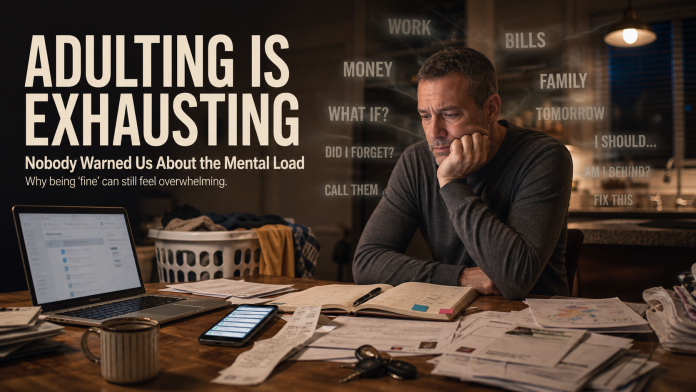
The Hidden Emotional Load of Adult Life

There is a part of adult life that rarely shows up on a to-do list.
You can see the bills. You can see the laundry. You can see the dishes in the sink, the work schedule, the doctor’s appointment, and the pile of things that need to be handled before Friday.
What you cannot always see is the mental weight behind all of it.
That weight is often called the emotional load.
It is the constant thinking, remembering, worrying, planning, deciding, and managing that happens quietly in the background of daily life. It is remembering that a bill is due next week. It is wondering whether your child is doing okay. It is thinking about what will happen if your car breaks down. It is trying to figure out how to afford something before you even know the final cost.
It is also carrying your own feelings while trying to deal with everyone else’s.
This hidden load helps explain why so many people reach the end of the day and think, “I didn’t even do that much. Why am I so tired?”

Because doing is only part of the work.
Thinking about everything you have to do is work, too.
What “Emotional Load” Really Means
The emotional load of adult life is not one single problem. It is the pile of invisible mental and emotional jobs that follow you throughout the day.
You may be physically sitting on the couch, but your brain is still working.
You might be thinking:
- Did I forget to answer that email?
- What are we going to do about that bill?
- I need to make that appointment.
- Why hasn’t my friend answered me?
- Did I say something wrong?
- What should I make for dinner?
- I really need to start exercising.
- I should call my family.
- I need to figure out what I am doing with my life.
- Am I falling behind everyone else?
None of those thoughts may seem huge by themselves.
That is part of the problem.
The emotional load often builds through small things that never fully leave your mind.
One worry leads to another. One responsibility creates three more decisions. Something that takes five minutes to do may take hours of mental space before you finally do it.
For example, making a doctor’s appointment may sound simple. But the full mental process can look more like this:
| The Visible Task | The Hidden Emotional Load |
|---|---|
| Make the appointment | Remember you need one |
| Find the phone number | |
| Check your schedule | |
| Think about insurance | |
| Decide which day works | |
| Hope the problem is nothing serious | |
| Remember to arrange transportation or time off | |
| Keep thinking about it until it is done |
The phone call may only take ten minutes.
The mental space it takes up can last for days.
That is emotional load.
It also includes the pressure adults place on themselves. Many people believe they should know what they are doing by a certain age. They think they should be better with money, more successful at work, happier in their relationships, more organized at home, and somehow still have time to relax.
The word should can become surprisingly heavy.
You should have more money by now.
You should know your career path.
You should have your life together.
You should be a better parent, partner, friend, worker, or adult.
The problem is that there is no single point where a person suddenly graduates from being confused. Getting older does not automatically make every decision easier.
In many ways, adulthood gives you more freedom while also giving you more things to manage.
You decide what to eat, but now you have to buy the food.
You want independence, but now you are responsible when something goes wrong.
You build a career, but you may also worry about whether you chose the right one.
You have relationships, but relationships require time, communication, and emotional energy.
You finally get some quiet time, and your brain starts reminding you of everything you forgot.
That is why adult exhaustion is not always about working too many hours.
Sometimes you are exhausted because nothing in your mind feels finished.
Stress can also affect concentration, sleep, energy, and the ability to make decisions. The more pressure that stays active for long periods, the harder it may become to feel like you have truly had a break. The CDC’s guidance on managing stress notes that stress can affect emotions, sleep, energy, concentration, and decision-making.
This does not mean every tired person has a mental health condition. It means the human mind is not a machine that can carry an endless number of open tabs without feeling the weight.
Think about your emotional load like a backpack.
At first, you put one thing inside.
Then another.
Then another.
A bill.
A family problem.
A work deadline.
A health concern.
A decision you have been avoiding.
A friendship that feels different.
A future you are not sure how to reach.

Eventually, the backpack becomes heavy enough that even standing still feels tiring.
The strange part is that other people may not see it.
They may see someone who is functioning.
Someone who goes to work.
Someone who pays their bills.
Someone who answers texts.
Someone who shows up.
They may not see the person quietly thinking, “I don’t know how much longer I can keep carrying all of this.”
That is one of the hidden parts of adult life.
You can be doing okay on the outside while feeling overloaded on the inside.
And recognizing that difference matters.
You do not have to wait until you completely fall apart before admitting that something feels heavy.
Sometimes the first step toward lightening the load is simply being honest about the fact that you are carrying one.
Why It’s Invisible but Exhausting
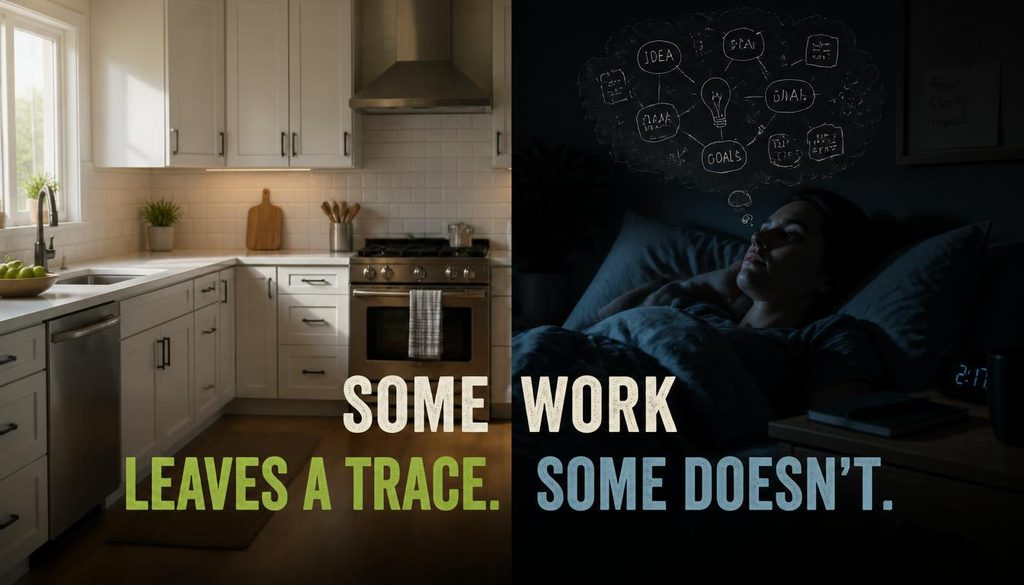
Some kinds of work leave proof behind.
You clean the kitchen, and the kitchen looks clean.
You finish a report, and there is a completed report.
You mow the lawn, and everyone can see the result.
Emotional work is different.
You can spend an entire day worrying, planning, remembering, calming yourself down, supporting another person, making decisions, and trying to keep everything together—and at the end of the day, there may be nothing you can point to and say, “There. That proves how hard today was.”
That is one reason the emotional load is so easy to dismiss.
People often judge exhaustion by visible activity.
If you did not run a marathon, work twelve hours, or spend the day doing physical labor, you may tell yourself you have no reason to be tired.
But your mind may have been busy from the moment you woke up.
You may have spent the morning making choices.
Then worrying about those choices.
Then solving problems.
Then preparing for problems that have not happened yet.
Then trying to hide your stress so nobody else worries.
That takes energy.
Decision-making alone can become draining when life keeps demanding one choice after another. What should you do first? What can wait? Should you spend the money? Should you say yes? Should you say no? Should you quit? Should you stay? Should you bring it up? Should you let it go?
At some point, even a small question like “What do you want for dinner?” can feel like too much.

This is one reason people sometimes become irritated by tiny things after a long day.
The tiny thing is not always the real problem.
It may simply be the last thing added to an already full mental backpack.
The American Psychological Association has also discussed how high stress can make everyday choices feel harder and how repeated choices can leave people more likely to take the easiest option rather than carefully think through later decisions. That does not mean every choice literally drains a fixed amount of brain power. It does mean that stress and a constant stream of demands can make clear decision-making more difficult. You can read more about this in the APA’s discussion of stress and decision-making.
Another reason emotional load stays invisible is that adults often become good at hiding it.
Someone may say, “I’m fine,” because explaining everything feels like more work.
Someone may laugh while feeling lonely.
Someone may keep helping everyone else because they do not know how to ask for help themselves.
Someone may stay busy because slowing down would mean finally noticing how overwhelmed they feel.
This is especially common when a person becomes known as the reliable one.
The reliable one gets the call.
The reliable one figures it out.
The reliable one remembers the important dates.
The reliable one keeps things moving.
The reliable one may also hear, “You handle things so well.”
What people may not realize is that handling things well does not mean handling them is easy.
A person can be capable and overwhelmed at the same time.
A person can love their family and still feel tired from being needed.
A person can be grateful for their job and still feel burned out by constant pressure.
A person can have friends and still feel lonely.
These things can exist together.
That matters because adults often talk themselves out of their own feelings.
“I have no right to complain.”
“Other people have it worse.”
“I should be grateful.”
“I just need to push harder.”
Gratitude is valuable. Perspective is valuable. But neither one magically removes a heavy load.
You can appreciate what you have and still admit that life feels difficult.
The CDC recommends healthy ways of coping with stress, including taking time to unwind, connecting with others, moving your body, and finding ways to manage daily stress before it builds further. The CDC’s emotional well-being guidance also points to communication and asking for support as useful parts of coping.
The goal is not to create a life with zero stress.
That is not realistic.
The goal is to stop treating every responsibility as if you must carry it alone, carry it perfectly, and carry it forever.
Sometimes emotional exhaustion comes from the fact that you are still mentally holding things that could be handled differently.
Maybe a decision does not need to be made today.
Maybe somebody else’s emergency is not yours to solve.
Maybe the message can wait until tomorrow.
Maybe you do not need to explain every “no.”
Maybe “good enough” is actually enough.
Maybe rest does not need to be earned by reaching total exhaustion first.
The hidden emotional load becomes dangerous when we never stop to ask what is actually inside the backpack.
Instead, we just keep adding things.
Then we blame ourselves when it becomes too heavy.
A better question is not always, “Why can’t I handle more?”
Sometimes the better question is, “Why am I carrying all of this in the first place?”
How This Ties to Nobody Told Me About This Part of Adult Life
The emotional load is at the center of what makes adulthood feel so different from what many people expected.
As children and teenagers, adulthood can look simple from far away.
You imagine freedom.
Your own home.
Your own money.
Your own choices.
Nobody really explains the other side in full.
The choices keep coming.
The responsibilities do not always clock out.
Friendships change.
Family roles change.
Money problems can appear without warning.
Work can take more than just your time.
You can reach a goal you wanted for years and still wonder why you do not feel the way you expected.
You may spend years waiting to finally feel like a “real adult,” only to discover that many adults are quietly making things up as they go.
That is a major idea behind Nobody Told Me About This Part of Adult Life.
The book focuses on the parts of adulthood people often experience privately: loneliness, burnout, fading friendships, constant pressure, decision fatigue, and the strange feeling that life can look stable while something inside still feels unsettled.
It is not about pretending adulthood is terrible.
It is about being honest about the fact that adulthood can be emotionally demanding in ways nobody clearly explains.
There is a difference between saying, “Adult life is hard sometimes,” and actually looking at why it feels hard.
The emotional load gives us part of that answer.
Consider a normal week.
You work.
You take care of the house.
You answer messages.
You make decisions.
You worry about money.
You try to spend time with people you care about.
You think about the future.
You remember things that other people forget.
You deal with problems as they happen.
You try not to make mistakes.
You compare where you are with where you thought you would be.
You wonder whether everyone else has somehow figured out a secret that you missed.
Then somebody asks how you are doing.
You say, “Good. Just tired.”
That one sentence can hide an entire week.
Nobody Told Me About This Part of Adult Life was built around the idea that many of these experiences are common but rarely discussed honestly. Feeling tired, uncertain, disconnected, or emotionally overloaded does not automatically mean you are failing.
It may mean you are carrying more than you have named.
That distinction is important.
If you believe the problem is that you are broken, your answer may be to push yourself harder.
If you realize the problem may be that your load has become too heavy, you can start looking for ways to change how you carry it.
You may not be able to remove every responsibility.
Bills still exist.
Work still needs to be done.
Children still need care.
Problems still happen.
But not every solution requires becoming more productive.
Sometimes the answer is reducing unnecessary decisions.
Sometimes it is setting a boundary.
Sometimes it is telling somebody, “I can’t take this on right now.”
Sometimes it is admitting that you need support before you reach a breaking point.
Sometimes it is simply stopping the fight against yourself.
The book’s larger message is simple: you are not failing just because adulthood feels harder than you expected.
You are experiencing the part people often leave out.
There is no universal age when you are supposed to have every answer. There is no point where all uncertainty disappears. Being responsible does not mean never needing help. Being strong does not mean never getting tired.
And getting better at adult life does not mean performing adulthood perfectly for other people.
It can mean learning what drains you.
Learning what you can control.
Learning what you need to let go of.
Learning when to rest.
Learning when to ask for help.
Learning that your worth is not measured by how much pressure you can survive without saying anything.
That is where the next step begins.
Before you can lighten the emotional load, you need to see it.
Not the version other people see.
The real version.
The thoughts.
The pressure.
The open loops.
The worries.
The expectations.
The responsibilities you accepted because you thought you had to.
Once those things have a name, they become easier to examine.
And once you begin examining them, you may discover something important:
You were never weak because the backpack felt heavy.
You may simply have been carrying far more than anyone knew.
Why Adulting Feels Heavier Than Expected

There is a funny thing about becoming an adult.
When you are younger, adulthood often looks like freedom.
You imagine having your own money, making your own choices, living wherever you want, buying whatever you want, and finally being able to do things without someone telling you what to do.
Then you get there.
And nobody tells you that freedom comes with a mountain of decisions.
You can choose what job you want, but you also have to worry about paying the bills.
You can choose where you live, but now you have rent or a mortgage, repairs, insurance, utilities, and groceries.
You can choose who you spend time with, but friendships take work.
You can choose whether you want children, but raising children comes with an enormous amount of responsibility.
You can change careers, but changing careers can mean starting over.
You can stay home on a Friday night, but then you might wonder whether everyone else is out having fun without you.
You can work harder, but then you may have less time for everything else.
You can slow down, but then the little voice in your head may tell you that you are falling behind.
This is one reason adulting feels heavier than expected.
It is not simply that adulthood contains more work. It contains more things that matter.
When you are responsible for yourself, your choices have consequences. When other people depend on you, those choices can affect them too. Even ordinary days can contain dozens of small decisions that nobody notices.
What makes it harder is that there is no universal adult handbook.
There is no age when someone hands you a certificate and says, “Congratulations. You now understand money, relationships, careers, family, health, stress, and what you are supposed to do with the next 40 years.”
Most people learn as they go.
Some learn through experience.
Some learn because they make expensive mistakes.
Some learn because someone finally gives them good advice.
And some spend years believing they are the only person who has no idea what they are doing.
That last group is much larger than it looks.
Decision Fatigue and Constant Responsibility
One of the biggest reasons adult life can feel exhausting is the sheer number of decisions packed into an ordinary day.
Some decisions are important.
Some are completely unimportant.
Your brain does not always get a clean break between them.
You wake up and decide whether to get out of bed now or hit snooze.
Then you decide what to wear.
What to eat.
Whether you have time for breakfast.
Whether you need gas.
Whether you should answer that message.
Whether you should call your doctor.
Whether you can afford something.
Whether you should accept an invitation.
Whether you should take on another project.
Whether you should speak up at work.
Whether you should let something go.
Whether you should call your parents.
Whether you should check your bank account.
Whether you should start exercising again.
Whether you should finally clean the garage.
None of these choices necessarily feels enormous.
Together, they can create a very crowded day.
The term decision fatigue is commonly used to describe the feeling of being worn down by repeated choices. There is good reason people recognize the experience. Research and discussion from the American Psychological Association have found that stress and a large number of choices can make everyday decisions harder, particularly when people are already dealing with uncertainty and pressure. (American Psychological Association)
That does not mean your brain has a little meter that reaches zero after exactly 47 decisions.
Real life is more complicated than that.
Stress, sleep, time pressure, the importance of the decision, and your emotional state all matter.
But the basic experience is easy to recognize.
After a long day of making decisions, you may not want another one.
That is why someone can spend eight hours making important choices at work and then stare at the refrigerator at 7:30 p.m. thinking:
“I don’t care. You pick.”
It is not always laziness.
Sometimes you simply do not want to make one more decision.
The problem becomes even bigger when responsibility follows you everywhere.
Work may end at five, but your responsibilities do not necessarily end with your workday.
There may be children to pick up.
Food to prepare.
Laundry to fold.
Bills to pay.
Messages to answer.
Appointments to schedule.
A house to maintain.
A partner who needs your attention.
Parents who need help.
A friend who is going through something.
A problem with the car.
A problem with the internet.
A problem with the house.
A problem that you do not even know how to solve yet.
The list never seems completely finished.
That creates a strange feature of adult life:
There is always something else you could be doing.
You could clean something.
Save more money.
Work on your career.
Read a book.
Exercise.
Call someone.
Organize your house.
Learn something.
Fix something.
Plan something.
Improve something.
The list has no natural ending.
That can make rest feel uncomfortable.
You sit down, and instead of relaxing, your brain starts producing reminders.
“You should really…”
That sentence may be one of the most exhausting sentences in adult life.

You should really clean that.
You should really answer them.
You should really get more exercise.
You should really save more money.
You should really get ahead at work.
You should really spend more time with your family.
You should really call your friend.
You should really figure out what you want to do with your life.
The problem is not that any one of these suggestions is terrible.
The problem is when they all arrive at once.
A person can become so focused on everything that still needs to be done that they stop noticing everything they have already accomplished.
That creates a permanent feeling of being behind.
And being behind is one of the most powerful forms of emotional pressure because there is no finish line.
If you finish today’s work, tomorrow has more.
If you clean the house, it eventually gets dirty again.
If you pay the bills, new bills arrive.
If you answer your email, more email appears.
If you reach one career goal, another one may replace it.
If you finally get your life organized, life may immediately throw something new at you.
This does not mean adult life is hopeless.
It means adulthood requires a different definition of success.
If your definition of success is “everything is finished,” you are going to lose.
Everything is never finished.
A healthier goal is something closer to:
“I handled what mattered most today.”
That is a very different standard.
It leaves room for reality.
It also leaves room for being human.
The person who learns to separate urgent, important, optional, and not mine to handle can often reduce some of the pressure without changing their entire life.
Consider this simple approach:
| Question | What It Helps You Decide |
|---|---|
| Does this need to happen today? | Separates urgency from noise |
| Does this actually matter? | Protects your attention |
| Can someone else handle it? | Reduces unnecessary responsibility |
| Can it wait? | Prevents everything from becoming an emergency |
| Am I doing this because I want to or because I think I should? | Exposes outside pressure |
| What happens if I do nothing? | Gives the decision some perspective |
That last question can be surprisingly useful.
Sometimes the answer is, “Something important will happen.”
Sometimes the answer is, “Someone might be disappointed.”
And sometimes the answer is, “Absolutely nothing.”
Those three answers are very different.
Adult life becomes heavier when we treat all three as emergencies.
The goal is not to stop caring.
It is to become more selective about what deserves your limited attention.
Loneliness, Comparison, and the Feeling That You’re Behind
There is another part of adulting that people do not always expect.

You can be surrounded by people and still feel alone.
You can have coworkers.
Family.
Friends.
Followers.
Neighbors.
A partner.
Children.
People who text you.
People who like your posts.
And still have moments when you think:
“Does anybody actually understand what is going on inside my head?”
Adult loneliness can be strange because it is not always about having nobody around.
Sometimes it is about not feeling understood.
Sometimes it is about losing the friendships you once assumed would last forever.
Sometimes it is about moving to a new place.
Sometimes everyone gets busy.
Sometimes people marry, have children, change jobs, move away, or simply become different people.
There may be no dramatic argument.
No big ending.
The friendship just becomes quieter.
One person stops calling.
Then the other stops calling.
Months pass.
Nobody is angry.
Nobody did anything terrible.
But something that once felt permanent is suddenly part of the past.
That can be difficult to explain to someone who thinks loneliness means sitting alone in an empty room.
It does not always look that way.
Sometimes loneliness looks like having nobody you feel comfortable calling when something important happens.
Sometimes it looks like having a great day and realizing you do not know who you want to tell.
Sometimes it looks like being with your family while feeling emotionally somewhere else.
Sometimes it looks like scrolling through social media at midnight and wondering why everyone else’s life appears to be moving forward.
That last one can make the feeling of being behind much worse.
Social media gives us a strange window into other people’s lives.
You see the vacation.
The new house.
The wedding.
The promotion.
The engagement.
The new car.
The family photo.
The business launch.
The before-and-after transformation.
The person who apparently wakes up at 5 a.m., works out, drinks a green smoothie, runs a successful company, raises three children, travels twice a month, and somehow still has time to make a motivational video about discipline.
Then you look at your own life.
Maybe your laundry is sitting on the floor.
Maybe your bank account is not where you want it.
Maybe your career has stalled.
Maybe your relationship is complicated.
Maybe you have no idea what your next move should be.
Maybe you are doing fine but still feel like you should be doing better.
That comparison can create a painful question:
“What is wrong with me?”
Often, nothing is wrong with you.
You are comparing your entire life to carefully selected pieces of someone else’s.
You see their announcement.
You do not see their arguments.
You see the new house.
You do not see the financial stress.
You see the promotion.
You do not see the years of uncertainty that came before it.
You see the happy family picture.
You do not see what happened ten minutes before the camera came out.
You see the result.
You do not see the full story.
This is especially difficult because adulthood does not follow one clean timeline.
There is no rule that says everyone should own a home at 30.
There is no universal age for marriage.
There is no deadline for finding your career.
There is no required schedule for becoming financially comfortable.
There is no age at which you are supposed to stop changing your mind.
Yet people often carry imaginary deadlines anyway.
By 25, I should…
By 30, I should…
By 40, I should…
By 50, I should…
The list changes, but the pressure stays.
You may reach one goal only to discover that your brain has already created another.
That is why “behind” can become a moving target.
Suppose you spend years working toward a promotion.
You finally get it.
You should be happy.
But now you think you should be earning more.
Then you think you should have a better title.
Then you think you should be managing a bigger team.
Then you see someone younger than you doing something impressive.
Suddenly your accomplishment feels smaller.
Nothing changed about what you achieved.
The measuring stick changed.
This is where comparison can quietly steal satisfaction.
It can also make ordinary life feel like failure.
A quiet weekend becomes “I have no social life.”
A normal job becomes “I’m not successful.”
A small apartment becomes “I’m behind.”
Being single becomes “Something must be wrong with me.”
Having a family becomes “Everyone else has more freedom.”
There is almost always another version of life that looks better from the outside.
The trick is remembering that better-looking is not the same thing as better for you.
Your life has different circumstances.
Different responsibilities.
Different resources.
Different values.
Different history.
Different goals.
You do not need to win someone else’s race.
And there is something else worth remembering: feeling behind does not necessarily mean you are behind.
Sometimes it means your expectations have become unrealistic.
Sometimes it means you are tired.
Sometimes it means you have been comparing too much.
Sometimes it means you are judging your current chapter against someone else’s highlight reel.
And sometimes it means something really does need to change.
The important thing is figuring out which one it is.
That takes honesty.
Not self-criticism.
If you feel behind, ask:
- Behind according to whom?
- What exactly do I believe I should have accomplished?
- Did I choose that goal, or did someone else teach me to want it?
- Would reaching it actually make my life better?
- What have I already survived or accomplished that I rarely give myself credit for?
- What part of my life genuinely needs attention right now?
Those questions can turn a vague feeling into something you can actually work with.
Instead of saying, “My whole life is a mess,” you might discover:
“I am unhappy with my job.”
That’s a problem you can examine.
Or:
“I miss having close friends.”
That’s something you can work on.
Or:
“I’m worried about money.”
Now you can look at the numbers.
Or:
“I don’t actually want the life I thought I was supposed to want.”
That may be uncomfortable.
But it is useful information.
The goal is not to convince yourself that everything is wonderful.
The goal is to stop turning every difficult feeling into evidence that you are failing.
The Myth of “Having It All Together”

One of the biggest lies adults tell themselves is that everyone else knows what they are doing.
Look around a room full of adults and you may see people who appear completely capable.
Someone knows how to buy a house.
Someone knows how to invest.
Someone knows how to raise children.
Someone knows how to fix a toilet.
Someone knows how to manage employees.
Someone knows how to cook.
Someone knows how to negotiate.
Someone knows how to make a budget.
Someone knows how to handle family conflict.
Someone knows exactly what career they want.
It is easy to assume they have figured adulthood out.
But capability in one area does not mean certainty in every area.
The person who is excellent at work may have no idea how to deal with loneliness.
The person who manages money well may struggle with relationships.
The person who seems confident may spend hours second-guessing themselves.
The parent who looks completely organized may have spent the morning trying not to lose their mind.
The successful business owner may be terrified about the future.
The calm person at the table may be carrying a problem nobody knows about.
Everyone has areas where they feel competent and areas where they feel lost.
That is normal.
The myth comes from believing adulthood should eventually produce complete certainty.
It does not.
Life keeps changing.
You solve one problem and another appears.
You learn something new and discover something else you do not understand.
You become comfortable with one stage of life and then circumstances change.
That does not mean you failed.
It means you are alive in a world that keeps moving.
The phrase “having it all together” is also dangerous because it sounds like a permanent condition.
As though one day you will reach a magical level of adulthood where your house is clean, your finances are perfect, your relationships are healthy, your career is exactly where you want it, your schedule is under control, your body feels great, and you never forget why you walked into a room.
Then you will finally be a proper adult.
That day is probably not coming.
And honestly, that may be good news.
Because if perfection is the goal, almost every ordinary day becomes evidence that you failed.
If competence is the goal, however, the standard changes.
You do not have to know everything.
You need to know how to learn.
You do not have to solve every problem alone.
You need to know when to ask for help.
You do not have to make perfect decisions.
You need to learn from the ones that do not work.
You do not have to feel confident all the time.
You need to keep moving even when confidence is missing.
You do not have to have your entire future planned.
You need to figure out what deserves your attention now.
That is a much more realistic definition of being an adult.
It also fits the reality described in Nobody Told Me About This Part of Adult Life. The book openly focuses on the less polished side of adulthood, including loneliness, burnout, fading friendships, responsibility, decision fatigue, and the feeling that something is wrong simply because life does not feel as settled as expected. (Ray McNally)
The book’s message is not that adults should stop trying.
It is almost the opposite.
Trying becomes easier when you stop wasting so much energy pretending.
You can say:
“I don’t know.”
“I need help.”
“I’m tired.”
“I changed my mind.”
“I don’t want that.”
“I made a mistake.”
“I thought I would be further along by now.”
“I need some time.”
Those are not signs of failure.
They are honest statements.
And honesty gives you something perfection never can: a place to start.
A person who admits they are overwhelmed can change something.
A person who insists they are perfectly fine while quietly falling apart has a much harder problem.
This is why the goal should not be having it all together.
The goal should be knowing what matters and dealing with life one piece at a time.
Some days you will handle everything beautifully.
Other days you will forget something obvious, eat whatever is easiest, leave the laundry unfolded, answer an email three days late, and wonder what happened to your motivation.
That does not erase the good days.
It is simply part of being a person.
Adulting feels heavy because it is real responsibility combined with uncertainty.
It feels heavy because there are so many choices.
It feels heavy because people compare their private struggles with other people’s public successes.
It feels heavy because many adults believe they are supposed to have answers that nobody actually has.
And it feels especially heavy when every difficult day becomes a judgment about who you are.
Maybe the better question is not:
“Why can’t I handle adult life better?”
Maybe it is:
“What part of adult life is asking too much of me right now?”
That question changes the conversation.
It moves you away from shame and toward problem-solving.
Maybe the answer is work.
Maybe it is money.
Maybe it is loneliness.
Maybe it is family.
Maybe it is too many commitments.
Maybe it is unrealistic expectations.
Maybe it is the constant pressure to be productive.
Maybe it is simply that you have not had a real chance to recover.
Whatever the answer is, you cannot change what you refuse to notice.
And you do not have to fix your entire life tonight.
Start with one thing.
One decision you can remove.
One responsibility you can share.
One expectation you can question.
One boundary you can set.
One hour when you stop trying to prove that you have everything under control.
Because perhaps being a better adult is not about carrying a bigger backpack.
Perhaps it is about learning what does not belong inside it in the first place.
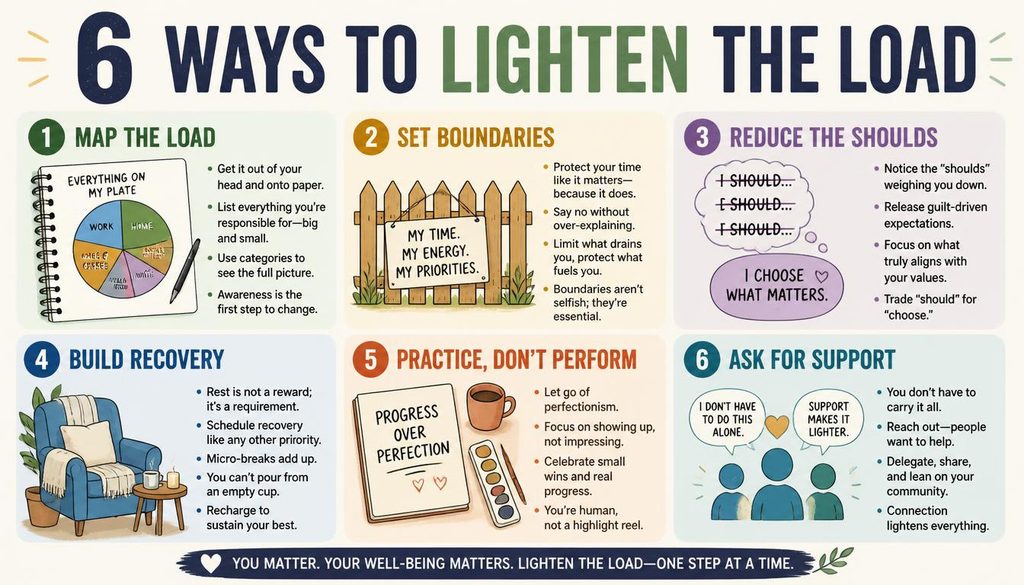
6 Ways to Lighten the Emotional Load
Knowing that adult life feels heavy is useful.
Knowing what to do about it is better.
The answer does not have to be a complete life makeover. In fact, trying to completely rebuild your life when you are already exhausted can become another source of stress.
You do not need another giant project called Fix Myself.
You need a few practical ways to make the load lighter.
That may mean removing something.
It may mean changing how you handle something.
It may mean asking someone else to help.
It may even mean deciding that something you have been treating as important really is not that important anymore.
The goal is not to create a perfect stress-free life. That is not realistic. Bills will still show up. People will still need things. Work will still be work. Your phone will still find a way to make noise when you are trying to relax.
The goal is to stop making every responsibility heavier than it needs to be.
Here are six places to start.
Strategy #1: Name and Map Your Load
The first step is simple, but many people skip it.
Write down what is actually bothering you.
Not what you think should be bothering you.
Not what you believe sounds important.
What is actually taking up space in your head?
This can be surprisingly difficult because an emotional load is often messy.
You may have ten small things bothering you instead of one giant problem.
Maybe you need to schedule an appointment.
Maybe your car needs work.
Maybe you are worried about money.
Maybe someone at work is getting on your nerves.
Maybe you have not talked to a friend in months.
Maybe your house feels out of control.
Maybe you are tired of being the person everyone calls when something needs fixing.
Maybe you are worried about where your life is going.
Put all of it down.
Do not organize it yet.
Do not judge it.
Just get it out of your head.
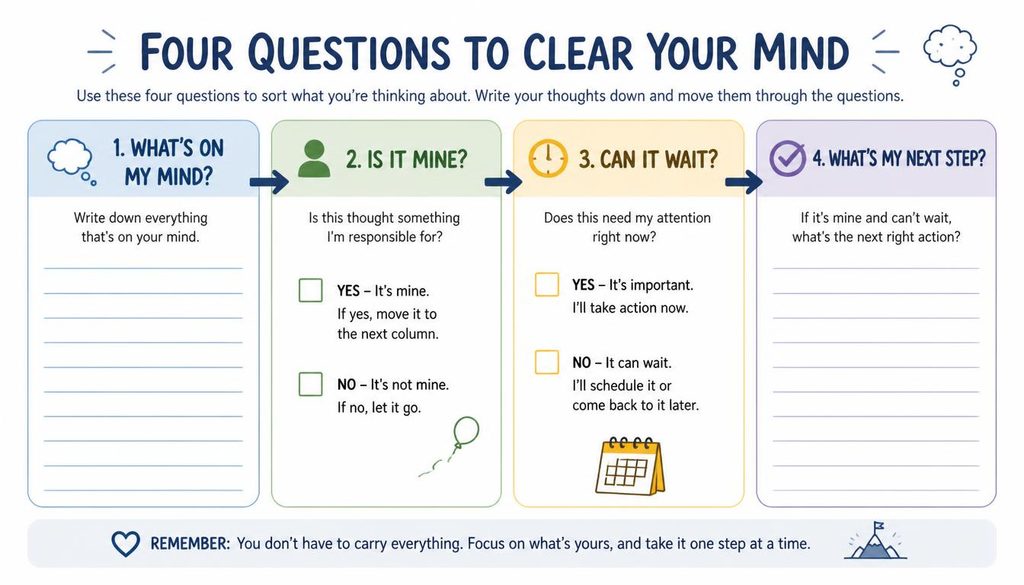
A simple load map can look like this:
| What is on my mind? | Is it mine to handle? | Can it wait? | What is the next step? |
|---|---|---|---|
| Work project | Yes | No | Finish first section |
| Family problem | Partly | Maybe | Have a conversation |
| House cleaning | Yes | Yes | Do one room |
| Friend’s problem | No | Yes | Let them know I care |
| Money worries | Yes | No | Review budget |
| Old obligation | Maybe | Yes | Decide whether to continue |
The important part is the last column.
What is the next step?
Not the entire solution.
Just the next step.
If your finances are worrying you, the next step might be opening your bank account and looking at the numbers.
If your house is overwhelming you, the next step might be clearing one surface.
If you need a medical appointment, the next step might be finding the phone number.
If you are avoiding a conversation, the next step might be writing down what you actually want to say.
This matters because vague problems tend to feel bigger.
“I have to fix my life” is enormous.
“I need to call the dentist” is manageable.
“I need to get healthier” is enormous.
“I will take a 15-minute walk today” is manageable.
“I need to repair my relationship with my family” is enormous.
“I need to have one honest conversation” is manageable.
The brain handles concrete actions better than giant clouds of worry.
Mapping your emotional load also helps you notice something else: not every item belongs to you.
That can be a shock.
Adults often pick up responsibilities simply because they are capable of handling them.
You become the person who remembers.
You become the person who organizes.
You become the person who fixes.
You become the person who listens.
Eventually, everyone starts assuming you will do it.
That does not automatically make it your responsibility.
Ask yourself:
- Is this actually my problem?
- Did I agree to handle it?
- Is someone else capable of handling it?
- Am I helping because I want to, or because I am afraid of disappointing someone?
- What would happen if I stopped doing it?
Those questions are not selfish.
They are a way to understand the difference between responsibility and automatic responsibility.
The book Nobody Told Me About This Part of Adult Life explores this larger problem of carrying invisible pressure while trying to function normally. One of the practical ideas behind dealing with that pressure is learning to recognize what is actually happening instead of simply telling yourself to work harder.
You cannot lighten a load you refuse to look at.
Start there.
Write it down.
Strategy #2: Set Micro-Boundaries at Work and Home

When people hear the word boundary, they sometimes imagine something dramatic.
They imagine cutting someone out of their life.
They imagine a huge confrontation.
They imagine saying, “I will never do that again.”
Most boundaries do not need to be that dramatic.
A micro-boundary is a small limit that protects your time, attention, energy, or personal space.
It can be as simple as:
“I can’t talk right now. Can we talk tonight?”
Or:
“I can help with that tomorrow, but I can’t do it today.”
Or:
“I’m going to finish this before I take on something else.”
Or:
“I’m not checking work email after dinner.”
Or:
“I need 30 minutes to myself when I get home.”
These small choices can make a major difference because they stop every request from becoming an automatic yes.
Work is an obvious place to start.
If you are constantly checking messages, answering emails late at night, jumping between tasks, and accepting every new request, your workday does not really end.
You may physically leave the building.
Your brain does not.
A small boundary might be deciding that you will check email at specific times rather than every few minutes.
Another might be keeping a short list of your top priorities so that every new request does not automatically become your new priority.
At home, boundaries can be just as important.
Home is supposed to be a place where you recover.
But many people walk through the front door and immediately switch into another work shift.
Dinner.
Laundry.
Homework.
Cleaning.
Messages.
Family problems.
Planning tomorrow.
There is nothing wrong with caring for your family.
The problem is when you never get a transition between one responsibility and the next.
Try creating one.
Maybe you sit in your car for five minutes before walking inside.
Maybe you take a short walk.
Maybe you change clothes and drink something before starting the evening routine.
Maybe the household agrees that everyone gets a quiet period after work or school.
The exact boundary does not matter as much as the principle.
You are allowed to have transitions.
You are allowed to stop being “on” for a few minutes.
You are also allowed to say no without writing a three-page explanation.
A boundary is not an argument.
It is information.
“I can’t.”
“I don’t have the time.”
“That doesn’t work for me.”
“I can do this, but not that.”
“I need more notice.”
“I’ll get back to you tomorrow.”
These sentences may feel uncomfortable at first.
Especially if you are used to being helpful.
But discomfort does not mean you are doing something wrong.
Sometimes it simply means you are doing something new.
Strategy #3: Reduce the “Shoulds” and External Expectations
One of the heaviest things many adults carry is a backpack full of shoulds.
You should make more money.
You should exercise.
You should have a better career.
You should own a house.
You should travel more.
You should call your family more.
You should have more friends.
You should be more organized.
You should be further ahead.
You should know what you want.
You should be happier.
You should have figured this out by now.
Some of these goals may be good.
That does not mean every “should” deserves your attention.
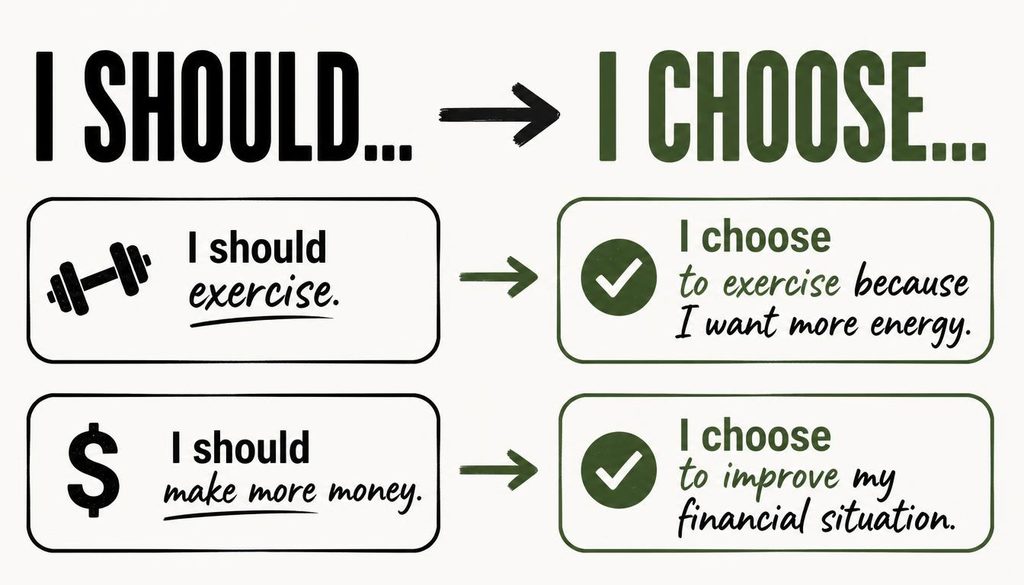
A useful trick is to replace should with choose.
“I should exercise.”
becomes:
“I choose to exercise because I want more energy.”
“I should call my family.”
becomes:
“I want to stay connected with my family.”
“I should make more money.”
becomes:
“I want to improve my financial situation.”
That small change can reveal whether the goal is actually yours.
Sometimes you discover that it is.
Great.
Now you have a reason.
Other times, you discover that you are chasing something because you think you are supposed to want it.
That is worth knowing too.
External expectations can come from parents, friends, coworkers, social media, culture, advertising, and even your own past.
Maybe you always assumed you would own a house.
Maybe you thought you would have children by a certain age.
Maybe you believed you would have a high-paying career.
Maybe you thought you would be married.
Maybe you thought adulthood would feel more exciting.
There is nothing wrong with wanting those things.
The problem begins when you treat them as requirements for being successful.
Your life does not have to look like someone else’s checklist.
Try sorting your goals into three categories:
| Category | Question |
|---|---|
| Mine | Do I genuinely want this? |
| Maybe | Am I unsure whether this still matters to me? |
| Not Mine | Am I doing this mainly to satisfy someone else’s expectations? |
You may find that the third category is larger than expected.
That can be freeing.
It can also be uncomfortable.
Because sometimes the life you are trying to build is not actually the life you want.
That does not mean you have to throw everything away.
It means you get to reconsider.
Strategy #4: Build Small Recovery Rituals

Recovery does not have to mean a two-week vacation.
Most people cannot take one every time life becomes stressful.
Instead, build tiny moments of recovery into ordinary days.
A recovery ritual might be ten minutes with coffee before everyone else wakes up.
It might be taking a shower without bringing your phone into the bathroom.
It might be sitting outside.
It might be reading five pages.
It might be listening to music while doing absolutely nothing else.
It might be taking the dog for a walk without turning it into another productivity task.
It might be sitting in your car after work and letting your brain become quiet.
The important thing is that the activity actually feels restorative.
Do not turn recovery into another assignment.
If your “relaxation routine” contains twelve steps, three apps, a journal, a workout, a meditation timer, a special drink, and a detailed scoring system, you may have accidentally created another job.
Keep it simple.
The CDC’s guidance on stress and emotional well-being includes practical approaches such as connecting with others, taking care of your body, making time to unwind, and finding ways to manage stress.
Small recovery matters because exhaustion can make everything else harder.
When you are already drained, ordinary problems feel bigger.
A small disagreement can feel enormous.
A minor inconvenience can make you angry.
A simple decision can feel impossible.
A task you normally handle easily can suddenly feel like climbing a mountain.
Recovery does not remove every problem.
It gives you more room to deal with them.
Strategy #5: Reframe “Adulting” as Practice, Not Performance
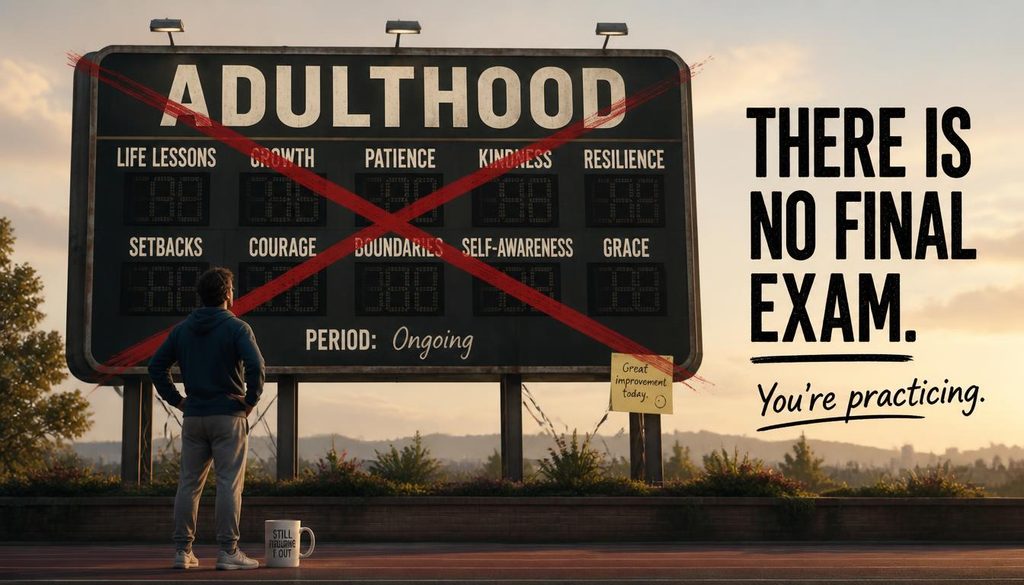
You do not have to perform adulthood.
You have to live it.
That sounds like a small difference, but it changes a lot.
Performing adulthood means trying to look like you have everything under control.
Living adulthood means admitting that sometimes you do not.
Performance asks:
“How does this look?”
Practice asks:
“What am I learning?”
That shift can make mistakes less threatening.
You missed an appointment?
What system could prevent that next time?
You spent too much money?
What can you change?
You handled an argument badly?
What would you do differently?
You picked the wrong job?
What did you learn about what you actually need?
A mistake becomes information instead of a verdict.
You are not being graded on adulthood.
There is no final exam.
You are practicing.
That is a much more forgiving way to live.
Strategy #6: Know When and How to Ask for Support
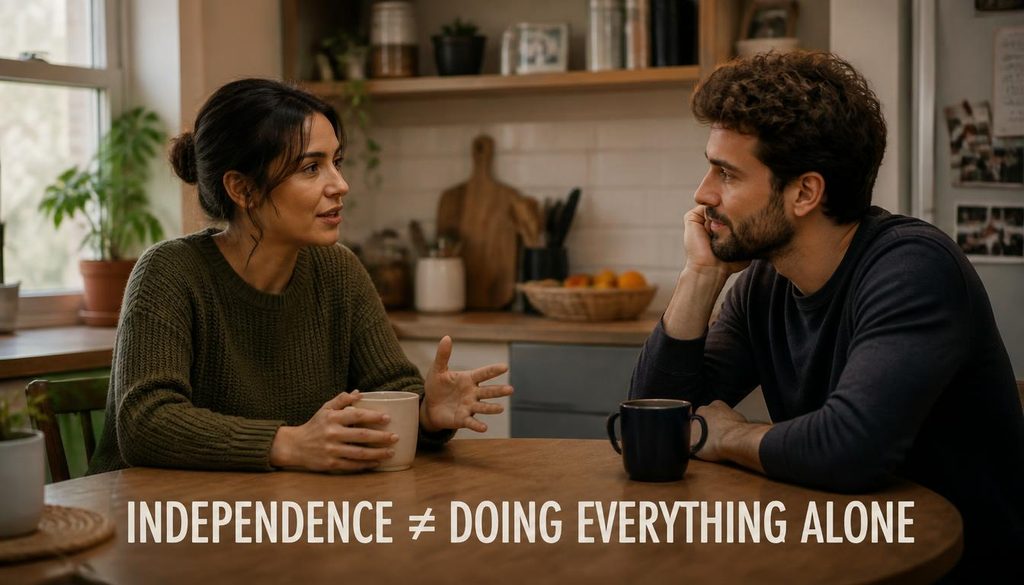
There is a difference between independence and isolation.
Being independent means you can handle many things yourself.
Isolation means you believe you have to handle everything yourself.
Those are not the same.
Sometimes support is practical.
“Can you watch the kids for an hour?”
“Can you help me move this?”
“Can you show me how to do this?”
“Can you look over my budget?”
Sometimes support is emotional.
“I’ve had a rough week.”
“I don’t need you to fix it. I just need someone to listen.”
Sometimes professional support is the right choice.
If stress, sadness, anxiety, or other emotional difficulties are interfering with your daily life, relationships, sleep, work, or ability to function, talking with a qualified mental health professional can be an important step.
Asking for support does not mean you failed at adulting.
Sometimes it means you are finally doing adulting correctly.
The goal is not to become someone who never needs help.
The goal is to become someone who knows when carrying everything alone has stopped working.
And that may be the most practical lesson of all:
You do not have to remove every responsibility from your life to feel better. You may only need to stop treating every responsibility as something you must carry alone.
Real Stories: What This Looks Like in Real Life
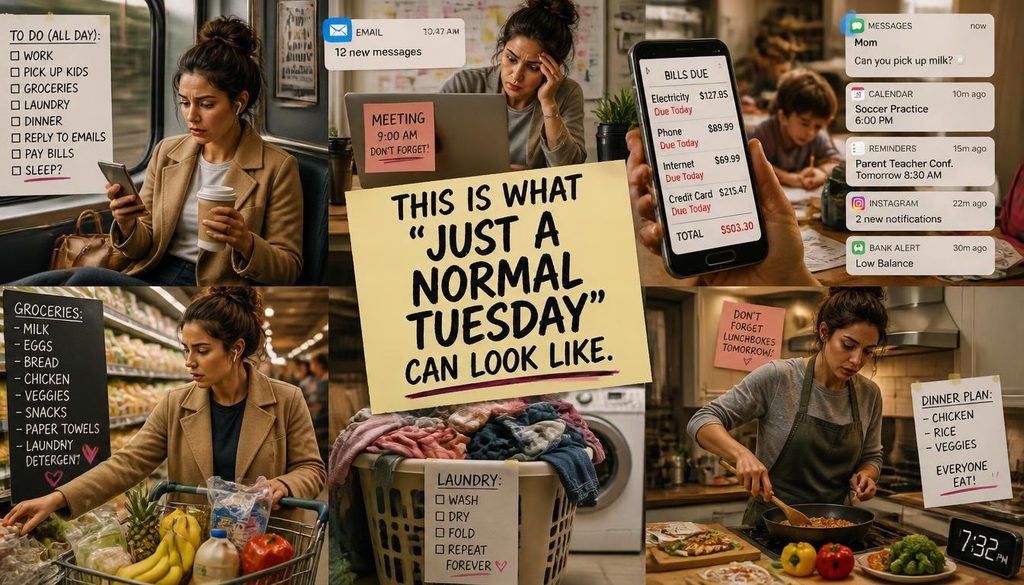
Sometimes the idea of an emotional load sounds good until you try to connect it to an actual Tuesday.
That is where things get interesting.
Most people do not wake up thinking, Today I am going to experience emotional labor, decision fatigue, social comparison, and mental overload.
They wake up thinking about getting to work.
They think about breakfast.
They think about traffic.
They think about an email they forgot to answer.
They think about money.
They think about dinner.
They think about the argument they had last night.
They think about whether they are doing enough.
The emotional load hides inside ordinary life.
The following examples are composite examples, created from common adult-life situations. They are not presented as interviews or as real people quoted from private conversations. Their purpose is to show how the same basic problem can look completely different depending on a person’s life.
The Overwhelmed Young Professional
Imagine someone named Alex.
Alex is 27 and has been working full-time for several years.
From the outside, things look pretty good.
Alex has a decent apartment, a steady job, friends, a car that works most of the time, and enough money to get by. There is nothing obviously falling apart.
But Alex is exhausted.
The problem is difficult to explain.
Alex is not working 80 hours a week.
There is no major crisis.
There is no single disaster that can be blamed.
Instead, there are dozens of small pressures.
The job has become demanding.
There are constant messages.
Meetings move around.
Projects overlap.
Someone always needs something.
Alex starts checking work email before getting out of bed.
Then comes the commute.
At lunch, Alex thinks about money.
Rent went up.
Groceries cost more than they used to.
There is a credit card balance that needs attention.
Alex wants to save more but also wants to enjoy life.
That creates another decision.
Should the money go toward savings?
Debt?
A vacation?
Something fun?
Every answer feels like the wrong answer.
After work, Alex wants to see friends.
But socializing takes energy.
Sometimes Alex cancels plans and stays home.
Then comes the loneliness.
The next day, Alex sees pictures of friends going out.
Now the thought becomes:
“I never do anything anymore.”
That creates another problem.
Alex starts comparing life with other people.
Someone from high school just bought a house.
Another friend got engaged.
Someone else started a business.
A former classmate is posting pictures from Europe.
Alex is sitting on the couch wondering whether adulthood is supposed to look different.
This is how the emotional load can sneak up on someone.
Nothing is individually enormous.
But the pile becomes enormous.
A useful way to understand Alex’s situation is to separate the visible workload from the invisible workload.
| Visible | Invisible |
|---|---|
| Going to work | Worrying about career progress |
| Paying rent | Worrying about future financial security |
| Answering emails | Thinking about unanswered emails after work |
| Meeting friends | Wondering whether friendships are changing |
| Going grocery shopping | Comparing prices and worrying about money |
| Going home | Feeling guilty for not being more productive |
| Using social media | Comparing personal progress with others |
| Going to bed | Thinking about everything that needs to happen tomorrow |
The obvious solution might be to tell Alex to “get organized.”
But Alex is already organized enough to keep functioning.
The deeper issue is that there are too many open mental loops.
Everything feels unfinished.
So Alex tries productivity.
A new planner.
A new phone app.
A morning routine.
A workout schedule.
A budget spreadsheet.
A goal tracker.
A list of books to read.
A list of podcasts to listen to.
A list of habits to build.
For a week, things feel better.
Then the system becomes another responsibility.
That is an important lesson.
Sometimes an overloaded person does not need another productivity system.
They need fewer things demanding attention.
Alex starts making smaller changes.
The first is simple: work email stays off until the workday begins.
That does not solve everything.
But it stops the workday from starting before breakfast.
The second change is a weekly money check.
Instead of worrying about money every day, Alex chooses one time each week to look at the numbers.
Again, not a miracle.
Just less constant thinking.
The third change is limiting social media when comparison starts becoming toxic.
Alex does not delete every account.
There is no dramatic announcement.
The phone simply becomes less involved in the evening.
The fourth change is learning to say:
“I can’t tonight, but I’d love to see you this weekend.”
That is different from disappearing.
Alex is still social.
There is simply less pressure to be available every time someone asks.
After a few weeks, life has not become perfect.
The job still has stressful days.
Bills still exist.
Alex still worries.
But something important has changed.
The problems are no longer all shouting at once.
That is what reducing emotional load often looks like.
It is not a movie moment where everything suddenly becomes easy.
It is quieter.
One less notification.
One less unnecessary commitment.
One decision made ahead of time.
One boundary.
One honest conversation.
One evening where nothing needs to be accomplished.
That is enough to begin.
The Parent Juggling Work and Family
Now consider a completely different situation.
Imagine Jamie.
Jamie is a parent with a full-time job.
The pressure here is different because other people depend on Jamie.
There are school schedules.
Meals.
Laundry.
Work deadlines.
Appointments.
Household expenses.
Family activities.
Messages from teachers.
Messages from work.
Messages from relatives.
And the endless question:
“What’s for dinner?”
Jamie loves the family.
That is not the issue.
In fact, love can make the emotional load heavier because Jamie cares deeply about getting things right.
Jamie wants the children to be happy.
Jamie wants to be a good partner.
Jamie wants to perform well at work.
Jamie wants the house to be reasonably clean.
Jamie wants everyone to eat decent food.
Jamie wants to save money.
Jamie wants to have time for the family.
Jamie also wants five minutes alone.
The problem is that all of those wants compete for the same limited supply of time and energy.
A normal weekday might look something like this:
6:00 a.m.
Wake up.
Think about the day.
Check the weather.
Check school messages.
Think about what needs to happen after work.
7:00 a.m.
Get everyone moving.
Someone cannot find a shoe.
Someone needs help with homework.
Someone suddenly remembers an assignment.
8:00 a.m.
Work begins.
10:30 a.m.
A message arrives from school.
Now Jamie’s attention is split.
12:00 p.m.
Lunch happens while checking work messages.
3:00 p.m.
Jamie is already thinking about the evening.
5:30 p.m.
Work ends.
Family responsibilities begin again.
6:30 p.m.
Dinner.
7:30 p.m.
Homework.
8:30 p.m.
Clean up.
9:00 p.m.
Finally quiet.
Except the laundry needs to be moved.
And tomorrow’s schedule needs to be checked.
And there is an email that should probably be answered.
By 10:30, Jamie is exhausted.
But instead of going to bed, Jamie scrolls through a phone for an hour.
Why?
Because it is the first time all day that nobody needs anything.
That hour may look like wasted time.
It may actually be the only part of the day that feels like it belongs to Jamie.
This is where judging yourself can make the situation worse.
Jamie thinks:
“I should have gone to bed earlier.”
Maybe.
But simply telling yourself to be more disciplined does not address the reason the late-night scrolling happened.
The person needed a break.
The better question is:
“How can I create a little recovery time before I am completely exhausted?”
That leads to a different solution.
Instead of trying to squeeze an hour of personal time into the end of an already overloaded day, Jamie creates a 20-minute transition period.
Sometimes it is a shower.
Sometimes it is sitting outside.
Sometimes it is watching something funny.
Sometimes it is simply sitting in silence.
The activity does not have to be impressive.
It just needs to provide a small break from responsibility.
Jamie also begins using a family calendar.
Not because a calendar fixes emotional exhaustion.
It does not.
But putting schedules in one visible place reduces the number of things Jamie has to keep inside their head.
That is an important distinction.
Organization is useful when it reduces mental work.
Organization is not useful when it becomes another project to maintain.
Jamie also starts asking for help.
Instead of automatically handling every family task, some responsibilities are shared.
The goal is not to make everyone else do everything.
It is to stop one person from becoming the household’s permanent memory system.
That change may create some uncomfortable conversations.
Maybe someone says:
“I thought you were already handling that.”
Jamie can answer honestly:
“I have been handling it, but it is becoming too much. I need us to split some of this.”
That is not a failure.
That is information.
And this is where emotional load becomes easier to understand.
Sometimes the problem is not that one person is weak.
The problem is that the system depends too heavily on one person.
What Changed When They Shifted Their Approach

Alex and Jamie have very different lives.
One is a young professional trying to manage work, money, friendships, and the pressure of becoming an adult.
The other is a parent balancing work, family, household responsibilities, and the emotional needs of other people.
Yet their solutions have something in common.
Neither one tried to become superhuman.
They did not decide to wake up at 4:30 every morning and squeeze another two hours of productivity into the day.
They did not create a 37-step morning routine.
They did not decide they needed to become perfect.
They started by asking a different question.
“What can I stop carrying the way I am carrying it now?”
That question is powerful because there are several ways to make a load lighter.
You can remove something.
You can delay something.
You can share something.
You can simplify something.
You can stop doing something.
You can change your expectations.
You can create a boundary around something.
You can ask for help.
And sometimes you can simply stop treating something as an emergency.
Here is what that looked like for the two examples:
| Problem | Old Approach | New Approach |
|---|---|---|
| Work messages | Always available | Specific times for checking |
| Money worries | Thinking about money every day | Scheduled money review |
| Social comparison | Constant scrolling | More intentional use of social media |
| Social plans | Automatic yes or complete cancellation | Honest, flexible scheduling |
| Family responsibilities | One person remembers everything | Shared responsibilities |
| Household planning | Kept in one person’s head | Shared calendar |
| Recovery | Wait until completely exhausted | Small breaks built into the day |
| Mistakes | “I should have done better” | “What can I learn from this?” |
The changes are not dramatic.
That is exactly why they are realistic.
There is a temptation in self-help to make change sound exciting.
Wake up earlier.
Transform your mindset.
Build incredible habits.
Become your best self.
Crush your goals.
Those ideas can sound great when you have plenty of energy.
They are much less useful when you are already running on empty.
A person carrying a heavy emotional load may need less, not more.
Less pressure.
Less comparison.
Less unnecessary decision-making.
Less guilt.
Less pretending.
Less responsibility that does not actually belong to them.
That does not mean becoming careless.
It means becoming selective.
The same idea runs through Nobody Told Me About This Part of Adult Life, which focuses on the parts of adulthood that can be difficult to explain from the outside: loneliness, burnout, fading friendships, responsibility, decision fatigue, emotional exhaustion, and the pressure to keep functioning even when life feels heavy.
The point is not that every adult has the same problems.
They do not.
The point is that many adults have the same experience of carrying things nobody else can easily see.
That is why one person’s emotional load may look like a stressful job while another person’s looks like family responsibilities.
For someone else, it might be debt.
For another person, it may be loneliness.
It may be grief.
A difficult relationship.
A career change.
A major move.
A growing list of obligations.
Or simply the feeling that life has become one long series of things to manage.
The answer will not be identical for everyone.
But the starting point can be.
Look at the load.
Name what is there.
Separate what matters from what does not.
Notice what belongs to you.
Notice what does not.
Then change one thing.
Not twenty things.
One.
Maybe you stop checking work messages after dinner.
Maybe you ask someone to take over one household responsibility.
Maybe you stop agreeing to plans you do not have the energy for.
Maybe you give yourself permission to have a weekend that is not productive.
Maybe you finally tell someone you trust:
“I’m having a harder time than I have been letting on.”
That one sentence can change a lot.
There is also something important about what didn’t change for Alex and Jamie.
Their lives did not suddenly become easy.
Their responsibilities did not disappear.
They still had difficult days.
They still made mistakes.
They still got tired.
They still had problems.
The difference was that they stopped measuring success by whether they could carry everything without complaint.
Instead, they started paying attention to whether the way they were living was sustainable.
That is a much healthier question.
Because adulthood is not a test of how much pressure you can survive.
It is a long process of learning how to live with responsibility without allowing responsibility to consume your entire identity.
You will have busy seasons.
You will have stressful weeks.
You will have moments when everything seems to happen at once.
That is normal.
The goal is not to eliminate those moments.
The goal is to recognize when a temporary heavy season has quietly become your normal life.
When that happens, something needs to change.
And it may not need to be your entire life.
Sometimes it is one boundary.
One conversation.
One responsibility handed to someone else.
One expectation released.
One hour of actual recovery.
One reminder that being an adult does not mean having everything figured out.
It means learning what to do when you don’t.
Mistakes That Make the Load Heavier
Sometimes adult life is hard because life is hard.
Other times, we accidentally make it harder.
That does not mean we are foolish or doing something wrong. Most of these habits start for perfectly understandable reasons. We want to help people. We want to do a good job. We want to be dependable. We want to keep things moving. We want to avoid disappointing anyone.
The trouble starts when those good intentions become patterns that leave us with no room to breathe.
A person can become so used to carrying extra weight that they stop noticing it.
They say yes before thinking.
They keep working after they are tired.
They avoid difficult feelings by staying busy.
They take care of everyone else and call it being responsible.
They ignore the little warning signs because nothing seems bad enough to justify stopping.
Then one day they wonder why they are exhausted.
The answer may not be that they need more motivation.
They may need to stop adding weight to an already heavy load.
There are three common mistakes worth looking at closely: saying yes to everything, ignoring early signs of burnout, and using productivity as a way to avoid what we do not want to feel.
Saying Yes to Everything
There is a particular kind of person everyone loves having around.
They are helpful.
Reliable.
Flexible.
They show up.
They answer the phone.
They volunteer.
They cover shifts.
They help friends move.
They listen when someone has a problem.
They take on another task at work.
They agree to the family event.
They say, “Sure, I can do that.”
And then they go home completely exhausted.
Being helpful is not the problem.
The problem is automatic yes.
An automatic yes happens before you have asked yourself whether you actually have the time, energy, or desire to do something.
Someone asks for help.
“Sure.”
Someone asks you to stay late.
“Okay.”
Someone needs a favor.
“Of course.”
Someone wants you to attend an event.
“I’ll be there.”
Before long, your calendar belongs to everybody except you.
This can happen at work, at home, with friends, and even online.
A person might agree to manage a project because they do not want coworkers to think they are difficult.
A parent might take every household task because it seems faster than explaining how to do it.
A friend might become everyone’s unpaid counselor because people know they will always answer.
None of those choices is automatically bad.
But when they happen repeatedly, they create a problem.
You have committed your future time before you know what your future energy will look like.
That is an easy trap.
Monday-you says yes to Saturday-you.
Monday-you feels energetic.
Saturday-you is tired.
Saturday-you now has to live with Monday-you’s decisions.
One simple way to interrupt this habit is to stop answering immediately.
You do not have to say no.
You can say:
“Let me check my schedule.”
Or:
“I need to think about that before I commit.”
That tiny pause can change everything.
It gives you time to ask better questions:
- Do I actually have time for this?
- Do I want to do it?
- Is this my responsibility?
- What will I have to give up if I say yes?
- Am I agreeing because I want to help or because I feel guilty?
- Will I resent this later?
That last question is particularly useful.
If saying yes now almost guarantees that you will be angry, exhausted, or resentful later, the answer deserves more thought.
There is also a difference between helping when you can and being permanently available.
You can care about people without being available every minute.
You can be a good employee without answering every message immediately.
You can love your family without solving every problem yourself.
You can be a good friend without becoming someone’s emergency service.
A healthy boundary may sound uncomfortable at first.
“I can’t take that on right now.”
“I don’t have the time this week.”
“I can help for an hour, but I can’t stay all afternoon.”
“I won’t be able to do that.”
Those statements do not require a long defense.
You are allowed to have limits.
And when you start saying no to things that do not fit, you create room for the things that actually matter.
Ignoring the Early Signs of Burnout
Burnout usually does not arrive with a marching band.
Most people do not wake up one morning and suddenly become completely exhausted.
Often, the warning signs are much quieter.
You are more irritated than usual.
Things that normally would not bother you suddenly make you angry.
You start procrastinating.
You have trouble concentrating.
You stop enjoying things you normally enjoy.
You feel tired even after sleeping.
You begin avoiding people.
You feel like everything is a chore.
You start thinking about work when you are supposed to be relaxing.
You dread Monday before the weekend has even started.
You tell yourself:
“I just need to get through this week.”
Then another week comes.
Then another.
Eventually, the temporary period becomes your normal.
That is when problems can become much harder to deal with.
Burnout is often discussed as though it is simply “being really tired.”
It is more complicated than that. The World Health Organization describes burnout in the context of chronic workplace stress that has not been successfully managed, with three main features: exhaustion, increased mental distance or negative feelings related to one’s job, and reduced professional effectiveness. It is classified as an occupational phenomenon rather than a medical condition.
That distinction matters.
Feeling tired after a difficult week does not automatically mean you are burned out.
But repeated exhaustion, growing negativity toward work, and feeling less effective are worth paying attention to.
The mistake is waiting until everything becomes unbearable before admitting something needs to change.
People often negotiate with themselves.
“I’ll rest after this project.”
“I’ll take a break next month.”
“Things will calm down after the holidays.”
“I just have to make it through this deadline.”
Sometimes that is necessary.
Life has busy seasons.
But if every season is busy, you no longer have a busy season.
You have built a lifestyle that requires constant recovery but never provides enough time to recover.
That is a problem.
Pay attention to patterns instead of isolated bad days.
One terrible Monday is one thing.
Feeling like you cannot face another Monday for six months is something else.
One sleepless night happens.
Constantly struggling to sleep because your mind will not shut off deserves attention.
Getting annoyed with someone once is normal.
Feeling angry at nearly everyone around you is information.
The goal is not to diagnose yourself.
The goal is to notice when your normal has changed.
A simple weekly check-in can help:
| Question | What to Notice |
|---|---|
| How is my energy? | Better, the same, or steadily worse? |
| How is my mood? | Calm, irritated, numb, anxious, or low? |
| Am I enjoying anything? | Do enjoyable activities still feel enjoyable? |
| How is my concentration? | Can I focus on normal tasks? |
| Am I avoiding people? | Am I withdrawing more than usual? |
| Am I recovering? | Do weekends or evenings actually help? |
| What keeps draining me? | Is there a repeated source of pressure? |
This is not a medical test.
It is a reality check.
If you notice serious or persistent symptoms that interfere with daily life, relationships, work, or your ability to function, it is worth talking with a qualified health professional rather than trying to solve everything with a productivity trick.
You do not get extra points for waiting until you are completely exhausted.
Using Productivity as Avoidance
This one can be sneaky.
Very sneaky.
Because productivity is normally considered a good thing.
Getting things done feels useful.
Finishing a project feels good.
Cleaning the house feels productive.
Organizing your files feels productive.
Making lists feels productive.
Planning your next six months feels productive.
Sometimes we genuinely need to do those things.
But productivity can also become a way to avoid sitting still long enough to notice what is going on inside us.
You feel anxious.
So you clean.
You feel lonely.
So you work.
You feel uncertain about your career.
So you reorganize your desk.
You are unhappy in a relationship.
So you start another project.
You are worried about money.
So you spend three hours building the perfect spreadsheet without actually looking at your spending.
You feel emotionally exhausted.
So you decide you need a better morning routine.
That is when productivity stops being a tool and starts becoming an escape.
The danger is that it can look incredibly responsible from the outside.
People may even praise you.
“You’re always so busy.”
“You get so much done.”
“I don’t know how you manage everything.”
Meanwhile, you may be using activity to avoid a question you do not want to answer.
“Am I actually okay?”
Sometimes the hardest thing to do is nothing.
Not because doing nothing is inherently better.
Because when you stop moving, your thoughts have room to catch up.
That can feel uncomfortable.
So you pick up your phone.
Check email.
Start cleaning.
Make a list.
Research something.
Open another project.
Find another problem to solve.
The activity gives you a temporary sense of control.
And sometimes that is exactly what you need.
But if you never stop long enough to deal with the underlying issue, the activity becomes a loop.
The answer is not to become unproductive.
Productivity is useful.
The answer is to ask yourself what you are trying to accomplish.
Before starting another task, try asking:
“Am I doing this because it matters, or because I don’t want to think about something else?”
That question can be uncomfortable.
It can also be revealing.
If you are cleaning because the kitchen needs cleaning, clean the kitchen.
If you are cleaning the kitchen for the third time because you are avoiding a difficult conversation, that is different.
If you are working late because an important deadline requires it, finish the work.
If you are working late because being busy feels easier than thinking about how unhappy you are with your career, the work may be serving another purpose.
If you are planning your future because you want direction, make a plan.
If you are endlessly planning because taking the first real step scares you, planning has become avoidance.
There is nothing wrong with productivity.
There is something wrong with believing constant productivity is proof that everything is okay.
When Good Habits Become Too Much
There is another trap hiding underneath all three mistakes.
Sometimes a useful habit becomes harmful when taken too far.
Helping people is good.
Helping everyone all the time can become exhausting.
Working hard is good.
Working constantly can become destructive.
Being organized is useful.
Trying to control every detail can create more stress.
Having goals is healthy.
Believing you are worthless unless you reach those goals is not.
Even self-care can become another pressure.
You can turn relaxation into something you are “supposed” to be doing correctly.
You can start judging yourself because you missed meditation.
Then feel guilty because you did not journal.
Then feel bad because you did not exercise.
Then decide you need a better sleep routine.
Congratulations.
Your relaxing evening has become another performance review.
That misses the point.
The goal of reducing emotional load is not to become perfect at managing your emotional load.
It is to make life more livable.
One useful test is to ask whether a habit leaves you with more room or less room.
Does this boundary give me breathing room?
Does this routine make life easier?
Does this commitment add meaning or merely obligation?
Does this productivity system save time or consume time?
Does this relationship support me, drain me, or do both?
Does this goal still matter to me?
These questions do not produce perfect answers.
They produce useful information.
And information gives you choices.
The Biggest Mistake: Turning Every Problem Into a Personal Failure
Perhaps the most damaging habit underneath all of these is self-blame.
You say yes too much.
Then blame yourself for being exhausted.
You ignore your limits.
Then blame yourself for having limits.
You become burned out.
Then blame yourself for not being stronger.
You stay busy to avoid difficult feelings.
Then blame yourself for never having enough time.
That cycle adds another layer to the emotional load.
Instead of asking:
“What’s wrong with me?”
try asking:
“What pattern am I stuck in?”
Patterns can change.
Maybe you have spent years saying yes because you were taught that being helpful makes you a good person.
Maybe you learned to work through exhaustion because that was how your family handled stress.
Maybe being busy feels safer than being alone with your thoughts.
Maybe you never learned how to set boundaries.
Maybe you genuinely have too much responsibility and need practical support.
Those are different problems.
They deserve different answers.
The point of recognizing these mistakes is not to give yourself another reason to feel guilty.
That would defeat the entire purpose.
It is to notice the extra weight you may be adding without realizing it.
Adult life already comes with enough unavoidable responsibilities.
You do not need to volunteer for every additional one.
You do not need to prove your worth by being endlessly available.
You do not need to wait for complete burnout before admitting you need a change.
And you do not need to stay busy every minute to prove that you are making progress.
Sometimes the strongest thing you can do is pause.
Look at the load.
Put something down.
And admit:
“I don’t actually have to carry this one.”
Simple Tools and Templates
Knowing that your emotional load is too heavy is one thing.
Doing something about it is another.
This is where simple tools can help.
Not complicated systems. Not a 90-day transformation plan. Not another app that sends you notifications reminding you to relax.
The best tools for emotional overload are often the ones you will actually use when you are tired.
That matters.
When someone is already overwhelmed, giving them a 14-step system can make the problem worse. The tool itself becomes another responsibility.
The purpose of the tools in this section is different. They are meant to help you see what is taking up space in your head, create a little distance from it, and decide what deserves your attention next.
You can use a piece of paper.
You can use a notebook.
You can type the answers into your phone.
You can print the worksheet and keep it beside your desk.
There is no special equipment required.
The important part is doing the thinking somewhere other than inside your head.
That may sound almost too simple.
It is not.
When everything stays in your head, every problem can feel connected to every other problem. A work issue reminds you about money. Money reminds you about the car. The car reminds you about the appointment you forgot to make. The appointment reminds you that you need to call someone. Then you remember the message you never answered.
Suddenly you are thinking about six things when you were originally worried about one.
Writing things down creates separation.
That separation can make a problem easier to understand.
It also lets you ask a very important question:
What actually needs my attention?
Not everything that enters your mind deserves immediate action.
The One-Page Emotional Load Map
The emotional load map is designed for one purpose: getting the invisible stuff out of your head and onto paper.
You do not need to make it pretty.
You do not need color coding.
You do not need a special planner.
Grab a sheet of paper and divide it into four sections.
| What Is Taking Up Space in My Head? | Is It Mine to Handle? | Does It Need Action Now? | What Is the Smallest Next Step? |
|---|---|---|---|
Start by filling in the first column.
Write everything.
Do not try to sound reasonable.
If you are worried about money, write it down.
If you are annoyed with someone, write it down.
If you are worried about work, write it down.
If you need to clean the kitchen, write it down.
If you are thinking about a conversation you have been avoiding, write it down.
If you feel lonely, write that down too.
If you are worried that you are not where you thought you would be at this point in your life, put that on the page.
This is not the place to judge yourself.
It is a dump zone.
You are simply answering:
“What keeps coming back into my thoughts?”
Once the list is there, move to the second column.
Ask:
“Is this actually mine to handle?”
This is where things can get interesting.
Some responsibilities clearly belong to you.
Paying your bill?
Probably yours.
Going to your appointment?
Yours.
Doing your work?
Yours.
But other things may not be so clear.
Your friend is upset.
You can care.
You can listen.
You can offer support.
But you may not be able to fix their entire situation.
Your coworker has a problem.
You may be able to help.
But you may not need to take ownership of the whole problem.
A family member is making a decision you disagree with.
You can express your concern.
You cannot live their life for them.
This distinction is important because emotional load often grows when concern becomes responsibility.
You care about something, so your brain decides you must solve it.
Those are not the same thing.
The third column asks:
“Does this need action now?”
Use simple answers:
- Yes
- No
- Maybe
- Not mine
A surprising number of things will probably move into the “No” column.
That does not mean they do not matter.
It means they do not require your attention right now.
That difference can give your brain a break.
The final column is where you turn a large problem into a small action.
Do not write:
“Fix my finances.”
Write:
“Open my bank account tonight.”
Do not write:
“Get my life organized.”
Write:
“Clean the desk.”
Do not write:
“Fix my relationship.”
Write:
“Ask if we can talk tomorrow.”
Do not write:
“Figure out my career.”
Write:
“Update my résumé for 20 minutes.”
The next step should be small enough that you do not need to psych yourself up for an hour before starting it.
This worksheet can also be used when you are feeling emotionally overloaded but cannot explain why.
Sometimes seeing the list is enough to reveal the problem.
You may discover that you are not upset about one giant thing.
You are carrying fifteen small things.
That is useful information.
You can then sort them.
A Simple Emotional Load Sorting System
After completing the map, place each item into one of these groups:
| Category | Meaning | Example |
|---|---|---|
| Do | Needs action soon | Pay a bill |
| Schedule | Important but can wait | Make an appointment |
| Share | Someone else can help | Household responsibility |
| Release | Not yours to carry | Someone else’s reaction |
| Decide Later | Needs thought, not immediate action | Career decision |
| Ignore for Now | Low-value mental noise | Minor annoyance |
That last category is important.
Adults often treat every thought as a task.
It is not.
A thought can simply be a thought.
You can think, “I should probably clean the garage,” without cleaning the garage that minute.
You can remember something and write it down instead of mentally repeating it twenty times so you will not forget.
You can notice that you are worried without immediately trying to solve the worry.
This is one of the simplest ways to reduce mental clutter.
Capture it. Sort it. Then stop carrying it in your head.
The worksheet is especially useful at the beginning of the week.
Sunday evening can work well.
So can Monday morning.
But you can also use it whenever life starts feeling like too much.
If the list becomes enormous, do not panic.
That is not evidence that the worksheet failed.
It may be the first honest picture of how much you have been carrying.
Once you can see it, you can start making choices.
The Five-Minute Nightly Decompress Routine
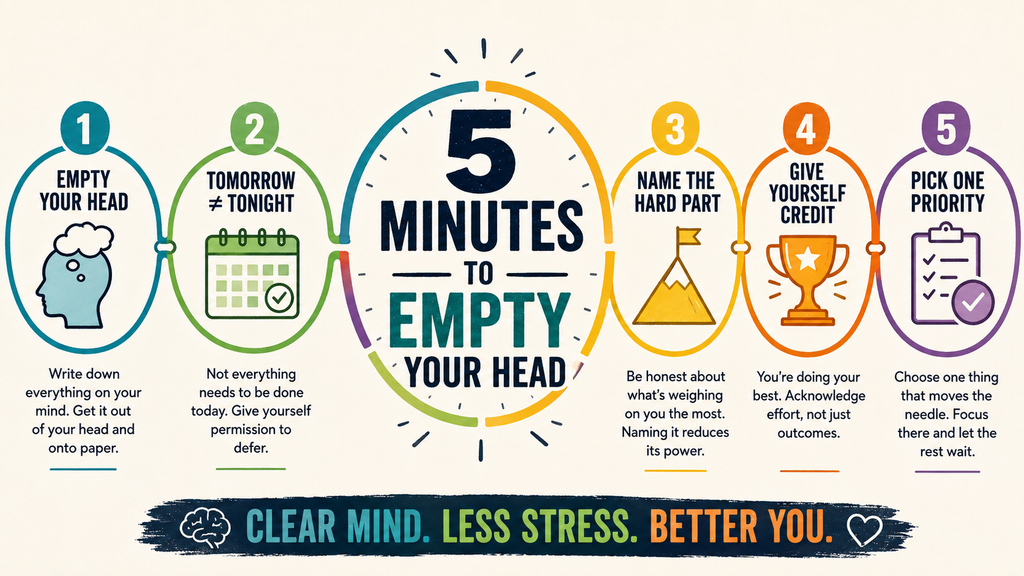
The second tool is even smaller.
Five minutes.
That is it.
The purpose is not to create a perfect bedtime routine.
It is to give your brain a place to put the day’s unfinished business.
Many people climb into bed physically tired but mentally wide awake.
The body is ready to stop.
The brain is not.
It starts replaying conversations.
It remembers tomorrow’s tasks.
It worries about money.
It thinks about work.
It remembers something embarrassing from five years ago for absolutely no useful reason.
Then you try to force yourself to stop thinking.
That usually does not work very well.
Instead, give your thoughts somewhere to go.
Use five minutes.
Minute One: Empty Your Head
Write down whatever is still bouncing around in your mind.
No organization.
No grammar.
No judgment.
Just write.
“Need to call dentist.”
“Work meeting tomorrow.”
“Need groceries.”
“Still annoyed about argument.”
“Worried about money.”
“Need to email John.”
“I don’t know what I’m doing with my career.”
Whatever is there goes onto the page.
Minute Two: Separate Tomorrow From Tonight
Look at the list.
Ask:
“Does this require action tonight?”
Most things will not.
Move tomorrow’s tasks into a short list.
Then give yourself permission to stop working on them.
There is a big difference between:
“I must remember this.”
and
“I have written this down and will deal with it tomorrow.”
The second statement gives your brain something concrete.
You do not have to trust your memory anymore.
The notebook has the job.
Minute Three: Name the Hardest Part of the Day
Write one sentence:
“The hardest part of today was…”
Maybe the answer is work.
Maybe it was a fight.
Maybe it was loneliness.
Maybe you were simply exhausted.
Do not try to solve it.
Name it.
That is all.
Then write:
“What I needed was…”
Maybe you needed rest.
Maybe you needed help.
Maybe you needed reassurance.
Maybe you needed five minutes alone.
Maybe you needed someone to listen.
This tiny exercise can teach you something about your patterns.
If you repeatedly write “I needed rest,” but you never rest, there is a problem worth addressing.
If you repeatedly write “I needed help,” but you never ask for help, there is another problem.
The pattern matters more than any one night’s answer.
Minute Four: Give Yourself Credit
Write down one thing you handled today.
It can be tiny.
You went to work.
You made dinner.
You answered a difficult message.
You got through a rough meeting.
You helped someone.
You took a walk.
You made it through a difficult day without giving up.
This is not about fake positivity.
It is about correcting a common mental habit.
Many people remember what they failed to do and forget what they actually did.
You are allowed to notice your effort.
Minute Five: Choose Tomorrow’s One Priority
Pick one thing that matters tomorrow.
Not ten.
One.
It could be:
- Make the phone call.
- Finish the report.
- Take a walk.
- Have the conversation.
- Pay the bill.
- Spend 20 minutes on the project.
- Ask for help.
You may do more tomorrow.
That is fine.
But choosing one priority prevents tomorrow from becoming another giant cloud of unfinished business.
Then stop.
The five-minute routine is complete.
You do not need to turn it into an hour.
The Rule That Makes the Routine Work
There is one important rule:
Do not use the nightly routine to beat yourself up.
This is not a nightly performance review.
Do not write:
“I failed because I only got three things done.”
Do not write:
“I should have worked harder.”
Do not use the page to create a new list of reasons you are disappointed in yourself.
The purpose is to unload.
If you had a terrible day, you can write:
“Today was terrible. I am tired. Tomorrow I will handle one thing.”
That is enough.
Some nights will be productive.
Some will not.
The routine still works.
How the Book Expands These Strategies
The tools above are useful because they give you something to do.
But a worksheet cannot answer every question.
It cannot tell you why you keep saying yes.
It cannot explain why a friendship suddenly feels different.
It cannot tell you whether the career you built is still the career you want.
It cannot solve loneliness.
It cannot make adult responsibility disappear.
That is where Nobody Told Me About This Part of Adult Life goes deeper.
The book looks at the larger emotional reality behind the daily problems.
*Nobody Told Me About This Part of Adult Life*
The first strategy in this article is awareness.
The book takes that idea further by looking at the things adults often experience but rarely say out loud: feeling lonely while surrounded by people, wondering why friendships fade, carrying constant responsibility, feeling emotionally exhausted without understanding why, and questioning whether you are somehow doing adulthood wrong.
The second strategy is about boundaries.
The book examines the pressure that comes from being responsible, dependable, and constantly available. It looks at what happens when you become “the strong one” and people begin assuming you can handle anything.
The third strategy is about expectations.
This is a major part of adult life.
You may have an image in your head of where you were supposed to be by now.
Maybe you thought you would have more money.
Maybe you thought you would be married.
Maybe you thought you would have a different career.
Maybe you thought your friendships would stay the same.
Maybe you thought adulthood would feel more satisfying.
Then reality arrived.
The book deals with that uncomfortable gap between the life you expected and the life you actually have.
That gap can create a lot of emotional weight.
The book also explores areas that the worksheet cannot fully address, including:
- Why loneliness can exist even when you have people around you
- Why friendships sometimes fade without a dramatic ending
- Why responsibility can feel like it never shuts off
- Why decision fatigue can make simple choices frustrating
- Why emotional exhaustion does not always look like obvious burnout
- Why becoming “the strong one” can become isolating
- Why questioning your life does not automatically mean something is wrong
- Why missing an earlier version of yourself can be part of growing older
- Why adulthood can feel confusing even when everything looks fine from the outside
That is why these tools work best as starting points, not complete solutions.
The emotional load map helps you see what is happening today.
The nightly routine helps you stop dragging every unfinished thought into tomorrow morning.
The book helps you step back and understand the larger picture.
Together, they create a simple process:
Notice it.
Name it.
Sort it.
Do what matters.
Let go of what does not.
Recover.
Repeat.
You do not need to master the process in one week.
You may even discover that your emotional load changes from week to week.
One week, work may be the biggest problem.
The next week, family may take more energy.
Then money.
Then loneliness.
Then nothing in particular—you are simply tired.
That is normal.
Your life is not a spreadsheet.
The goal is not to keep your emotional load at exactly the same level every day.
The goal is to notice when it is becoming too heavy and respond before you are completely buried underneath it.
Make Your Own Version
You can change these tools to fit your life.
If writing by hand annoys you, use your phone.
If five minutes feels like too much, start with two.
If a full emotional load map feels overwhelming, write down three things.
If you prefer checkboxes, use checkboxes.
If you need to talk instead of write, record a private voice memo.
The method is not sacred.
The result is what matters.
You are trying to create a little distance between you and everything demanding something from you.
That distance can give you room to think.
And room to think is valuable when adult life has become one long string of reactions.
Try the load map once this week.
Try the five-minute decompress routine for three nights.
Then ask yourself:
- Did my thoughts feel less scattered?
- Did I forget fewer things?
- Did I notice any repeated sources of stress?
- Did I discover responsibilities that could be shared?
- Did I notice any “shoulds” that are not really mine?
- Did writing things down make it easier to sleep or switch off?
- Did I learn something about what I actually need?
You do not need every answer to be positive.
If the tools do not help, that is information too.
Maybe the problem is bigger than a worksheet.
Maybe you need a conversation.
Maybe you need practical help.
Maybe you need to change something at work or home.
Maybe you need professional support.
The purpose of these tools is not to convince you that every problem can be solved with a piece of paper and five quiet minutes.
It is to give you a place to begin.
Because sometimes the first thing an overwhelmed person needs is not another piece of advice.
They need somewhere to put everything they have been carrying.
A page can be that place.
And once the load is on the page instead of in your head, you can finally look at it and ask the question that matters:
What can I put down?
FAQ
Questions about adult life often sound simple.
The answers are not always simple.
When people hear about emotional load, decision fatigue, boundaries, burnout, or adulting stress, it is easy to wonder whether these ideas actually apply to them. Maybe they think the problem is too small. Maybe they think they are too old. Maybe they think they are too busy. Maybe they have tried self-help before and ended up with a notebook full of advice they never used.
That is exactly why these questions matter.
The point is not to put another label on ordinary life. The point is to make some of the confusing parts of adulthood easier to understand and easier to handle.
Is This Just for Young Adults or for Anyone?
No.
The phrase adulting is often used when talking about younger adults who are learning how to manage money, careers, relationships, housing, and independence.
Those challenges are real.
But the emotional load of adult life does not disappear when you turn 30, 40, 50, 60, or older.
In many cases, responsibilities change rather than disappear.
A 25-year-old might be worried about getting established in a career.
A 35-year-old might be balancing work, children, and housing costs.
A 45-year-old might be dealing with career pressure, teenagers, aging parents, or changing relationships.
A 55-year-old might be thinking about retirement, family responsibilities, health, finances, or what the next part of life should look like.
A 65-year-old might be adjusting to retirement, changes in friendships, family roles, or a completely different daily routine.
The details change.
The underlying experience can be surprisingly similar.
There can still be too many decisions.
Too many expectations.
Too many things to remember.
Too many people who need something.
And sometimes, too little time to simply exist without being responsible for something.
That is why the ideas in this article are not limited to young adults.
The same emotional load can show up at different stages of life.
The important question is not “How old are you?”
It is:
“What are you carrying right now?”
That question makes much more sense.
Someone who looks successful may still feel overwhelmed.
Someone who has been an adult for decades may still feel like they are figuring things out.
Someone with a family may feel lonely.
Someone living alone may feel perfectly content.
Someone with a great career may hate going to work.
Someone with a simple job may love their life.
There is no single adult experience.
That is one of the problems with the idea that everyone eventually “has it all together.”
They do not.
People simply become experienced at different things.
You may know how to manage money but have no idea how to handle a difficult relationship.
You may be excellent at your job but struggle to rest.
You may be great at caring for other people but terrible at asking for help.
You may be confident socially but uncertain about your career.
Nobody gets every part of adulthood right.
That is why Nobody Told Me About This Part of Adult Life is not really about one particular age group. The book explores the less talked-about side of adulthood, including loneliness, responsibility, burnout, fading friendships, emotional pressure, and the strange feeling that you are supposed to understand life better than you actually do.
If you are an adult carrying responsibilities that feel heavier than you expected, the conversation applies to you.
What If I Don’t Have Time for “Self-Care”?
Then do not make self-care another job.
Seriously.
If the phrase “self-care” makes you picture expensive products, long baths, meditation apps, spa days, candles, journals, yoga classes, and an hour of peaceful silence that you simply do not have, forget that picture.
Recovery does not have to look like that.
Sometimes self-care is boring.
Sometimes it is practical.
Sometimes it is going to bed instead of staying up to finish something that can wait.
Sometimes it is eating something before you become completely drained.
Sometimes it is taking ten minutes without your phone.
Sometimes it is asking someone else to handle one task.
Sometimes it is saying no.
Sometimes it is sitting in the car for five minutes before going inside.
Sometimes it is canceling something you agreed to when you had more energy.
Sometimes it is admitting that you are exhausted.
The American Psychological Association recommends practical ways of managing stress that include making time to unwind, maintaining social connection, getting adequate sleep, physical activity, and other healthy coping habits. The important point is that stress management does not require turning your life into a wellness project.
The better question is not:
“How can I fit another self-care activity into my schedule?”
Try:
“Where can I make my life require slightly less from me?”
That could be more useful.
Maybe you stop checking work messages during dinner.
Maybe you prepare a few simple meals instead of trying to cook something impressive every night.
Maybe you shop online instead of spending two hours in a store.
Maybe you ask a family member to take over one regular task.
Maybe you stop volunteering for things you do not have time to do.
Maybe you give yourself permission to have an untidy house for one evening.
That last one can be surprisingly difficult.
Adults often believe that everything must be finished before they are allowed to relax.
But there is always another load of laundry.
Another email.
Another dish.
Another bill.
Another project.
Another thing that needs fixing.
If you wait until everything is finished before resting, you may never rest.
Rest has to exist while life is still unfinished.
That is not laziness.
That is reality.
Can These Ideas Help With Anxiety and Depression?
They may help with some of the daily pressures that can make life feel harder, but they are not a treatment for anxiety or depression.
That distinction matters.
An emotional load map can help you organize worries.
A boundary can reduce some unnecessary demands.
A nightly decompression routine may help create a calmer transition into the evening.
Talking with someone may reduce isolation.
Those are useful actions.
But anxiety and depression can be serious mental health conditions that deserve proper attention.
You should not assume that feeling overwhelmed means you have anxiety or depression.
You also should not assume that someone with anxiety or depression simply needs better organization.
Those are very different things.
The National Institute of Mental Health explains that depression can involve persistent changes in mood and interest along with other symptoms that affect daily functioning, while anxiety disorders involve more than ordinary temporary worry or fear.
If sadness, anxiety, hopelessness, loss of interest, sleep problems, concentration problems, or other symptoms are persistent or are interfering with your daily life, talking with a qualified health professional is a better choice than trying to handle everything alone.
Practical tools can sit alongside professional care.
They should not be presented as a replacement for it.
There is also an important difference between reducing stress and treating a mental health condition.
Reducing unnecessary obligations can make life easier.
It does not cure depression.
Getting better sleep may improve how you feel.
It does not automatically treat an anxiety disorder.
Spending time with people you trust can reduce loneliness.
It does not mean every mental health problem disappears.
This is one place where honest self-help is better than exaggerated promises.
You do not need to believe that one worksheet will change your life.
You only need to ask whether a small action could make today a little easier.
And if things are becoming too difficult to manage, getting professional help is not giving up.
It is support.
How Do I Talk to Family About My Emotional Load?
This can be one of the hardest parts.
Especially if your family is used to you handling everything.
If you suddenly announce, “I am overwhelmed and everyone needs to change,” people may become defensive.
A better approach is to talk about specific problems and specific needs.
Instead of:
“Nobody helps me around here.”
Try:
“I have been handling too many of the household tasks, and I am getting worn out. I need us to divide some of them differently.”
Instead of:
“You people are always asking me for things.”
Try:
“I cannot keep being available every evening. I need some nights where I am not responsible for extra things.”
Instead of:
“You don’t understand how stressed I am.”
Try:
“I have been feeling overloaded lately, and I need you to listen for a few minutes. I am not asking you to fix it.”
Specific language gives people something they can respond to.
It also helps to choose the right moment.
Do not wait until you are furious.
Do not start the conversation in the middle of an argument.
Do not try to explain your entire emotional history while everyone is rushing out the door.
Pick a calmer time.
Then keep the conversation focused.
A simple structure can help:
What is happening:
“I have been feeling overloaded.”
What is causing it:
“I am keeping track of most of the appointments, chores, and scheduling.”
What it is doing to you:
“I am exhausted and becoming short-tempered.”
What you need:
“I need us to split some of these responsibilities.”
That is much easier to understand than a long list of everything everyone has done wrong since 2014.
There is another important point.
Your family may not immediately agree.
They may not understand.
They may have become comfortable with the way things are.
That does not automatically mean your concern is wrong.
A boundary is not a demand that everyone approve of your feelings.
It is a statement about what you can and cannot continue doing.
You may need to repeat yourself.
Calmly.
Clearly.
Without turning every conversation into a fight.
And remember that asking for help does not mean dumping every responsibility onto somebody else.
The goal is a fairer load, not a new person carrying yours.
Will This Feel Too “Self-Help” or Actually Practical?
That depends on what you mean by self-help.
If you mean endless motivational quotes, promises that you can completely transform yourself in seven days, and advice that sounds good but does not survive contact with real life, then hopefully not.
Real life is messier than that.
You may understand exactly what you should do and still struggle to do it.
You may know you need boundaries and still feel guilty setting them.
You may know social media comparison makes you feel bad and still open the app.
You may know you need sleep and still stay up too late.
You may know you should ask for help and still hesitate.
Knowing is not the same as changing.
That is why practical advice needs to account for how people actually behave.
If you are exhausted, the answer cannot always be “try harder.”
Sometimes trying harder is what got you exhausted.
The ideas in this article are intentionally small.
Write down the load.
Choose one boundary.
Remove one unnecessary commitment.
Create five quiet minutes.
Ask one person for help.
Question one “should.”
That is not a dramatic transformation.
It is something you might actually do.
And that is the point.
A useful self-help tool should give you something you can test.
Try it.
See what happens.
Keep what helps.
Change what does not.
Throw out what is useless.
You do not have to believe every piece of advice simply because it appeared in a book or blog post.
Use your own experience as information.
If a five-minute nightly routine makes your evenings calmer, keep it.
If it annoys you, change it.
If a boundary improves your workday, continue it.
If a boundary creates a problem you did not expect, reconsider how you are using it.
There is no prize for following a self-help plan perfectly.
That would turn personal growth into another performance.
And that is exactly what this entire discussion is trying to avoid.
What If I Feel Like I Am Behind in Life?
This question deserves its own answer because it sits underneath many of the others.
Feeling behind can make every part of adulthood feel heavier.
You look around and see people buying homes, getting married, having children, starting businesses, changing careers, traveling, making money, or reaching goals.
Then you look at your own life and think:
“I should be further along.”
But “further along” only makes sense if everyone starts at the same place, has the same resources, wants the same things, and follows the same path.
They do not.
Your life is not late because it looks different.
That does not mean you should ignore genuine problems.
If you hate your job, deal with it.
If you have serious financial problems, look at them.
If a relationship is unhealthy, take it seriously.
If you are lonely, find ways to reconnect.
But do not turn someone else’s timeline into a measuring stick for your worth.
There is a difference between wanting change and believing you are a failure because change has not happened yet.
The first can motivate you.
The second can crush you.
This is one of the uncomfortable truths explored throughout Nobody Told Me About This Part of Adult Life.
There is no universal schedule for feeling settled.
Some people find their direction early.
Some change careers at 40.
Some build families.
Some do not.
Some people love where they live.
Some start over.
Some friendships last decades.
Others disappear and are replaced by new ones.
Some years are full of progress.
Other years are about surviving.
That does not make one person a success and another person a failure.
It makes them different lives.
What If Nothing Seems Wrong, But I Am Still Exhausted?
This may be the hardest question of all.
Because sometimes you look around and think:
“My life is fine. Why don’t I feel fine?”
You have a home.
A job.
People who care about you.
Food.
A safe place to sleep.
Maybe even many things you are grateful for.
And yet you are tired.
That feeling deserves attention without immediately turning it into a diagnosis.
Start by looking at the basics.
Are you sleeping enough?
Are you constantly connected to work?
Are you carrying responsibilities that could be shared?
Are you spending too much time comparing yourself with other people?
Are you getting any time when nobody needs anything from you?
Are you avoiding a problem that keeps returning to your thoughts?
Have your relationships changed?
Have you stopped doing things you enjoy?
Are you saying yes because you want to or because you feel obligated?
Are you recovering from stress, or simply moving from one stressful day into the next?
Sometimes the answer will be obvious.
Sometimes it will not.
And sometimes feeling exhausted despite apparently having “everything together” is a reason to talk with a health professional, especially if the exhaustion is persistent, severe, or comes with other concerning symptoms.
The point is not to find a clever label.
It is to pay attention.
You do not need to prove that your life is bad enough before you are allowed to admit that something feels wrong.
Your emotional load is worth noticing.
Your time is worth protecting.
Your relationships are worth caring for.
Your rest is worth having.
And asking for help is not evidence that you failed at being an adult.
It may simply be evidence that you finally stopped pretending you were supposed to do everything alone.
7-Day Emotional Load Lightening Challenge
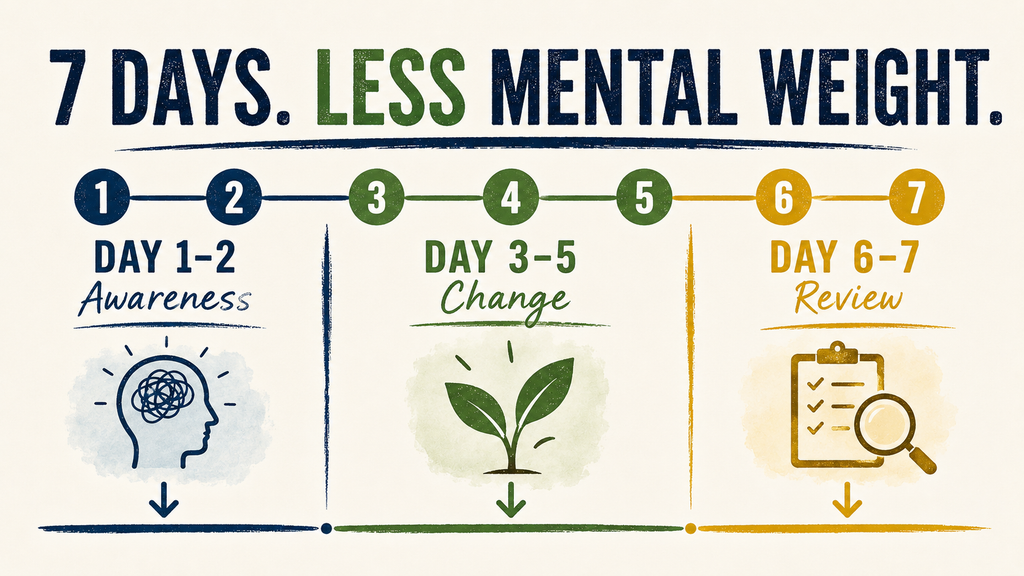
You do not need to change your entire life this week.
That is the first rule.
If you are already carrying a lot, another giant self-improvement plan is probably the last thing you need. You do not need a color-coded schedule, a new morning routine, a dozen apps, or a promise that you will become a completely different person by next Monday.
You need a starting point.
The 7-Day Emotional Load Lightening Challenge is built around a much smaller idea: spend one week paying attention to what is draining you, make a couple of realistic changes, and then see what happens.
That is all.
The goal is not to make every problem disappear. Some problems cannot disappear in seven days. Bills still exist. Work still exists. Family responsibilities still exist. Your inbox will probably still be waiting for you.
What can change is your relationship with some of those demands.
You may discover that one responsibility can be shared.
You may realize that you have been saying yes to things you do not actually have time for.
You may notice that one person, place, habit, or situation is taking much more energy than you realized.
You may find that you are carrying a problem that is not really yours to solve.
Or you may simply discover that you are more tired than you thought.
That information matters.
The challenge uses three stages:
| Days | Focus | Main Goal |
|---|---|---|
| Days 1–2 | Awareness and mapping | Find out what is actually weighing on you |
| Days 3–5 | Two practical strategies | Make small changes instead of trying to fix everything |
| Days 6–7 | Review and adjust | Keep what works and change what does not |
You can do this with a notebook, a sheet of paper, or the notes app on your phone.
You do not need to buy anything.
You do not need to post about it.
You do not need to tell anyone you are doing it.
This is for you.
Days 1–2: Awareness and Mapping
The first two days are about noticing.
That sounds easy.
It is not always easy.
Most people are moving too quickly to notice what is actually bothering them. They know they are tired. They know they are irritated. They know they have too much to do. But the reasons can become one giant blur.
The first day is about catching the blur.
At some point during the day, stop for five minutes and ask yourself:
“What is taking up space in my head right now?”
Write down everything that comes to mind.
Do not organize it at first.
Maybe your list looks like this:
- Work project
- Money
- Need to call the doctor
- Laundry
- Argument with my spouse
- Mother’s birthday
- Car needs an oil change
- I haven’t talked to my friend in weeks
- I hate my job
- Need groceries
- I feel behind
- I haven’t had any time alone
- I need to answer three emails
- I promised to help someone this weekend
The list may look ridiculous.
That is okay.
The point is to see how many separate things your brain is trying to keep track of at the same time.
Then look at the list without trying to solve everything.
Put a mark beside each item:
M for something you must manage.
S for something that could be shared.
W for something that can wait.
L for something you may need to let go of.
This is not about deciding that your problems are unimportant.
It is about deciding which problems deserve your attention right now.
For example, paying an overdue bill may need action.
Remembering that someone made a rude comment three weeks ago probably does not need a three-hour mental meeting tonight.
Those two things can feel equally loud in your head.
They are not equally urgent.
That difference is one of the main reasons mapping works.
On Day 2, repeat the exercise.
But this time, pay attention to patterns.
Ask:
- What keeps appearing on my list?
- Which responsibilities are repeated?
- What am I worried about most?
- What am I avoiding?
- What am I doing that someone else could help with?
- What keeps making me say, “I don’t have time”?
- Where am I saying yes when I really want to say no?
- What part of my day leaves me most drained?
- When do I feel most relaxed?
- What has changed recently?
You may notice something important.
Your emotional load may not come from one enormous problem.
It may come from dozens of small demands that never completely shut off.
One email is not exhausting.
One appointment is not exhausting.
One household chore is not exhausting.
One favor is not exhausting.
But when the brain is constantly switching between work, family, money, errands, relationships, messages, appointments, and unfinished tasks, the combined load can become much harder to manage.
Do not try to fix all of it during these first two days.
That is the temptation.
Resist it.
The first stage is awareness, not repair.
You cannot make a good decision about a load you have never actually looked at.
Days 3–5: Implementing Two Strategies
Now the challenge changes.
You have spent two days noticing the load.
It is time to put down a little of it.
Not all of it.
Just some.
Choose two strategies from the earlier sections of this article.
The best choices are usually the ones that address something you identified during Days 1 and 2.
For example, if your map shows that you are constantly agreeing to things you do not have time for, choose the boundary strategy.
If your list is full of “should” statements, work on reducing outside expectations.
If you never stop working, build a small recovery ritual.
If you are trying to solve everything alone, ask for support.
The important word is two.
Do not choose all six.
You are not taking a final exam.
You are running a small experiment.
Try a Micro-Boundary
Suppose your biggest problem is constant availability.
You might decide:
“I am not checking work messages after 7 p.m. tonight.”
That is a micro-boundary.
It is small.
It is clear.
And you can test it.
Or maybe your problem is family requests.
You might decide:
“Before I agree to a favor this week, I will give myself time to think about it.”
You are not automatically saying no.
You are simply removing the automatic yes.
Maybe your problem is that everyone assumes you will handle household tasks.
Try:
“I am going to ask someone else to take over one regular task this week.”
Again, small.
That is the point.
Try Reducing One “Should”
Look at your emotional load map.
Find one sentence that contains the word should.
“I should call everyone back.”
“I should exercise every day.”
“I should keep the house cleaner.”
“I should be further ahead in my career.”
“I should have more money.”
“I should spend more time with friends.”
“I should be able to handle this.”
Now ask:
“Who says?”
Sometimes the answer is you.
Sometimes it is your family.
Sometimes it is social media.
Sometimes it is an old idea about what successful adulthood is supposed to look like.
Sometimes the expectation is reasonable.
Sometimes it is not.
You do not have to throw every expectation away.
Just question one.
Try a Recovery Ritual
A recovery ritual does not need to be impressive.
Pick something that signals:
The day is slowing down now.
It could be:
- A ten-minute walk
- Sitting outside
- Taking a shower without your phone
- Listening to music
- Reading a few pages
- Making tea
- Stretching
- Calling someone you enjoy talking to
- Sitting quietly in the car before going inside
- Turning off notifications for an hour
The activity itself matters less than the transition.
Your brain needs some indication that it is allowed to stop responding to demands.
If you choose this strategy, protect the ritual from becoming another obligation.
If you miss it one night, nothing has failed.
Try again tomorrow.
Try Asking for Support
If your map contains a problem you have been carrying alone, choose one person who may be able to help.
Do not make the request vague.
Instead of:
“I’m overwhelmed.”
Try:
“Could you take care of dinner Thursday?”
Or:
“Can you listen for ten minutes? I don’t need advice right now.”
Or:
“Would you be able to help me with this task?”
Or:
“Can we split this responsibility differently?”
Specific requests are easier for people to understand.
And remember: asking for support does not guarantee that someone will say yes.
That is okay.
The point is to stop assuming that you must handle everything alone.
Days 6–7: Review and Adjust
The final two days are not about adding more.
They are about looking back.
This part is easy to skip.
People love starting new things.
They are less interested in reviewing what happened.
But review is where the useful information is.
Ask yourself:
What changed?
Maybe nothing changed.
That is information too.
Maybe your new boundary worked better than expected.
Maybe you discovered that one person respected it while another did not.
Maybe asking for help made a task easier.
Maybe it created a conversation you had been avoiding.
Maybe the recovery ritual helped.
Maybe it felt ridiculous.
Maybe writing everything down made you realize that one problem was much bigger than you wanted to admit.
Do not judge the result too quickly.
Look for evidence.
Use a simple table:
| Question | Your Answer |
|---|---|
| What felt lighter? | |
| What still feels heavy? | |
| Which strategy helped most? | |
| Which strategy did not help? | |
| What surprised me? | |
| What do I want to continue? | |
| What can I stop doing? | |
| What do I need help with? | |
| What is one change I can make next week? |
Then look at your original emotional load map.
Compare it with how you feel now.
You might notice that the number of responsibilities did not change much.
But perhaps the mental pressure did.
That counts.
Maybe you stopped checking your phone every few minutes.
Maybe you stopped agreeing to every request immediately.
Maybe you shared one household task.
Maybe you finally wrote down a problem instead of replaying it in your head all night.
Small changes can matter because they create breathing room.
What If the Challenge Does Not Work?
That is allowed.
This challenge is not a test of whether you are good at self-help.
If seven days pass and you still feel completely overwhelmed, do not decide that you failed.
Look closer.
Maybe your emotional load is coming from circumstances that cannot be fixed with small habits.
Maybe you have serious financial pressure.
Maybe your workplace is unhealthy.
Maybe your relationship needs attention.
Maybe you are dealing with grief.
Maybe you are isolated.
Maybe you are struggling with your mental health.
Maybe you simply have more responsibility than one person can reasonably manage.
A seven-day exercise cannot solve every situation.
Sometimes the correct next step is bigger.
That might mean having a serious conversation, changing an arrangement, seeking professional support, getting practical assistance, or making a major decision.
The challenge is meant to help you see the problem more clearly.
Clarity does not always make a problem disappear.
But it can make the next decision easier to see.
The Most Important Rule of the Challenge
Do not turn the challenge into another way to judge yourself.
You do not get extra credit for completing every day.
You do not lose because you forgot Day 4.
You do not need to wake up at 5 a.m., meditate for 30 minutes, drink a green smoothie, exercise, journal, clean your entire house, and become emotionally enlightened before breakfast.
That is not the goal.
The goal is much simpler.
Notice what you are carrying.
Find one thing you can put down.
Protect one small piece of your time.
Ask for help when you need it.
Give yourself permission to be a person instead of a machine that is expected to perform perfectly.
Adult life will still be adult life when the seven days are over.
There will still be bills.
There will still be dishes.
There will still be difficult people.
There will still be decisions.
There will still be days when everything feels like too much.
But perhaps you will know yourself a little better.
Perhaps you will recognize the difference between something that truly needs your attention and something that is simply making noise.
Perhaps you will catch yourself before saying yes automatically.
Perhaps you will notice when you need rest instead of waiting until you collapse into it.
Perhaps you will understand that feeling overwhelmed does not mean you are bad at being an adult.
It may simply mean you have been carrying too much.
And once you know that, you can finally start deciding what deserves to stay in your hands.
Next Steps and Resources
By this point, you may have a better idea of what emotional load actually looks like.
Maybe you recognized yourself in some of it.
Maybe you recognized your spouse, friend, coworker, parent, or adult child.
Maybe you realized that what you called “being tired” has been going on for much longer than you admitted.
Or maybe nothing dramatic happened at all.
Maybe you simply found one thing that has been bothering you and finally gave it a name.
That is enough to start.
The mistake now would be turning everything you have learned into another giant project.
You do not need to fix your entire life this week.
You do not need to rebuild your schedule.
You do not need to become perfectly organized.
You do not need to eliminate every stressful situation.
Adult life does not work that way.
There will always be responsibilities.
There will always be decisions.
There will always be things you would rather not deal with.
The goal is not to create a life with zero pressure.
The goal is to build a life where the pressure does not completely take over.
One Small Boundary to Set This Week
Start with one.
Not five.
Not ten.
One.
A boundary is simply a limit around what you are willing or able to do. It can involve your time, availability, work, relationships, money, attention, or energy.
The best first boundary is usually a small one that solves a real problem.
If your phone keeps pulling you back into work at night, try this:
“I am not checking work messages after 7 p.m.”
If people regularly ask you for favors without giving you time to think, try:
“Let me check my schedule and get back to you.”
If you keep accepting invitations when you are already exhausted:
“I can’t make it this time, but thank you for inviting me.”
If someone expects you to answer every message immediately:
“I may not always respond right away, but I will get back to you when I can.”
If your evenings are filled with tasks:
“Tonight I am doing only what absolutely needs to be done.”
If you keep taking responsibility for another person’s choices:
“I can support you, but I can’t make this decision for you.”
None of these statements is complicated.
That is intentional.
A boundary that requires a five-minute explanation every time you use it may not be the best starting point.
You also do not need to apologize repeatedly.
You can be kind without making your boundary sound like a crime.
There is a difference between:
“I’m so sorry, I feel terrible, I know this is probably selfish, but maybe I can’t…”
and:
“I can’t do that this week.”
The second one is clearer.
It does not mean you care less.
It means you know what you can realistically handle.
There is another important part of setting boundaries: expect some discomfort.
If you are used to saying yes to everything, saying no can feel wrong even when it is reasonable.
That feeling does not necessarily mean the boundary is wrong.
Sometimes it simply means the boundary is new.
You may feel guilty.
You may wonder whether someone is angry.
You may worry that people will think you have changed.
You have changed, at least in one small way.
You are paying attention to your limits.
That is not a bad thing.
Try choosing one boundary from this list:
| If Your Problem Is… | Try This Boundary |
|---|---|
| Work follows you home | Stop checking work messages after a set time |
| Too many favors | Give yourself time before answering |
| Constant phone use | Create one phone-free period each day |
| Too many social commitments | Say no to one event you genuinely cannot handle |
| Household overload | Ask someone else to own one recurring task |
| Constant interruptions | Protect one short block of uninterrupted time |
| Emotional dumping | Decide when you can listen instead of always being available |
| Overcommitting | Stop adding new commitments until you review your schedule |
Do not choose the boundary that sounds most impressive.
Choose the one you are most likely to actually use.
Start With the Book That Inspired This Conversation
If the emotional side of adulthood described in this article sounds familiar, Nobody Told Me About This Part of Adult Life goes further into those experiences.
Read more about Nobody Told Me About This Part of Adult Life.
The book is described as a “Brutally Honest Adult Survival Handbook” and focuses on the parts of adulthood that often receive less attention: loneliness, burnout, fading friendships, constant pressure, decision fatigue, emotional exhaustion, changing identity, and the feeling that you are supposed to have everything figured out. (Ray McNally)
It also takes a practical approach.
The book does not present adulthood as something that needs to be “fixed.” Instead, it focuses on understanding what is happening beneath the surface and finding ways to handle real-life responsibilities without completely losing yourself in them. (Ray McNally)
That makes it a natural next step if you found yourself thinking, “Yes. That’s exactly what I’ve been feeling, but I never knew how to explain it.”
The book is available in multiple formats, including:
The book’s official page also covers subjects such as adult life reality, coping with stress as an adult, emotional burnout, loneliness in adulthood, mental fatigue, personal growth, and why adulthood can feel so difficult. (Ray McNally)
If you are looking for something that treats adulthood as a real, sometimes confusing experience instead of pretending every problem can be solved with positive thinking, that is where the book fits.
Keep the Tools That Actually Help
You do not need to keep every tool from this article.
In fact, you probably should not.
Try them.
Then pay attention.
Maybe the emotional load map helps because you can finally see everything in one place.
Keep it.
Maybe the five-minute nightly routine makes your evenings calmer.
Keep it.
Maybe setting a boundary around work makes your evenings feel like your own again.
Keep it.
Maybe asking someone for help changes more than you expected.
Remember that.
But if something does not work for you, change it.
There is no reason to keep a system simply because someone said it was supposed to help.
That includes the advice in this article.
The point is not to create another set of rules.
The point is to give you useful choices.
A good tool should make life easier, not create another standard you feel guilty about failing to meet.
This is especially important for people who already feel “behind.”
If you already believe you should be doing more, another productivity system can become another weapon against yourself.
You miss a day.
You feel guilty.
You stop using the system.
You decide you failed.
Then you search for a better system.
The cycle starts again.
Instead, try something much simpler.
Keep what works. Drop what does not.
That is a perfectly reasonable approach to self-help.
Related Reading for the Real Problems Behind Adult Stress
Emotional load does not exist in isolation.
Sometimes the thing keeping you awake is not your schedule.
It may be anxiety.
Sometimes the problem is not that you need a better task list.
It may be that you are afraid of something.
Sometimes the exhaustion is not simply because you have too much to do.
It may be because you have spent months or years operating under constant pressure.
That is why it can help to explore the specific problem underneath the larger feeling.
For example, if nighttime worry is part of your emotional load, Quiet the Mind: Sleep Help for Anxiety focuses on nighttime anxiety and the difficulty of getting your mind to settle.
If you find yourself constantly worried about physical sensations and wondering whether something terrible is happening, This Is Anxiety, Not Death addresses that particular fear cycle.
These subjects overlap with adult stress, but they are not all the same problem.
That distinction is important.
You do not need to force every problem into one explanation.
Sometimes you are overwhelmed because you have too much responsibility.
Sometimes you are lonely.
Sometimes you are anxious.
Sometimes you are burned out.
Sometimes you are simply going through a difficult period of life.
And sometimes several of those things are happening at once.
Understanding which problem you are actually dealing with makes it easier to choose the right response.
Build a Personal “When Life Gets Heavy” Plan
One useful thing you can do after reading this article is create a very short plan for yourself.
Keep it somewhere easy to find.
It might look like this:
| When I Notice… | I Will… |
|---|---|
| I am saying yes automatically | Wait before answering |
| My thoughts are racing | Write them down |
| I feel overloaded | Make an emotional load map |
| I am becoming irritable | Take a short break and check what is draining me |
| I am avoiding everything | Choose one small next step |
| I cannot handle everything alone | Ask one person for specific help |
| Work is taking over my evening | Protect a stopping time |
| I feel like I am behind | Stop comparing my timeline with someone else’s |
| I have been exhausted for a long time | Consider talking with a qualified professional |
The point is not to follow the chart perfectly.
It is there for the days when your brain is too tired to figure out what to do.
That happens.
When you are overwhelmed, even deciding what to do about being overwhelmed can become another decision.
A simple plan removes some of that work.
You Do Not Have to Carry Everything at Once
There is an idea worth taking with you from this entire discussion:
You can care about something without carrying all of it.
You can love your family without solving every family problem.
You can care about your job without being available every minute.
You can support a friend without becoming responsible for their entire life.
You can want a better future without hating your current life.
You can admit that you are struggling without deciding that you are failing.
You can be grateful for what you have and still admit that something is difficult.
Those things can exist together.
Adult life is rarely one clean emotion.
You can be happy and exhausted.
Successful and lonely.
Grateful and frustrated.
Loved and overwhelmed.
Confident at work and completely unsure about your personal life.
That does not make you fake.
It makes you human.
The goal is not to remove every difficult feeling.
The goal is to stop allowing every difficult feeling to become another responsibility you believe you must solve immediately.
Sometimes the next step is very small.
Make the phone call.
Write the list.
Ask for help.
Turn off the notifications.
Say no.
Go outside.
Go to bed.
Have the conversation.
Make the appointment.
Put the problem on paper.
Then deal with the next thing.
Not everything.
The next thing.
Stay Connected for More Practical Tools
If this article helped you put words to something you have been experiencing, the best next step is not necessarily another giant change.
Keep learning.
Keep noticing your patterns.
Keep looking for practical ways to make real life a little more manageable.
You can visit the official Ray McNally blog for additional articles covering everyday struggles, personal growth, anxiety, stress, writing, publishing, and other real-life topics.
You can also explore the complete collection of books by Ray McNally to find other practical guides that may fit what you are dealing with right now.
And if you have been feeling like adulthood is harder than someone promised it would be, remember this:
You are not required to prove that you can carry everything.
You are allowed to put something down.
You are allowed to change your mind.
You are allowed to ask for help.
You are allowed to build a life that works for the person you actually are instead of constantly chasing the life you think you are supposed to have.

Sometimes making adult life better does not begin with doing more.
It begins with deciding what no longer deserves to take so much from you.