

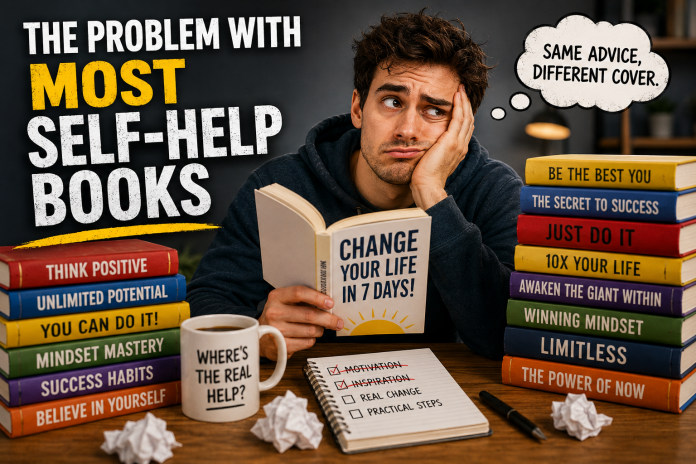
Why readers are becoming skeptical of motivational advice and what actually helps people change.

The Problem With Most Self-Help Books
Walk into any bookstore and you’ll find entire shelves packed with self-help books promising a better life. They promise more confidence, more success, more happiness, more money, stronger relationships, and better habits. The covers are often bold. The titles are ambitious. The testimonials sound life-changing.
Yet something strange keeps happening.
Millions of people buy these books every year, read them, feel excited for a few days or weeks, and then quietly return to the same struggles they had before.
This raises an uncomfortable question: why self-help books don’t work for so many people?
The answer isn’t that personal growth is impossible. People change every day. They overcome addictions, improve relationships, lose weight, start businesses, and rebuild their lives after devastating setbacks.
The problem is that many self-help books accidentally create the illusion of change rather than supporting real change.
Readers often finish a chapter feeling inspired but have no idea what to do next. They are given motivational stories, catchy phrases, and powerful promises, but very little guidance for dealing with the messy reality of everyday life.
Real life is complicated.
People get tired. They get discouraged. They face health problems, financial stress, family responsibilities, and unexpected setbacks. They don’t live inside the controlled environment that many self-help books seem to assume.
A parent working two jobs doesn’t have the same opportunities as a millionaire entrepreneur with unlimited resources.
Someone dealing with chronic pain doesn’t have the same daily challenges as a healthy twenty-year-old influencer.
Someone struggling with depression may not be able to simply “choose happiness” because a chapter told them to.
When advice ignores these realities, readers begin to feel disconnected from the author.
Instead of feeling understood, they feel judged.
Instead of feeling encouraged, they feel inadequate.
Over time, that disconnect has created growing skepticism toward the self-help industry.
People are becoming more cautious about grand promises and miracle solutions. They have heard them before.
Many readers are no longer looking for someone to tell them they can conquer the world by next Tuesday.
They simply want advice that feels honest.
Why So Many Self-Help Books Feel Empty
One of the biggest complaints readers have about modern self-help books is that they feel strangely hollow.
The words may sound powerful.
The stories may be dramatic.
The lessons may seem important.
But when the book is finished, very little actually sticks.
Part of the problem comes from focusing on emotional highs instead of practical change.
Many books are designed to create excitement. The reader feels energized while reading because the author uses inspirational language and success stories that trigger hope.
Hope is valuable.
But hope alone doesn’t create lasting transformation.
A person can feel deeply motivated on Sunday night and completely overwhelmed by Wednesday morning.
That emotional crash happens because inspiration is temporary.
Real growth requires systems, habits, and repetition.
Psychologist James Clear has often emphasized that outcomes are largely driven by systems rather than goals. This idea resonates with readers because it focuses on action instead of emotion.
When books spend hundreds of pages discussing mindset but only a few paragraphs discussing practical implementation, readers are left with inspiration but no roadmap.
The result is similar to watching a sports movie.
You may leave feeling energized.
You may even feel ready to change your life.
But eventually the emotional effect fades.
Then you’re back to reality.
Readers increasingly recognize this pattern.
They know the difference between feeling motivated and actually making progress.
That awareness is one reason many traditional self-help books no longer have the same influence they once enjoyed.
Recycled Advice
Another major reason readers have become skeptical is the endless recycling of the same ideas.
After reading enough self-help books, many people begin noticing a pattern.
Different authors.
Different covers.
Different marketing.
The same advice.
Wake up earlier.
Think positively.
Set goals.
Believe in yourself.
Visualize success.
Work harder.
Stay focused.
These ideas are not necessarily wrong.
In fact, many of them can be useful.
The problem is repetition without deeper insight.
Readers who purchase a new book expect new perspectives.
Instead, they often discover familiar advice wrapped in fresh branding.
The experience can feel frustrating.
Imagine buying ten different cookbooks only to discover every recipe starts with the same ingredients.
Eventually you’d stop buying cookbooks.
The same thing happens with personal development content.
Many authors draw from the same pool of concepts, studies, stories, and success examples. Over time, readers notice.
This has become even more obvious in the internet age.
Today people can watch podcasts, interviews, YouTube videos, TED Talks, newsletters, and blogs discussing personal growth.
Because information is everywhere, simply repeating old advice is no longer enough.
Readers want nuance.
They want context.
They want solutions that acknowledge modern challenges.
A worker facing economic uncertainty may need different advice than someone writing a self-help book from a beachfront office.
A caregiver raising children and supporting aging parents faces a different reality than a productivity expert with complete control over their schedule.
Generic advice often fails because it assumes everyone is playing the same game.
People know that’s not true.
The most respected self-help writers today tend to succeed because they add context, honesty, and practical realism rather than repeating motivational clichés.
Fake Positivity
Perhaps the biggest reason readers are losing trust in self-help books is the rise of fake positivity.
Positive thinking has value.
Optimism can help people persevere during difficult times.
Hope can provide strength when circumstances feel overwhelming.
But fake positivity is different.
Fake positivity refuses to acknowledge pain.
It treats struggle as weakness.
It dismisses genuine hardship with simplistic slogans.
Readers have grown tired of being told that every setback is secretly a blessing.
They are exhausted by messages suggesting that negative emotions should simply disappear if they adjust their attitude.
Life doesn’t work that way.
People experience grief.
They experience fear.
They experience disappointment.
They experience uncertainty.
Those emotions are part of being human.
Research from organizations such as the American Psychological Association has repeatedly shown that emotional acceptance is healthier than emotional suppression.
Ignoring difficult feelings does not eliminate them.
It often makes them stronger.
Modern readers understand this intuitively.
They don’t want books that pretend life is easy.
They want books that acknowledge reality while still offering hope.
The most trusted voices in personal growth today are often those who openly discuss failure.
They share mistakes.
They admit uncertainty.
They talk honestly about setbacks.
That honesty creates credibility.
Readers are more likely to trust someone who says, “This was hard, and I struggled too,” than someone who claims they found a secret formula for success.
Authenticity feels real.
Perfection feels suspicious.
That shift may be the biggest change happening in self-help today.
People are no longer searching for flawless gurus.
They are searching for relatable guides.
They don’t expect perfection.
They expect honesty.
And that expectation is reshaping what successful self-help writing looks like in the modern world.
The future belongs less to authors who promise miraculous transformations and more to those willing to tell the truth: meaningful change is possible, but it is usually slower, messier, and far less glamorous than most self-help books would have us believe.
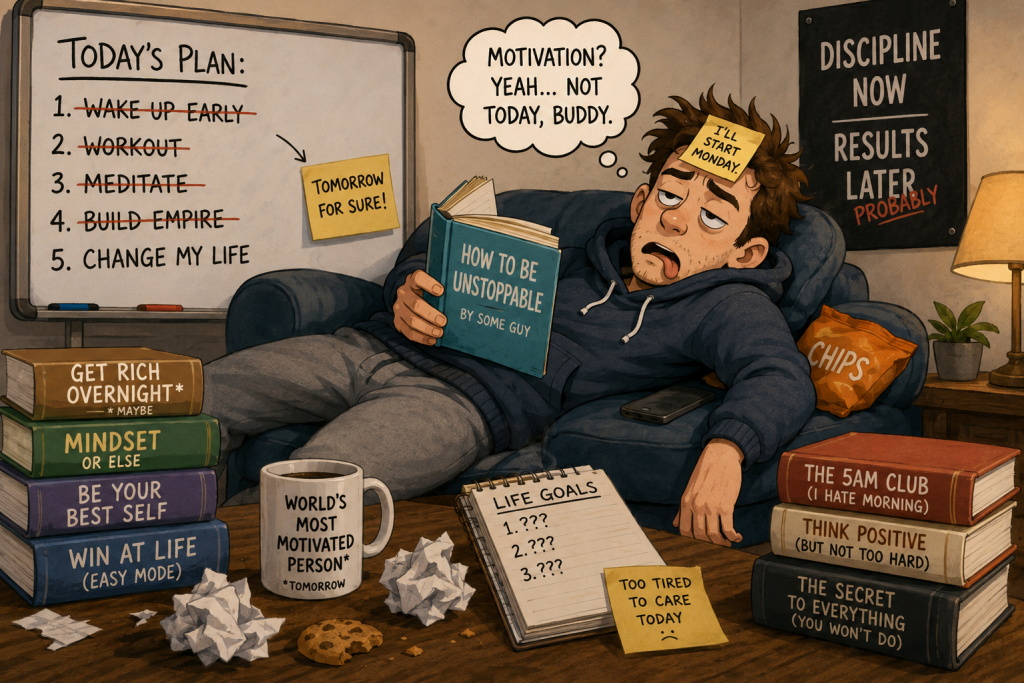
Why Self-Help Advice Often Fails
Most people do not buy self-help books because they enjoy collecting advice.
They buy them because they want something in their lives to improve.
Maybe they want to lose weight.
Maybe they want more confidence.
Maybe they want to stop procrastinating, earn more money, improve a relationship, or finally achieve a goal they have been putting off for years.
The desire is real.
The effort is real.
Yet many readers eventually find themselves asking the same question:
“If this advice is so good, why isn’t it working?”
This question sits at the heart of why self-help books don’t work for many people.
The issue is rarely that the reader is lazy or incapable.
More often, the advice itself does not survive contact with real life.
What sounds powerful in a quiet room with a cup of coffee often becomes much harder when bills are due, children are sick, work is stressful, and life refuses to cooperate.
Many self-help books are built around ideal conditions.
Real people live in imperfect conditions.
That gap explains why so many readers start strong but struggle to maintain momentum.
Motivation vs Real Life
Motivation is one of the most misunderstood concepts in personal development.
Most self-help books treat motivation like fuel.
They assume that if a person becomes motivated enough, everything else will fall into place.
Unfortunately, real life tells a different story.
Motivation is helpful.
But motivation is unreliable.
Some days people wake up feeling energized and optimistic.
Other days they wake up tired, stressed, frustrated, or discouraged.
If progress depends entirely on motivation, progress becomes unpredictable.
Consider a simple example.
A person reads a motivational book on Sunday.
They feel excited.
They create goals.
They make plans.
They imagine a better future.
By Monday morning, they are ready to change their life.
Then reality arrives.
The alarm clock rings too early.
Work is stressful.
Traffic is frustrating.
A child gets sick.
Unexpected expenses appear.
Energy disappears.
Suddenly the motivational advice that seemed life-changing yesterday feels difficult to follow.
This doesn’t mean the person failed.
It means they are human.
One reason self-help advice often fails is that it assumes people will always operate at their best.
Real people rarely operate at their best every day.
Successful habits are usually built during ordinary days, not extraordinary ones.
The challenge isn’t maintaining discipline when everything is going well.
The challenge is maintaining it when things go wrong.
The following table highlights the difference:
| Self-Help Fantasy | Real Life Reality |
|---|---|
| Every day feels productive | Some days feel exhausting |
| Motivation stays high | Motivation comes and goes |
| Progress happens quickly | Progress is often slow |
| Setbacks are rare | Setbacks are common |
| Confidence comes first | Action often comes first |
This is why practical systems outperform motivational speeches.
A person who exercises because it is part of their routine will often outperform someone who exercises only when they feel inspired.
A person who saves money automatically every month will usually do better than someone who waits until they feel financially motivated.
The truth is simple.
Motivation can start a journey.
It rarely finishes one.
Why Inspiration Fades Quickly
Have you ever finished a book and felt like you could accomplish anything?
Many readers know this feeling.
A powerful chapter creates excitement.
A success story creates hope.
An inspiring quote seems to unlock something inside you.
For a brief moment, change feels easy.
Then a few days pass.
The emotional high fades.
Life becomes normal again.
This is not a personal failure.
It is actually how human psychology works.
Research from the American Psychological Association has repeatedly shown that emotions naturally rise and fall over time. Excitement is temporary. Inspiration is temporary. Even happiness itself fluctuates.
Many self-help books accidentally create what could be called “borrowed momentum.”
The reader absorbs the author’s energy.
The author’s confidence becomes contagious.
The author’s success story feels inspiring.
For a while, that emotional energy carries the reader forward.
But eventually the book ends.
The author is no longer speaking directly to them.
The excitement fades.
What remains is reality.
This is where many personal development plans collapse.
The reader mistakenly believed motivation would last forever.
Instead, it lasted a few days.
A famous quote often attributed to motivational speaker Zig Ziglar says:
“People often say that motivation doesn’t last. Well, neither does bathing—that’s why we recommend it daily.”
While humorous, the quote highlights an important truth.
Motivation is not permanent.
It requires continual renewal.
The problem is that many self-help books sell motivation as though it were a permanent transformation.
Readers expect a breakthrough.
What they experience is a temporary boost.
The difference matters.
Consider how quickly people lose enthusiasm after:
- New Year’s resolutions
- Fitness challenges
- Productivity systems
- Diet programs
- Financial goals
- Personal improvement plans
The pattern is remarkably similar.
Initial excitement.
Strong effort.
Gradual decline.
Eventual abandonment.
This cycle is so common that psychologists sometimes refer to it as the “motivation trap.”
People keep searching for a stronger emotional spark when what they actually need is a sustainable process.
The most successful people are often not the most motivated.
They are the most consistent.
They continue taking small actions even after inspiration disappears.
That lesson rarely makes for a flashy book title, but it reflects reality far more accurately than promises of instant transformation.
The Problem With Unrealistic Expectations
Another major reason self-help advice often fails is because it creates unrealistic expectations.
Many books unintentionally convince readers that change should happen quickly.
This expectation creates frustration.
People expect:
- Rapid success
- Immediate confidence
- Fast results
- Permanent happiness
- Complete transformation
Real life rarely works this way.
Most meaningful change happens slowly.
Learning new skills takes time.
Building confidence takes time.
Improving relationships takes time.
Recovering from failure takes time.
Changing habits takes time.
Readers who expect dramatic results often become discouraged when progress looks ordinary.
This creates a dangerous cycle.
The reader follows advice.
Results appear slowly.
The reader assumes something is wrong.
The reader quits.
The real problem wasn’t lack of progress.
The real problem was unrealistic expectations.
A useful comparison is planting a tree.
Nobody plants a tree on Monday and expects shade by Friday.
Growth takes time.
Personal growth works the same way.
Yet many self-help books market themselves as shortcuts.
They promise dramatic outcomes in surprisingly short periods.
Common promises include:
| Common Promise | Reality |
|---|---|
| Change your life in 30 days | Real change may take years |
| Unlock your potential instantly | Growth is gradual |
| Eliminate self-doubt forever | Self-doubt returns occasionally |
| Become unstoppable | Everyone struggles sometimes |
| Never fail again | Failure remains part of growth |
Readers are increasingly aware of these exaggerated claims.
That awareness is one reason many people are becoming skeptical of motivational advice.
They have seen too many promises fail to match reality.
Today, readers are looking for something different.
They want honesty.
They want realistic expectations.
They want guidance that respects the complexity of human behavior.
Many of the most respected voices in modern personal development focus less on dramatic transformation and more on gradual improvement.
Instead of promising perfection, they encourage progress.
Instead of promising certainty, they acknowledge uncertainty.
Instead of promising instant success, they discuss patience.
This shift reflects a deeper truth about why self-help books don’t work for so many people.
The issue is not that people are incapable of change.
The issue is that lasting change is often slower, messier, and more complicated than the self-help industry has traditionally been willing to admit.
When readers finally understand that reality, something interesting happens.
They stop chasing magical solutions.
They stop searching for the next motivational breakthrough.
And they begin focusing on small actions that can actually survive the challenges of everyday life.
Ironically, that is often the moment real progress finally begins.

What Readers Actually Want
For years, the self-help industry focused on motivation.
Authors tried to inspire readers with success stories, powerful slogans, and promises of dramatic transformation.
Sometimes it worked.
Often it didn’t.
As readers became more experienced, many started noticing a pattern. The books that stayed with them were not always the most motivational. They were the most relatable.
The books that made a lasting impact were usually written by people who felt real.
Not perfect.
Not superhuman.
Not endlessly positive.
Just real.
This shift helps explain why self-help books don’t work for many readers anymore. The audience has changed.
People have heard enough speeches about unlimited potential.
They have read enough stories about waking up at 4:00 a.m., building a billion-dollar company, and achieving impossible goals.
What many readers want now is something much simpler.
They want honesty.
They want understanding.
They want practical guidance from someone who understands how difficult life can sometimes be.
Modern readers are not looking for perfection.
They are looking for connection.
That difference changes everything.
Readers Want Honesty
Honesty has become one of the most valuable qualities in modern self-help writing.
Readers are tired of feeling like every author has a perfect life.
They know better.
Everyone struggles.
Everyone fails.
Everyone makes mistakes.
When authors pretend otherwise, trust begins to disappear.
Today’s readers can often sense when a book feels overly polished or artificially positive.
They recognize when challenges are being minimized.
They notice when failures are conveniently skipped over.
And they often stop listening.
By contrast, honest writing creates credibility.
When an author admits:
- “I struggled with this.”
- “I made mistakes.”
- “This took years.”
- “I still don’t have everything figured out.”
Readers tend to lean in closer.
Those statements feel believable.
The truth is that honesty creates trust faster than expertise.
An author can have impressive credentials, but if the writing feels disconnected from reality, readers may struggle to relate.
Meanwhile, someone with fewer accomplishments but greater authenticity can create a powerful connection.
A great example can be found in many popular memoirs and personal development books today. Readers frequently praise books not because the author succeeded, but because the author openly discusses how difficult the journey was.
The following table highlights the difference:
| Traditional Self-Help Approach | What Readers Want Today |
|---|---|
| I have all the answers | I’m still learning too |
| Success was inevitable | Success was messy |
| Failure is weakness | Failure teaches lessons |
| Think positive constantly | Feel your emotions honestly |
| Follow my exact formula | Find what works for you |
This shift reflects a larger cultural change.
People are surrounded by carefully edited social media posts.
They see filtered photos.
They see highlight reels.
They see success stories without context.
As a result, authenticity stands out more than ever.
According to research published by the Pew Research Center, people increasingly value authenticity and transparency from public figures, brands, and creators. That same expectation extends to authors.
Readers don’t expect perfection.
They expect truth.
A book that honestly acknowledges uncertainty can often be more powerful than a book filled with certainty.
Ironically, admitting limitations often makes advice more believable.
When an author says, “This worked for me, but your situation may be different,” readers feel respected.
When an author says, “Do exactly this and your life will change,” many readers become skeptical.
Honesty does not weaken a message.
It strengthens it.
Vulnerability Builds Trust
There is a word that appears more and more often in discussions about effective self-help writing.
That word is vulnerability.
For a long time, vulnerability was viewed as weakness.
Many self-help books focused on confidence, strength, certainty, and control.
Authors presented themselves as people who had conquered every obstacle.
Today, readers often respond more strongly to vulnerability than to confidence.
Why?
Because vulnerability feels human.
When an author shares a difficult experience, readers recognize something familiar.
They see themselves.
The best self-help books often contain moments where the writer admits fear, doubt, embarrassment, failure, or confusion.
Those moments create emotional connection.
Researcher and author Brené Brown became widely known for exploring the importance of vulnerability in human connection. Her work resonated with millions because it challenged the idea that strength requires emotional perfection.
One of her most quoted statements is:
“Vulnerability is the birthplace of innovation, creativity and change.”
Readers connect with vulnerability because it removes the distance between author and audience.
Instead of standing on a stage giving instructions, the author sits beside the reader and shares an experience.
That subtle difference changes how advice is received.
Consider these two examples:
Example One
“I never struggled with confidence. Here’s exactly how to become confident.”
Example Two
“I struggled with confidence for years. Here’s what gradually helped me improve.”
Most readers instinctively trust the second statement more.
Not because the advice is necessarily better.
But because the person giving it feels more relatable.
Vulnerability signals honesty.
It signals humility.
It signals authenticity.
These qualities matter because self-improvement is deeply personal.
Readers are often dealing with:
- Anxiety
- Financial stress
- Relationship problems
- Career uncertainty
- Health challenges
- Fear of failure
When an author openly discusses similar struggles, readers feel understood.
And feeling understood is often the first step toward meaningful change.
Real Struggles Matter
Perhaps the biggest lesson the self-help industry is learning today is that real struggles matter.
For years, many books focused almost entirely on success.
Success stories are inspiring.
But they can also feel distant.
Readers may admire someone who built a business empire or achieved extraordinary wealth.
They may even feel motivated by the story.
But motivation alone does not create connection.
Connection often comes from shared struggle.
People want to know:
- What happened when things went wrong?
- What mistakes were made?
- What failures occurred?
- What doubts appeared?
- What obstacles almost ended the journey?
Those details matter because they reflect reality.
Life rarely follows a straight path.
Most people experience setbacks far more often than breakthroughs.
The challenge with many traditional self-help books is that they spend hundreds of pages describing success and very little time discussing failure.
That imbalance creates unrealistic expectations.
Readers start believing that successful people rarely struggle.
Nothing could be further from the truth.
Look at the biographies of entrepreneurs, athletes, artists, scientists, and leaders.
Failure appears everywhere.
Mistakes appear everywhere.
Uncertainty appears everywhere.
The difference is not the absence of struggle.
The difference is how people respond to struggle.
Readers increasingly want books that acknowledge this reality.
They want authors who understand:
- Motivation fades.
- Confidence fluctuates.
- Progress is uneven.
- Setbacks happen.
- Growth takes time.
This desire for realism is one reason books focused on habits, psychology, resilience, and behavioral science have gained popularity.
Readers appreciate practical insights that acknowledge complexity.
For example, resources from the American Psychological Association often discuss human behavior in ways that recognize both strengths and limitations. This balanced perspective tends to resonate more than simplistic motivational messages.
People don’t need another promise that life will become easy.
They know life will continue to be challenging.
What they want is guidance that helps them navigate those challenges more effectively.
The most successful self-help books of the future will likely be those that combine hope with realism.
Not false optimism.
Not endless negativity.
A balance between the two.
Readers want encouragement, but they want honest encouragement.
They want optimism grounded in reality.
They want stories that include failure as well as success.
They want advice that recognizes how complicated life can be.
Most importantly, they want authors who treat them like intelligent human beings rather than broken people waiting to be fixed.
That may be the most important answer to the question of why self-help books don’t work for so many readers.
Many books spend too much time telling people what they should become.
The books that truly connect spend more time understanding who people already are.
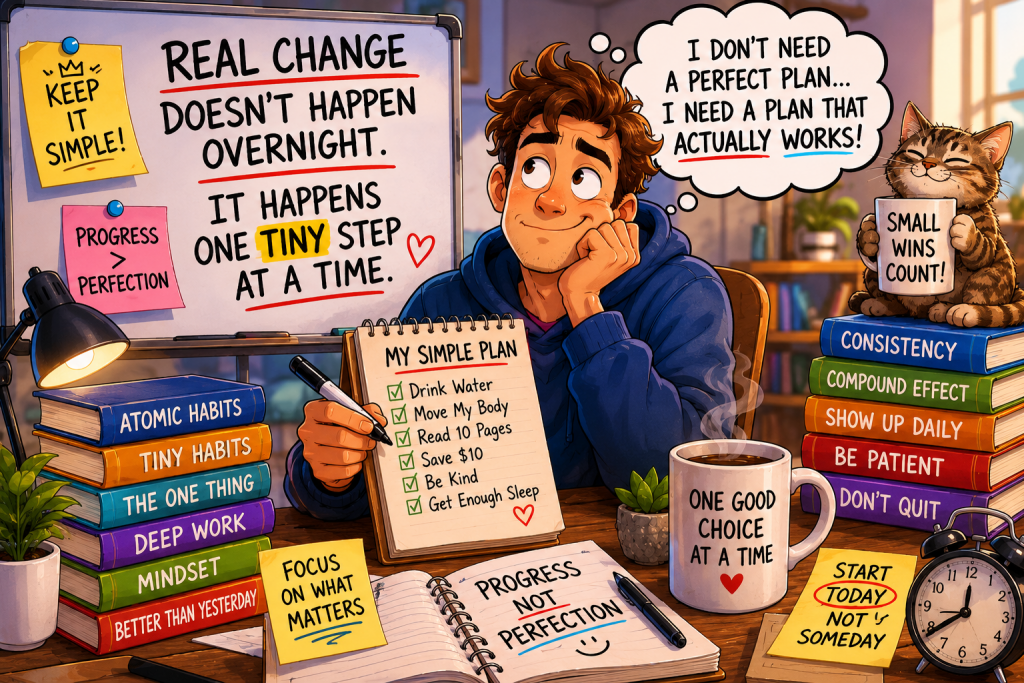
What Actually Helps People Change
If most motivational advice is not enough, what actually creates lasting change?
This is where many self-help books get things wrong.
They spend hundreds of pages discussing mindset, inspiration, success stories, and big goals, but very little time explaining how change really happens.
Real change is rarely dramatic.
It usually does not happen in a single breakthrough moment.
It does not arrive because someone heard the perfect quote.
It does not appear because someone read one great book.
Most meaningful change happens through small actions repeated consistently over time.
That answer may sound less exciting than promises of instant transformation, but it reflects reality far more accurately.
The reason many readers eventually become frustrated with self-help books is that they are searching for results, not inspiration.
They want to know what actually works.
They want practical tools they can use on an ordinary Tuesday afternoon when motivation is gone and life feels messy.
They want advice that survives real life.
The good news is that researchers have spent decades studying behavior change, habit formation, and personal growth.
The findings are surprisingly consistent.
People change when they take small actions repeatedly.
People change when progress becomes sustainable.
People change when systems become stronger than emotions.
That may not sell as many books as a promise to “unlock your limitless potential,” but it is far closer to the truth.
Small Practical Steps
One reason many self-help books fail is that they encourage people to think too big too soon.
The reader becomes excited.
They decide to change everything at once.
They create enormous goals.
They redesign their entire life.
Then they become overwhelmed.
This pattern is extremely common.
Someone decides to:
- Wake up two hours earlier.
- Exercise every day.
- Read fifty books per year.
- Start a side business.
- Eat perfectly.
- Meditate daily.
- Eliminate all distractions.
The plan looks impressive.
The problem is that it is rarely sustainable.
Within a few weeks, exhaustion appears.
Life becomes complicated.
The system collapses.
The person assumes they failed.
In reality, the goal was simply too large.
Research consistently shows that smaller changes are easier to maintain because they require less mental energy.
The popular concept of habit stacking, discussed by authors like James Clear, reflects this idea.
Rather than attempting massive transformations, people attach small behaviors to routines they already perform.
For example:
| Large Goal | Smaller Practical Step |
|---|---|
| Read 50 books this year | Read 5 pages today |
| Run a marathon | Walk for 10 minutes |
| Save $10,000 | Save $5 today |
| Meditate daily | Sit quietly for 2 minutes |
| Become healthier | Drink one extra glass of water |
Notice how simple these actions are.
That simplicity is not a weakness.
It is the entire point.
Small actions reduce resistance.
When something feels easy, people are more likely to do it consistently.
The problem with many self-help books is that they focus heavily on outcomes.
Readers become obsessed with where they want to go.
What often matters more is creating actions that can actually be repeated.
A useful question is not:
“What would change my life?”
A better question is:
“What can I realistically do today?”
That shift may seem minor, but it changes everything.
People often underestimate the power of tiny improvements.
A single healthy meal does not transform a person’s health.
A single workout does not create fitness.
A single productive day does not build a successful career.
But repeated actions eventually create meaningful results.
The following habits often appear insignificant in the moment:
- Taking a short walk
- Reading a few pages
- Writing one paragraph
- Saving a few dollars
- Going to bed slightly earlier
- Spending ten minutes learning a skill
Yet these actions accumulate over time.
The results become visible months later.
This is one reason practical advice often outperforms motivational advice.
Practical advice gives readers something they can actually do.
Motivational advice often leaves them wondering where to start.
Consistency Over Hype
If there is one lesson that separates meaningful self-improvement from empty self-help promises, it is this:
Consistency beats intensity.
Again and again.
Many self-help books celebrate dramatic effort.
Readers hear stories about entrepreneurs working twenty hours per day or athletes pushing themselves beyond normal limits.
While these stories can be inspiring, they often create unrealistic expectations.
Most people do not need extraordinary effort.
They need sustainable effort.
A person who exercises moderately three times every week for five years will usually achieve better results than someone who exercises intensely every day for three weeks before quitting.
The same principle applies almost everywhere.
Consistency matters more than occasional bursts of enthusiasm.
Consider the following comparison:
| Hype-Based Approach | Consistent Approach |
|---|---|
| Extreme diet for 30 days | Better food choices long term |
| Daily motivation videos | Daily action regardless of mood |
| Massive goals | Repeatable habits |
| Intense effort followed by burnout | Moderate effort maintained |
| Perfection | Progress |
This distinction helps explain why self-help books don’t work for many readers.
Too many books focus on emotional intensity.
They create excitement.
They create urgency.
They create momentum.
But they often fail to teach sustainability.
The truth is that lasting change is frequently boring.
That may sound disappointing, but it is incredibly important.
Healthy habits are often repetitive.
Financial discipline is repetitive.
Learning new skills is repetitive.
Building strong relationships is repetitive.
Progress usually comes from doing simple things consistently rather than doing extraordinary things occasionally.
This principle is supported by decades of behavioral research. Organizations such as the American Psychological Association regularly publish findings showing that long-term behavioral change is strongly connected to habit formation, routine, and environmental support rather than momentary inspiration.
Readers who understand this often experience a major mindset shift.
They stop chasing motivation.
They stop searching for the perfect system.
They stop waiting for ideal conditions.
Instead, they focus on repetition.
A useful way to think about personal growth is through the concept of votes.
Every action is a vote for the type of person you want to become.
One healthy meal is a vote for better health.
One writing session is a vote for becoming a writer.
One workout is a vote for becoming more fit.
One difficult conversation is a vote for improving a relationship.
No single vote decides the outcome.
But over time, the votes add up.
That perspective removes much of the pressure that self-help culture often creates.
People no longer need perfect days.
They simply need more positive votes than negative ones.
Perhaps the biggest misunderstanding in personal development is the belief that successful people feel motivated all the time.
They do not.
Successful people experience the same emotions as everyone else.
They feel tired.
They feel discouraged.
They doubt themselves.
They lose momentum.
The difference is that many have learned how to continue moving forward even when motivation disappears.
That skill is far more valuable than inspiration.
Inspiration comes and goes.
Consistency stays.
And that is the truth many readers are beginning to discover.
The books that create lasting impact are not necessarily the ones that generate the strongest emotional reaction.
They are the ones that help readers build practical systems they can follow when life becomes difficult.
Because in the end, meaningful change is rarely about finding the perfect motivational message.
It is about creating simple actions that can be repeated long after the excitement fades.
That is where real transformation lives.
Not in hype.
Not in promises.
Not in slogans.
But in the ordinary decisions people make every day, often without anyone noticing, until those small decisions eventually become a different life.
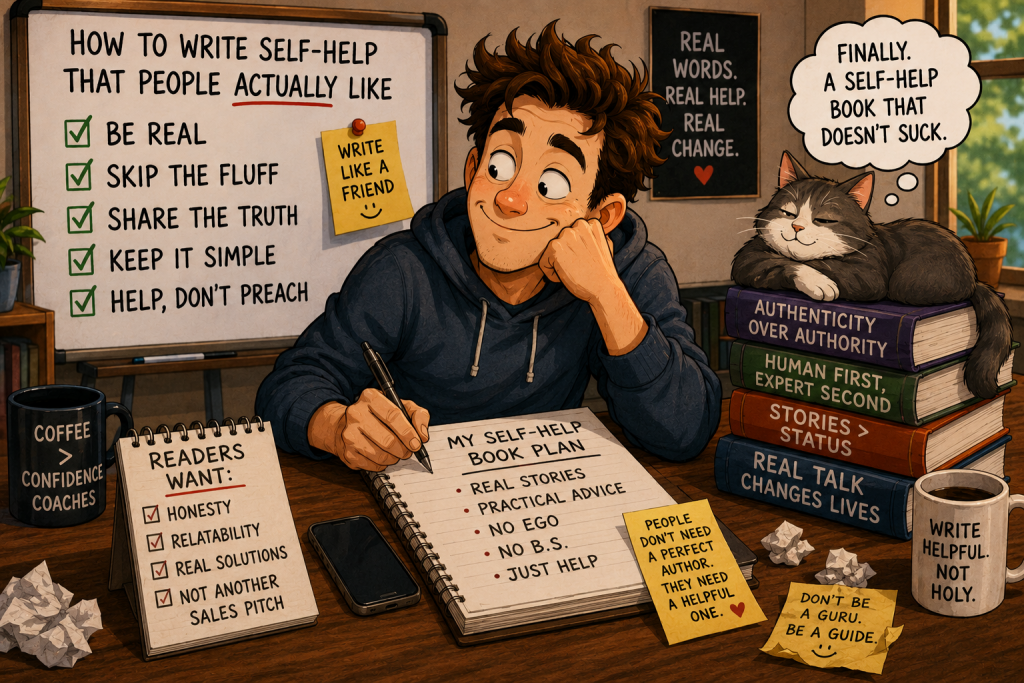
Writing Self-Help That Connects
The self-help industry is crowded.
Every year, thousands of new books are published promising better habits, more confidence, greater success, improved relationships, and a happier life.
Some books sell well for a few months and quickly disappear.
Others continue helping readers for years or even decades.
The difference is not always better research.
It is not always better marketing.
And it is not always a bigger platform.
Often, the books that connect most deeply with readers are the ones that feel the most human.
This matters because one of the biggest answers to why self-help books don’t work is that many books stop sounding like conversations and start sounding like lectures.
Readers do not want to feel like they are being talked down to.
They do not want to feel like they are sitting through a sales presentation.
They do not want to feel like they are reading instructions written by someone who has never struggled.
They want guidance from someone who understands what real life feels like.
The most effective self-help books today are less focused on impressing readers and more focused on helping them.
That may sound obvious.
But it changes the entire writing process.
The goal is no longer to sound like the smartest person in the room.
The goal is to be the most useful person in the room.
Talking Like a Real Human
One of the fastest ways to lose readers is to sound like a textbook.
Another is to sound like a motivational poster.
Unfortunately, many self-help books fall into one of these two traps.
Some become overly academic.
Others become overly dramatic.
Neither approach creates connection.
Readers respond best when they feel like a real person is speaking to them.
Think about the difference between these two statements:
Version One
“Individuals frequently encounter psychological resistance when attempting behavioral modification due to established neurological pathways.”
Version Two
“People often struggle to change because their brains like familiar routines.”
Both statements communicate a similar idea.
Only one sounds like a normal conversation.
Most readers prefer the second version.
Simple language is not weak writing.
Simple language is clear writing.
Many of the most successful communicators in the world understand this principle.
They explain difficult ideas using everyday language.
That approach makes readers feel included rather than intimidated.
A helpful self-help book should feel like a conversation with a trusted friend.
Not a lecture from a stage.
Not a seminar disguised as a book.
Not a collection of buzzwords and complicated theories.
Readers are already overwhelmed by information.
They do not need more complexity.
They need clarity.
Consider what readers often appreciate most:
- Clear examples
- Simple explanations
- Relatable stories
- Practical advice
- Honest observations
- Actionable next steps
Notice what is missing from that list.
Fancy language.
Technical jargon.
Overcomplicated frameworks.
Excessive motivational speeches.
These things may sound impressive, but they do not necessarily help people change.
Research communication experts have long recognized that understanding matters more than complexity. The writing advice published by organizations such as the Plain Language Association International emphasizes that clear communication improves comprehension and engagement.
Readers should never need to decode what an author is trying to say.
If a concept can be explained simply, it should be.
The following table highlights the difference:
| Writing That Pushes Readers Away | Writing That Connects |
|---|---|
| Complex terminology | Everyday language |
| Long explanations | Clear explanations |
| Talking at readers | Talking with readers |
| Showing expertise constantly | Sharing useful insights |
| Impressing readers | Helping readers |
One reason readers are becoming skeptical of motivational advice is that they are tired of being marketed to.
Many books spend so much time trying to sound important that they forget to be helpful.
The books that stand out are often the ones that sound genuine.
Readers trust writers who sound like real people.
Avoiding Guru Culture
Another major problem in self-help publishing is the rise of guru culture.
At first glance, guru culture may seem harmless.
An expert shares advice.
People listen.
Everyone benefits.
The problem begins when expertise turns into authority without accountability.
Many self-help authors accidentally position themselves as people who have all the answers.
They become larger than life.
Their stories become exaggerated.
Their success becomes the center of the message.
Eventually, the reader begins focusing on the author rather than the advice.
This creates several problems.
First, it creates unrealistic expectations.
Readers compare their messy lives to a carefully constructed success story.
The comparison often feels discouraging.
Second, it encourages dependency.
Instead of learning how to think critically, readers are encouraged to follow someone else’s formula.
Third, it creates distrust.
When authors present themselves as flawless, readers eventually notice the cracks.
Nobody is perfect.
Nobody has all the answers.
Nobody succeeds at everything.
Readers know this.
That is why authenticity often outperforms authority.
The strongest self-help writers today increasingly position themselves as guides rather than gurus.
The distinction matters.
A guru says:
- Follow me.
- Trust me.
- I have the answers.
- Do exactly what I did.
A guide says:
- Here is what helped me.
- Your experience may differ.
- Let’s explore this together.
- Use what works and leave the rest.
Most modern readers prefer the second approach.
It feels respectful.
It feels honest.
It feels realistic.
One reason books by authors like Brené Brown resonate so strongly is that they often emphasize exploration rather than certainty.
Readers appreciate being treated as participants rather than followers.
The following comparison illustrates the difference:
| Guru Culture | Guide Culture |
|---|---|
| Claims certainty | Admits uncertainty |
| Focuses on status | Focuses on service |
| Builds dependency | Encourages independence |
| Sells perfection | Embraces humanity |
| Centers the author | Centers the reader |
This shift is becoming increasingly important because readers have more access to information than ever before.
They can fact-check claims.
They can compare opinions.
They can research evidence.
They are less likely to accept grand promises without scrutiny.
As a result, humility has become surprisingly powerful.
Readers respect authors who admit limitations.
They appreciate writers who acknowledge nuance.
They trust people who understand that life is complicated.
A famous quote from author Maya Angelou captures an important truth:
“People will forget what you said, people will forget what you did, but people will never forget how you made them feel.”
While not written specifically about self-help books, the principle applies perfectly.
Readers may not remember every chapter.
They may not remember every technique.
But they will remember how the book made them feel.
Did it make them feel judged?
Did it make them feel inadequate?
Did it make them feel manipulated?
Or did it make them feel understood?
The best self-help writing creates understanding.
It reminds readers they are not alone.
It acknowledges the difficulty of change without removing hope.
It offers guidance without pretending to possess absolute truth.
Ultimately, writing self-help that connects requires a simple mindset shift.
The author stops asking:
“How can I sound impressive?”
And starts asking:
“How can I genuinely help someone?”
That question changes the tone.
It changes the message.
It changes the relationship between writer and reader.
And in a world where many people are questioning why self-help books don’t work, that human connection may be the very thing readers have been searching for all along.
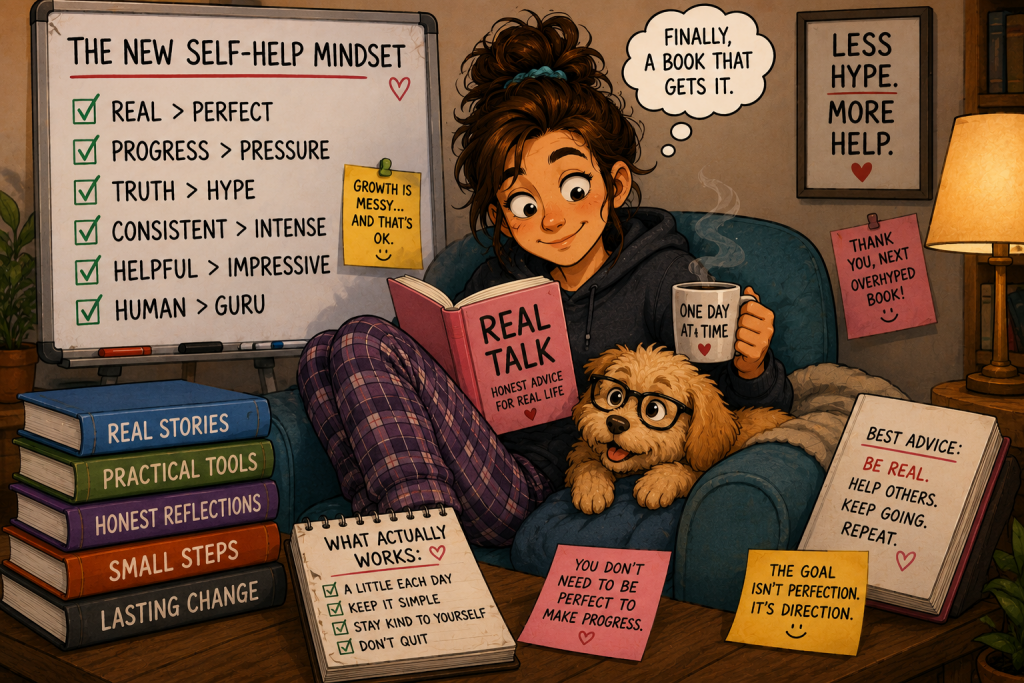
Final Thoughts: People Want Truth More Than Perfection
The self-help industry is not disappearing.
People will always want to improve their lives.
They will always look for better ways to manage stress, build confidence, improve relationships, earn more money, develop healthy habits, and overcome personal challenges.
The desire for growth is part of being human.
What is changing is the type of advice people are willing to trust.
Readers are becoming more selective.
They are becoming more skeptical.
They are asking harder questions.
And in many ways, that skepticism is healthy.
It forces authors, coaches, speakers, and content creators to move beyond empty promises and exaggerated claims.
It encourages a return to something much more valuable.
Truth.
Throughout this article, we have explored why self-help books don’t work for many readers.
The answer is not that self-improvement is impossible.
Nor is it that readers are unwilling to put in effort.
The real problem is that too much advice has been built around motivation, perfection, and unrealistic expectations instead of practical action and human reality.
Many readers have spent years chasing inspiration.
They have read the books.
They have watched the videos.
They have listened to the podcasts.
They have attended the seminars.
Yet they often find themselves facing the same challenges.
Not because they failed.
But because the advice itself failed to account for real life.
Real life is unpredictable.
Real life is emotional.
Real life is messy.
People do not need more pressure.
They need better guidance.
The future of meaningful self-help is not about convincing people they can become perfect.
It is about helping people make progress.
That distinction may seem small, but it changes everything.
Why Authenticity Outperforms Inspiration
For decades, inspiration was often treated as the highest goal in personal development.
Books were designed to motivate.
Speeches were designed to energize.
Seminars were designed to create excitement.
There is nothing inherently wrong with inspiration.
The problem occurs when inspiration becomes the entire strategy.
A person can feel inspired today and discouraged tomorrow.
Emotions change quickly.
That is why inspiration alone rarely creates lasting results.
Authenticity works differently.
Authenticity creates trust.
Trust creates connection.
Connection creates influence.
And influence is what ultimately helps people change.
Think about the people whose advice has genuinely impacted your life.
Chances are they were not perfect.
They probably did not have all the answers.
They may not have been the most successful person you ever encountered.
But they were honest.
They were relatable.
They were believable.
Authenticity works because it reflects reality.
Readers understand struggle.
They understand setbacks.
They understand self-doubt.
They understand failure.
When an author openly discusses these experiences, readers feel less alone.
That emotional connection is powerful.
In fact, many readers report learning more from someone’s mistakes than from their successes.
The reason is simple.
Mistakes feel accessible.
Failures feel relatable.
Perfect success stories often feel distant.
Consider the difference:
| Inspiration Alone | Authenticity |
|---|---|
| Creates excitement | Creates trust |
| Often temporary | Often lasting |
| Focuses on success | Includes struggle |
| Can feel unrealistic | Feels believable |
| Encourages admiration | Encourages connection |
One reason why self-help books don’t work for some readers is that they prioritize inspiration at the expense of authenticity.
Readers may feel motivated while reading.
But they do not necessarily feel understood.
Modern audiences increasingly want both.
They want hope.
But they want honest hope.
They want encouragement.
But they want realistic encouragement.
They want confidence.
But they want confidence grounded in reality.
This shift is visible across many forms of media.
Readers are drawn to personal stories.
They appreciate transparency.
They value honesty about challenges.
Research from the Pew Research Center consistently shows that trust and authenticity play major roles in how people evaluate information and public voices.
The same principle applies to books.
Readers trust people who sound human.
The most effective self-help authors are increasingly becoming storytellers, teachers, and guides rather than motivational celebrities.
They understand that readers do not need another perfect role model.
They need someone willing to tell the truth.
The Future of Self-Help Writing
The future of self-help writing will likely look very different from the past.
The traditional model relied heavily on authority.
An expert stood on a stage.
The audience listened.
The expert delivered answers.
The audience followed instructions.
That model is becoming less effective.
Today’s readers have access to endless information.
They can research ideas instantly.
They can compare perspectives.
They can challenge assumptions.
They no longer rely on a single voice for guidance.
As a result, modern self-help writing must offer something deeper than information.
It must offer perspective.
It must offer empathy.
It must offer practical value.
The authors who succeed in the future will likely share several characteristics.
They will:
- Speak honestly about failure.
- Share real experiences.
- Avoid exaggerated promises.
- Focus on practical actions.
- Respect the intelligence of readers.
- Embrace nuance and complexity.
- Encourage independent thinking.
In many ways, the future of self-help is becoming less about selling solutions and more about facilitating growth.
Readers do not want someone to magically fix their lives.
They want tools.
They want insight.
They want understanding.
Most importantly, they want advice that works in the real world.
The following table highlights the shift that is already taking place:
| Traditional Self-Help | Modern Self-Help |
|---|---|
| Perfect success stories | Honest journeys |
| Motivation-focused | Action-focused |
| One-size-fits-all advice | Personalized thinking |
| Guru authority | Relatable guidance |
| Big promises | Practical progress |
| Perfection | Improvement |
This evolution is a positive development.
It reflects a more mature understanding of human behavior.
People are beginning to recognize that growth is rarely dramatic.
Most transformations happen quietly.
A better habit.
A healthier decision.
A difficult conversation.
A small act of courage.
A consistent effort repeated over time.
These moments rarely appear on motivational posters.
Yet they are often the moments that matter most.
One of the greatest misconceptions in personal development is that change must feel extraordinary.
In reality, meaningful growth often feels ordinary.
It happens through repetition.
It happens through patience.
It happens through persistence.
And it happens despite setbacks.
The most valuable self-help books of the future will not promise to eliminate struggle.
They will help readers navigate it.
They will not pretend life is easy.
They will acknowledge that life can be difficult while still offering hope.
They will not promise perfection.
They will encourage progress.
Ultimately, that may be the most important lesson of all.
People do not need another book that tells them they are one secret away from happiness.
They do not need another promise of instant success.
They do not need another formula for becoming perfect.
What they need is truth.
They need practical advice.
They need encouragement that respects reality.
They need reminders that setbacks are normal.
They need permission to be human.
And perhaps that is the real answer to why self-help books don’t work for so many readers.
The books that fail often try to sell perfection.
The books that succeed help people embrace progress.
Because at the end of the day, readers are not looking for flawless gurus, impossible promises, or magical solutions.
They are looking for something much simpler.
A voice they can trust.
A message that feels real.
And advice that still makes sense after the motivation fades.
Key Takeaways: Why Self-Help Books Don’t Work
- Most self-help books fail because they focus on motivation instead of sustainable action.
- Readers are becoming skeptical of recycled advice that promises fast results but ignores real-life challenges.
- Motivation fades naturally, which is why habits and systems are more effective than inspiration alone.
- Honesty, vulnerability, and authentic storytelling build stronger trust than polished success stories.
- Small practical actions repeated consistently create more lasting change than dramatic life-overhaul plans.
- Readers increasingly want realistic guidance that acknowledges setbacks, failures, and human struggles.
- Self-help authors who act as guides rather than gurus tend to connect more deeply with modern audiences.
- The future of self-help belongs to practical advice, authenticity, and helping people make progress instead of chasing perfection.
Frequently Asked Questions
Why do so many self-help books fail to create lasting change?
Many self-help books focus heavily on motivation and inspiration while providing little practical guidance. Readers may feel excited while reading, but without clear systems and habits, that motivation often fades and old behaviors return.
Why does motivation stop working after a few days?
Motivation is an emotion, and emotions naturally change. A person may feel highly motivated after reading a book or watching a speech, but real life eventually returns. Lasting progress usually comes from routines, habits, and consistency rather than emotional highs.
Are self-help books a waste of money?
Not necessarily. Many self-help books contain valuable ideas and useful lessons. The problem is that some books rely too heavily on hype, unrealistic promises, or recycled advice rather than practical strategies readers can actually use.
What kind of self-help books are most effective?
The most effective self-help books tend to focus on realistic expectations, practical habits, behavior change, personal responsibility, and honest storytelling. Readers often respond best to authors who acknowledge struggle rather than pretending life is easy.
Why are readers becoming skeptical of motivational advice?
Many readers have experienced the cycle of feeling inspired by motivational content only to see the excitement disappear within days. As a result, people increasingly value realistic advice and actionable strategies over emotional hype.
What do readers actually want from modern self-help books?
Readers want honesty, practical solutions, relatable experiences, vulnerability, and guidance that works in everyday life. They are looking for real help rather than promises of instant transformation.
What helps people change more than motivation?
Consistency helps people change more than motivation. Small actions repeated over time build habits, and habits often create lasting results. Sustainable progress usually comes from daily effort rather than occasional bursts of inspiration.
Why is authenticity becoming more important in self-help writing?
Authenticity builds trust. Readers know that everyone struggles, makes mistakes, and experiences setbacks. Authors who openly discuss these realities tend to connect more deeply with readers than those who present themselves as flawless experts.
Can self-help books still be useful today?
Absolutely. The best self-help books continue to provide valuable guidance and encouragement. The difference is that readers now expect more honesty, realism, and practical value than previous generations.
What is the biggest reason why self-help books don’t work?
The biggest reason why self-help books don’t work for many readers is that they often prioritize inspiration over implementation. Readers may learn what they should do, but they are rarely shown how to continue doing it when motivation disappears.