

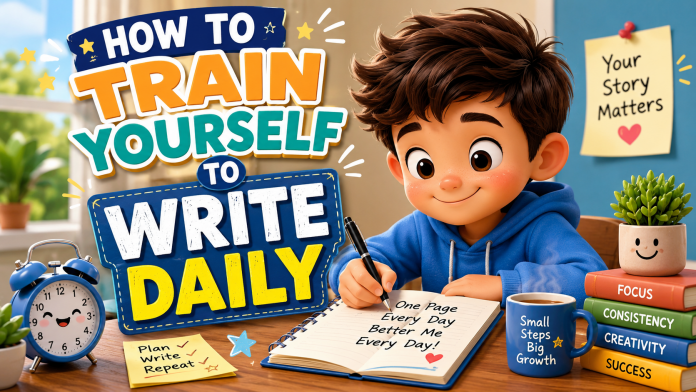
Simple habits and systems that help writers create consistently without burning out.
How to Train Yourself to Write Daily

Write Daily is not about being perfect, being gifted, or having a quiet life with no problems. It is about teaching your brain that writing is something you do often, not something you wait to feel ready for.
I used to think writers had some special spark that made them sit down every day with ease. I thought they woke up full of ideas, opened a notebook, and poured out perfect words.
That is not how it worked for me.
For me, learning to Write Daily started with showing up when I did not feel ready. Some days I had energy, and some days I felt tired before I even opened the page.
The biggest change came when I stopped treating writing like a mood. I started treating it like brushing my teeth, making coffee, or checking the mail.
You do not need a huge plan to begin. You need a small promise you can keep.
What It Really Means to Write Daily
To Write Daily does not mean you must write a full chapter every day. It does not mean you must write for three hours, fix every sentence, or feel proud of every word.
It means you build a steady writing habit. You give your thoughts a place to go, even when those thoughts are messy.
Some days, daily writing may look like one paragraph. Some days, it may look like ten minutes in a notebook.
Other days, it may look like typing a rough idea into your phone while dinner is cooking. That still counts, because the habit is being trained.
The goal is not to impress anyone at first. The goal is to become the kind of person who comes back to the page.
| What People Think Daily Writing Means | What It Can Really Mean |
|---|---|
| Writing thousands of words every day | Writing a small amount on purpose |
| Making every sentence sound great | Getting ideas out first |
| Having lots of free time | Using small pockets of time |
| Feeling inspired before starting | Starting even without inspiration |
| Never missing a day forever | Building a habit you return to |
Start With a Promise That Feels Almost Too Easy
When I first tried to write every day, I made the mistake of aiming too high. I told myself I would write for an hour every morning.
That sounded strong, but it fell apart fast.
Life got busy. I missed a day, then felt bad, then missed another day because I already felt behind.
A better way is to make your first promise small. So small that your brain does not fight it.
Try something like this:
- Write one sentence.
- Write for five minutes.
- Open the document and add one thought.
- Write one messy paragraph.
- List three ideas you may use later.
This may feel too small, but that is the point. Small habits are easier to repeat.
When you repeat something, your brain starts to trust it. That trust matters more than one big writing burst.
Make Writing Easy to Start
If you want to Write Daily, make the start simple. The harder it is to begin, the easier it is to avoid.
I like to keep my writing tools ready before I need them. That may mean leaving a notebook on the desk or keeping the same document open on the computer.
You can also write down your first line before you stop for the day. That way, when you return, you are not staring at a blank page.
A blank page can feel loud. A page with one sentence already on it feels more like an open door.
Simple Ways to Lower the Pressure
| Writing Problem | Easy Fix |
|---|---|
| I do not know what to write | Use a simple prompt |
| I feel too tired | Write for five minutes |
| I keep editing too soon | Write first, fix later |
| I forget to write | Attach writing to a daily habit |
| I feel judged by my own words | Keep the draft private |
A simple prompt can help when your mind feels stuck. You do not need anything fancy.
You can start with “Today I am thinking about…” or “The idea I keep coming back to is…” or “What I really want to say is…”
These are easy doorways into writing. Once the first line is down, the next line often feels less scary.
Train Your Brain With Repetition
A writing habit grows through repetition. Not force, not guilt, and not pressure.
Your brain learns from what you repeat. If you sit down to write at the same time or in the same place often enough, your mind starts to connect that moment with writing.
That is why routines help so much.
You might write after coffee. You might write after lunch. You might write right before bed.
The exact time matters less than the repeat pattern. Your brain likes patterns because they save energy.
When writing becomes part of your normal rhythm, it stops feeling like a big event.
Do Not Wait Until You Feel Like a Writer
One thing that held me back was thinking I had to feel like a “real writer” before I could act like one. That kept me waiting for confidence.
But confidence often comes after action, not before it.
You train yourself to Write Daily by writing before you feel fully ready. You write while you still have doubts.
You write while the page feels rough. You write while your idea is still cloudy.
That does not mean your writing is bad. It means your writing is alive and still becoming something.
“A daily writing habit is built by showing up small, not by waiting to feel powerful.”
That thought helped me a lot. It made writing feel less like a test and more like practice.
Give Yourself a Clear Daily Target
A clear target helps because it removes the guesswork. You do not have to ask, “Did I do enough?”
You already know what enough is for that day.
Your target can be based on time, words, pages, or effort. Pick the one that feels easiest to follow.
| Daily Target Type | Example |
|---|---|
| Time goal | Write for 10 minutes |
| Word goal | Write 200 words |
| Page goal | Write half a page |
| Idea goal | Write 5 bullet points |
| Habit goal | Open the draft and add something |
For beginners, I like time goals best. A 10-minute timer feels less scary than a word count.
When the timer starts, your only job is to write until it ends. You do not have to judge the work while you are doing it.
That makes it easier to stay with the habit.
Let the First Draft Be Messy
If you want to Write Daily, you must give yourself permission to write badly at first. This sounds strange, but it is one of the most helpful writing lessons.
A clean draft usually starts as a messy draft. A strong paragraph often begins as a weak one.
Trying to make every sentence perfect while you write can slow you down. It can also make you quit early.
Writing and editing are different jobs. When you write, your job is to get the clay on the table.
You can shape it later.
This is why daily writing is so powerful. It gives you more clay to work with.
More words mean more chances to find the good stuff hiding inside the rough stuff.
Build Identity, Not Just Output
The real goal is not only to finish pages. The deeper goal is to see yourself as someone who writes.
That shift matters.
Instead of saying, “I am trying to write,” you begin to think, “I am a person who writes.”
That does not mean you never struggle. It means writing belongs in your life.
When you miss a day, you do not need to turn it into a story about failure. You just come back.
A daily writing life is built by returning over and over. One page, one sentence, one quiet choice at a time.
The more often you return, the more natural it feels to Write Daily.
Key Takeaways: Write Daily
- Start small. You do not need huge writing sessions to build a daily writing habit. One sentence, one paragraph, or five minutes can still count.
- Use routines and triggers. Attach writing to something you already do, like drinking coffee, finishing lunch, or sitting at your desk.
- Protect your focus. Phones, notifications, open tabs, and noisy spaces can make it harder to Write Daily with real attention.
- Choose progress over perfection. Rough drafts, ugly drafts, and short sessions are all part of becoming a stronger writer.
- Build a habit that lasts. Rest, flexibility, tracking, and small wins help you keep writing without burning out.
Why Daily Writing Feels So Hard
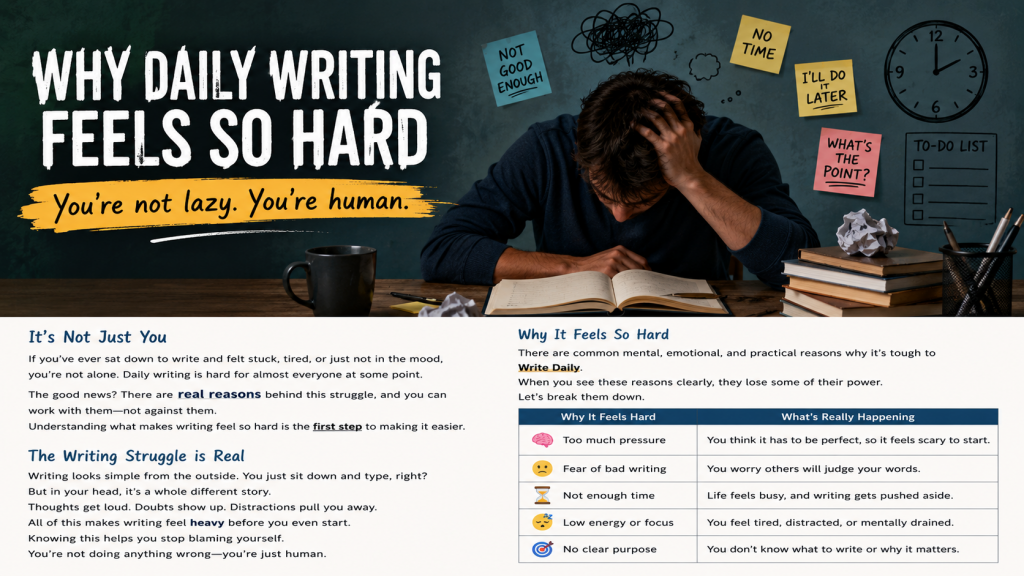
Write Daily sounds simple until you sit down, open the page, and suddenly every other task in the world feels more important. That is the strange part about writing.
You may want to write. You may even care deeply about your book, blog, journal, story, or idea.
But when the time comes to actually do it, your brain may push back. It may tell you that you are too tired, too busy, too distracted, or not good enough today.
I have felt that many times. I have sat there with the page open, knowing I wanted to write, but still finding ways to avoid it.
That does not mean you are lazy. It means writing asks more from your mind than most people think.
Writing Uses More Energy Than It Looks Like
From the outside, writing looks easy. You sit down, type words, and make sentences.
But inside your mind, a lot is happening at once.
You are thinking, choosing, remembering, feeling, planning, judging, and trying to make sense of your thoughts. That can feel heavy, even if your body is just sitting still.
This is one reason it can be hard to Write Daily. Writing does not only use time.
It uses focus.
It uses emotion.
It uses patience.
It also asks you to face your own thoughts. Some days, that feels harder than the writing itself.
| What Writing Looks Like | What Writing Can Feel Like |
|---|---|
| Sitting at a desk | Facing your thoughts |
| Typing words | Sorting messy ideas |
| Making sentences | Fighting doubt |
| Working quietly | Staying focused |
| Filling a page | Trusting yourself |
Your Brain Likes Easy Rewards
One big reason daily writing feels hard is that your brain likes quick rewards. Writing often gives slow rewards.
A phone gives fast rewards. A video gives fast rewards. A snack, message, game, or scroll gives your brain something right away.
Writing does not always do that.
When you write, the reward may come later. You may not feel proud until the draft grows, the idea becomes clearer, or the work starts to take shape.
That delay can make your brain look for something easier.
This is why you may suddenly want to clean the kitchen, check email, fold clothes, or look something up. Your brain is trying to escape the harder task.
It is not always about the task itself. It is about the feeling that comes with starting.
The Blank Page Can Feel Too Big
A blank page has no mistakes on it, but it also has no path. That can make it feel scary.
When I see a blank page, my mind can start asking too many questions at once.
What should I write?
Will this be good?
Is this idea strong enough?
What if I waste my time?
What if nobody cares?
Those questions make writing feel bigger than it needs to be. They turn a simple writing session into a test.
That is when the habit to Write Daily starts to feel like pressure instead of practice.
Why the First Line Feels So Hard
The first line carries too much weight when we expect it to be perfect. We think it has to sound smart, strong, and clear right away.
Most of the time, it does not.
The first line is just a starting point. It is a doorway, not the whole house.
You can change it later. You can delete it later.
You can even write a bad first line on purpose just to break the silence.
Life Keeps Interrupting the Plan
Another reason it is hard to Write Daily is real life. Most people do not have a perfect writing day.
There are bills, meals, kids, work, chores, noise, stress, errands, health issues, and people who need things from you.
It is easy to think, “I will write when life calms down.”
But life does not always calm down on command. That is why the writing habit needs to fit into real life, not some perfect life you may never get.
I learned that waiting for the perfect day was one of the fastest ways to not write at all.
| Daily Problem | What It Does to Writing |
|---|---|
| Too much noise | Makes focus harder |
| Busy schedule | Makes writing feel optional |
| Stress | Drains creative energy |
| Tired body | Lowers patience |
| Too many tasks | Pushes writing to later |
Writing Can Bring Up Fear
Writing is not only about words. It can bring up fear.
You may fear that your work is bad. You may fear that you are wasting time.
You may fear that someone will judge it. You may fear that you will never finish.
Sometimes, the fear is quiet. It does not say, “I am afraid.”
It says, “Do this later.”
It says, “You need more research.”
It says, “You are not ready yet.”
It says, “Start tomorrow.”
That is why daily writing can feel like a fight even before you type one word.
You May Be Expecting Too Much Too Soon
Many people quit writing because they expect too much from the early days. They want the habit to feel natural right away.
But habits need time.
When you first try to Write Daily, it may feel awkward. You may forget.
You may write slowly. You may feel like the words are not good.
That does not mean the habit is failing. It means the habit is new.
New things often feel strange before they feel normal.
If you expect smooth progress every day, you may feel upset when the work feels rough. But rough days are part of training.
A person who exercises does not expect every workout to feel amazing. A person learning piano does not expect every practice to sound beautiful.
Writing works the same way.
Too Many Choices Can Stop You
Sometimes, writing feels hard because you have too many choices. You can write a blog post, book chapter, email, journal entry, poem, outline, or scene.
Choice sounds good, but too much choice can freeze you.
When everything is possible, nothing feels clear.
That is why it helps to decide ahead of time what kind of writing you will do. You do not need a perfect plan.
You just need a clear next step.
Simple Choices That Make Writing Easier
| Choice to Make | Simple Example |
|---|---|
| Where to write | Desk, couch, notebook, laptop |
| When to write | Morning, lunch break, night |
| What to write | One scene, one idea, one page |
| How long to write | 5, 10, or 20 minutes |
| When to stop | After the timer or target |
The more choices you remove, the easier it is to begin.
Your Inner Critic Gets Loud
The inner critic is that voice in your head that judges your words too soon. It may sound like it is helping, but it often slows you down.
It may tell you a sentence is weak before you finish the thought. It may compare your rough draft to someone else’s finished book.
That is not fair to you.
A rough draft is not supposed to be polished. A daily writing session is not supposed to prove your worth.
It is just a place to practice.
When the inner critic gets loud, I try to remind myself that writing time is not judging time. I can fix the words later.
The job during writing time is to keep moving.
Daily Writing Feels Hard Because It Matters
If writing did not matter to you, you probably would not feel so much pressure around it. The hard feeling often shows that you care.
You may care about telling the truth. You may care about helping someone.
You may care about finishing the book, sharing the story, building the blog, or finally proving to yourself that you can stay with something.
That caring can make the page feel heavier.
But it can also become your reason to return.
The goal is not to make writing feel easy every single day. The goal is to make it possible, even on days when it feels hard, so you can continue to Write Daily.
Mental Resistance
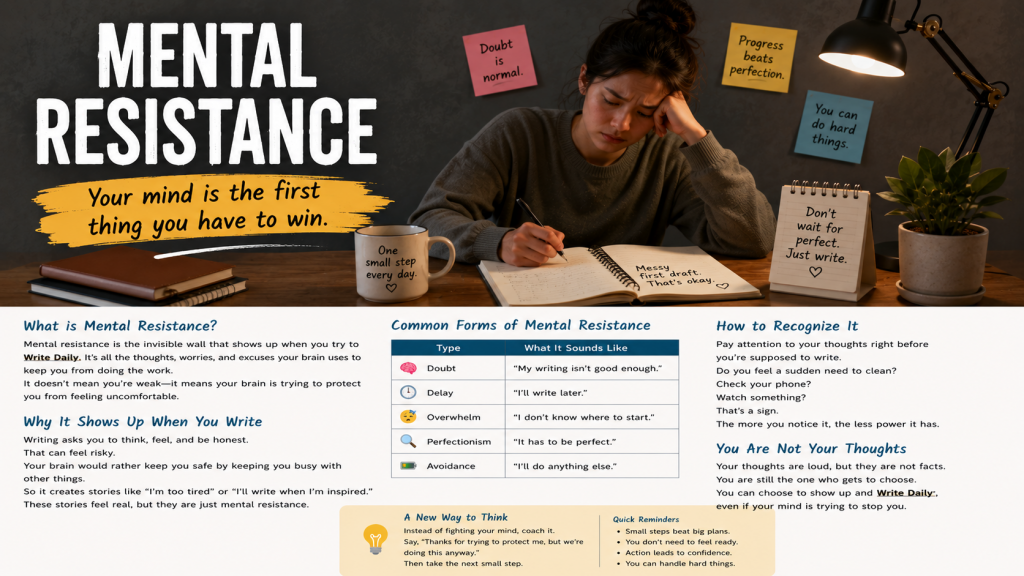
Mental resistance is the quiet pushback you feel when it is time to write. It is that heavy feeling that shows up right before you open the notebook, start the document, or sit with your thoughts.
When you want to Write Daily, mental resistance can feel like a wall. You know the writing matters, but part of you still wants to run from it.
I have felt this many times. I would plan to write, make time for it, sit down, and then suddenly feel like doing anything else.
The strange part was that I still wanted to write. I just did not want to face the discomfort that came with starting.
What Mental Resistance Sounds Like
Mental resistance does not always sound harsh. Sometimes it sounds reasonable.
It may sound like common sense, but it is really fear wearing a nice coat.
It says things like, “You can write later,” or “You need to be in the right mood first.” It may even tell you that you should clean, research, plan, or think more before you begin.
That is why it can be tricky. It does not always feel like fear.
Sometimes, it feels like delay.
| Mental Resistance Thought | What It May Really Mean |
|---|---|
| I will write later | Starting feels uncomfortable |
| I need a better idea | I am afraid this idea is not good enough |
| I am too tired | I do not want to face the page right now |
| I need to research more | I am using research to avoid writing |
| This will not be good | I am judging before I begin |
When you notice these thoughts, you do not have to fight them like an enemy. You can see them as signals.
They are signs that your mind is trying to protect you from feeling unsure, judged, or uncomfortable.
Why Your Mind Pushes Back
Your brain likes safety. It likes things that feel easy, known, and low risk.
Writing does not always feel safe to the brain. Writing asks you to make choices, share thoughts, and create something that might not be perfect.
That can feel risky, even if no one else sees the page.
When you try to Write Daily, your brain may worry that you will fail. It may worry that the words will sound bad.
It may worry that you will start and not finish. It may worry that the work will prove something painful about you.
That sounds dramatic, but this is often what sits under the surface.
Writing can touch identity. It can make you ask, “Am I really a writer?” or “Do I have anything worth saying?”
Those questions can make the page feel heavier than it is.
Resistance Grows When You Make Writing Too Big
One reason mental resistance gets strong is that we make writing feel too large. We turn one writing session into a life test.
Instead of thinking, “I need to write for ten minutes,” we think, “I need to prove I can finish this whole project.”
That is too much weight for one day.
A daily writing habit works better when the task feels small enough to enter. Small steps lower the fear.
You do not need to win the whole writing battle today. You only need to take the next step.
Smaller Ways to Face the Page
| Big Pressure Thought | Smaller Writing Step |
|---|---|
| I need to finish this chapter | Write one paragraph |
| I need a perfect opening | Write a plain first line |
| I need to know everything | Write what you know today |
| I need to feel ready | Write for five minutes anyway |
| I need this to be great | Let this draft be rough |
This shift helped me a lot. When the goal got smaller, my mind had less to fight.
I did not need to feel brave for a full hour. I only needed enough courage to begin.
Do Not Believe Every Thought You Have
Your thoughts can feel true even when they are not. This is very important when you are trying to Write Daily.
A thought like “I am not good at this” may show up, but that does not make it a fact. It is just a thought passing through.
A thought like “Nobody will care” may feel powerful, but it cannot see the future. It is guessing.
A thought like “This is pointless” may come from being tired, not from the truth.
When I started seeing thoughts as thoughts, they had less control over me. I could notice them without obeying them.
“You do not need a quiet mind to write. You need to write while the mind is making noise.”
That idea makes writing feel more possible. You can bring your doubt with you and still put words down.
Resistance Often Shows Up Right Before Progress
Mental resistance can get loud when you are close to doing something that matters. That is why it often appears right before a writing session.
It may not mean you are on the wrong path. It may mean the work matters to you.
If writing did not matter, your mind would not spend so much energy trying to avoid it.
This does not mean you should force yourself until you break. It means you can learn to read resistance better.
Sometimes resistance says, “You need rest.” Other times, it says, “This feels hard, so I want to escape.”
Learning the difference takes practice.
How to Answer Mental Resistance
You do not have to argue with mental resistance all day. Long arguments can become another way to avoid writing.
A better way is to answer it with a small action.
If your mind says, “I do not know what to write,” write one messy sentence.
If your mind says, “This will be bad,” write badly on purpose for five minutes.
If your mind says, “You are not ready,” open the document anyway.
Action teaches your brain that discomfort is not danger.
| Resistance Says | You Can Say |
|---|---|
| I do not feel ready | I can start small |
| This sounds bad | Bad words can be fixed |
| I do not have time | Five minutes still counts |
| I am not a real writer | Writers write, even when unsure |
| I should wait | I can begin before I feel ready |
This is how you train the habit. You do not wait for the resistance to vanish.
You move with it in the room.
Make the First Move Easy
The first move should be simple. Do not make your brain climb a mountain just to begin.
Open the notebook. Type the date. Write one line.
That may sound too basic, but basic works.
The goal is to get your hand moving or your fingers typing. Once that starts, the mind often follows.
Some of my best writing sessions started with a sentence I did not even like. The sentence was not special, but it opened the door.
The first move is not about quality. It is about motion.
Stop Treating Resistance Like Failure
Mental resistance is not proof that you are failing. It is part of the process.
Many people think they should feel excited every time they write. When they do not, they think something is wrong.
Nothing is wrong.
Writing can matter and still feel hard. You can love writing and still avoid it.
You can want to build a writing life and still have days when your mind fights you.
That does not make you weak. It makes you human.
The habit gets stronger each time you return to the page, even with doubt sitting beside you.
Build Trust With Yourself
Mental resistance gets weaker when you build trust with yourself. You build that trust by keeping small promises.
If you promise to write for ten minutes and you do it, your brain notices. If you promise one paragraph and you write it, your brain notices that too.
Over time, you start to believe yourself more.
That belief matters because it makes the habit feel safer. The page stops feeling like a threat and starts feeling like a place you know how to enter.
You do not need to crush resistance. You need to keep showing your mind that writing is something you can survive, repeat, and grow through.
Each small writing session becomes proof that you can Write Daily even when your thoughts try to pull you away.
Fear of Starting
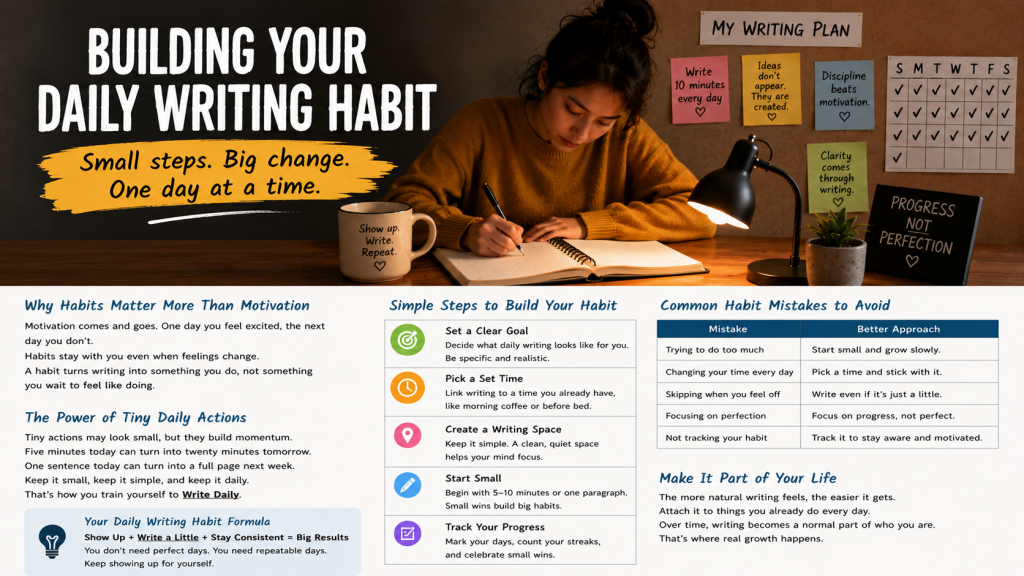
Write Daily can feel scary before the first word ever lands on the page. That fear of starting is one of the biggest reasons people avoid writing, even when they truly want to write.
I know that feeling well. I have sat in front of a blank page and felt frozen, even with ideas in my head.
The page was not yelling at me. No one was standing over my shoulder.
Still, starting felt heavy.
That is because the first step often feels bigger than it really is. Your mind turns one sentence into a test of your talent, your future, and your worth.
Why Starting Feels So Scary
Starting feels scary because it makes the idea real. Before you write, the idea can stay safe in your head.
In your head, it can feel perfect. It can feel clear, strong, and full of promise.
But once you write it down, you can see the weak parts. You can see where it does not sound right yet.
That can feel uncomfortable.
This is why many people keep thinking about writing instead of writing. Thinking feels safer than doing.
When you try to Write Daily, you are not only starting a writing session. You are facing the gap between the idea you imagined and the words you can create right now.
| Fear Before Starting | What Is Really Happening |
|---|---|
| I do not know where to begin | The project feels too big |
| This idea may be bad | You are judging too early |
| I might not finish | You are looking too far ahead |
| I do not feel ready | You are waiting for comfort |
| My writing will sound wrong | The draft needs room to be messy |
The First Step Feels Bigger Than the Rest
The first step often feels harder than the work itself. Once you begin, the pressure usually drops a little.
Before starting, your brain has too much space to worry. It can imagine every problem at once.
After starting, your brain has a job to do. It has a sentence to shape, a thought to follow, or a small point to make.
That shift matters.
One blank page can feel like a mountain. One rough sentence feels like a path.
The trick is to stop asking yourself to climb the whole mountain at once. Ask yourself to place one foot down.
Easy First Steps That Count
| If Starting Feels Hard | Try This First |
|---|---|
| The blank page scares you | Type one plain sentence |
| You feel stuck | Write a messy list |
| You feel tired | Set a five-minute timer |
| You feel unsure | Start with “I think…” |
| You feel pressure | Write badly on purpose |
A small start is still a start. It teaches your brain that writing does not have to begin with a big moment.
Fear Loves Perfect Conditions
Fear often says you need better conditions before you begin. It tells you to wait until you have more time, more energy, more peace, or more confidence.
That sounds smart, but it can become a trap.
I used to believe I needed the right mood before writing. If I felt tired, stressed, or unsure, I would tell myself it was not the right day.
The problem was that the perfect day almost never came.
There was always noise. There was always something to do.
There was always a reason to wait.
When I stopped waiting for perfect conditions, writing became more possible. I did not need the whole day to feel right.
I only needed a few minutes where I chose to begin.
Your First Words Do Not Have to Be Good
One of the best ways to reduce fear is to lower the job of the first words. The first words do not need to be strong.
They do not need to be clean. They do not need to be the words you keep.
They only need to get you moving.
When you Write Daily, the early words are often warm-up words. They help your mind shift into writing mode.
Think of them like stretching before a walk. Stretching is not the walk, but it helps you start.
You can delete the first line later. You can rewrite the first paragraph later.
You can move things around later.
The first draft is allowed to be plain, clumsy, and unfinished.
“The first sentence is not a final answer. It is just the door opening.”
That thought can take pressure off the page. You are not carving words into stone.
You are making a draft.
Starting Before You Feel Ready
Feeling ready is nice, but it is not required. Many writing sessions begin before confidence shows up.
Sometimes, confidence comes after five minutes. Sometimes, it comes after the session is over.
Sometimes, it does not come at all, and you still get the work done.
That is part of learning to Write Daily. You practice starting without needing every feeling to line up first.
You can feel nervous and still write. You can feel tired and still write one small paragraph.
You can feel unsure and still put down a rough thought.
Readiness is not always a feeling. Sometimes it is a choice.
Make Starting So Small It Feels Silly
If fear is strong, make the start smaller. Make it almost too easy to refuse.
Do not say, “I have to write for an hour.” Say, “I will write one sentence.”
Do not say, “I have to finish this section.” Say, “I will open the file.”
Do not say, “This has to be good.” Say, “This just has to exist.”
Small starts help because fear has less to argue with.
| Big Start | Smaller Start |
|---|---|
| Write a full article | Write the opening idea |
| Finish a chapter | Write one scene note |
| Plan the whole book | List three thoughts |
| Write for one hour | Write for five minutes |
| Make it perfect | Make it real |
The smaller the start, the easier it is to repeat. The easier it is to repeat, the stronger the habit becomes.
Use a Starter Line
A starter line can help when your mind goes blank. It gives you a simple way into the page.
You do not have to keep the starter line. It is only there to get your thoughts moving.
Here are a few starter lines that can work:
- What I am trying to say is…
- The reason this matters is…
- I do not know how to start, but…
- The main idea here is…
- If I were explaining this to a friend, I would say…
These lines are simple on purpose. They help you skip the fight with the blank page.
Once your hand starts moving or your fingers start typing, your brain has something to follow.
Fear Shrinks When You Repeat the Start
The more often you start, the less strange starting feels. Your brain learns from repeated action.
At first, starting may feel like pushing through a locked door. Later, it may feel more like turning a handle.
That change happens slowly.
Each time you begin, you prove that the fear is not in charge. You prove that a blank page can be entered.
You prove that one small step can lead to another.
This is why daily writing is not only about word count. It is also about training your nervous system to survive the beginning.
A person who starts often becomes less afraid of starting.
Let the Start Be Private
Sometimes fear grows because you imagine other people reading the work too soon. You may hear their opinions before they ever see a word.
That can stop you before you begin.
Keep the start private. Let the first draft belong only to you.
You do not have to show anyone the messy part. You do not have to explain it.
Private writing gives your thoughts room to breathe. It lets you practice without feeling watched.
When the pressure to perform goes down, the chance of starting goes up.
Turn Starting Into a Tiny Ritual
A small ritual can help your brain know it is time to write. It does not need to be fancy.
You might pour coffee, open the same notebook, light a lamp, play quiet music, or set a timer.
The ritual is not magic. It is a signal.
It tells your brain, “This is what we do now.”
Over time, that signal can make starting easier. Your mind begins to connect the ritual with writing.
| Simple Ritual | Why It Helps |
|---|---|
| Open the same document | Removes choice |
| Set a timer | Creates a clear edge |
| Use the same notebook | Builds familiarity |
| Write at the same desk | Trains focus |
| Start with one line | Lowers pressure |
Fear of starting does not mean you are not meant to write. It means the start matters enough to feel uncomfortable, and you can still Write Daily while that fear sits beside you.
Building a Simple Writing Habit
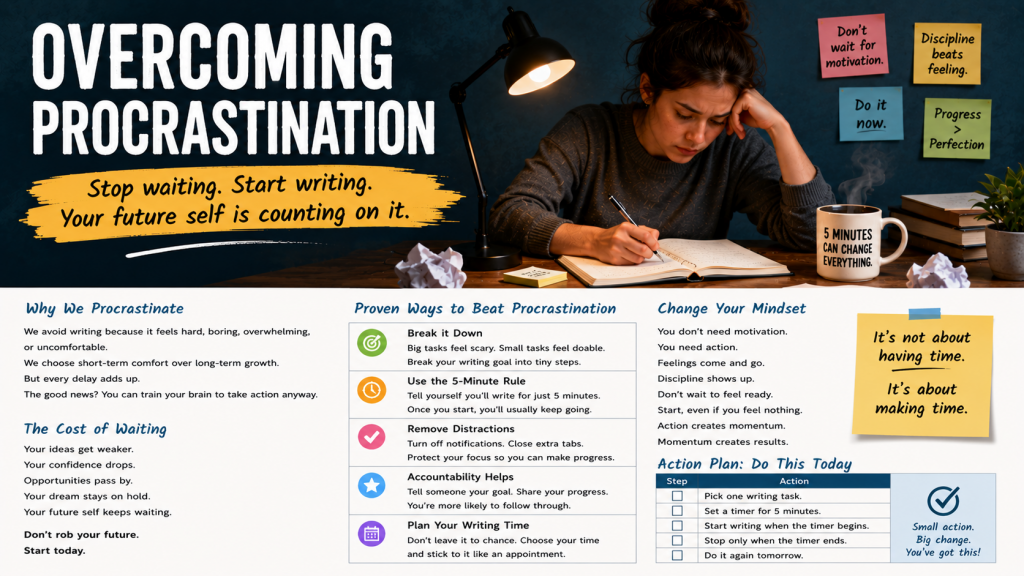
Write Daily becomes much easier when you stop making writing feel like a huge event. A simple writing habit gives your brain a clear path to follow, so you do not have to fight yourself every time you sit down.
The mistake I made for a long time was thinking I needed a big plan. I thought I needed the perfect schedule, the perfect desk, the perfect mood, and the perfect idea.
That made writing feel too heavy before I even started.
A better habit is simple. It is something you can do on a normal day, even when life is busy, loud, or not going your way.
Make the Habit Clear
A habit gets stronger when it is clear. If your plan is vague, your brain has too much room to escape.
Saying “I should write more” is not clear. It sounds nice, but it does not tell you when to write, where to write, or what counts as done.
A clearer plan might be, “I will write for ten minutes after coffee.” That gives your mind a real instruction.
When you want to Write Daily, clear beats big. You do not need a giant promise.
You need a promise you can understand and repeat.
| Vague Writing Plan | Clear Writing Habit |
|---|---|
| I should write more | I will write for 10 minutes after breakfast |
| I need to work on my book | I will write one rough paragraph today |
| I want to blog more | I will draft one idea before lunch |
| I need to be consistent | I will write before I check social media |
| I will write when I have time | I will write at 8:30 every night |
A clear habit removes the debate. You already know what to do.
That matters because the more you debate, the easier it is to delay.
Pick One Writing Goal
A simple writing habit works best when you pick one main goal. Too many goals can make your writing time feel messy.
You may want to write a book, start a blog, keep a journal, make social posts, and build a newsletter. Those are all good goals, but trying to do them all at once can freeze you.
Start with one.
Pick the writing goal that matters most right now. Then build your daily habit around that goal.
If your goal is a book, your daily habit may be one scene, one page, or one idea. If your goal is a blog, your daily habit may be one section, one outline, or one draft paragraph.
Simple Goal Examples
| Main Goal | Daily Writing Habit |
|---|---|
| Write a book | Add 200 rough words |
| Start a blog | Draft one small section |
| Keep a journal | Write five honest lines |
| Build an email list | Write one helpful email idea |
| Improve skill | Rewrite one weak paragraph |
This keeps your mind focused. Instead of asking, “What should I work on today?” you already have the answer.
Focus makes writing feel safer and easier.
Attach Writing to Something You Already Do
One of the easiest ways to build a writing habit is to attach it to a habit you already have. This is helpful because your day already has built-in patterns.
You already wake up. You already drink something.
You already eat. You already sit down at some point.
You already end your day.
When you attach writing to one of those moments, you do not have to create a brand-new life. You just add writing to the life you already have.
For example, you could write after your morning coffee. You could write after lunch.
You could write before turning on the TV. You could write right after brushing your teeth at night.
This makes it easier to Write Daily because the old habit becomes the reminder.
| Current Habit | Writing Habit to Add |
|---|---|
| Drinking coffee | Write for 10 minutes |
| Eating lunch | Write one paragraph |
| Finishing work | Add notes to your draft |
| Sitting in bed | Journal five lines |
| Opening laptop | Open writing file first |
The habit does not need to be fancy. It just needs to be repeatable.
Make the First Step Obvious
If starting takes too much effort, the habit will be harder to keep. Your first step should be easy to see and easy to do.
Leave your notebook where you can see it. Keep your writing file easy to open.
Put your pen beside the notebook. Save your document on the desktop.
If you write on your phone, keep a note pinned at the top.
Small setup choices can make a big difference. When the tool is ready, starting feels less like work.
“The easier it is to begin, the more likely you are to begin.”
That is why I like keeping the next writing step visible. It saves energy.
You do not want to spend your best focus looking for the file, finding the notebook, or deciding what app to use.
Keep the Daily Target Small
A strong habit does not need to be dramatic. In fact, the best writing habit is often small enough to survive bad days.
If your habit only works on perfect days, it is too fragile.
A small habit can live inside real life. It can fit into tired mornings, busy afternoons, and messy nights.
This is why a daily target like 10 minutes can work so well. Ten minutes is short enough to start, but long enough to matter.
You may write more once you begin. But you do not have to.
That is the key.
The habit is built by showing up, not by draining yourself.
Use a Simple Writing Checklist
A checklist helps because it tells you what to do without making you think too hard. It gives the habit a shape.
You do not need a long checklist. Long checklists can become another excuse.
Keep it short and direct.
| Step | Action |
|---|---|
| Open | Open notebook or document |
| Start | Set timer for 10 minutes |
| Write | Add words without editing |
| Mark | Check off the day |
| Stop | Leave a note for tomorrow |
The last step is powerful. Leaving a note for tomorrow makes the next start easier.
You can write something like, “Next, explain why the habit matters,” or “Continue with the scene at the kitchen table.”
That tiny note gives your future self a gift.
Build the Habit Before You Build the Speed
Many people want to write faster right away. They want bigger word counts, longer sessions, and stronger output.
That can come later.
At first, your job is to make writing normal. Speed is not the main goal.
The habit is the main goal.
Once writing becomes normal, you can grow it. You can add more time, more words, or more structure.
But if you try to grow too fast, the habit can break.
Think of it like walking before running. You are not failing because you start slow.
You are training your mind to trust the process.
Make It Easy to Return After Missing a Day
A simple writing habit should have room for real life. You may miss a day.
That does not mean the habit is ruined.
One missed day is just one missed day. The danger comes when one missed day turns into a story about failure.
Do not make the restart dramatic. Just return to the smallest version of the habit.
Write one line. Open the file.
Add one idea. Mark the day and keep moving.
A strong writing habit is not built by never falling off. It is built by coming back without making the fall bigger than it needs to be.
Reward the Act of Showing Up
Your brain likes rewards. Give it a small reward after writing.
This does not need to be big. It can be a checkmark, a cup of coffee, a short walk, or a few minutes of rest.
The reward tells your brain, “That was good. We should do that again.”
Over time, the habit starts to feel more natural.
| After Writing | Simple Reward |
|---|---|
| 10 minutes done | Mark a check on a calendar |
| Paragraph finished | Stretch or walk |
| Draft opened | Enjoy coffee without guilt |
| Idea captured | Take a short break |
| Goal met | Track the win |
The more you connect writing with progress, the less it feels like punishment.
The page becomes a place where you show up for yourself, one small promise at a time, until it feels normal to Write Daily.
Starting Small
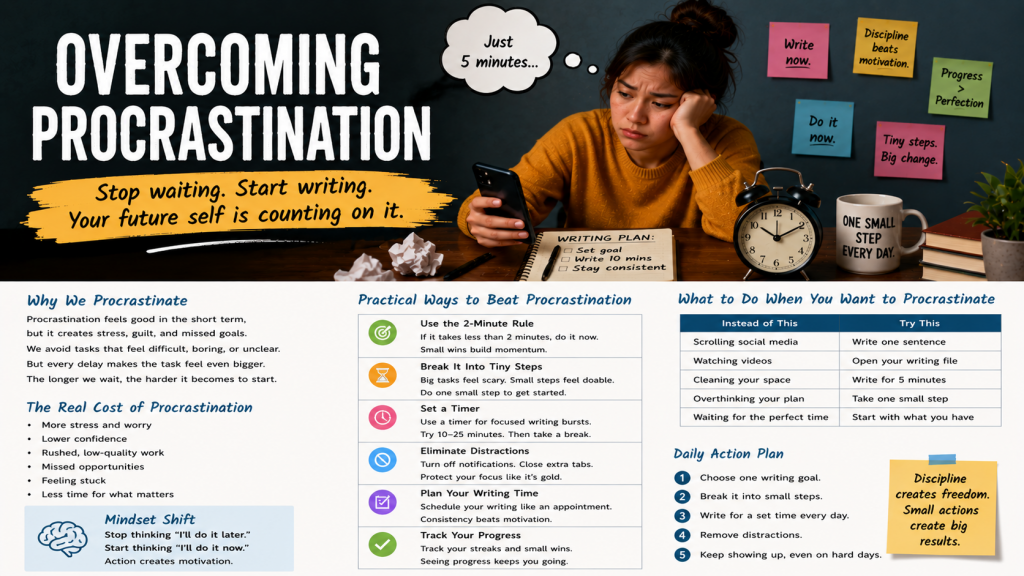
Write Daily becomes much less scary when you start small. Small does not mean weak, lazy, or unimportant.
Small means possible.
I used to think a writing session had to be big to count. If I did not write a full page or work for a long time, I felt like I had failed.
That kind of thinking made writing harder than it needed to be.
Once I learned to start small, writing became easier to return to. I stopped trying to win the whole day and started trying to win one small moment.
Why Small Starts Work
Small starts work because they lower pressure. Your brain does not fight as hard when the task feels easy.
If you tell yourself, “I have to write 2,000 words,” your mind may panic before you begin. That sounds like a lot, especially on a busy or tired day.
But if you say, “I only have to write one sentence,” your mind may calm down.
One sentence feels safe. One sentence feels doable.
That is how the habit begins.
When you want to Write Daily, the first goal is not to write a masterpiece. The first goal is to show up often enough that writing becomes normal.
| Big Goal | Small Start |
|---|---|
| Write a full chapter | Write one paragraph |
| Finish a blog post | Write one idea |
| Write for two hours | Write for five minutes |
| Create a perfect draft | Create a rough note |
| Plan the whole book | List three points |
A small start gives you motion. Motion matters because it breaks the freeze.
One Sentence Can Change the Day
One sentence may not sound like much, but it can change the whole direction of your writing day. It gets you past the hardest part, which is starting.
Many times, I have told myself I would only write one sentence. Then I wrote two.
Then I wrote a paragraph.
Then I stayed longer than planned.
That does not happen every time, and it does not have to. The win is keeping the promise.
If one sentence is all you write, you still trained the habit. You still proved that you can return to the page.
That is not nothing.
It is proof.
Small Writing Builds Trust
Every small writing session builds trust with yourself. You start to believe that you are someone who follows through.
This matters because many writers do not only struggle with words. They struggle with broken promises to themselves.
They say they will write, then they do not. After a while, the mind stops believing the plan.
Small promises fix that.
If you promise five minutes and you do five minutes, your brain sees success. If you promise one paragraph and you write one paragraph, your brain sees success.
That steady proof makes it easier to Write Daily without needing a big speech or a burst of motivation.
Make the Smallest Version of Your Habit
The smallest version of your writing habit should be something you can do even on a rough day. It should be so simple that it feels hard to say no to.
This is your backup version.
You may have a normal writing goal, like 300 words or 20 minutes. But your smallest version might be one sentence or three bullet points.
That way, the habit does not break just because the day is messy.
| Type of Day | Writing Goal |
|---|---|
| Good day | Write 500 words |
| Normal day | Write for 15 minutes |
| Busy day | Write one paragraph |
| Tired day | Write one sentence |
| Very hard day | Open the document and add one note |
This removes the all-or-nothing trap. You do not have to choose between doing a lot and doing nothing.
There is always a smaller way to show up.
Small Does Not Mean Staying Small Forever
Starting small does not mean your writing dream is small. It means you are building the base first.
A house needs a foundation before it needs walls. A writing habit works the same way.
If the base is weak, big goals fall apart fast.
Once the small habit feels steady, you can grow it. You can add more time, more words, or more structure.
But growth works better when it comes from a habit that already feels safe.
A Simple Growth Plan
| Week | Daily Writing Target |
|---|---|
| First week | 5 minutes |
| Second week | 10 minutes |
| Third week | 15 minutes |
| Fourth week | 20 minutes |
| Later | Add word count or project goals |
This kind of growth feels gentle. It lets your mind and schedule adjust without shock.
Use Tiny Wins to Build Momentum
Tiny wins matter because they give you energy. A checked box, a finished sentence, or a short paragraph can make you feel like you are moving.
That feeling helps.
When you see progress, you are more likely to continue. When you feel like nothing counts unless it is huge, you are more likely to quit.
Small wins teach your brain that writing can feel good. Not always easy, but good.
You can track tiny wins in a notebook, calendar, app, or simple sheet of paper.
The method does not matter as much as seeing the streak grow.
Stop Insulting Small Progress
Many writers talk down to their own progress. They say things like, “I only wrote a little,” or “It was just a few lines.”
That kind of language makes the habit feel less valuable.
Try saying it differently.
“I wrote today.”
“I kept the habit alive.”
“I added something that did not exist before.”
Those statements are true, and they help your mind respect the work.
A few lines today can become a page later. A page later can become a chapter.
A chapter can become a book.
Small writing adds up because time keeps moving.
Make Starting Feel Safe
Starting small makes writing feel safer. That is important because fear often grows when the task feels too big.
If your writing goal makes you tense before you begin, shrink it.
Make it simple. Make it clear.
Make it something you can do without needing the perfect mood.
You are not lowering your standards. You are lowering the door so you can walk through it.
Once you are inside the writing session, you can choose to stay longer.
Small Daily Writing Creates Big Change
The power of small writing is easy to miss at first. One sentence does not feel like a big deal.
Five minutes does not feel dramatic.
But when you repeat small actions, they begin to shape your identity. You stop seeing writing as something far away and start seeing it as part of your day.
That is the real shift.
You are not just chasing pages. You are training yourself to return, again and again.
The writer who returns often has a much better chance than the writer who waits for the perfect day.
Starting small gives you a way to keep going when life feels busy, your mind feels loud, or your energy feels low, and that steady return is how you learn to Write Daily.
Creating Triggers and Routines
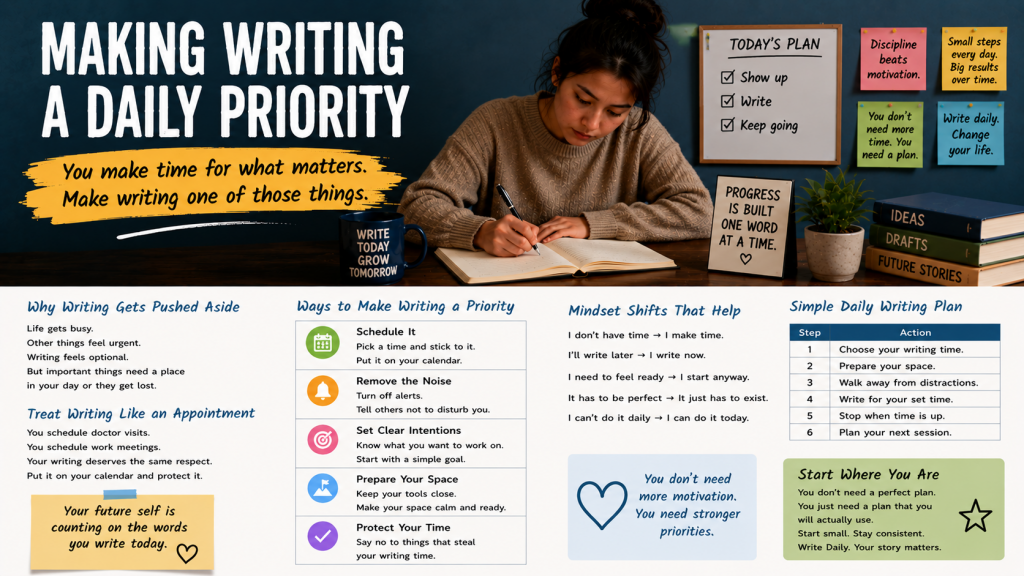
Write Daily gets easier when your brain has a clear signal that says, “It is time to write now.” That signal is called a trigger.
A trigger is something that starts the habit. It can be a time, place, action, sound, object, or simple routine.
For a long time, I tried to write only when I felt ready. That did not work well because my feelings changed every day.
Some days I felt focused. Some days I felt tired, busy, or pulled in ten different directions.
When I started using triggers and routines, writing felt less random. I did not have to wait for the right mood because the routine helped lead me into the work.
What a Writing Trigger Does
A writing trigger tells your mind what comes next. It takes some of the choice out of the moment.
That matters because too many choices can slow you down. If you have to decide when to write, where to write, what to open, and how long to work, you may quit before you begin.
A trigger keeps it simple.
You do one normal thing, then you write.
For example, you drink coffee, then you write. You finish lunch, then you write.
You sit at your desk, then you open your draft. You turn on the lamp, then you write one paragraph.
| Trigger | Writing Action |
|---|---|
| After morning coffee | Write for 10 minutes |
| After lunch | Add one paragraph |
| After work | Review yesterday’s notes |
| After brushing teeth | Journal five lines |
| When the desk lamp turns on | Open the writing file |
The trigger does not have to be special. It only has to be clear enough that your brain can connect the action to writing.
Use Habits You Already Have
The easiest writing triggers are habits you already do every day. These habits are already part of your life, so they can carry the new habit with them.
This is much easier than trying to rebuild your whole day.
When I wanted to Write Daily, I looked for moments that already happened without much thought. Coffee was one of them.
Instead of saying, “I will write sometime today,” I made the plan tighter. I wrote after coffee.
That made writing feel less like a floating task and more like the next step in a normal routine.
Easy Daily Habits to Attach Writing To
| Existing Habit | New Writing Routine |
|---|---|
| Making coffee | Open notebook and write one idea |
| Eating breakfast | Write one short paragraph |
| Taking a lunch break | Draft for 10 minutes |
| Sitting at computer | Open writing file first |
| Getting ready for bed | Write three lines about the day |
This is simple, but it works because your brain already knows the first habit. You are just adding writing to the end of it.
Create a Tiny Writing Ritual
A ritual is a small pattern you repeat before writing. It helps your mind settle into the task.
This does not need to be dramatic. You do not need candles, music, a perfect chair, or a special room.
A ritual can be as simple as clearing one space, opening the document, setting a timer, and taking one breath before you begin.
The point is not to make writing fancy. The point is to make writing familiar.
When the same small steps happen before each writing session, your brain starts to understand the pattern.
| Step | Simple Writing Ritual |
|---|---|
| Prepare | Clear the desk or open the notebook |
| Signal | Turn on a lamp or start quiet music |
| Focus | Set a timer for 10 minutes |
| Begin | Write one sentence without judging |
| Close | Leave a note for the next session |
A good ritual should help you start, not give you more things to avoid. If the ritual becomes too long, it can turn into another form of delay.
Make the Routine Easy to Repeat
A routine only works if you can repeat it. That means it needs to fit your real life.
Do not build a writing routine that only works on your best day. Build one that can survive a normal day.
If your house is noisy, your routine may need headphones. If your schedule changes, your routine may need a backup time.
If you get tired at night, your routine may need to happen earlier.
The goal is to make it easy to Write Daily, not to create a perfect plan that breaks the first time life gets messy.
Use Time Triggers Carefully
Time triggers can be powerful. Writing at the same time each day can train your mind to expect the habit.
But time triggers can also fail if your schedule is not steady.
If your days are different, use a flexible trigger instead. Try writing after a regular action, not at an exact time.
For example, “after breakfast” may work better than “8:00 a.m.” if your mornings change.
| If Your Schedule Is Stable | If Your Schedule Changes |
|---|---|
| Write at 7:30 every morning | Write after coffee |
| Write at lunch every day | Write after your first meal |
| Write at 9:00 every night | Write before screen time |
| Write after work ends | Write after the house gets quiet |
| Write before bed | Write after brushing teeth |
Both types can work. The best trigger is the one you can actually follow.
Keep Your Writing Tools Ready
Your routine gets weaker when it takes too much effort to begin. If you have to hunt for your notebook, find your charger, open five tabs, or search for the right file, you may lose the moment.
Keep your writing tools ready before you need them.
Put the notebook where you can see it. Keep the pen nearby.
Save the writing document in an easy place. Leave yourself a note about where to start.
When tools are ready, your trigger can lead straight into action.
That small setup removes friction. Less friction means fewer excuses.
Add a Clear Ending Point
A routine needs a clear start, but it also helps to have a clear ending. This keeps writing from feeling endless.
If you never know when you are done, the habit can feel too big. That makes it easier to avoid.
A clear ending could be a timer, a word count, a paragraph, or a small note for tomorrow.
| Writing Session Type | Clear Ending Point |
|---|---|
| Timed session | Stop when 10 minutes ends |
| Word goal | Stop after 200 words |
| Idea session | Stop after 5 bullet points |
| Draft session | Stop after one rough paragraph |
| Planning session | Stop after next step is written |
The ending point gives your mind relief. It says, “This task has a shape.”
That makes the habit feel safer and easier to repeat.
Build a Backup Routine
A backup routine protects the habit on hard days. This is important because life will not always respect your writing plan.
Some days will be too full. Some days you will be tired.
Some days your normal writing spot will not work.
A backup routine keeps the habit alive without forcing you to do the full version.
Your backup could be one sentence on your phone. It could be three lines in a notebook.
It could be one idea typed into a notes app before bed.
The backup routine is not failure. It is smart habit design.
Simple Backup Writing Routine
| Problem | Backup Action |
|---|---|
| No time | Write one sentence |
| Too tired | Add three bullet points |
| Away from desk | Use phone notes |
| No clear idea | Write one question |
| Bad mood | Write one honest line |
This is how you avoid the all-or-nothing trap. The full routine is great, but the small routine still counts.
Let the Routine Carry You
A strong routine helps when motivation is low. That is the real power of it.
You do not need to feel excited every day. You do not need to feel inspired every time.
The routine becomes the path. You step onto it, and it carries you into the work.
Some days, you may only write a little. Some days, the words may surprise you.
Either way, the routine keeps the door open.
“A writing routine is not a cage. It is a path back to the page.”
That is how I like to think about it. The routine is not there to make writing feel strict.
It is there to make writing easier to start.
Make the Trigger Personal
Your trigger should fit you. Do not copy someone else’s routine if it makes your life harder.
Some people write early. Some people write late.
Some people need silence. Some people like soft background noise.
Some people write at a desk. Some people write at the kitchen table, in bed, or during lunch.
The right routine is the one that helps you show up. It does not need to look impressive.
It only needs to help you Write Daily in a way you can keep using.
Eliminating Distractions
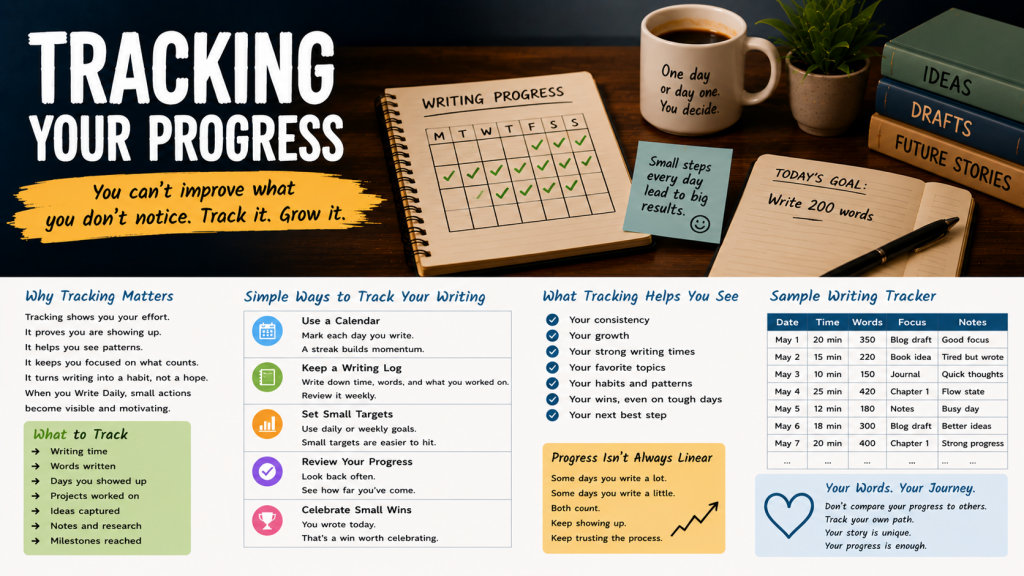
Write Daily is much harder when distractions are allowed to sit beside you. Even a small distraction can pull your mind away from the page and make it harder to return.
I used to think I had a writing problem. Many times, I really had a distraction problem.
I would sit down to write, but my phone was close. A browser tab was open.
A message would pop up. A thought would hit me.
Then I would check one thing, then another thing, and suddenly my writing time was gone.
Distractions Steal More Than Time
A distraction does not only steal a few seconds. It also steals your focus.
That matters because writing needs a certain kind of quiet inside your mind. You need enough space to think, follow an idea, and stay with the sentence in front of you.
When you keep stopping, your brain has to restart again and again. That can make writing feel harder than it really is.
This is why trying to Write Daily in a noisy, busy, alert-filled space can feel so frustrating. You are not just writing.
You are also fighting for attention.
| Distraction | What It Steals |
|---|---|
| Phone notifications | Focus and calm |
| Open browser tabs | Mental space |
| Background TV | Deep thought |
| Social media | Time and energy |
| Cluttered desk | Clear attention |
| Random chores | Writing momentum |
Make Writing the Only Job
One of the best ways to protect your writing habit is to make writing the only job during writing time. That sounds simple, but it takes practice.
When you sit down to write, do not also answer messages. Do not also check email.
Do not also research, edit old work, scroll, shop, or clean the room.
Writing time is for writing.
If you are trying to Write Daily, your brain needs to know what the session is for. When the goal is clear, it is easier to stay with it.
A simple rule helps: one session, one job.
If the job is drafting, draft. If the job is outlining, outline.
If the job is editing, edit.
But do not mix everything at once, because mixed tasks create messy focus.
Clear the Space Before You Start
Your space does not have to be perfect. It does not need to look like a magazine photo.
But it should make writing easier, not harder.
If your desk is full of bills, dishes, tools, laundry, and random notes, your brain may keep jumping from one thing to another. Each item can become a tiny reminder of something else you should do.
That can pull you away from the page.
Before writing, clear only what you need to clear. Do not turn it into a full cleaning project.
Just make enough room for the writing to happen.
Simple Space Reset
| Before Writing | Quick Fix |
|---|---|
| Too much clutter | Move extra items to one side |
| Noise nearby | Use headphones or change rooms |
| Wrong tools missing | Place notebook, pen, or laptop ready |
| Unfinished chores visible | Turn your chair away from them |
| Messy computer screen | Close unused tabs and apps |
This should take a minute or two. The goal is not a perfect space.
The goal is fewer things pulling at your mind.
Put the Phone Away
For many writers, the phone is the biggest distraction. It is small, close, and always ready to steal attention.
Even if you do not pick it up, seeing it can be enough to make your brain wonder what is happening.
A message may come in. A notification may light up.
You may suddenly think of something to check.
That one tiny pull can break your writing rhythm.
When I want to Write Daily, I do better when the phone is not within reach. Across the room is better than beside the keyboard.
In another room is even better.
If you need your phone for writing, turn on focus mode, airplane mode, or do not disturb. Make it harder for the phone to win.
Close the Extra Tabs
Computer distractions can be sneaky. You may open your writing document, but also leave email, social media, news, shopping, music, and research tabs open.
Each tab is like a little door your brain can walk through.
The problem is that your mind may walk through one of those doors as soon as writing feels hard.
Close what you do not need.
If you need research later, write a note inside the draft that says, “Check this later.” Then keep writing.
Research can feel productive, but it can also become a hiding place.
| Writing Need | Better Setup |
|---|---|
| Drafting | Writing document only |
| Outlining | Notes and outline only |
| Editing | Draft and checklist only |
| Researching | Source pages and notes only |
| Planning | Calendar or project plan only |
Keep the screen as simple as possible. A simple screen helps create a simple focus.
Protect Your Writing Time From People
Distractions do not always come from screens. Sometimes they come from people.
Family, friends, kids, coworkers, or housemates may not understand that writing time is real work. If you are home, they may think you are free.
That can make it hard to Write Daily, especially if you are always available to everyone else.
You may need a small boundary.
It can be kind and simple. You do not need to be harsh.
You can say, “I am writing for 20 minutes, then I can help.” You can say, “I need this short block quiet.”
If you have kids or a busy home, you may need to choose a time when the house is calmer. You may also need a backup plan for noisy days.
A boundary is not selfish. It protects the promise you made to yourself.
Make Distractions Harder to Reach
You do not need perfect self-control if you design your space better. Make the distractions harder to reach and the writing easier to reach.
Put the phone across the room. Log out of social apps.
Turn off notifications. Keep your notebook open.
Put your draft on the screen before writing time begins.
The easier path should lead to writing. The harder path should lead to distraction.
Distraction Setup Swap
| Instead of This | Try This |
|---|---|
| Phone beside laptop | Phone across the room |
| Social tabs open | Only writing tab open |
| TV playing nearby | Quiet room or soft background sound |
| Writing “whenever” | Writing at a set time |
| Waiting for focus | Creating a focus-friendly setup |
This helps because you are not relying only on willpower. You are changing the room so the habit has a better chance.
Use a Short Timer
A timer can help you stay focused because it gives the writing session a clear edge. You are not writing forever.
You are writing until the timer ends.
This can make distractions easier to ignore. If your brain says, “Check your phone,” you can answer, “After the timer.”
Start with a short block. Ten minutes is enough.
If that feels too long, use five minutes.
During that time, your only job is to write. It does not have to be perfect.
It just has to happen.
“Focus gets easier when the task has a clear start and a clear stop.”
A timer gives your brain a small container. That container makes writing feel safer.
Keep a Distraction List
Sometimes distractions come from inside your own head. You may suddenly remember a bill, a message, a chore, an idea, or something you forgot to do.
Instead of stopping your writing, keep a distraction list nearby.
When a thought pops up, write it down quickly and return to the page. This tells your brain the thought is not lost.
You can handle it later.
| Random Thought | What to Do |
|---|---|
| I need to reply to that message | Add it to the list |
| I should buy that thing | Add it to the list |
| I forgot to clean something | Add it to the list |
| I need to look up a fact | Mark it for later |
| I just had another idea | Capture it in one line |
This keeps your writing session from turning into a task-switching session.
Choose Boring Over Busy
A little boredom can be good for writing. When there is nothing exciting pulling you away, your mind has more room to create.
The modern world gives us constant noise. Writing often needs the opposite.
It needs space.
It needs quiet.
It needs enough stillness for thoughts to rise.
That can feel strange at first. You may feel restless.
But that restlessness is often the doorway into deeper focus.
If you always feed your brain quick entertainment, writing will feel slow. If you let the moment stay quiet, the words have more room to come forward.
Build a Distraction-Free Writing Rule
A simple rule can help protect your habit. Make it clear and easy to follow.
For example:
- No phone during writing time.
- No social media until writing is done.
- No email before the first writing session.
- No research during drafting.
- No editing during first-draft time.
Pick one rule to start. Do not try to fix every distraction at once.
One strong rule can change the whole writing session.
When you protect your focus, writing becomes easier to repeat. The fewer things pulling at your mind, the easier it becomes to sit down, stay with the page, and Write Daily.
Phones and Notifications
Write Daily becomes harder when your phone keeps pulling your eyes away from the page. A phone may look small, but it can break a writing habit faster than almost anything else.
I have had days where I sat down ready to write, then one notification lit up. I checked it for “just a second,” and that second turned into ten minutes.
Then I came back to the page and had no idea where my thought went.
That is the real problem with phones and notifications. They do not only take your time.
They break your thinking.
Why Your Phone Feels So Hard to Ignore
Your phone is built to get your attention. It lights up, buzzes, rings, flashes, and shows little red numbers that make your brain want to check.
That pull can feel stronger when writing gets hard. The moment a sentence feels tricky, your brain looks for an easier reward.
Your phone gives that reward fast.
Writing gives slower rewards. You may not feel the win until the end of the session.
That makes your phone feel more tempting, even when you care about writing.
| Phone Pull | What It Does to Writing |
|---|---|
| Text messages | Breaks your thought |
| Social media alerts | Pulls you into scrolling |
| Email notifications | Creates new stress |
| News alerts | Changes your mood fast |
| App badges | Makes you feel behind |
| Group chats | Keeps your mind half-alert |
When you want to Write Daily, your attention needs protection. Your phone does not have to be bad, but it does need boundaries.
Notifications Train Your Brain to Stop
Every notification is like a tiny interruption. It teaches your brain to stop what it is doing and look away.
That can become a habit by itself.
If your phone interrupts you all day, your mind starts expecting interruption. Then, when you try to write, quiet focus can feel strange.
You may even reach for your phone without thinking. I have done that more times than I want to admit.
The phone was not even buzzing. My hand still went looking for it.
That is how strong the habit can become.
If you want to Write Daily, you need to train the opposite habit. You need to teach your brain that writing time is protected time.
Put Your Phone Out of Reach
The easiest phone rule is also the most powerful: move it away from you.
Do not keep it beside your laptop. Do not keep it next to your notebook.
Do not keep it face up on the desk where the screen can light up and pull you away.
Put it across the room. Put it in a drawer.
Put it in another room if you can.
The goal is not to hate your phone. The goal is to make writing easier than checking.
| Phone Location | How It Affects Focus |
|---|---|
| Beside your hand | Very easy to check |
| Face up on desk | Screen pulls your eyes |
| Face down on desk | Still easy to grab |
| Across the room | Harder to check |
| In another room | Best for deep focus |
Distance creates a pause. That pause gives you a chance to choose writing instead of reacting.
Use Do Not Disturb
Do Not Disturb can be one of the best tools for daily writing. It helps stop the buzzing and flashing before it reaches you.
You can turn it on for a short writing block. Even ten minutes of quiet can help.
If you are worried about missing something important, set exceptions for certain people. That way, true urgent calls can still come through.
But most notifications are not emergencies.
Most can wait.
When I started treating writing time like real work time, Do Not Disturb became easier to use. I stopped feeling guilty about being unavailable for a short block.
A writing session is allowed to have a fence around it.
Make a Phone Parking Spot
A phone parking spot is a set place where your phone goes during writing time. It could be a shelf, drawer, kitchen counter, charger, or basket.
This works because it removes the choice.
Instead of asking, “Where should I put my phone today?” you already know.
Writing starts, phone goes there.
That tiny routine helps your brain understand the boundary.
Simple Phone Parking Ideas
| Writing Situation | Phone Parking Spot |
|---|---|
| Writing at a desk | Drawer or shelf |
| Writing at kitchen table | Counter across the room |
| Writing in bed | Dresser or hallway |
| Writing in a café | Bag pocket with alerts off |
| Writing outside | Backpack or jacket pocket |
The spot should be close enough that you feel safe, but far enough that checking it takes effort.
Turn Off Non-Essential Alerts
You may not need as many notifications as your phone sends you. Many alerts are not useful.
They are just noise.
Look at the apps that interrupt you most. Ask yourself which ones truly need to reach you right away.
Messages from family may matter. Emergency alerts may matter.
But sale alerts, random app updates, social likes, game notices, and news headlines may not need to interrupt your writing.
| Notification Type | Better Setting |
|---|---|
| Social media likes | Turn off |
| Shopping alerts | Turn off |
| News alerts | Limit or silence |
| Email alerts | Check at set times |
| Group chats | Mute during writing |
| Important contacts | Allow if needed |
You do not have to fix every setting at once. Start with the loudest app.
One less interruption can make a real difference.
Stop Using Your Phone as the Default Break
Breaks are fine. Your brain needs rest.
But if every break turns into phone time, it can be hard to return to writing.
A quick scroll can fill your mind with other people’s thoughts, problems, opinions, and noise. Then your own writing feels farther away.
Try using a different kind of break.
Stand up. Stretch.
Drink water. Look out a window.
Walk for two minutes.
Let your brain stay close to the writing instead of being pulled into a whole new world.
| Instead of Checking Your Phone | Try This |
|---|---|
| Scroll social media | Stretch your hands |
| Watch a short video | Walk around the room |
| Check messages | Drink water |
| Read news | Look outside |
| Open email | Breathe for one minute |
A good break should refresh your focus, not scatter it.
Use Your Phone Only If It Helps the Writing
Sometimes your phone can help you write. You may use it for notes, voice memos, timers, or quick idea capture.
That is fine.
The key is to use it with a clear job.
If the phone is your writing tool, make the screen simple. Open only the notes app or timer.
Turn on focus mode. Hide tempting apps if you need to.
When you use the phone with a purpose, it can support your habit. When you use it without a purpose, it can take over the habit.
Try a Short Phone-Free Writing Block
You do not need to put your phone away for the whole day. Start with one short block.
Try ten minutes.
For those ten minutes, the phone is away, alerts are off, and the only job is writing.
Ten minutes may not sound like much, but it can be powerful. It gives your mind a small taste of quiet.
If ten minutes works, try fifteen. If fifteen works, try twenty.
Build slowly.
| Writing Block | Phone Rule |
|---|---|
| 5 minutes | Phone face down across the room |
| 10 minutes | Do Not Disturb on |
| 15 minutes | Phone in another room |
| 20 minutes | Alerts off, writing only |
| 30 minutes | Check phone only after session |
The point is to make focused writing feel possible. Once it feels possible, it becomes easier to repeat.
Do Not Let Other People’s Urgency Own Your Writing Time
Phones make everyone else feel close. That can be good, but it can also make every message feel urgent.
Not every message needs an instant answer.
Not every alert needs your attention right now.
If you answer everything the moment it arrives, your writing time will always come last.
That is hard to hear, but it matters.
To Write Daily, you need to let some things wait. You need to believe your writing deserves a protected space in your day.
You can still be kind. You can still be responsible.
You can reply after the timer ends.
Create a Simple Phone Rule You Can Keep
A phone rule works best when it is clear and easy. Do not make it so strict that you quit after one day.
Pick one rule that feels doable.
You might choose:
- No phone for the first 10 minutes of writing.
- Phone across the room during drafting.
- Do Not Disturb during writing time.
- No social media until writing is done.
- Check messages only after the writing timer ends.
The rule should protect the habit, not punish you.
A good rule makes it easier to show up. It helps your brain stay with the page long enough for the words to come.
When the phone gets quieter, your thoughts get louder in the best way, and that gives you more room to Write Daily.
Creating a Writing Environment
Write Daily becomes easier when your writing space helps you focus instead of fighting against you. Your environment does not have to be fancy, expensive, or perfect, but it should make writing feel easier to begin.
I used to think I needed a dream office before I could take writing seriously. I pictured the perfect desk, perfect chair, perfect lighting, and perfect quiet.
That kind of thinking kept me waiting.
The truth is, a good writing environment is not about having the best room. It is about having a space that tells your brain, “This is where writing happens.”
Your Space Shapes Your Focus
The place where you write affects how you feel. A loud, messy, stressful space can make writing feel harder before you even start.
A calm, simple space can help your mind settle down faster.
That does not mean everything has to be spotless. Real life is not always clean and quiet.
But when your space has fewer distractions, it is easier to Write Daily without feeling pulled in every direction.
| Writing Space Problem | How It Can Affect You |
|---|---|
| Too much clutter | Makes your mind feel busy |
| Loud background noise | Breaks your focus |
| Poor lighting | Makes you feel tired |
| Uncomfortable chair | Makes you stop early |
| Phone nearby | Pulls attention away |
| No clear writing spot | Makes writing feel random |
Your space is not just a place. It is a signal.
If the space feels ready, your brain may feel more ready too.
Choose a Writing Spot You Can Return To
A writing spot helps because it gives your habit a home. When you return to the same place often, your brain starts to connect that spot with writing.
It can be a desk, kitchen table, couch corner, bedroom chair, or quiet place in the house. It does not need to look perfect.
It only needs to be a place where you can write with fewer interruptions.
When I started using the same spot, writing felt less like a random task. It felt more like stepping into a routine.
That made it easier to Write Daily because the space itself became part of the habit.
Simple Writing Spot Ideas
| Space | Why It Can Work |
|---|---|
| Desk | Gives writing a clear work area |
| Kitchen table | Easy to use if space is limited |
| Couch corner | Comfortable for journaling or idea work |
| Bedroom chair | Quiet if the house is busy |
| Library table | Helpful when home feels distracting |
| Coffee shop | Works well for people who like background noise |
The best spot is the one you will actually use. Do not pick a place because it sounds impressive.
Pick the place that helps you show up.
Keep Only What You Need Nearby
A writing environment works better when it is simple. Too many objects can pull your attention away from the page.
Keep the tools you need close. Move the rest away.
You may need a notebook, pen, laptop, charger, water, and maybe a simple outline. You probably do not need bills, extra papers, snacks, remote controls, or three open devices.
A clean writing area gives your brain fewer things to process.
| Keep Nearby | Move Away |
|---|---|
| Notebook | Bills |
| Pen | Random papers |
| Laptop | Phone |
| Charger | Laundry |
| Water | TV remote |
| Outline | Unneeded books |
This does not mean you have to deep clean the whole room. Just clear the area right around where you write.
A small reset can make the space feel lighter.
Use Light to Help Your Energy
Lighting can change the way a writing space feels. A dark room may make you sleepy or heavy.
Harsh light may make you feel tense.
Soft, clear light can help your eyes and your mood.
Natural light is great when you can get it. A window can make the space feel more open.
If you write at night, a small lamp can help create a calm writing mood.
The goal is to make the space feel awake but not stressful.
| Time of Day | Lighting Idea |
|---|---|
| Morning | Sit near natural light |
| Afternoon | Use window light or a desk lamp |
| Evening | Use a warm lamp |
| Late night | Keep light soft but clear |
| Cloudy day | Add a steady lamp nearby |
Light is a small thing, but small things matter when you are building a habit.
Make Comfort Part of the Plan
It is hard to write when your body is uncomfortable. A bad chair, tight shoulders, sore back, or awkward screen angle can make you quit early.
Comfort does not mean luxury. It means your body has enough support to stay with the work.
Sit in a way that helps you breathe and focus. Keep your feet steady if possible.
Raise your screen if your neck hurts. Use a pillow if your chair is too hard.
Take short breaks if your body gets stiff.
When your body is fighting the space, your mind has less energy for writing.
Quick Comfort Check
| Check | Ask Yourself |
|---|---|
| Chair | Can I sit here without pain for a short session? |
| Desk height | Are my arms relaxed? |
| Screen | Am I looking down too much? |
| Notebook | Can I write without straining? |
| Body | Do I need to stretch before starting? |
A better setup can help you stay longer without forcing yourself.
Add One Small Writing Signal
A writing signal is a simple object or action that tells your brain it is time to write. It can help your space feel more connected to the habit.
This could be a certain mug, notebook, lamp, pen, playlist, or timer. It does not need to be special to anyone else.
It only needs to mean something to you.
For me, opening the same document and setting a timer can be enough. That tiny pattern tells my brain the session has started.
When you repeat the same signal, it becomes part of the routine.
| Writing Signal | What It Tells Your Brain |
|---|---|
| Turning on a desk lamp | Writing time has started |
| Opening a notebook | Thoughts go here |
| Starting a timer | Focus has a clear limit |
| Using the same pen | This is the writing tool |
| Playing soft music | Settle into the work |
A signal works best when it is simple. If it takes too long, it becomes another delay.
Remove Visual Noise
Visual noise is anything in your space that keeps grabbing your eyes. It can be clutter, open tabs, piles of paper, bright screens, or unfinished tasks sitting nearby.
Your mind may not fully relax when it keeps seeing things that remind you of other work.
You do not have to remove everything. Just reduce what is directly in front of you.
Face a wall if the room is busy. Turn your chair away from chores.
Close extra tabs. Put loose papers in a stack.
Make the page the easiest thing to look at.
This helps you Write Daily because your focus has fewer places to run.
Build a Portable Writing Environment
Sometimes you cannot control your space. You may be away from home, in a noisy room, or stuck waiting somewhere.
That is why a portable writing setup can help.
A portable setup gives you a way to write even when your normal space is not available.
It can be as simple as a notebook and pen. It can be a notes app on your phone.
It can be a small folder with your outline or a document saved where you can reach it.
| Portable Tool | How It Helps |
|---|---|
| Small notebook | Lets you write anywhere |
| Pen in your bag | Removes one excuse |
| Phone notes app | Captures quick ideas |
| Cloud document | Keeps your draft available |
| Printed outline | Helps you focus without internet |
A portable setup protects the habit from real life. You are not trapped waiting for the perfect room.
Keep the Space Emotionally Safe
A writing environment is not only physical. It is also emotional.
If you sit down and instantly judge yourself, the space will not feel safe. If you keep telling yourself the work is bad, your brain will start avoiding the space.
Try to make your writing area a place where rough drafts are allowed. Let it be a place where ideas can be messy.
You can fix the work later.
During writing time, the space should feel like a workshop, not a courtroom.
“A writing space should help you create, not make you feel judged.”
That shift matters. When the space feels safe, you are more willing to return.
Make the Environment Match the Type of Writing
Different kinds of writing may need different setups. A journal session may feel best with a notebook and quiet.
A blog draft may need a laptop and outline. A book chapter may need notes, research, and more time.
You can adjust your space based on the kind of writing you are doing.
| Writing Type | Helpful Setup |
|---|---|
| Journaling | Notebook, pen, quiet spot |
| Blog writing | Laptop, outline, timer |
| Book drafting | Notes, chapter plan, focused block |
| Brainstorming | Blank page, sticky notes, open space |
| Editing | Draft, checklist, calm lighting |
This helps your brain understand the task faster. The setup becomes part of the work.
Let the Space Stay Simple
A good writing environment should make writing easier, not give you another project to manage. You do not need to spend weeks building the perfect setup.
Start with what you have.
Clear a small space. Choose one writing spot.
Put your tools nearby. Move distractions away.
Use light, comfort, and a small signal to help your brain settle.
The goal is not to create a perfect room. The goal is to create a place where it feels possible to sit down and Write Daily.
Writing Even When It Is Bad
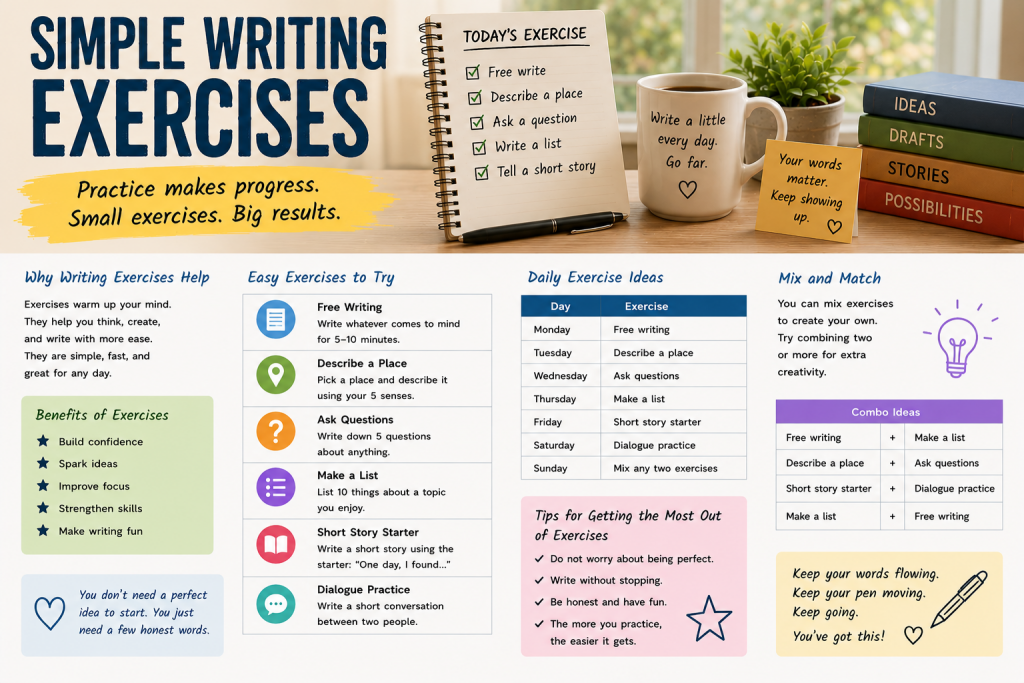
Write Daily gets much easier when you stop needing every sentence to sound good right away. Bad writing is not the enemy.
Bad writing is often the doorway.
I know that can feel strange. Nobody wants to sit down and write something clumsy, flat, boring, or messy.
But the truth is, every writer writes weak lines. Every writer has drafts that feel rough.
The difference is that writers who keep going do not treat bad writing like a stop sign. They treat it like part of the work.
Bad Writing Is Still Writing
When you write something bad, you still did something important. You made words appear where there were no words before.
That matters.
A blank page gives you nothing to shape. A messy page gives you something to work with.
When you want to Write Daily, you need to make peace with rough words. If every writing session has to feel smart and clean, you will avoid writing whenever you feel off.
And people feel off a lot.
You may be tired. You may be distracted.
You may have a weak idea. You may not know how to explain what you mean yet.
That does not mean you should stop. It means you are in the early part of making something.
| What Bad Writing Feels Like | What It Can Really Be |
|---|---|
| A waste of time | A rough starting point |
| Proof you are not good | Proof you are practicing |
| Something to delete | Something to shape later |
| A failed session | A completed habit |
| A reason to quit | A reason to revise |
The First Draft Is Supposed to Be Rough
A first draft is not meant to be perfect. It is meant to exist.
That one idea can save your writing habit.
If you expect the first draft to sound polished, you put too much pressure on the session. You start judging every sentence before it has a chance to breathe.
Writing and editing are two different jobs. Writing creates the material.
Editing improves the material.
When you try to do both at the same time, your brain can freeze. You write a sentence, judge it, delete it, rewrite it, doubt it, and then feel stuck.
That cycle can make it hard to Write Daily because writing starts to feel like punishment.
The Job of Each Stage
| Stage | Main Job |
|---|---|
| First draft | Get the idea out |
| Second draft | Make the idea clearer |
| Third draft | Improve the flow |
| Final edit | Fix weak spots and errors |
| Finished piece | Share or publish when ready |
The first draft does not need to carry the whole load. It only needs to give you something to build from.
Bad Writing Shows You What You Mean
Sometimes you do not know what you are trying to say until you write it badly first. That happens to me often.
I may start with a weak sentence, but that weak sentence leads to a better one. Then the better one leads to the real point.
If I had waited until the perfect words came first, I would have written nothing.
This is why bad writing can be useful. It gets your thoughts moving.
It lets you see what is unclear. It shows you where the real idea is hiding.
A rough paragraph can point you toward a stronger paragraph later.
“Bad writing is not the end of the process. It is often the first honest step into the process.”
That thought helps take the fear out of the page. You are not failing when the words come out rough.
You are finding the shape.
Do Not Edit Too Soon
Editing too soon can break your flow. It can also make you lose trust in yourself.
If you stop after every sentence to fix it, you may never build momentum. The page will feel slow, heavy, and full of judgment.
Give yourself permission to write forward.
You can mark a sentence and fix it later. You can leave a note that says “make this better.”
You can write a rough line and keep moving.
The goal during draft time is not to sound perfect. The goal is to keep the ideas alive long enough to catch them.
| If You Think This | Try This Instead |
|---|---|
| This sentence is bad | I can fix it later |
| This paragraph is messy | I am still finding the idea |
| I should delete this | I will keep moving for now |
| I do not sound smart | I am writing a draft, not a final |
| This is not ready | It does not need to be ready yet |
When you protect the draft from early judgment, you give yourself room to create.
Let Ugly Words Count
If you want to Write Daily, ugly words have to count. They are part of the habit.
A daily writing practice cannot depend on perfect output. It has to include tired writing, awkward writing, slow writing, and unsure writing.
Some days, the best thing you can do is write something plain. Some days, the win is just staying with the page.
That still counts.
You are training consistency, not chasing a perfect mood.
You are building trust, not proving genius.
The habit gets stronger when you show up even when the words are not pretty.
Use a Bad Draft Rule
A bad draft rule can help you start with less fear. It gives you permission before the doubt begins.
You can tell yourself, “This draft is allowed to be bad.” You can even write that at the top of the page.
That may sound silly, but it works because it lowers the pressure.
When the pressure drops, words often come easier.
Simple Bad Draft Rules
| Rule | Why It Helps |
|---|---|
| No deleting for 10 minutes | Keeps momentum moving |
| Bad sentences are allowed | Lowers fear |
| Fix later, write now | Separates writing from editing |
| One rough page counts | Makes progress visible |
| Messy is allowed | Keeps perfectionism quiet |
A rule like this gives your brain a safer place to work. It reminds you that the draft is not being graded.
Write Like You Are Explaining It to One Person
When writing feels bad, try making it simple. Pretend you are explaining the idea to one person who needs help.
This can remove some of the pressure to sound fancy.
You do not need huge words. You do not need perfect style.
You need clarity.
If the sentence feels stiff, make it more natural. If the paragraph feels confusing, say it like you would say it out loud.
That is often where stronger writing begins.
Simple writing is not weak. Simple writing can be clear, useful, and powerful.
Bad Writing Can Become Good Writing
Many strong pieces begin as weak drafts. The reader never sees that part.
They see the cleaned-up version. They see the shaped version.
They see the work after the writer stayed with it.
This is important because comparing your rough draft to someone else’s finished work is unfair. You are looking at your messy kitchen and their plated meal.
Of course yours looks worse.
You are still cooking.
| Rough Draft Problem | Revision Can Improve |
|---|---|
| Too wordy | Cut extra words |
| Too flat | Add stronger examples |
| Too confusing | Move ideas around |
| Too boring | Add clearer emotion or detail |
| Too short | Expand the useful points |
Bad writing is not permanent. It is material.
Once it exists, you can shape it.
Keep Going Past the Bad Part
Sometimes a writing session starts badly but gets better after a few minutes. The first lines are warm-up lines.
They may not be useful later, but they help you enter the work.
This is why quitting too early can be a problem. You may leave before the better thoughts arrive.
Give yourself a little time. Let the bad part pass through.
Keep typing. Keep writing.
Stay long enough to see if the page opens up.
The habit to Write Daily grows when you stop being scared of a rough start. You learn that bad words do not have to end the session.
Measure the Showing Up
If you judge every day only by quality, you will feel defeated often. Quality changes from day to day.
Showing up is easier to measure.
Did you write today? Did you add something?
Did you stay with the page for the time you promised?
Those questions help you see progress even when the draft feels weak.
| Better Question | Why It Helps |
|---|---|
| Did I show up? | Measures the habit |
| Did I add words? | Shows forward motion |
| Did I keep going? | Builds discipline |
| Did I avoid quitting early? | Builds confidence |
| Did I create something to revise? | Gives you material |
Some days, the words will be good. Some days, they will not.
Both kinds of days can still build the habit.
Give Yourself Room to Be a Beginner Again
Every new project can make you feel like a beginner. A new book, blog post, story, or idea may bring back doubt.
That is normal.
You may know how to write and still feel unsure when something new begins. You may have finished work before and still write a rough first page today.
That does not erase your progress.
It means you are working at the edge of what you know.
Give yourself room to be clumsy there.
A writer who allows rough work can keep moving. A writer who demands perfect work may stay stuck.
Bad writing is not something to fear when it helps you return to the page, build the draft, and Write Daily.
Ugly Drafts Matter
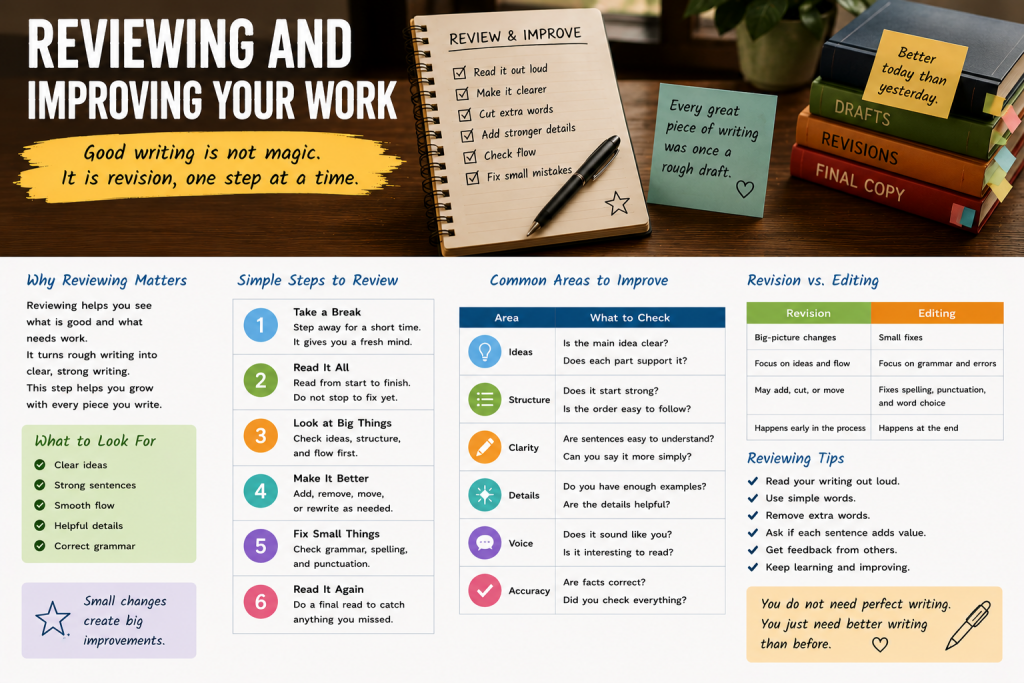
Write Daily becomes a lot easier when you understand that ugly drafts are not a problem. Ugly drafts are part of how real writing gets made.
An ugly draft is a draft that feels messy, weak, boring, too long, too short, or all over the place. It may not sound the way you hoped it would sound.
That does not mean it is useless.
It means it is early.
I used to hate ugly drafts. I would write a few lines, read them back, and feel disappointed.
Then I would think, “This is terrible,” and stop writing.
That kept me trapped because I was judging the seed before it had time to grow.
An Ugly Draft Gives You Something to Work With
A blank page gives you nothing. An ugly draft gives you a starting place.
That is why ugly drafts matter so much.
You can fix a rough sentence. You can move a messy paragraph.
You can cut extra words. You can add better examples.
But you cannot improve words that do not exist.
When you want to Write Daily, your first job is not to make every line beautiful. Your first job is to create material.
| Blank Page | Ugly Draft |
|---|---|
| Nothing to edit | Something to shape |
| No direction | A rough path |
| No progress to see | Proof you started |
| More fear | More options |
| Stays empty | Can become better |
An ugly draft may not look like success at first. But it is often the first visible sign that your idea is becoming real.
Ugly Drafts Lower the Pressure
When you allow ugly drafts, the pressure drops. You no longer need the first version to carry the full weight of the final piece.
That matters because too much pressure can stop you before you begin.
If you sit down thinking, “This must be good right now,” writing feels tight and scary. If you sit down thinking, “This can be messy,” writing feels more open.
That small shift can help you Write Daily without fighting yourself so much.
You are not lowering your standards. You are giving the work a fair chance to develop.
High standards are useful later. They are not always useful during the first draft.
The Ugly Draft Is Where You Find the Real Idea
Many times, the first idea you write is not the real idea. It is the doorway to the real idea.
You may write a weak paragraph, then notice one sentence inside it that has power. That sentence can become the center of the whole piece.
You may write a page that feels messy, then realize what you were actually trying to say.
That has happened to me many times.
I thought I was wasting time, but I was really digging. The good part was under the rough part.
What Ugly Drafts Can Reveal
| Ugly Draft Problem | What It May Reveal |
|---|---|
| Too many ideas | You need a clearer focus |
| Weak opening | You are warming up |
| Messy order | The structure needs shaping |
| Repeated thoughts | The main point matters to you |
| Flat writing | You need stronger examples |
| Confusing lines | You are still finding the meaning |
The draft does not have to be clean to be useful. It only has to show you what is there.
Do Not Confuse Ugly With Wrong
Ugly does not mean wrong. Ugly means unfinished.
A rough draft may feel clumsy because the idea is still new. It may feel weak because you have not added details yet.
It may feel boring because you have not found the right angle. It may feel confusing because the order is not right yet.
None of that means the work is bad forever.
It means the work needs care.
“An ugly draft is not failed writing. It is writing that has not been shaped yet.”
That thought can help you stay calm when the page does not look good right away. You do not need to panic.
You need to keep working.
Ugly Drafts Help You Beat Perfectionism
Perfectionism wants the draft to look finished too soon. It wants every sentence to be clean, every point to be smart, and every paragraph to flow right away.
That sounds nice, but it can choke the writing.
If you are trying to Write Daily, perfectionism can become a trap. It may make you stop after one bad line.
It may make you edit the same paragraph for an hour. It may make you avoid writing because you are afraid the draft will disappoint you.
Ugly drafts break that trap.
They teach you that the first version is allowed to be imperfect. They teach you that progress can look messy.
They teach you that the work does not need to be pretty to be real.
Give Each Draft a Job
One reason ugly drafts feel upsetting is that we expect them to do too much. We expect the first draft to have the idea, structure, voice, flow, examples, and polish.
That is too much for one draft.
Give each draft a smaller job.
| Draft Stage | Job |
|---|---|
| Ugly draft | Get the idea out |
| Shape draft | Put ideas in better order |
| Clarity draft | Make the meaning easier to understand |
| Style draft | Improve voice and flow |
| Clean draft | Fix errors and polish |
This makes writing feel more fair. The ugly draft is not failing because it looks rough.
It is doing its job.
How to Write an Ugly Draft on Purpose
Writing an ugly draft on purpose can feel freeing. You stop trying to impress yourself and start trying to get the idea down.
Set a timer for ten minutes. Write without fixing every line.
Do not stop to search for the perfect word. Use a simple word and keep moving.
If you get stuck, write, “What I mean is…” and continue from there.
If a section feels weak, leave a note like “add better example here.” Then keep going.
Ugly Draft Rules
| Rule | Why It Helps |
|---|---|
| No deleting during the timer | Keeps the words moving |
| Use simple words | Stops overthinking |
| Leave notes for later | Protects flow |
| Skip hard parts for now | Prevents getting stuck |
| Keep writing badly if needed | Builds the habit |
The goal is not to make a mess for no reason. The goal is to keep the idea alive long enough to shape it later.
Ugly Drafts Build Confidence Over Time
At first, ugly drafts may feel discouraging. You may wonder why the words do not match the idea in your head.
But over time, they build confidence.
You learn that rough writing can be fixed. You learn that bad starts do not ruin the whole piece.
You learn that you can sit with discomfort and still create something.
That confidence matters because it makes you braver. You become more willing to start.
You become more willing to try ideas that are not fully clear yet.
You become more willing to stay with the page.
Keep the Ugly Draft Private
An ugly draft does not need an audience. It does not need approval.
It needs space.
Do not show it too early if that will make you feel judged. Let it be private while it is still forming.
Private drafts are like a workshop. You can make noise, spill things, move parts around, and figure out what works.
Later, when the piece is stronger, you can share it if you choose.
| Draft Is Private | Draft Is Ready to Share |
|---|---|
| Messy ideas | Clear main point |
| Rough sentences | Stronger flow |
| Missing parts | Filled-in details |
| Notes to self | Cleaned-up sections |
| No polish yet | More readable shape |
Protecting the ugly stage can help you keep going. Not every part of the process needs to be seen.
Ugly Drafts Are Proof of Effort
An ugly draft is not something to be ashamed of. It is proof that you showed up.
It means you faced the page. It means you put thoughts into words.
It means you gave the idea a chance to become something more.
That matters, especially on the days when writing feels hard.
If you only respect polished writing, you miss the value of the work that comes before it. Finished writing is built from unfinished writing.
Clean pages grow from messy ones.
Strong ideas often start as weak lines that someone cared enough to keep shaping.
When you let ugly drafts count, you give yourself more freedom to Write Daily.
Progress Over Perfection
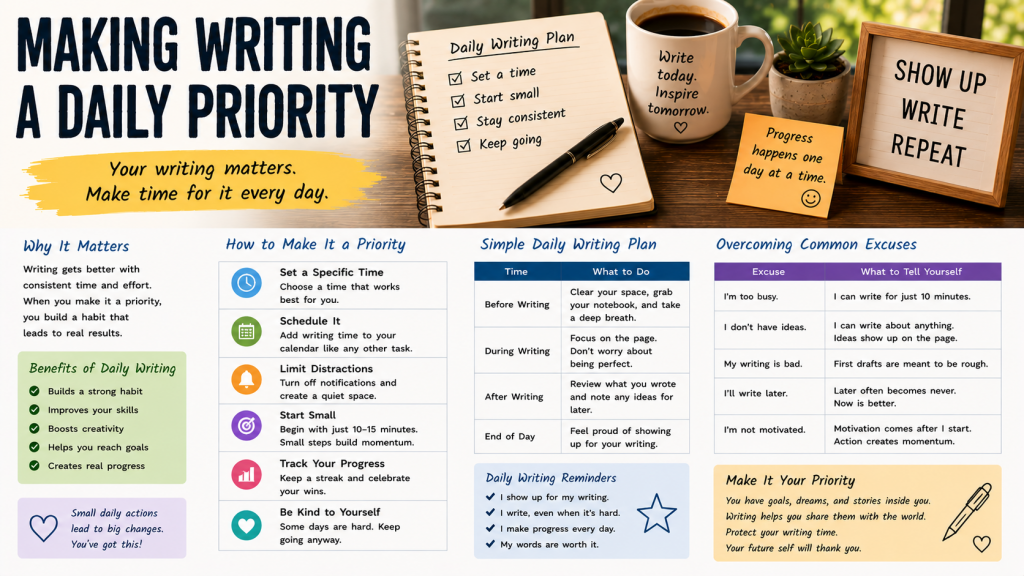
Write Daily becomes much more possible when you choose progress over perfection. Perfection sounds strong, but it often keeps writers stuck.
Progress is different.
Progress lets you move. Progress lets you learn.
Progress lets you build something one small piece at a time.
I used to think good writing had to feel clean right away. If a sentence sounded wrong, I would stop and fix it.
Then I would fix it again.
Then I would read it again.
By the end, I had spent twenty minutes on one small paragraph and had no energy left to keep going. That was not discipline.
That was perfectionism wearing a serious face.
Perfection Can Slow You Down
Perfection tells you the work is not good enough yet. It tells you to keep fixing, keep waiting, keep planning, and keep doubting.
At first, that may sound helpful. After all, you want your writing to be good.
But perfection often asks for finished-level work too early. It wants the first draft to act like the final draft.
That is too much pressure for one writing session.
When you want to Write Daily, too much pressure can make the habit feel heavy. If every day has to produce amazing writing, you may start avoiding the page.
| Perfection Says | Progress Says |
|---|---|
| This has to be perfect now | This can get better later |
| Do not move on yet | Keep the draft moving |
| One bad sentence means failure | One bad sentence can be fixed |
| You are not ready | Start and learn |
| This does not count unless it is great | Showing up counts |
Progress gives you room to breathe. It lets you keep going without needing every word to be perfect today.
Progress Builds the Habit
A daily writing habit is built by repeated action, not flawless action. That means imperfect writing still has value.
When you write a rough paragraph, you are still training your mind to show up. When you write a messy page, you are still building the habit.
That matters more than people think.
If you only count polished writing, you will miss most of your growth. Growth often happens in the quiet, awkward, unfinished parts.
To Write Daily, you need to value the act of writing, not only the final result.
A finished piece may get the attention, but the daily habit creates the finished piece.
Small Progress Is Still Progress
Small progress can feel easy to dismiss. You may say, “I only wrote a few lines,” or “I only worked for ten minutes.”
But small progress adds up when you repeat it.
One paragraph today may not feel like much. But one paragraph a day for a month becomes pages.
A few notes today can become an outline later. A weak idea today can become a strong chapter after you shape it.
Examples of Real Writing Progress
| Small Action | Why It Matters |
|---|---|
| Wrote one paragraph | Added something that did not exist |
| Made a short outline | Gave the project structure |
| Fixed one weak section | Improved the draft |
| Listed five ideas | Created future writing material |
| Opened the document | Kept the habit alive |
| Wrote for ten minutes | Trained consistency |
Progress does not always look dramatic. Sometimes it looks like a quiet checkmark on a normal day.
That still matters.
Perfection Can Hide Fear
Perfection often feels like high standards, but sometimes it hides fear. It can be fear of being judged, fear of failing, or fear of not being good enough.
I have caught myself saying, “I just want this to be right,” when the truth was, “I am scared this will not be good.”
That is a very human feeling.
But fear should not get to control the whole writing process.
If perfection keeps you from writing, it is not helping you. It is blocking you.
The goal is not to stop caring about quality. The goal is to care about quality at the right time.
Draft first. Improve later.
Improvement Comes From Finished Drafts
You learn more from finishing a rough draft than from endlessly polishing the first page. A full draft shows you the shape of the whole idea.
It shows what is missing. It shows what is too long.
It shows what needs to move.
You cannot see all of that if you never let the draft grow.
When you Write Daily, you give yourself more chances to improve. Each session teaches you something.
Some lessons are small. Some are big.
But they come from doing the work, not waiting until you can do it perfectly.
| If You Keep Polishing Too Early | If You Keep Moving |
|---|---|
| The draft grows slowly | The draft gets built |
| You get stuck on tiny details | You see the full idea |
| You lose energy fast | You build momentum |
| You fear every sentence | You learn from each page |
| You may quit early | You create material to improve |
A rough full draft is often more useful than one perfect opening paragraph.
Let Good Enough Be a Step
“Good enough” does not mean careless. It means the work is ready for the next step.
A sentence may be good enough for today. A paragraph may be good enough for the first draft.
An outline may be good enough to begin.
This mindset can save your writing habit. It keeps you from turning every small choice into a major battle.
You can always return later with fresh eyes.
That is one of the best parts of writing. The first version is not the only version.
A Simple Good Enough Check
| Question | If Yes, Move Forward |
|---|---|
| Does this sentence say the basic idea? | Keep writing |
| Does this paragraph belong here for now? | Keep drafting |
| Do I know the next point? | Move to it |
| Can this be fixed later? | Leave a note |
| Am I stuck because I am overthinking? | Take the next small step |
Good enough keeps the work alive. Perfect too early can freeze it.
Celebrate Movement
Progress needs to be noticed. If you never notice it, your brain may feel like nothing is working.
That can make writing feel pointless.
Take a moment to see what you did. You wrote today.
You added words. You shaped an idea.
You kept a promise. You returned to the page.
That is not small when you are building a daily writing life.
You do not need a huge reward. A checkmark, a short note, or a simple “done” can help.
| Progress Moment | Simple Way to Mark It |
|---|---|
| Wrote today | Check off the day |
| Finished a section | Mark it in your outline |
| Fixed a weak part | Write “improved” beside it |
| Reached a word goal | Track the number |
| Stayed focused | Note what helped |
Marking progress helps your brain connect writing with success. That makes it easier to return tomorrow.
Stop Comparing Your Draft to Someone Else’s Final Work
Comparison can make progress feel invisible. You may look at a finished book, blog post, or article and think your draft is terrible.
But you are not seeing the messy parts behind that finished work.
You are not seeing the deleted lines, weak starts, confusing sections, or edits. You are seeing the cleaned-up result.
Comparing your draft to that is not fair.
Your draft is still growing.
Their finished piece already went through the hard middle.
If you want to Write Daily, protect your progress from unfair comparison. Let your work be where it is.
Make Progress the Daily Win
The daily win does not have to be perfect writing. The daily win can be showing up.
It can be adding one clear thought. It can be staying with the page for ten minutes.
It can be writing even when your mood was not great.
This makes the habit more stable because the win is under your control. You cannot always control how inspired you feel.
You cannot always control how strong the words sound.
But you can control whether you return to the page and take the next small step.
“Progress gives you proof. Perfection gives you pressure.”
That proof builds confidence. Each small session says, “I can do this again.”
Use Perfection Later, Not First
There is a place for high standards. Editing matters.
Clarity matters. Strong sentences matter.
But those things work better after the draft exists. Perfection is a terrible starting tool, but careful revision can be a useful finishing tool.
Think of it like building a table. First, you need the wood in place.
Then you sand it.
You do not sand air.
Writing works the same way. First, get the words down.
Then make them better.
Progress Keeps the Door Open
Progress over perfection keeps the writing door open. It lets you return even after a rough day.
It lets you keep going even when the draft is not ready.
It lets you build trust with yourself one session at a time.
When you choose progress, you are not giving up on quality. You are choosing the path that actually leads to better writing.
Every small step makes the next step easier. Every rough page gives you something to shape.
Every imperfect session helps train the habit to Write Daily.
Tracking Momentum
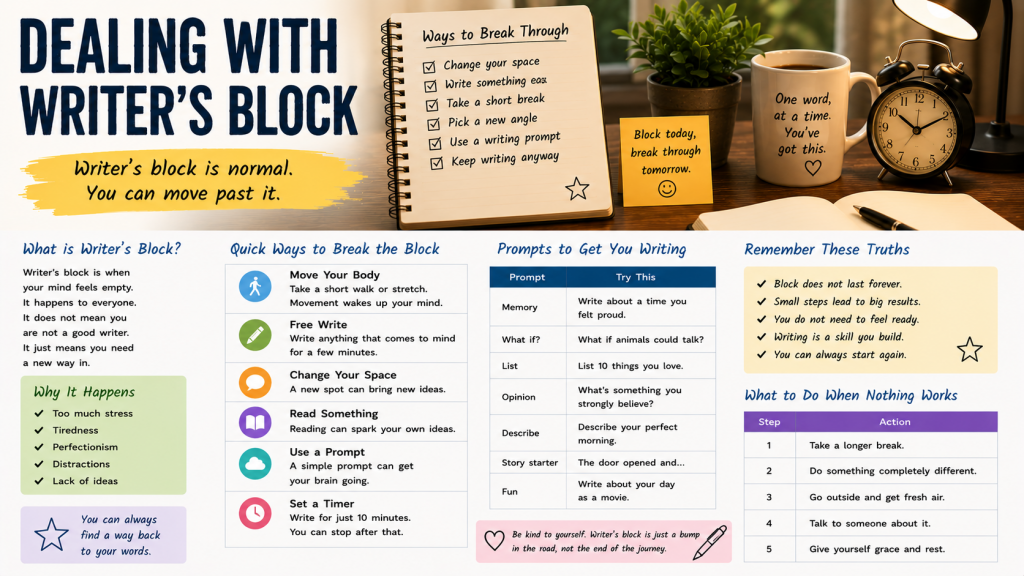
Write Daily becomes easier when you can see your progress. Momentum is that feeling that you are moving forward, even if the steps are small.
Some days, writing may not feel exciting. You may not feel fast, clever, or full of ideas.
But when you can look back and see that you showed up, it gives you proof. That proof can help you keep going.
I used to think momentum came from big writing days. I thought I needed long sessions and huge word counts to feel like a real writer.
Now I see it differently.
Momentum often comes from small wins that are easy to repeat. One paragraph today can help you come back tomorrow.
What Momentum Really Means
Momentum does not mean you are writing perfectly. It does not mean every day feels easy.
Momentum means you have movement. You are not stuck in the same place.
When you Write Daily, even a little, you are building a chain of effort. Each writing session connects to the next one.
That chain can help you feel less lost.
You start to see that the work is growing. You start to see that your habit is real.
| What Momentum Is Not | What Momentum Is |
|---|---|
| Writing perfectly every day | Returning to the page often |
| Always feeling inspired | Writing even when energy is low |
| Huge word counts only | Small steady progress |
| Never missing a day | Getting back on track quickly |
| Feeling confident all the time | Building proof through action |
Momentum is not about being flawless. It is about keeping motion alive.
Why Tracking Helps
Tracking helps because your brain forgets progress quickly. You may write for ten minutes, then feel like it did not matter.
But when you mark it down, you can see that it mattered.
A checkmark on a calendar may look small, but it tells a story. It says, “I showed up.”
When you are trying to Write Daily, that story is powerful. It helps you trust yourself more.
Tracking also helps you notice patterns. You may see that you write better in the morning.
You may see that short sessions work better than long ones. You may notice that your best ideas come after a few minutes of warm-up writing.
Those patterns can help you build a better routine.
Keep Your Tracking Simple
Do not make tracking so complicated that it becomes another job. The point is to help your writing habit, not slow it down.
A simple tracker is enough.
You can use a notebook, calendar, spreadsheet, sticky note, planner, or app. The tool does not matter as much as using it.
Track only what helps you.
| Simple Thing to Track | Why It Helps |
|---|---|
| Date | Shows when you wrote |
| Time spent | Shows effort |
| Words written | Shows output |
| Project worked on | Shows focus |
| Mood or energy | Shows patterns |
| Notes for tomorrow | Makes the next start easier |
If tracking feels heavy, track less. A checkmark can be enough.
The best tracker is the one you will keep using.
Use Checkmarks for Quick Wins
A checkmark is simple, but it works. It gives your brain a fast reward after writing.
That little mark says the habit happened.
You do not need to write a full report. You do not need to judge the writing.
You only need to mark the day.
Simple Checkmark System
| Mark | Meaning |
|---|---|
| Checkmark | Wrote today |
| Dot | Opened the draft or added one note |
| Star | Strong writing session |
| Circle | Rest day or planned break |
| Arrow | Continue this idea tomorrow |
This kind of system lets you see progress without turning tracking into a chore. It also gives room for real life.
Some days may be full writing days. Some may be tiny writing days.
Both can stay visible.
Track Effort, Not Just Results
Word counts are useful, but they are not the only thing that matters. Some writing sessions are important even when the word count is low.
You may spend time fixing a weak paragraph. You may plan a better section.
You may organize notes. You may cut words that no longer belong.
That is still writing work.
If you only track word count, you may miss real progress. This can make you feel like you are failing when you are actually improving the draft.
| Writing Work | Why It Counts |
|---|---|
| Drafting new words | Builds the piece |
| Revising a section | Makes the piece stronger |
| Outlining | Gives the piece direction |
| Cutting weak parts | Improves clarity |
| Taking notes | Captures ideas |
| Reading your draft | Helps you see what to fix |
To Write Daily, you need to respect more than fresh words. Writing is also thinking, shaping, cutting, and improving.
Watch for Patterns
Tracking can show you what works. This is where the habit starts to become smarter.
Maybe you write more when your phone is away. Maybe you write better after coffee.
Maybe night writing sounds good in your head, but you are too tired when night comes. Maybe five minutes turns into twenty when you start before checking messages.
These patterns matter.
They help you stop guessing.
| Pattern You Notice | What It May Teach You |
|---|---|
| Better focus in the morning | Write earlier when possible |
| More ideas after walking | Walk before hard sessions |
| Low energy at night | Use nights for notes only |
| Distraction after phone use | Keep phone away first |
| Stronger sessions with timer | Use timers more often |
Tracking is not about judging yourself. It is about learning how you work.
The more you learn, the easier it becomes to build a writing life that fits you.
Let Momentum Pull You Forward
When you see several writing days in a row, you may feel more motivated to keep going. That is momentum doing its job.
A streak can make writing feel like part of your identity. You start thinking, “I am someone who shows up.”
That feeling can help on harder days.
But be careful not to let the streak become a weapon. If you miss a day, the habit is not dead.
Momentum can restart.
A missed day does not erase your effort. It only gives you a place to begin again.
Create a Restart Rule
A restart rule helps you avoid the shame spiral. Without a restart rule, missing one day can turn into missing a week.
Your rule should be simple.
For example, “If I miss a day, I write one sentence the next day.” That gives you a clear way back.
You do not have to punish yourself. You do not have to make up for the missed day with a huge session.
Just return.
| If This Happens | Restart Rule |
|---|---|
| Miss one day | Write one sentence the next day |
| Miss three days | Write for five minutes |
| Feel overwhelmed | Open the draft and add one note |
| Lose track | Mark today and begin again |
| Feel guilty | Do the smallest writing action |
A restart rule keeps the habit from becoming fragile. It gives you a bridge back to the page.
Use Notes to Help Tomorrow
One of the best ways to keep momentum is to leave yourself a note at the end of each session. This makes tomorrow easier.
The note does not have to be long.
Write down what to do next. Write the next point.
Write the next scene idea. Write one question you want to answer.
When you return, you do not have to start cold.
Helpful End-of-Session Notes
| Note Type | Example |
|---|---|
| Next step | “Explain why short sessions work.” |
| Reminder | “Keep this simple and personal.” |
| Question | “What does the reader need here?” |
| Scene note | “Start with the character entering the room.” |
| Fix later | “Add a better example here.” |
This small habit keeps the thread alive. It gives your future self a handhold.
Make Progress Visible
Progress feels stronger when you can see it. This is why visual tracking helps.
A calendar with marks can show your effort. A word count log can show growth.
A project checklist can show how much is done.
Seeing progress can help on days when your feelings are not reliable. You may feel like nothing is happening, but the tracker shows otherwise.
| Visual Tracker | What It Shows |
|---|---|
| Calendar | Days you showed up |
| Word count chart | Growth over time |
| Project checklist | Sections completed |
| Writing log | What you worked on |
| Draft folder | Pieces created |
Visible progress reminds you that the work is not disappearing. It is adding up.
Do Not Track Yourself Into Stress
Tracking should support you, not pressure you into burnout. If tracking makes you feel judged, simplify it.
You do not need to track ten things. You do not need perfect records.
You are building awareness, not creating a report card.
If word count makes you tense, track time. If time makes you tense, track checkmarks.
If checkmarks make you tense, write one sentence about what you did.
The tracker should make it easier to Write Daily, not make the habit feel heavier.
Celebrate Small Momentum
Small momentum deserves respect. You do not need to wait until the book is done or the article is published to feel proud.
You can feel proud that you wrote today. You can feel proud that you returned after missing a day.
You can feel proud that you stayed with a hard paragraph. You can feel proud that you opened the page when part of you wanted to avoid it.
These small moments are where the writing life is built.
| Small Win | Why It Matters |
|---|---|
| Wrote one sentence | Started the habit |
| Wrote for ten minutes | Protected writing time |
| Finished a paragraph | Built the draft |
| Came back after missing a day | Strengthened trust |
| Tracked the session | Made progress visible |
Momentum grows when you notice it. The more you notice small wins, the more your brain starts to believe that writing is something you can keep doing.
Tracking gives you proof that the habit is alive, and that proof helps you return to the page and Write Daily.
Word Counts
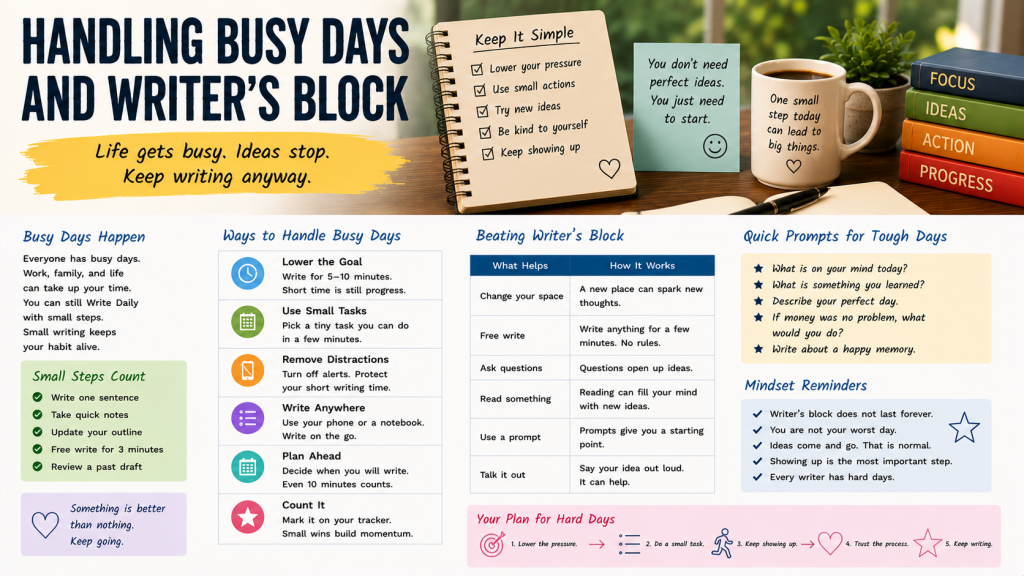
Write Daily can feel clearer when you use word counts, but word counts should help you, not scare you. A word count is just a simple way to measure how much you wrote.
It is not a measure of your worth.
It is not proof that you are good or bad.
It is only a number that can help you see movement.
I used to look at word counts the wrong way. If the number was high, I felt proud.
If the number was low, I felt like I failed.
That made writing feel like a test, and that is not the best way to build a daily habit.
Why Word Counts Can Help
A word count gives your writing session a clear target. It tells you what done looks like.
That can be helpful when the page feels endless.
Instead of saying, “I need to write a lot,” you can say, “I will write 200 words.” That feels more real.
When you want to Write Daily, clear goals can make the habit easier to start. Your brain likes knowing where the finish line is.
| Vague Goal | Clear Word Count Goal |
|---|---|
| Write more today | Write 200 words |
| Work on my book | Add 300 words to the chapter |
| Make progress | Write 150 rough words |
| Finish something | Draft 500 words |
| Try to write | Write 100 words before lunch |
A clear word count can lower stress because you are not guessing. You know what you are aiming for.
Start With a Small Word Count
A small word count is often better than a big one when you are building the habit. Big goals may sound exciting, but they can also create fear.
If you set the goal too high, you may avoid writing because the task feels too large.
Start with a number you can reach on a normal day. Not your best day.
Not your dream day.
A normal day.
For some people, that may be 100 words. For others, it may be 300 words.
If life is busy, even 50 words can count.
| Experience Level | Simple Daily Word Count |
|---|---|
| New writer | 50 to 150 words |
| Busy writer | 100 to 250 words |
| Steady writer | 300 to 500 words |
| Strong routine | 500 to 1,000 words |
| Drafting push | 1,000+ words |
The best word count is the one you can repeat. A goal you actually hit is better than a goal you keep avoiding.
Word Counts Are Tools, Not Chains
A word count should guide you. It should not trap you.
Some days, you may reach your number fast. Other days, every sentence may feel slow.
That is normal.
If your goal is 300 words and you write 180, that is still progress. You added something.
You showed up.
You kept the writing habit alive.
When you Write Daily, the real win is not always hitting the exact number. The real win is returning to the page and doing the work.
Match the Word Count to the Type of Writing
Not all writing tasks create the same number of words. Drafting usually adds words fast.
Editing may remove words.
Outlining may create fewer words, but it can still help the project.
That is why you should match your word count goal to the kind of writing you are doing.
| Writing Task | Good Way to Measure It |
|---|---|
| First draft | Words added |
| Blog section | Words added or section finished |
| Book chapter | Words added |
| Editing | Pages reviewed |
| Outlining | Ideas listed |
| Research notes | Useful notes captured |
If you are editing, a low word count does not mean you failed. You may have improved the work by cutting weak parts.
That still matters.
Use Word Counts to Build Confidence
Word counts can build confidence because they show proof. You can look back and see that your work is growing.
This is powerful when you feel like nothing is happening.
A few hundred words may not seem like much in one day. But over time, it becomes real progress.
| Daily Words | After 7 Days | After 30 Days |
|---|---|---|
| 100 words | 700 words | 3,000 words |
| 250 words | 1,750 words | 7,500 words |
| 500 words | 3,500 words | 15,000 words |
| 750 words | 5,250 words | 22,500 words |
| 1,000 words | 7,000 words | 30,000 words |
This is why small word counts matter. They do not stay small when repeated.
Do Not Let the Number Steal the Joy
A word count can help you focus, but it can also make writing feel cold if you let the number become everything.
Writing is still about ideas. It is about meaning, stories, thoughts, lessons, and connection.
If you only chase the number, you may start writing words just to fill space. That can make the draft weaker.
Use the number as a guide, but keep caring about what you are saying.
The goal is not just to add words. The goal is to build something useful, honest, or meaningful over time.
“A word count can measure the pile of bricks, but it cannot measure the heart of the house.”
That is how I like to think about it. The number helps, but it is not the whole story.
Create a Minimum and a Bonus Goal
One simple way to use word counts is to set two goals. The first goal is the minimum.
The second goal is the bonus.
The minimum keeps the habit alive. The bonus gives you room to grow on better days.
Simple Word Count Goal System
| Goal Type | Example | Purpose |
|---|---|---|
| Minimum goal | 100 words | Keeps the habit alive |
| Normal goal | 300 words | Builds steady progress |
| Bonus goal | 600 words | Uses strong energy days |
| Stretch goal | 1,000 words | Helps during big pushes |
This system helps because you do not feel like a failure on low-energy days. If you hit the minimum, you still win.
If you have more energy, you can keep going.
Count Rough Words Too
Rough words count. Messy words count.
Plain words count.
First-draft words count.
If you only count words you love, you will make the habit harder than it needs to be.
When you are trying to Write Daily, you need to respect the rough stage. Most good writing starts as something less polished.
A rough 300 words gives you something to shape. A perfect zero gives you nothing.
Do not punish the words for being early.
Track Word Counts Without Overthinking
Tracking your word count can be very simple. You do not need a complex system.
You can write the number at the top of the page. You can keep a note in your planner.
You can use a spreadsheet, app, or calendar.
Keep it easy.
| Date | Project | Words Written | Note |
|---|---|---|---|
| Monday | Blog draft | 250 | Slow start, good finish |
| Tuesday | Book chapter | 400 | Strong focus |
| Wednesday | Journal | 150 | Tired but wrote |
| Thursday | Article section | 500 | Clear idea |
| Friday | Notes | 100 | Captured useful points |
The note matters because it gives the number context. A lower number on a hard day may still be a strong win.
Avoid Comparing Word Counts
Some writers write thousands of words a day. Some write a few hundred.
Some write fast. Some write slow.
Your word count does not need to match someone else’s.
Comparison can turn a helpful tool into a source of shame. That is not useful.
Your life, energy, schedule, project, and writing speed are your own. Your word count should fit your real life.
If 200 words a day helps you keep going, that is a good goal.
If 1,000 words makes you quit after three days, it is not the right goal yet.
Use Word Counts to Notice Patterns
Word counts can show you how you work best. After a few weeks, you may notice useful patterns.
Maybe you write more in the morning. Maybe you write better in short sessions.
Maybe you write fewer words when your phone is nearby. Maybe you do better when you leave notes for the next day.
| Pattern | What You Can Try |
|---|---|
| Higher words in morning | Write earlier when possible |
| Lower words at night | Use night for planning |
| Better output with timer | Keep using timed blocks |
| Strong days after walking | Walk before writing |
| Low words after scrolling | Keep phone away first |
These patterns help you build a smarter habit. You stop guessing and start learning from your own work.
Let Low Word Counts Still Count
Some days will be low-word days. That does not mean they are wasted days.
Maybe you wrote 80 words, but those 80 words gave you a clear idea. Maybe you wrote 50 words, but you kept the streak alive.
Maybe you wrote one sentence that helped you return tomorrow.
That still matters.
A low word count can still be a high-value session.
Do not erase the effort just because the number is small.
Build the Number Slowly
Once your daily habit feels steady, you can raise the word count. Do it slowly.
Do not jump from 100 words to 2,000 words overnight unless you truly have the space and energy for it.
A slow increase is easier to keep.
| Current Goal | Small Increase |
|---|---|
| 100 words | 150 words |
| 200 words | 250 words |
| 300 words | 400 words |
| 500 words | 600 words |
| 750 words | 900 words |
This keeps the habit from feeling too heavy. You are growing the routine without breaking it.
Make the Word Count Serve the Habit
The word count should serve your writing habit. It should help you focus, track progress, and feel encouraged.
It should not make you dread the page.
If the number starts to feel stressful, lower it. If it feels too easy for a long time, raise it.
If your project changes, adjust the goal.
You are allowed to shape the system around your real life.
A healthy word count helps you show up, build trust, and keep adding words until it feels natural to Write Daily.
Streaks and Consistency
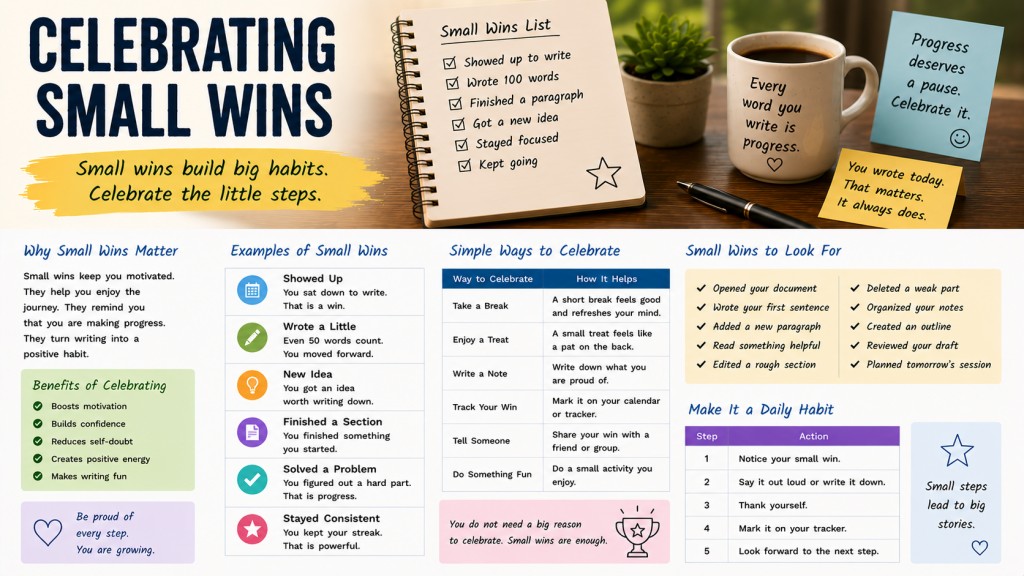
Write Daily gets easier when you understand the real purpose of a streak. A streak is not there to make you feel trapped.
A streak is there to show you that you are building trust with yourself.
When you write several days in a row, you start to feel something shift. Writing begins to feel less like a random task and more like part of who you are.
That is why streaks can be powerful.
But they can also become stressful if you use them the wrong way.
What a Writing Streak Really Means
A writing streak means you showed up more than once. It means you returned to the page again and again.
That repeated return matters.
It teaches your brain that writing is not only something you do when you feel inspired. It is something you practice.
When you want to Write Daily, a streak can give you proof that you are capable of staying with the habit.
That proof can help on days when your mood is low.
| What a Streak Is | What a Streak Is Not |
|---|---|
| Proof you showed up | Proof you are perfect |
| A way to build trust | A reason to punish yourself |
| A simple progress marker | A measure of your worth |
| A habit helper | A life sentence |
| A reminder to return | A reason to panic |
A streak should support you. It should not become another voice telling you that you are failing.
Consistency Matters More Than Intensity
Many people think a strong writer is someone who writes for hours every day. That can be true for some people, but it is not the only way to build a writing life.
Consistency is more important than intensity.
A huge writing day can feel great, but if it burns you out, it may not help the habit. A small writing day that you can repeat may be much more useful.
I have learned that steady writing beats dramatic writing most of the time.
A simple ten-minute session done often can build more trust than one giant session followed by weeks of avoidance.
When you Write Daily, you are not trying to prove how hard you can push once. You are trying to prove that you can return.
The Power of Showing Up Often
Showing up often changes how you see yourself. You begin to think, “Writing is part of my day.”
That shift is powerful because identity drives behavior.
If you see yourself as someone who writes, writing becomes less of a debate. You do not need to ask if you are in the mood every time.
You just take the next small step.
| Inconsistent Thinking | Consistent Thinking |
|---|---|
| I write when I feel ready | I write because this is my habit |
| I need a big block of time | I can use a small block today |
| Missing a day ruins everything | I can return quickly |
| I need perfect focus | I can write with the focus I have |
| I failed because it was short | I showed up, and that counts |
Consistency is not about being perfect every day. It is about making writing easier to return to.
Protect the Streak Without Worshiping It
A streak can motivate you, but it should not control you. There is a big difference between protecting a habit and worshiping a number.
Protecting the habit means you care about showing up.
Worshiping the number means you feel crushed if the streak breaks.
That is not healthy.
If a streak helps you feel excited, use it. Mark your calendar.
Track your days. Enjoy seeing the chain grow.
But do not let one missed day erase your whole identity as a writer.
Healthy Streak Rules
| Rule | Why It Helps |
|---|---|
| Small writing counts | Keeps the habit possible |
| Planned rest is allowed | Prevents burnout |
| Missing one day is not failure | Makes restarting easier |
| The streak serves the habit | Keeps pressure lower |
| Restart quickly | Builds long-term consistency |
A streak is a tool. It is not the boss of your writing life.
Create a Minimum Daily Action
A minimum daily action protects your consistency. This is the smallest writing action that still counts.
It should be easy enough to do on a hard day.
Your minimum might be one sentence. It might be five minutes.
It might be three bullet points, one journal line, or opening the draft and leaving a note.
This does not mean you only do the minimum forever. It means the habit has a safety net.
| Day Type | Minimum Writing Action |
|---|---|
| Normal day | Write 200 words |
| Busy day | Write one paragraph |
| Tired day | Write one sentence |
| Stressful day | Add three bullet points |
| Travel day | Capture one idea |
| Sick day | Rest or write one tiny note if able |
This keeps the habit from breaking under real life. You still have a way to show up without forcing a full session.
Be Careful With All-or-Nothing Thinking
All-or-nothing thinking can destroy consistency. It says, “If I cannot do the full plan, there is no point.”
That is not true.
A small session is still a session. A rough paragraph still adds material.
A five-minute effort still keeps the writing habit alive.
When you want to Write Daily, you need a middle path between doing everything and doing nothing.
That middle path is where most real habits live.
You may not always have time for your ideal writing session. But you may have time for a small one.
Small still counts.
Track Streaks in a Gentle Way
Tracking a streak should feel simple. If your tracking system makes you tense, it is too much.
Use a calendar, notebook, planner, or habit app if it helps. Keep the system light.
You can mark the day with a check, dot, line, or word count.
The point is to make your effort visible.
| Tracking Mark | Meaning |
|---|---|
| Checkmark | Full writing session |
| Dot | Tiny writing action |
| Star | Strong focus day |
| Circle | Planned rest |
| Arrow | Restart day |
| Note | Idea captured |
This kind of tracking shows the truth better than a simple yes-or-no system. It lets you see that even small days are part of the pattern.
Plan for Broken Streaks
Every writer needs a broken-streak plan. Life happens.
You may get sick. You may have family needs.
You may travel. You may have a stressful day.
You may simply forget.
That does not mean your writing habit is gone. It means you need a clear way back.
A broken-streak plan helps you restart without making the missed day bigger than it needs to be.
Simple Restart Plan
| What Happened | What to Do Next |
|---|---|
| Missed one day | Write one sentence today |
| Missed a few days | Write for five minutes |
| Feel embarrassed | Do not judge, just restart |
| Lost your place | Read your last paragraph |
| Forgot the habit | Attach it to a daily trigger again |
The faster you return, the less power the missed day has.
Consistency Builds Trust Slowly
Trust does not appear all at once. It grows as you keep promises to yourself.
Each writing session tells your mind, “I came back.” Each small action adds proof.
Over time, you begin to believe your own plan.
That matters because many people do not struggle only with writing. They struggle with trusting that they will follow through.
Consistency rebuilds that trust.
You do not need to become a different person overnight. You only need to keep making small promises and keeping them.
Make the Streak About Identity
The best streaks are not only about numbers. They are about identity.
The streak says, “I am becoming someone who writes.”
That does not mean you never struggle. It does not mean you always write well.
It means writing belongs in your life.
When you think this way, a short session still matters. A rough session still matters.
A restart still matters.
| Old Identity Thought | New Identity Thought |
|---|---|
| I am trying to become a writer | I am someone who writes |
| I always quit | I am learning to return |
| I need perfect days | I can write in real life |
| I failed because I missed a day | I restarted, and that matters |
| I am not consistent | I am building consistency |
Identity grows through action. Every time you return, you strengthen it.
Use Streaks to Build Energy, Not Shame
A good streak gives energy. It makes you want to keep going.
A harmful streak creates shame. It makes you afraid to mess up.
Pay attention to how your streak system feels.
If it helps you feel proud, keep it. If it makes you feel trapped, soften it.
You can track weekly consistency instead of daily perfection. You can aim for five writing days a week instead of seven.
You can count tiny sessions.
You can include planned rest.
The goal is not to build a streak that looks impressive to other people. The goal is to build a rhythm that keeps you writing.
Consistency Needs Flexibility
Real consistency is flexible. It adjusts to your life without disappearing.
Some days are full writing days. Some days are tiny writing days.
Some days are rest days. Some days are restart days.
A flexible habit survives longer because it does not break every time life changes.
| Rigid Habit | Flexible Habit |
|---|---|
| Must write 1,000 words daily | Write what fits today |
| Missed day means failure | Missed day means restart |
| Same time no matter what | Main time plus backup time |
| Only one perfect setup | Several ways to write |
| No rest allowed | Planned rest protects energy |
Flexibility is not weakness. It is how the habit stays alive.
Let Consistency Be Quiet
Consistency does not always feel exciting. Some days, it feels plain.
You sit down. You write a little.
You mark the day. You move on.
That may not feel dramatic, but it is how real progress often happens.
A writing life is built through many quiet returns. Not all of them will feel special.
But they still shape you.
The more often you show up, the more natural it becomes to Write Daily.
Avoiding Burnout
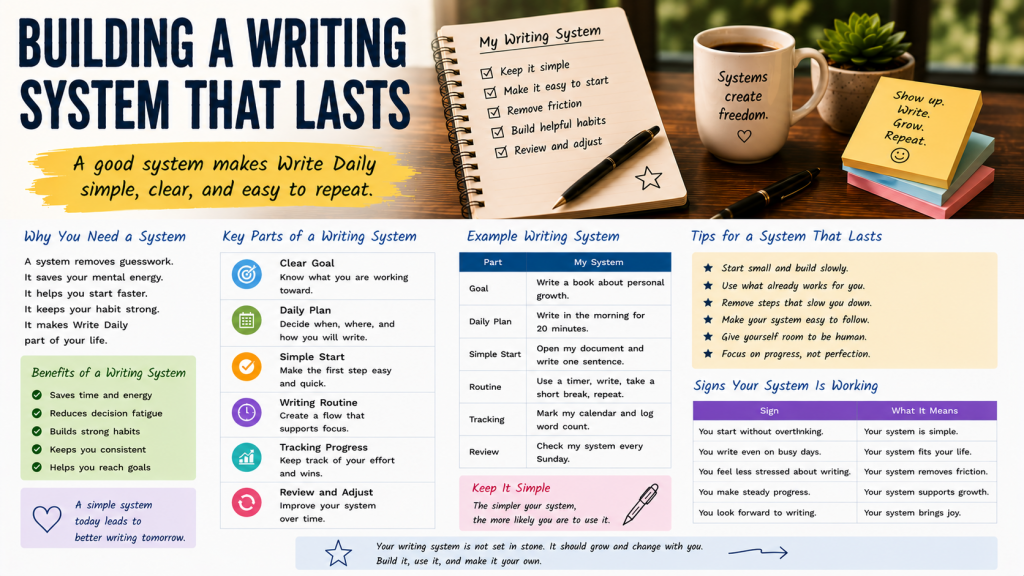
Write Daily should help you build a writing life, not drain the life out of you. Burnout happens when you push too hard for too long without enough rest, care, or balance.
At first, pushing hard can feel strong. You may feel proud because you are writing more, doing more, and trying to prove you are serious.
But if the pace is too much, the habit can start to feel heavy.
I have learned that writing every day does not mean ignoring your body, your mind, or your real life. A good writing habit should be steady enough to last.
What Writing Burnout Feels Like
Burnout can sneak up slowly. It may start as simple tiredness, but then writing begins to feel flat, forced, or stressful.
You may open your draft and feel nothing. You may avoid the page because it feels like another chore.
You may feel annoyed at your own project, even if you once cared about it.
That does not always mean the project is wrong. It may mean your system is asking too much from you.
| Burnout Sign | What It May Mean |
|---|---|
| You feel tired before writing | Your routine may be too heavy |
| You dread the page | Writing has too much pressure |
| You feel bored by every idea | Your mind may need fresh input |
| You keep missing sessions | Your goal may not fit your life |
| You feel guilty all the time | Your habit needs more kindness |
| You cannot focus | Your brain may need rest |
When you want to Write Daily, you need to notice these signs early. Ignoring them can make the habit harder to keep.
Daily Writing Should Not Mean Daily Pressure
There is a difference between daily writing and daily pressure. Daily writing is a practice.
Daily pressure is a burden.
A healthy writing habit gives you a clear place to show up. An unhealthy one makes you feel like you are failing every hour you are not writing.
That is too much.
Writing should matter, but it should not become a weapon you use against yourself.
If your habit makes you feel ashamed all the time, it needs to be adjusted. Shame does not build steady writers.
It usually makes people hide from the work.
Lower the Goal Before You Quit
When writing starts to feel too hard, many people think they have to quit. But sometimes, you do not need to quit.
You need to lower the goal.
If 1,000 words a day is burning you out, try 300. If 300 feels too hard, try 100.
If writing for one hour feels impossible, write for ten minutes.
If ten minutes feels like too much, write one sentence.
| If Your Goal Feels Too Heavy | Try This Instead |
|---|---|
| 1,000 words daily | 300 words daily |
| One hour daily | 10 minutes daily |
| Full chapter daily | One paragraph daily |
| Perfect draft daily | Rough notes daily |
| Seven hard days a week | Five writing days plus rest |
Lowering the goal is not weakness. It is how you keep the habit alive without breaking yourself.
Build Rest Into the Habit
Rest is not the enemy of writing. Rest helps writing.
Your brain needs time to think, refill, and make connections. Some ideas need quiet time before they become clear.
If you never stop, your writing can start to feel dry. You may keep producing words, but the words may feel empty.
Rest can mean sleep, walking, reading, stretching, cooking, sitting outside, or doing something that lets your mind breathe.
To Write Daily in a healthy way, you need to stop treating rest like failure.
Types of Rest That Help Writers
| Type of Rest | How It Helps Writing |
|---|---|
| Sleep | Clears the mind and restores energy |
| Walking | Helps ideas move and loosen |
| Reading | Refills your creative well |
| Quiet time | Lets thoughts settle |
| Time away from screens | Reduces mental noise |
| Light chores | Gives the brain space to wander |
Rest does not mean you stopped being serious. It means you are taking care of the tool that creates the work.
Watch the Difference Between Discipline and Force
Discipline helps you show up. Force makes you ignore warning signs.
Discipline says, “I can write a little even if I do not feel perfect.”
Force says, “I must keep going no matter what happens to me.”
Those are not the same.
A disciplined writer can still rest. A disciplined writer can still adjust the plan.
A disciplined writer knows that long-term consistency matters more than one extreme push.
When you are building the habit to Write Daily, you need discipline with wisdom. You need effort, but you also need care.
Keep Your Writing Goals Human
Your writing goals should fit a real human life. That means they should leave room for work, family, health, stress, meals, sleep, and normal problems.
If your plan only works when nothing goes wrong, it is too fragile.
A human writing goal has a normal version, a hard-day version, and a rest version.
| Day Type | Writing Plan |
|---|---|
| Strong day | Write your full goal |
| Normal day | Write your regular small target |
| Busy day | Write one paragraph |
| Hard day | Write one sentence or note |
| Recovery day | Rest without guilt |
This kind of plan helps you stay connected to the habit without pretending every day is the same.
Stop Turning Every Day Into a Test
Burnout grows when every writing day feels like a test of your talent, discipline, and future. That is too much weight for one day.
A writing session is not a final exam.
It is practice.
Some days will be strong. Some days will be weak.
Some days will feel clear. Some days will feel slow.
That is normal.
If you treat every rough day like proof that you cannot write, the habit will feel painful. If you treat rough days as part of the process, they are easier to survive.
“A hard writing day is not proof that you are failing. It is just one day in a longer practice.”
That thought can give you room to breathe. You are not building the whole dream in one sitting.
You are building one small piece.
Use Breaks Before You Feel Broken
Many writers wait too long to rest. They keep pushing until they feel empty.
A better way is to use short breaks before burnout takes over.
A five-minute break can help your focus. A walk can help your mood.
A day of lighter writing can protect the whole week.
Breaks work best when they are planned instead of used only after you crash.
| Warning Sign | Helpful Break |
|---|---|
| Eyes feel tired | Step away from the screen |
| Thoughts feel stuck | Take a short walk |
| Body feels tense | Stretch for a few minutes |
| Words feel forced | Read or rest briefly |
| Mood feels low | Lower the goal for the day |
Small breaks can keep you from needing a much bigger recovery later.
Do Not Confuse Rest With Avoidance
Rest and avoidance can look similar from the outside, but they feel different inside.
Rest gives you energy back. Avoidance keeps you stuck.
Rest is chosen with care. Avoidance is often driven by fear.
If you rest and return clearer, that rest helped. If you keep saying “later” because the page scares you, that may be avoidance.
| Rest | Avoidance |
|---|---|
| Helps you recover | Keeps you stuck |
| Has a clear reason | Has endless excuses |
| Makes returning easier | Makes returning harder |
| Feels kind | Feels like hiding |
| Supports the habit | Weakens the habit |
Both are human. The point is not to shame yourself.
The point is to be honest about what you need.
Protect Your Creative Energy
Creative energy is not endless. It needs fuel.
If you spend all day scrolling, worrying, rushing, and reacting, there may not be much left for writing.
That does not mean you are weak. It means your mind has limits.
Protecting creative energy may mean reducing noise. It may mean reading better things.
It may mean taking care of your body, saying no to extra stress when possible, or writing before the day drains you.
To Write Daily, you need energy for the page. That energy has to come from somewhere.
Use Lighter Writing on Heavy Days
Not every day needs deep, hard writing. Some days can be lighter.
You can journal. You can list ideas.
You can outline. You can write a few notes.
You can revise one small paragraph.
This keeps the habit alive without forcing heavy work when your mind is not ready for it.
| Heavy Writing | Lighter Writing |
|---|---|
| Drafting a full chapter | Listing chapter ideas |
| Writing a full blog section | Drafting a short outline |
| Deep emotional writing | Writing a simple journal note |
| Editing a whole piece | Fixing one paragraph |
| Building a new scene | Writing scene notes |
Lighter writing still counts. It keeps you connected to the work.
Make Burnout Less Likely
Burnout is easier to prevent than fix. The best way to avoid it is to build a routine that respects your limits from the start.
Keep the goal small enough to repeat. Use rest before you crash.
Track how writing feels, not only how many words you write. Change the plan when the plan stops working.
| Burnout Prevention Step | Why It Helps |
|---|---|
| Start small | Keeps pressure low |
| Take breaks | Protects focus |
| Sleep enough | Restores the brain |
| Use hard-day goals | Keeps the habit flexible |
| Celebrate small wins | Builds positive energy |
| Adjust when needed | Keeps the system realistic |
A writing habit should support your life, not swallow it.
Let the Habit Breathe
A daily writing routine needs room to breathe. It needs structure, but not a cage.
It needs effort, but not self-punishment.
It needs consistency, but also kindness.
When you give the habit space to adjust, it becomes more sustainable. You stop treating writing like something you must survive.
You start treating it like something you can grow with.
That is how you avoid burnout while still building the strength to Write Daily.
Sustainable Creativity
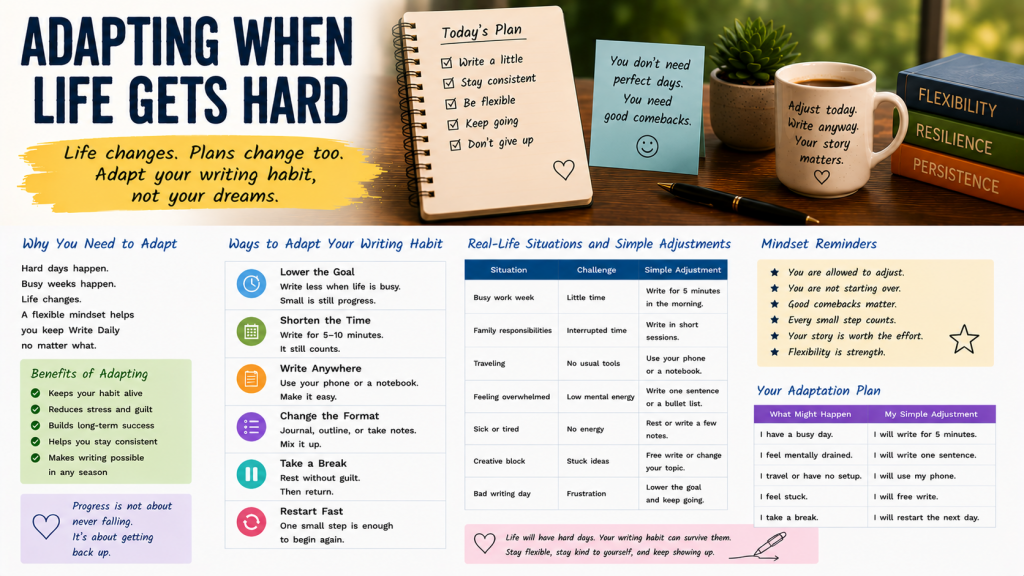
Write Daily works best when your creativity has room to breathe. Sustainable creativity means you can keep writing without feeling empty, rushed, or worn down all the time.
It means you are not only trying to produce more words. You are also protecting the part of you that creates those words.
I used to think creativity was something I had to squeeze out of myself. If I wanted to be serious, I thought I had to push harder every day.
That worked for a little while.
Then the ideas started to feel dry. Writing felt less like expression and more like pressure.
That is when I learned that creativity needs care, space, and fuel.
Creativity Needs Fuel
Creativity does not come from nowhere. It grows from what you notice, read, feel, live, think about, and pay attention to.
If all you do is push yourself to write, but you never refill your mind, the writing may start to feel thin. You may feel like you are pulling from an empty well.
To Write Daily in a healthy way, you need to give your mind something to work with.
That can be simple.
Read a few pages. Take a walk.
Listen to people talk. Notice a small detail in your day.
Write down one strange thought. Let your mind wander without forcing it to perform.
| Creative Fuel | How It Helps Your Writing |
|---|---|
| Reading | Gives your mind new language and ideas |
| Walking | Helps thoughts loosen and move |
| Quiet time | Lets ideas settle |
| Real conversations | Adds human detail |
| Journaling | Helps you understand your own thoughts |
| Trying new things | Gives you fresh material |
Creativity is not only built at the desk. A lot of it grows while you are living.
Do Not Turn Every Idea Into Work
When you care about writing, it is easy to treat every idea like a task. You get a thought and quickly wonder how to use it, shape it, post it, sell it, or finish it.
That can make creativity feel tense.
Some ideas need to stay playful for a while. They need room to be odd, unfinished, or unclear.
If every idea has to become useful right away, your mind may stop offering new ones.
When you Write Daily, give yourself some writing that is only for practice. Not every line needs to become a book, blog post, chapter, or finished piece.
Some writing can simply help you think.
Give Ideas Different Places to Live
| Type of Idea | Where It Can Go |
|---|---|
| Strong project idea | Main draft or outline |
| Random thought | Idea notebook |
| Personal feeling | Journal |
| Line of dialogue | Notes app |
| Future article topic | Content list |
| Strange image or memory | Creative scraps page |
This keeps your creative mind open. It also lowers the pressure on each idea.
Protect Your Creative Energy
Creative energy can be drained by too much noise. Constant scrolling, stress, arguing, overworking, and reacting to everyone else can leave very little room for your own thoughts.
That does not mean you need a silent life. Most people do not have that.
But it does mean you may need small pockets of quiet.
Even ten minutes away from noise can help. A short walk without your phone can help.
Sitting with a notebook before checking messages can help.
Your mind needs space where it is not always being filled by other people’s words.
| Energy Drain | Better Choice |
|---|---|
| Scrolling before writing | Write before checking feeds |
| Too much news | Limit it before creative work |
| Too many open tabs | Use one writing window |
| Constant messages | Use quiet mode during writing |
| No breaks | Take short recovery pauses |
To Write Daily, you need enough mental space to hear your own ideas.
Let Creativity Have Seasons
Some days, creativity feels alive. Ideas come fast, and the writing has energy.
Other days, it feels slow. You may write plain sentences and feel like nothing special is happening.
That is normal.
Creativity has seasons. It does not always bloom on command.
A sustainable writing habit makes room for those changes.
On high-energy days, you may draft more. On low-energy days, you may outline, journal, revise, or collect ideas.
| Creative Season | Best Writing Task |
|---|---|
| Full of ideas | Draft new material |
| Low energy | Write notes or short paragraphs |
| Emotionally heavy | Journal or write gently |
| Mentally sharp | Edit or structure |
| Feeling curious | Research or brainstorm |
| Feeling stuck | Free write or change format |
This keeps you moving without forcing the same kind of output every day.
Balance Output With Input
Output is what you create. Input is what you take in.
Writing is output. Reading is input.
Drafting is output. Resting can become input.
Talking, learning, observing, and living can all become input.
If you only focus on output, your work may start to feel forced. If you only focus on input, you may never finish anything.
The balance matters.
A strong writing life needs both.
Simple Creative Balance
| Day Type | Good Balance |
|---|---|
| Heavy writing day | Read or rest afterward |
| Low idea day | Take in something useful |
| Editing day | Add a short creative warm-up |
| Research day | Write a few notes in your own words |
| Busy day | Capture one idea from real life |
This kind of balance helps creativity last. You are not only spending energy.
You are also replacing it.
Make Creativity Feel Safe
Creativity gets quieter when it feels judged too soon. If you attack every idea the moment it appears, your mind may stop wanting to play.
Give your ideas a little safety.
Let the first version be strange. Let the note be messy.
Let the thought be incomplete.
You can decide later what is worth keeping.
“Creativity grows better in a safe room than in a courtroom.”
That is how I try to think about it. Drafting is not the place for harsh judgment.
Drafting is the place where ideas get to show up.
Use Play to Keep Writing Alive
Play is easy to forget when writing becomes a serious goal. But play can keep your writing fresh.
Try a silly prompt. Write a scene in a different style.
Describe something ordinary in a dramatic way. Write a list of titles.
Write a letter you will never send. Make up a fake opening line.
These small exercises can wake up the creative part of your brain.
| Playful Exercise | Why It Helps |
|---|---|
| Write a fake first line | Removes pressure |
| Describe your room like a movie scene | Builds detail |
| Make a list of strange titles | Sparks ideas |
| Rewrite a sentence three ways | Builds flexibility |
| Write from a different voice | Opens new angles |
Play does not waste time. It can help you stay connected to writing when the work feels too heavy.
Keep a Creative Scrap Pile
A creative scrap pile is a place where you save small pieces that may matter later. It can include lines, ideas, questions, titles, memories, images, or notes.
This is helpful because not every idea fits today’s project.
Without a scrap pile, those ideas may disappear. With one, they stay available.
You can use a notebook, notes app, document, or folder.
Keep it simple. Do not organize it so much that it becomes work.
| Scrap Type | Example |
|---|---|
| Title idea | “The Quiet Work No One Sees” |
| Question | “Why do people quit right before progress?” |
| Image | “Coffee cooling beside an open notebook” |
| Sentence | “He wanted the dream but feared the daily work.” |
| Topic | “How to write when tired” |
A scrap pile makes daily writing easier because you always have something to return to.
Build a Pace You Can Live With
Sustainable creativity needs a livable pace. You cannot always write like you are racing.
Some seasons may be intense, but your normal pace should not destroy you.
A livable pace respects your body, your mind, your schedule, and your personal life.
It lets writing become part of your life instead of taking over everything.
| Unsustainable Pace | Sustainable Pace |
|---|---|
| Push hard every day | Use steady, realistic goals |
| Ignore tiredness | Adjust when needed |
| Force big output | Build with small repeatable steps |
| Never refill ideas | Read, rest, and notice life |
| Treat rest as failure | Use rest as part of the process |
A writing habit that lasts is better than a writing sprint that leaves you empty.
Let Real Life Feed the Work
You do not need to escape your whole life to be creative. Real life can feed the work.
The things you notice can become examples. The problems you face can become lessons.
The questions you ask can become topics. The feelings you carry can become honest lines.
This does not mean every private thing needs to be shared. It means your life has material in it.
When you pay attention, ordinary days can give you plenty to write about.
That helps make creativity sustainable because you are not always chasing some huge idea. You are learning to notice what is already around you.
Keep the Creative Door Open
Sustainable creativity is not about feeling inspired all the time. It is about keeping the door open so ideas can keep coming back.
Some days, that door opens wide. Some days, it only opens a little.
Both matter.
When you build a habit that includes rest, input, play, focus, and kindness, writing becomes easier to continue.
You are no longer trying to force creativity through pressure alone. You are giving it a place to grow.
That kind of care helps you keep showing up, keep making progress, and keep learning how to Write Daily.
Knowing When to Rest
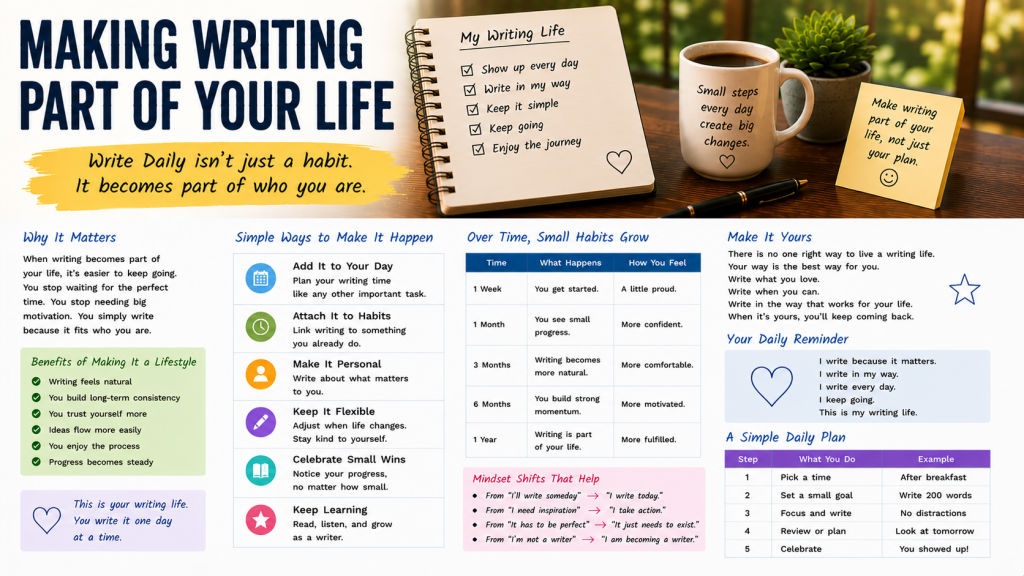
Write Daily does not mean you must push yourself until your mind feels empty. A strong writing habit also needs rest, because rest helps your words, ideas, focus, and energy come back.
This can be hard to accept if you are trying to be serious about writing. You may feel like rest means you are falling behind.
I used to feel that way too.
If I took a break, I felt guilty. If I had a low-energy day, I thought I was losing discipline.
But over time, I learned something important. Rest is not the opposite of writing.
Rest is part of writing.
Rest Helps Your Brain Keep Working
Your brain keeps working on ideas even when you step away from the page. That is why a problem can feel impossible at your desk, then feel clearer after a walk, shower, nap, or quiet moment.
Rest gives your mind room to sort things out.
When you try to Write Daily, you may think the only useful time is the time spent typing or writing by hand. But your brain also needs space between sessions.
That space helps ideas settle.
It helps weak thoughts connect. It helps strong ideas rise to the top.
| Type of Rest | How It Helps Writing |
|---|---|
| Sleep | Restores focus and energy |
| Walking | Helps ideas move |
| Quiet time | Lets thoughts settle |
| Breaks from screens | Reduces mental noise |
| Reading for pleasure | Refills your mind |
| Light movement | Helps your body relax |
Rest is not wasted time when it helps you return with more clarity.
Rest Is Different From Quitting
Rest and quitting are not the same thing. Rest has a return built into it.
Quitting says, “I am done.” Rest says, “I need to pause so I can keep going.”
That difference matters.
If you are building a habit to Write Daily, you need to learn how to rest without turning rest into shame. A planned pause can protect the habit.
A guilt-filled pause can make you avoid the page even more.
| Rest Sounds Like | Quitting Sounds Like |
|---|---|
| I need a short break | I will never get this done |
| I will come back after lunch | I am not cut out for this |
| I need sleep tonight | There is no point trying |
| I can write less today | I failed, so why bother |
| I am protecting my energy | I am giving up |
Rest should help you return. If it helps you come back clearer, calmer, or steadier, it is serving the work.
Signs You May Need Rest
Sometimes your body and mind give you signals before you burn out. The problem is that many writers ignore those signals.
They keep pushing because they think that is what discipline means.
But discipline is not the same as ignoring yourself.
If writing feels hard for one day, that may just be a normal hard day. But if every day feels heavy, dry, and tense, it may be time to rest.
Common Rest Signals
| Signal | What It May Mean |
|---|---|
| You keep rereading the same line | Your focus is tired |
| Every idea feels bad | Your mind may need space |
| You feel tense before writing | Pressure may be too high |
| You feel angry at the project | You may need distance |
| You cannot make simple choices | Your brain may be overloaded |
| You dread the page every day | Your routine may need adjustment |
These signs do not mean you are weak. They mean you are human.
Use Short Breaks First
You do not always need a full day off. Sometimes, a short break can help.
A five-minute break can reset your focus. A quick walk can loosen stuck thoughts.
A glass of water, a stretch, or a few quiet breaths can change the feel of the session.
When I get stuck, I try not to force the same sentence for too long. If I keep pushing and nothing moves, I step away for a little bit.
Then I come back and look again.
| Problem During Writing | Short Rest to Try |
|---|---|
| Mind feels foggy | Step away for 5 minutes |
| Body feels stiff | Stretch or walk |
| Sentence will not work | Leave it and return later |
| Mood feels tense | Breathe and lower the goal |
| Eyes feel tired | Look away from the screen |
Short rest keeps the session from turning into a fight.
Plan Rest Before You Crash
Rest works best when it is part of the plan, not only something you do after you break down. If you wait until you are fully drained, recovery can take longer.
A healthy writing routine has space for light days, short sessions, and planned pauses.
This does not mean you stop caring. It means you build a habit that can last.
If you want to Write Daily, think about what daily can look like in a healthy way. Some days may be full writing days.
Some days may be note days. Some days may be reading days.
Some days may be rest days with a tiny idea captured so the thread stays alive.
Create a Rest-Friendly Writing Plan
A rest-friendly plan gives you options. It helps you avoid the all-or-nothing trap.
Instead of saying, “I must write the same amount every day no matter what,” you can build levels.
This lets you keep the habit alive without forcing your best effort from your lowest-energy self.
| Energy Level | Writing Plan |
|---|---|
| High energy | Write your full goal |
| Normal energy | Write your regular target |
| Low energy | Write one paragraph |
| Very low energy | Write one sentence or note |
| Empty energy | Rest and return with a clear restart plan |
This kind of plan gives your habit room to breathe. It also helps you stop treating every low-energy day like failure.
Rest Can Make You More Honest
When you are tired, your writing may get flat. You may repeat yourself.
You may force ideas that do not feel true. You may write from pressure instead of meaning.
Rest can help you hear yourself again.
After rest, you may see what the piece really needs. You may notice that a section is too long, too cold, or too far from the point.
You may find the honest sentence that was hiding under the forced ones.
“Sometimes the best way back into the writing is to step away long enough to hear your own thoughts again.”
That kind of rest does not weaken the work. It can make the work stronger.
Watch for Guilt Around Rest
Guilt can make rest feel wrong, even when you need it. You may think, “I should be writing right now.”
That thought can follow you even when your body is tired and your mind is blank.
But guilt does not always tell the truth.
Sometimes guilt is just old pressure. Sometimes it is fear.
Sometimes it comes from comparing yourself to other people.
When you rest, try to make the rest real. Do not spend the whole break attacking yourself.
A guilty break does not feel like rest. It feels like punishment in a softer chair.
Use Rest to Protect the Long Game
Writing is a long game. Books, blogs, stories, and strong skills are not built in one day.
They are built over time.
That means your routine needs to protect your future energy, not just today’s output.
If pushing hard today makes you avoid writing for the next week, it may not be worth it. If writing a little and resting keeps you steady, that may be the wiser choice.
| Short-Term Push | Long-Term Care |
|---|---|
| Force more words while drained | Stop before burnout grows |
| Ignore body signals | Adjust the session |
| Chase huge output daily | Build a steady rhythm |
| Feel guilty for rest | Use rest as recovery |
| Treat breaks as failure | Treat breaks as maintenance |
The goal is not one heroic writing day. The goal is a writing life you can keep.
Rest Without Losing the Thread
One fear writers have is that rest will make them lose momentum. That can happen if you walk away with no plan to return.
A simple return note can fix that.
Before resting, write down where to restart. Leave yourself a small instruction.
It might be, “Continue with the example about morning writing,” or “Fix this paragraph later,” or “Start with why the reader feels stuck.”
Simple Return Notes
| Before You Rest | Leave This Kind of Note |
|---|---|
| Stopping mid-section | Write the next sentence idea |
| Feeling stuck | Write one question to answer |
| Ending for the day | Note tomorrow’s first step |
| Taking a full break | Mark where to restart |
| Switching tasks | Save the main thought |
This makes rest safer because you are not dropping the whole project. You are placing it down carefully.
Respect Physical Rest Too
Writing may seem like mental work, but your body is involved. Your back, hands, neck, eyes, and shoulders all take part.
If your body feels bad, writing can feel harder.
Physical rest matters.
Stretch your hands. Rest your eyes.
Change position. Drink water.
Take short breaks from sitting.
You do not have to treat your body like an afterthought. Your body is part of your writing system.
Know When Rest Means Sleep
Sometimes the answer is not another trick, prompt, or timer. Sometimes the answer is sleep.
Tired writing can still count, but deep tiredness makes everything harder. The page feels worse.
Your ideas feel weaker. Your mood drops.
Your patience gets thin.
If you are truly exhausted, sleep may help more than forcing another rough session.
A rested mind can often do in ten minutes what a drained mind fights for an hour.
Build a Return Ritual
After rest, it helps to return gently. Do not punish yourself for pausing.
Open the draft. Read the last few lines.
Look at your return note. Set a short timer.
Write the next small thing.
| Return Step | Action |
|---|---|
| Open | Bring up the draft or notebook |
| Read | Review the last small section |
| Notice | Find where you left off |
| Start | Write one simple sentence |
| Continue | Keep going for a short block |
A return ritual makes rest feel less dangerous. It teaches your brain that breaks do not end the habit.
Let Rest Be Part of the Practice
Knowing when to rest is part of becoming a steady writer. It takes honesty.
You need to know when you are avoiding the page. You also need to know when you are truly worn down.
That balance takes time.
Some days, you need discipline. Some days, you need care.
Some days, the strongest move is writing the sentence. Other days, the strongest move is resting so you can come back with a clearer mind.
A healthy writing habit gives room for both effort and recovery, which makes it much easier to Write Daily.
Final Thoughts
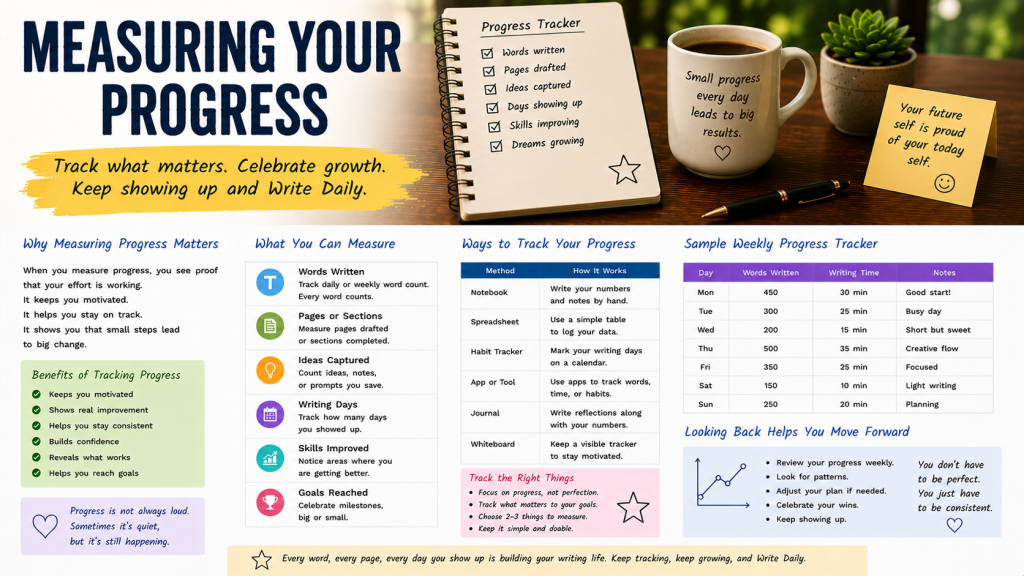
Write Daily is not about becoming perfect, fearless, or full of ideas every single morning. It is about building a simple writing life that you can return to, even when the day is busy, your mind is loud, or the words feel slow.
The real power is not in one huge writing session. It is in the small promise you keep again and again.
You sit down. You write something.
You come back. You do it again.
That is how the habit starts to feel less like a task and more like part of who you are.
The Habit Is Built One Return at a Time
A daily writing habit is not built by one strong day. It is built by returning to the page after easy days, hard days, busy days, and tired days.
Some days, you may write a lot. Some days, you may only write a few lines.
Both days can matter.
The point is not to make every session look the same. The point is to keep the door open.
When you Write Daily, you are training your mind to see writing as normal. You are telling yourself, “This is something I do.”
That message gets stronger each time you show up.
| Old Way of Thinking | Better Way to Think |
|---|---|
| I must write perfectly | I can write and improve later |
| I need a big block of time | I can use a small pocket of time |
| I failed if I miss a day | I can restart with one sentence |
| I need to feel inspired | I can begin before inspiration comes |
| My draft is bad | My draft is early |
Small Writing Still Counts
Small writing is easy to ignore, but it is often the reason the habit survives. One sentence can keep the habit alive on a rough day.
One paragraph can become the start of a page. One page can become part of a book, post, story, or message that matters.
You do not need every writing session to feel big. You need it to be real.
That is why small writing should be respected. It helps you keep moving when a larger goal feels too heavy.
If you are trying to Write Daily, let the small steps count. They are not filler.
They are the foundation.
Small Steps That Still Matter
| Small Step | Why It Matters |
|---|---|
| Opened the draft | You returned to the work |
| Wrote one sentence | You broke the silence |
| Added a note | You gave yourself a place to continue |
| Fixed one paragraph | You made the draft stronger |
| Listed ideas | You created future material |
| Wrote for five minutes | You protected the habit |
A small step today can make tomorrow easier. That is how momentum grows.
Your Writing Life Does Not Need to Look Like Anyone Else’s
It is easy to compare your writing routine to someone else’s. Maybe they write early in the morning.
Maybe they write thousands of words a day. Maybe they seem more focused, more skilled, or more confident.
But their life is not your life.
Your schedule, energy, responsibilities, stress, goals, and creative rhythm are your own. Your writing habit needs to fit your real life, not someone else’s highlight reel.
A writing plan only works if you can actually live with it.
| Someone Else’s Routine | Your Better Question |
|---|---|
| They write at 5 a.m. | What time can I repeat? |
| They write 2,000 words | What word count helps me continue? |
| They have a quiet office | What space can I use today? |
| They publish often | What pace is healthy for me? |
| They seem confident | What small action builds my trust? |
The goal is not to copy a perfect routine. The goal is to build one you can keep.
Make Writing Easier to Return To
A strong writing habit should have a path back. You will have days when you miss the plan.
You will have days when life interrupts you. You will have days when the words feel flat.
That does not mean the habit is broken.
It means you need a simple way to return.
Leave notes for yourself. Keep your tools ready.
Use a small goal when you feel tired. Track your wins so you can see that your effort is adding up.
“The best writing habit is not the one that never bends. It is the one that helps you come back.”
That kind of habit can survive real life. It can bend without breaking.
Keep the Pressure Low Enough to Keep Going
Pressure can make writing feel serious, but too much pressure can make it hard to begin. If every session feels like a test, you may start avoiding the page.
Lowering the pressure does not mean you do not care. It means you are giving yourself room to practice.
Writing is built through practice. Practice needs space.
Let the first draft be rough. Let the early ideas be simple.
Let the habit grow before you demand too much from it.
| If Writing Feels Too Heavy | Try This |
|---|---|
| The goal feels too big | Cut it in half |
| The page feels scary | Write one plain line |
| The draft feels bad | Keep moving and revise later |
| The routine feels stressful | Make it shorter |
| The habit feels broken | Restart with the smallest step |
A lighter goal is often easier to repeat. A repeatable goal is what builds the habit.
Let Writing Become Part of Your Identity
At some point, daily writing becomes less about checking off a task and more about how you see yourself. You begin to think, “I am someone who writes.”
That does not mean you always feel ready. It does not mean you never struggle.
It means writing has a place in your life.
You do not need permission to write. You do not need to wait until you feel like a professional.
You build the identity by doing the action. The action teaches the belief.
Identity Shifts That Help
| Old Thought | New Thought |
|---|---|
| I am trying to write | I am building a writing habit |
| I am not consistent | I am learning consistency |
| I keep starting over | I keep returning |
| I need to be better first | I get better by writing |
| I am not a writer yet | I am becoming someone who writes |
This identity grows slowly. Every session adds to it.
Keep Your System Simple
A simple system is easier to use. You do not need a complicated plan to build a strong writing habit.
You need a time, a place, a small goal, and a way to track that you showed up.
That is enough to begin.
You can improve the system later. You can change your word count, adjust your time, move your writing spot, or try new routines.
But do not wait until the system is perfect.
A simple system used often is better than a perfect system you never start.
| Part of the System | Simple Example |
|---|---|
| Time | After breakfast |
| Place | Kitchen table |
| Goal | 200 words |
| Tool | Notebook or document |
| Tracker | Calendar checkmark |
| Backup plan | One sentence on hard days |
Simple does not mean weak. Simple means usable.
Give Yourself Credit for the Work
Writing takes effort, even when no one sees it. The quiet work counts.
The rough drafts count. The short sessions count.
The restarts count. The days you came back after doubt count.
Give yourself credit for that.
You are not only building pages. You are building focus, patience, discipline, courage, and trust.
Those things take time.
When you notice your progress, you make it easier to keep going. Your brain begins to connect writing with growth instead of guilt.
Keep Returning to the Page
The page will not always feel easy. Some days, it may feel slow.
Some days, it may feel clear. Some days, it may feel like work.
That is normal.
A writing life has all kinds of days inside it. The steady writer learns how to move through them without turning every hard day into a reason to stop.
You can write small. You can write rough.
You can write tired. You can write unsure.
You can rest when needed and return when ready.
The path is built by showing up again, one honest session at a time, until it becomes natural to Write Daily.
Becoming the Kind of Person Who Writes
Write Daily is not only a habit. It is also a way of seeing yourself.
At first, writing may feel like something you are trying to add to your life. You may have to remind yourself, push yourself, and make little deals with yourself just to sit down.
But over time, something changes.
You stop thinking, “I should write.” You start thinking, “I write.”
That shift matters because your actions begin to shape your identity. Every time you return to the page, you are teaching yourself who you are becoming.
Your Identity Is Built Through Action
You do not become a writer by waiting until you feel like one. You become a writer by writing.
That may sound simple, but it can change everything.
I used to think I needed more confidence before I could take writing seriously. I thought I needed to feel ready, skilled, inspired, and sure of myself.
But confidence did not show up first.
Action showed up first.
The more I wrote, the more I began to believe writing belonged in my life. Not because every sentence was good, but because I kept coming back.
| Old Identity | New Identity |
|---|---|
| I want to write someday | I am writing today |
| I am not consistent | I am learning to be consistent |
| I always get stuck | I can restart small |
| I need to feel ready | I can begin before I feel ready |
| I am trying to become a writer | I am becoming someone who writes |
When you want to Write Daily, identity matters. The habit gets stronger when you stop seeing writing as a rare event and start seeing it as something you do.
Stop Waiting for Permission
Many people wait for permission to write. They wait for someone to tell them they are good enough.
They wait for a perfect idea. They wait for a big sign.
They wait until they feel more official.
But writing does not need permission. You are allowed to write before anyone praises you.
You are allowed to write before the draft is clean. You are allowed to write while you are still learning.
You are allowed to write because something inside you wants to speak, think, explore, teach, remember, or create.
To Write Daily, you need to stop waiting for the world to call you a writer first. You can begin living like one in small ways today.
Act Like the Person You Want to Become
If you want to become the kind of person who writes, ask what that person does on a normal day.
They do not only dream about writing. They make space for it.
They do not only talk about ideas. They capture them.
They do not only wait for motivation. They start small.
They do not quit forever after a bad day. They return.
Daily Writer Actions
| A Daily Writer Does This | Simple Version |
|---|---|
| Shows up | Opens the notebook |
| Captures ideas | Writes one note |
| Protects focus | Puts the phone away |
| Practices often | Writes for 10 minutes |
| Learns from drafts | Reviews one paragraph |
| Returns after breaks | Starts again small |
You do not need to do all of this perfectly. You only need to practice being that person in small moments.
Small moments shape identity.
Change the Way You Talk to Yourself
The way you talk to yourself matters. Your words can either build the habit or weaken it.
If you keep saying, “I am lazy,” “I never finish,” or “I am not a real writer,” your mind starts to carry that story.
A better story is more honest and more useful.
You can say, “I am learning to write more often.” You can say, “I came back today.”
You can say, “I am building trust with myself.”
That does not mean pretending everything is easy. It means choosing words that help you keep moving.
| Harsh Self-Talk | Better Self-Talk |
|---|---|
| I failed again | I can restart today |
| I am bad at this | I am practicing |
| I never stick with anything | I am learning consistency |
| This draft is terrible | This draft is early |
| I am not a writer | I am becoming someone who writes |
Your mind listens to the story you repeat. Give it a story that helps you return to the page.
Let Writing Become Normal
One of the best things that can happen is when writing stops feeling dramatic. It becomes part of the day.
You do not need a huge mood shift. You do not need a perfect setup.
You just sit down and write something.
That is where the habit becomes powerful. Not because every day feels magical, but because writing becomes normal enough to repeat.
When you Write Daily, you are making writing less rare. You are bringing it closer to everyday life.
That makes the dream feel less far away.
Build Proof You Can See
Identity grows faster when you can see proof. That proof can be simple.
A calendar with checkmarks. A notebook with filled pages.
A document with more words than last week. A folder with drafts inside it.
These things show you that your effort is real.
| Proof of Identity | What It Shows |
|---|---|
| Checked calendar days | You showed up |
| Filled notebook pages | You kept going |
| Saved drafts | You created material |
| Word count log | Your work is growing |
| Idea list | Your mind is active |
| Finished sections | You can complete pieces |
Seeing proof helps when your feelings are not steady. You may not always feel like a writer, but the evidence can remind you that you are practicing the life of one.
Do Not Build Your Identity on Perfect Days
If your identity depends on perfect days, it will always feel fragile. Nobody has perfect days all the time.
A stronger writing identity includes hard days.
It includes messy drafts, missed sessions, restarts, tired mornings, and low-word days. Those things do not cancel the habit.
They are part of it.
A real writer is not someone who never struggles. A real writer is someone who learns how to keep returning.
That thought can make the habit feel kinder and more possible.
Make Writing Personal
Your writing habit will last longer when it means something to you. Do not build the whole habit on pressure, guilt, or comparison.
Build it on a reason that feels real.
Maybe you write to understand yourself. Maybe you write to help someone.
Maybe you write to finish a book. Maybe you write because stories have always lived inside you.
Maybe you write because your ideas deserve a place to go.
Reasons That Can Keep You Going
| Reason to Write | What It Gives You |
|---|---|
| To share what you know | Purpose |
| To tell stories | Creative joy |
| To process life | Clarity |
| To help readers | Meaning |
| To build a book or blog | Direction |
| To prove you can keep going | Confidence |
A strong reason can carry you through weak days. It reminds you why the habit matters.
Keep Returning After You Change
Your writing identity will change as you grow. The person you are at the start may not be the same person you become after months of writing.
That is a good thing.
Your voice may get clearer. Your goals may shift.
Your routine may change. Your confidence may grow.
You may discover that you like a different kind of writing than you expected.
Let the habit grow with you.
| When You Grow | Your Habit May Change |
|---|---|
| You get faster | Raise the word count |
| You get busier | Use shorter sessions |
| You gain confidence | Try bigger projects |
| Your interests change | Explore new topics |
| Your life changes | Adjust the routine |
Becoming the kind of person who writes does not mean locking yourself into one method forever. It means staying connected to the work in a way that fits your life.
Let the Small Choices Count
Identity is built through small choices. The choice to open the draft counts.
The choice to write one line counts.
The choice to return after a break counts.
The choice to keep going when the words feel rough counts.
These choices may not look impressive from the outside, but they matter deeply. They are how you teach yourself that writing is part of who you are.
“You become the kind of person who writes by making the next writing choice, not by waiting to feel transformed.”
That is the quiet truth of the habit. Change often feels small while it is happening.
Carry the Identity Into Real Life
Being someone who writes does not only happen at the desk. You can carry that identity into your day.
Notice ideas. Pay attention to how people speak.
Save thoughts. Ask better questions.
Read with curiosity. Listen for details.
Let life become material without forcing every moment to become content.
A writing identity changes how you see the world. Ordinary moments can become useful, meaningful, or worth saving.
| Daily Moment | Writer’s Way to Use It |
|---|---|
| A strange thought | Save it as a note |
| A hard feeling | Journal about it |
| A good conversation | Notice the wording |
| A problem you solved | Turn it into a lesson |
| A quiet moment | Let ideas rise |
| A question you keep asking | Explore it on the page |
Writing becomes more natural when you stop treating it as separate from life. Your life can feed the page.
Keep Becoming
You do not have to arrive all at once. Becoming the kind of person who writes is a slow process.
It happens through practice. It happens through patience.
It happens through honest effort on ordinary days.
Some days, you will feel proud. Some days, you will feel unsure.
Some days, the work will feel easy. Some days, it will feel like walking uphill.
All of those days can still belong to the same writing life.
You are not only building pages. You are building a relationship with your own voice.
Each time you return to the page, you are becoming someone who knows how to Write Daily.
Frequently Asked Questions
How do I train myself to Write Daily?
You train yourself to Write Daily by making writing simple, clear, and easy to repeat.
Start with a small goal, like five minutes or one paragraph. Then attach it to something you already do each day, like drinking coffee, eating lunch, or sitting at your desk.
How long should I write every day?
You can start with five to ten minutes a day. That may sound small, but small sessions are easier to repeat.
Once the habit feels normal, you can slowly add more time or raise your word count.
What should I write about every day?
You can write about your thoughts, ideas, goals, memories, lessons, stories, blog topics, book chapters, or simple things you noticed that day.
If you feel stuck, use a prompt like, “What I am trying to say is…” or “The idea I keep coming back to is…”
What if my writing is bad?
Bad writing still counts. Rough words give you something to fix later.
A messy draft is better than an empty page because it gives your idea a place to grow.
How many words should I write daily?
A good beginner goal is 100 to 300 words a day. If that feels too high, start with 50 words.
The best word count is the one you can keep doing without burning out.
How do I stay consistent with daily writing?
Stay consistent by using a small goal, a set routine, and a simple tracker.
You can mark each writing day on a calendar, keep a word count log, or write a quick note about what you worked on.
How do I avoid distractions while writing?
Put your phone away, turn off notifications, close extra tabs, and keep your writing space simple.
Even a short phone-free writing block can help you focus better.
Is it okay to miss a day of writing?
Yes. Missing one day does not ruin your habit.
The best move is to return with a small action, like writing one sentence, opening your draft, or adding one note.
How do I avoid burnout when trying to Write Daily?
Avoid burnout by keeping your goals realistic, resting when needed, and using smaller writing sessions on hard days.
Daily writing should support your life, not drain it.
Can daily writing make me a better writer?
Yes. When you Write Daily, you practice thinking clearly, shaping ideas, finishing drafts, and trusting your own voice.
Small daily writing sessions can lead to real skill over time.
Other Resources
How to Build a Daily Writing Habit
This is a strong supporting resource for readers who want simple daily writing steps. It covers starting small, using routines, creating a writing space, accepting messy first drafts, tracking streaks, and rewarding progress. (Daily Prompt)
How to Start Journaling
This page is useful for readers who want to build a low-pressure writing habit through journaling. It explains how writing for just a few minutes, using simple tools, choosing a set time, and using prompts can make the habit easier to keep. (Healthline)
(Re)Committing to a Regular Writing Routine
This university writing resource is a good fit for readers who struggle with procrastination, waiting for inspiration, or getting overwhelmed by long writing projects. It supports the idea of using smaller chunks of time to rebuild a regular writing routine. (Writers Workshop)