
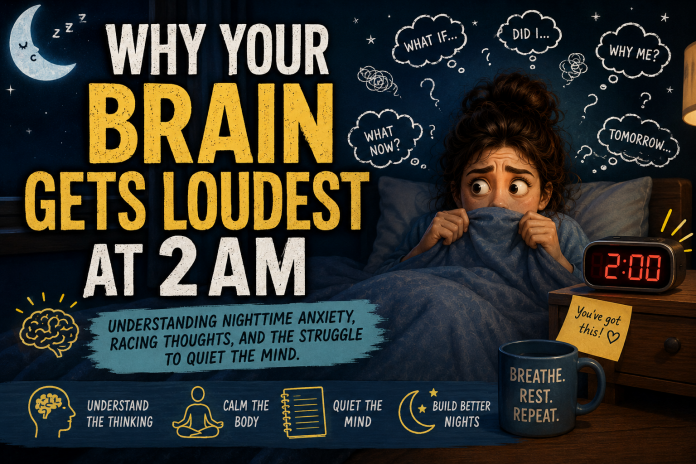
Understanding nighttime anxiety, racing thoughts, and the struggle to quiet the mind.
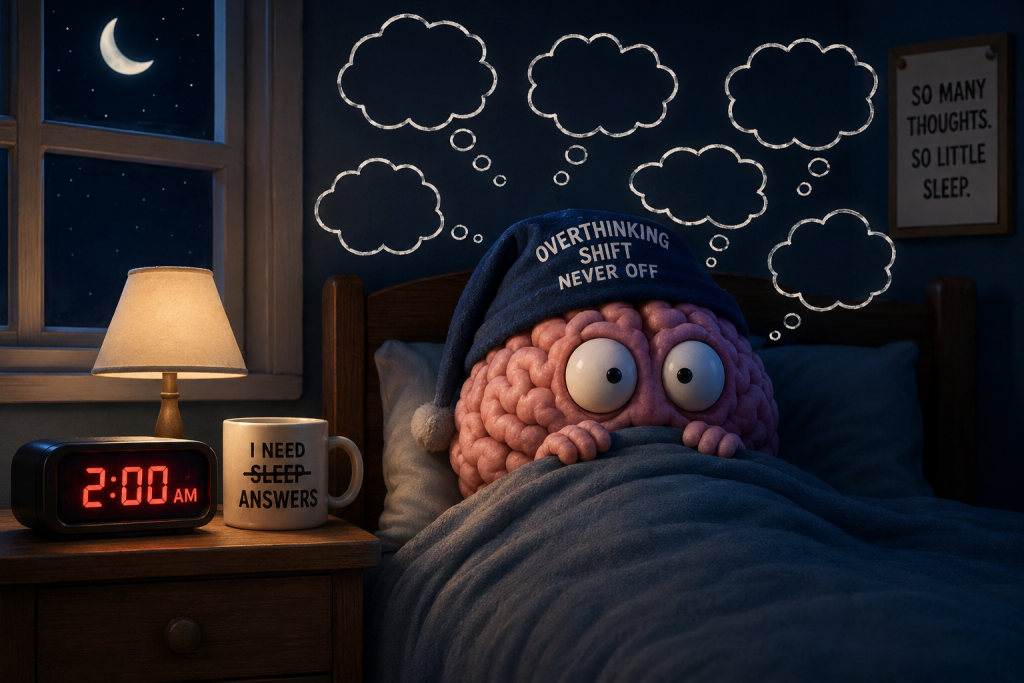
Why Your Brain Gets Loudest at 2AM
There is a special kind of quiet that shows up at night.
It is not peaceful quiet. It is not soft music, warm tea, and cozy blanket quiet. It is the kind of quiet where your brain suddenly decides it has a full staff meeting scheduled at 2AM.
During the day, your mind has places to hide. Work. Family. Chores. Texts. Noise. Pets. Bills. Errands. People talking. A sink full of dishes looking at you like it pays rent.
But at night, all of that slows down.
The house gets still. The lights go off. The phone is finally down. Nobody needs you for a minute. And then, out of nowhere, your brain gets loudest.
That is when one small thought can turn into twenty.
You may start with, “I hope I sleep tonight.”
Then it becomes, “What if I don’t sleep?”
Then it becomes, “What if tomorrow is ruined?”
Then your brain, being dramatic as usual, says, “What if your whole life is falling apart because you are still awake?”
That is nighttime anxiety.
It can feel scary, but it does not mean you are broken. It does not mean something is wrong with you as a person. It means your brain and nervous system may still be running in alert mode when your body is trying to rest.
The National Institute of Mental Health explains anxiety disorders as more than normal worry. Anxiety can bring fear, tension, restlessness, trouble focusing, and sleep problems. At night, those symptoms may feel bigger because there is less around you to pull your attention away.
This is one reason the phrase Brain Gets Loudest connects with so many people. It names something many people feel but do not always know how to explain.
It is not always that your life gets worse at night.
Sometimes it is that your distractions disappear.
And when the distractions are gone, the mind finally has room to replay, review, predict, worry, argue, and overthink.
That does not mean every thought is true.
It means your brain is active.
There is a big difference.
“The night is the hardest time to be alive and 4am knows all my secrets.”
— Poppy Z. Brite
That quote hits because many people know that feeling. Night can make regular worries feel heavier. A bill feels bigger. A conversation feels more serious. A mistake feels permanent. A body sensation feels dangerous. A quiet room can turn into a courtroom where your own mind is both the judge and the witness.
But there is a reason this happens.
And once you understand it, the night becomes less mysterious.
It may still be hard sometimes, but it becomes less scary.
Why Night Feels Different
Night feels different because your brain is not getting the same input it gets during the day.
During the day, your mind is busy sorting through sounds, sights, movement, people, choices, and tasks. Even if the day is stressful, that outside activity gives your brain something to grab onto.
At night, that changes.
The room is darker. The house is quieter. Your body is still. Your eyes may be closed. There are fewer fresh signals coming in from the outside world.
So the brain starts looking inward.
That is not always bad. This is why some people get creative at night. Ideas show up. Memories appear. Feelings rise. The mind finally has space.
But if you are anxious, stressed, tired, or emotionally worn out, that same space can turn into a worry machine.
Instead of thinking, “I am safe in bed,” your brain may think, “Great, now we have time to review every problem we avoided all day.”
This is why nighttime anxiety can feel so personal.
It often shows up when you are not trying to think at all. You are trying to sleep. You are trying to rest. You may even be exhausted. But your brain acts like it just drank three coffees and opened a legal case against your peace.
According to the Sleep Foundation’s guide to anxiety and sleep, anxiety and sleep are closely linked. Worry can make it harder to fall asleep and stay asleep, and poor sleep can also make anxiety feel worse.
That back-and-forth is what makes nighttime anxiety so frustrating.
You worry because you cannot sleep.
Then you cannot sleep because you are worried.
Then you worry about worrying.
Then you start checking the clock like it personally betrayed you.
This is why 2AM can feel so intense. It is not just the time. It is the meaning your brain gives to the time.
At 2PM, a strange thought may come and go. You might think, “That was weird,” then go back to what you were doing.
At 2AM, the same thought may feel urgent. There is no meeting to go to. No conversation to interrupt it. No daylight to soften it. No normal daytime rhythm to remind you that life is still moving.
So the thought gets louder.
Not because it is more true.
Because there is less noise around it.
Here is a simple way to see it:
| During the Day | At Night |
|---|---|
| Your brain has many things to focus on | Your brain has fewer distractions |
| Worries compete with daily tasks | Worries get more mental space |
| Light and activity help keep you grounded | Darkness and silence can make thoughts feel bigger |
| You can act on problems more easily | You may feel stuck because everything has to wait |
| Time feels normal | Time can feel slow and heavy |
This is why night can make small worries feel huge.
A text you forgot to answer becomes “I am a terrible friend.”
A bill becomes “I will never catch up.”
A body sensation becomes “Something is wrong with me.”
A bad day becomes “My whole life is going nowhere.”
That is not logic.
That is anxiety talking in the dark.
And anxiety loves the dark because there are fewer facts in the room to challenge it.
One helpful truth is this:
Night thoughts are often louder, not wiser.
That line matters.
Just because a thought shows up at 2AM does not mean it deserves to run the whole night. It may be a tired thought. A scared thought. A stress thought. A body-on-alert thought.
It may need care, but it does not need to be treated like a prophecy.
This is also where self-compassion matters. Many people get mad at themselves for being awake. They think, “Why am I doing this again?” or “What is wrong with me?”
That anger adds more stress.
The brain hears the anger as another threat. The body gets more tense. Sleep moves farther away.
A better first step is to name what is happening.
Something like:
“My brain is loud right now because it is quiet, dark, and I am tired. This is uncomfortable, but it is not dangerous.”
That may sound simple, but it changes the tone.
Instead of fighting the mind, you are observing it.
And when you observe a thought, you are no longer fully trapped inside it.
For readers who deal with this often, the deeper guide Quiet the Mind: Sleep Help for Anxiety was written around that exact struggle: the racing mind, the fear of sleep, and the feeling that night becomes too loud when life finally gets quiet.
Silence and Overthinking
Silence sounds peaceful until your brain decides to fill it with every unfinished thought you own.
That is what makes nighttime overthinking so strange. The world gets quiet, but your mind does not.
In the silence, your brain may start scanning.
It scans your day.
It scans your body.
It scans your future.
It scans your past.
It scans things you said in 2009 that nobody else remembers.
This is part of why overthinking feels worse at night. There is no fresh information coming in, so the brain works with what it has: memories, fears, guesses, and unfinished feelings.
And the brain is not always fair when it does this.
It does not always say, “Let us review the day in a calm and balanced way.”
It often says, “Let us replay the one awkward part and pretend it explains your whole personality.”
That is rumination.
Rumination is when your mind keeps chewing on the same thought without really solving it. It can feel like problem-solving, but it usually does not lead anywhere useful.
Harvard Health explains that racing thoughts can become worse when people get anxious about having racing thoughts. That is a key point because many people do not just suffer from the original worry. They suffer from the fear of the worry.
For example:
“I am worried about tomorrow.”
Then:
“Why am I worried?”
Then:
“What if I can’t stop worrying?”
Then:
“What if this means I’ll never sleep right again?”
Now the brain is not dealing with one problem. It is dealing with the original worry, plus the fear of the worry, plus the fear of the fear.
That is how silence becomes loud.
And it can happen fast.
One minute you are lying in bed.
The next minute you are mentally rebuilding your entire life, judging every choice you have ever made, and wondering why you did not become a calmer person who owns matching pajamas and drinks chamomile tea with confidence.
This is why overthinking at night is not just “thinking too much.”
It is thinking without a brake pedal.
During the day, life gives you natural breaks. Someone asks a question. The dog needs to go out. A timer goes off. You have to drive, cook, answer a message, or move your body.
At night, you may stay in the same position for a long time. That stillness can give the mind room to loop.
Here are some common nighttime thought loops:
| Thought Loop | What It Sounds Like |
|---|---|
| The replay loop | “Why did I say that?” |
| The future loop | “What if tomorrow goes badly?” |
| The health loop | “What if this feeling means something serious?” |
| The money loop | “What if I never catch up?” |
| The sleep loop | “What if I don’t sleep again?” |
| The life loop | “Why am I not farther ahead?” |
These loops feel important because they carry emotion.
But emotion is not the same as proof.
A thought can feel urgent and still be unhelpful.
A thought can feel scary and still be exaggerated.
A thought can feel true at 2AM and look very different at 9AM after coffee, sunlight, and a little perspective.
This does not mean you should ignore every concern. Some thoughts are useful. Some problems do need action.
But nighttime is usually not the best time to solve your whole life.
Night is for rest.
Morning is better for plans.
A helpful bedtime habit is to give your thoughts a parking lot before bed.
This can be a notebook, a note app, or a plain piece of paper. The goal is not to write a perfect journal entry. The goal is to get the mental noise out of your head and into a place where it can wait.
You can make three simple columns:
| Worry | Can I act on it tonight? | Next small step |
|---|---|---|
| Need to pay a bill | No | Check account tomorrow |
| Worried about work | No | Make a short list in the morning |
| Feeling tense | Yes | Breathe, stretch, lower lights |
| Forgot to reply | No | Send message after breakfast |
This gives the brain a signal.
It says, “I hear you. We are not ignoring this. But we are not solving it at 2AM.”
That matters because the anxious brain often gets louder when it feels dismissed.
If you try to shove every thought away, some thoughts push back harder.
But when you write them down, name them, and give them a place, they may soften.
Not always instantly.
But often enough to help.
This is not magic. It is a way to stop treating your bed like an office, courtroom, therapy couch, and emergency room all at once.
Your bed should not have to carry all of that.
The Brain Without Distractions
The brain without distractions can be a beautiful thing.
It can dream. Create. Reflect. Remember. Heal.
But the brain without distractions can also act like a raccoon in a trash can.
It starts digging.
At 2AM, the brain may dig through every open tab in your life. Not internet tabs. Mental tabs.
The bill tab.
The health tab.
The family tab.
The work tab.
The “am I doing enough with my life?” tab.
The “why did I eat that weird thing before bed?” tab.
The “what if I never sleep again?” tab.
No wonder sleep feels hard.
Your mind is not empty. It is overcrowded.
The problem is not that you are weak. The problem is that your brain is trying to protect you at the wrong time.
Anxiety is tied to threat detection. It is the system that says, “Pay attention. Something might be wrong.”
That system can be helpful in real danger. If a car swerves toward you, you want your body to react fast.
But at night, that same system can misread quiet as danger.
Your brain may not say, “The house is quiet because it is bedtime.”
It may say, “The house is quiet, so now we can finally check for threats.”
That is why body feelings get noticed more at night too.
A heartbeat.
A stomach sound.
A twitch.
A tight chest.
A warm face.
A weird little pain.
During the day, you may miss those things because you are busy. At night, they can feel huge because your attention has nowhere else to go.
The National Institute of Mental Health page on generalized anxiety disorder lists symptoms like restlessness, trouble relaxing, trouble sleeping, fatigue, muscle aches, stomachaches, trembling, twitching, sweating, lightheadedness, and shortness of breath. Those symptoms can feel even more frightening when they show up in the dark.
Again, this does not mean you should ignore serious symptoms. Chest pain, fainting, trouble breathing, one-sided weakness, confusion, or sudden severe symptoms need medical help.
But many people with nighttime anxiety know the pattern.
They feel something.
They check it.
They fear it.
They scan for more.
Then the body gets more anxious.
Then more symptoms appear.
Now the brain says, “See? Something is wrong.”
But what may really be happening is this:
Attention plus fear can turn normal body noise into an alarm.
That is one reason the brain gets loudest at night. It has less to focus on outside, so it focuses harder inside.
This is where gentle distraction can help.
Not loud distraction. Not doom-scrolling. Not bright screens and five hours of videos.
Gentle distraction.
A boring book.
Soft music.
A calm audio story.
Slow breathing.
A body scan.
A simple mental game like naming animals from A to Z.
The goal is not to entertain your brain. The goal is to give it a safer place to land.
Cleveland Clinic shares several ways to calm a racing mind before sleep, including breathing exercises, reducing screen time, and using journaling to move thoughts out of the mind before bed.
That last part is important.
Your brain likes closure.
If the day ends with noise, alerts, arguments, caffeine, bright light, bills, news, and stress, the brain may not know it is safe to power down.
It may need a bridge between day and sleep.
That bridge does not have to be fancy.
It can be simple:
- Lower the lights.
- Put the phone away.
- Write down tomorrow’s top three tasks.
- Wash up slowly.
- Stretch your shoulders.
- Read something calm.
- Breathe longer on the exhale.
- Remind yourself that thinking is not an emergency.
This is not about becoming a perfect sleep person.
Nobody needs another thing to fail at.
It is about teaching your brain, night after night, that bed is not the place where every problem must be solved.
The brain learns through repetition.
If you spend every night worrying in bed, the brain may start to link bed with worry.
If you start building a calmer routine, the brain can slowly learn a new link.
Bed can become rest again.
Not all at once.
Not perfectly.
But slowly.
And slowly still counts.
This is the heart of why your Brain Gets Loudest at 2AM. The night removes the noise, and the mind fills the empty space. But once you understand that pattern, you can stop treating every loud thought like an emergency.
You can say:
“This is my tired brain trying to protect me. I do not have to follow every thought it throws at me.”
That is not denial.
That is wisdom.
Because the loudest thought in the room is not always the truest one.
Sometimes it is just the most scared one.
And scared thoughts need calm.
Not a courtroom.
Not a fight.
Not a ten-page life review at 2AM.
Just calm, patience, and a gentle reminder:
You are in bed.
It is night.
Your brain is loud.
But you are still safe.
For readers who want a deeper, book-length guide on this exact struggle, Quiet the Mind: Sleep Help for Anxiety is available on Amazon.
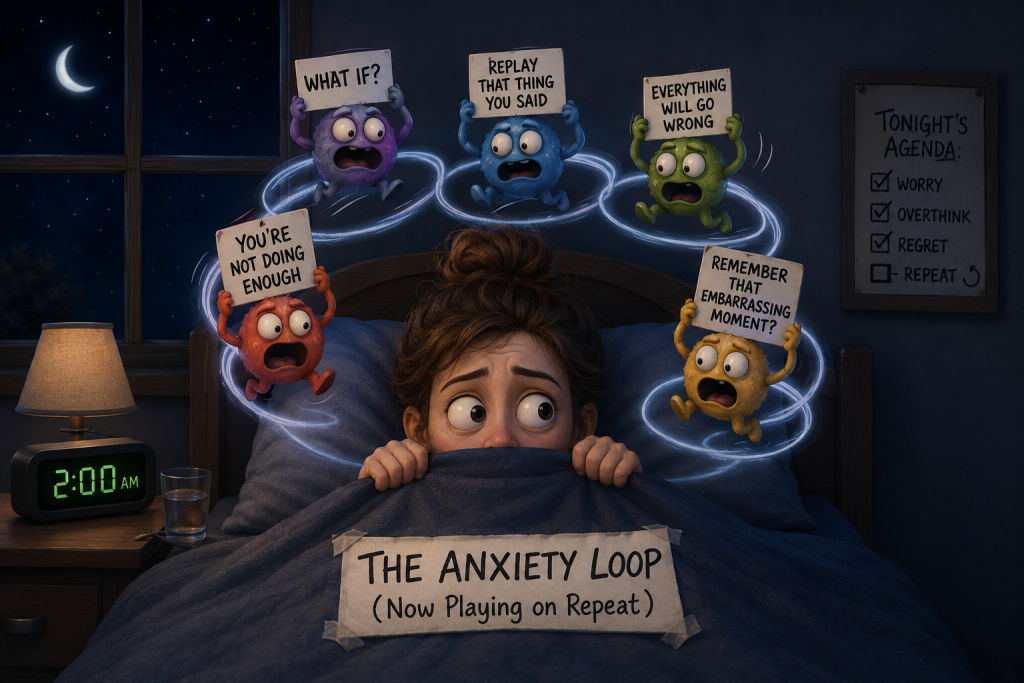
The Anxiety Loop at Night
Nighttime anxiety rarely walks in politely.
It usually kicks the door open, flips on every light in your head, and says, “Since we are awake, let’s discuss every possible thing that could go wrong.”
That is the anxiety loop at night.
It is not one thought. It is a chain.
One worry leads to another worry. Then that worry brings a body feeling. Then the body feeling scares you. Then the fear makes the body feeling stronger. Then your brain says, “See? We should be scared.”
And around it goes.
This is why the Brain Gets Loudest at night. The brain is not just thinking. It is reacting to its own thoughts like they are facts. It is taking a fear, adding a feeling, adding a guess, adding a memory, and turning it into a full midnight disaster movie.
The hard part is that it feels real while it is happening.
You may know during the day that most worries pass. You may know that one bad night does not ruin your life. You may know that anxiety can make things feel worse than they are.
But at 2AM, your brain does not always care what you know.
It cares what you feel.
And if you feel scared, your brain may decide there must be danger.
That is where the loop gets tricky.
Your body can be safe, but your brain may still sound the alarm.
According to the National Institute of Mental Health, anxiety can involve worry, fear, tension, restlessness, trouble sleeping, and physical symptoms. That matters because nighttime anxiety is not “just being dramatic.” It can be a real body-and-mind reaction.
The problem is that the reaction can feed itself.
Here is what the anxiety loop can look like:
| Step | What Happens | What It Feels Like |
|---|---|---|
| 1 | A thought pops up | “What if something is wrong?” |
| 2 | The body reacts | Heart races, stomach tightens, muscles tense |
| 3 | You notice the reaction | “Why do I feel like this?” |
| 4 | Fear grows | “This must mean something bad.” |
| 5 | The brain scans for proof | You check your body, memories, or future |
| 6 | The loop restarts | The thought feels even stronger |
The loop is powerful because it feels like problem-solving.
But most of the time, it is not solving anything.
It is just spinning.
There is a difference between useful thinking and anxious looping.
Useful thinking says, “This is the problem. Here is one next step.”
Anxious looping says, “Here are 400 possible problems, all urgent, all at once, and none of them can wait until morning.”
That is why nighttime anxiety is so draining. You are lying still, but your brain is running laps.
The goal is not to shame yourself for having anxious thoughts.
The goal is to see the loop for what it is.
A loop is not a truth.
A loop is a pattern.
And patterns can be changed.
Catastrophic Thinking
Catastrophic thinking is when your brain jumps to the worst possible ending before anything has actually happened.
It is the mental habit of turning “I feel weird” into “Something terrible is happening.”
It turns “I made a mistake” into “I ruined everything.”
It turns “I might be tired tomorrow” into “Tomorrow will be a disaster, the week will fall apart, and my entire life is now off track.”
At night, catastrophic thinking can feel stronger because your brain has fewer distractions and more emotional weight. The room is quiet. The clock is visible. Your body is tired. There is less daylight logic available.
So the mind starts filling in blanks.
And anxiety is terrible at filling in blanks.
It does not fill them in with calm, balanced guesses.
It fills them in with worst-case stories.
That is why a small thought can grow so fast.
You may start with:
“I have to be up early.”
Then:
“What if I don’t sleep?”
Then:
“What if I mess up tomorrow?”
Then:
“What if people notice?”
Then:
“What if I can’t handle my life?”
Now you are no longer thinking about sleep.
You are thinking about your identity, your future, your worth, and whether you are failing at being a human being.
That is a huge jump.
But anxiety makes huge jumps feel normal.
Here are a few common examples:
| First Thought | Catastrophic Version |
|---|---|
| “I am still awake.” | “I will not sleep at all.” |
| “My heart is beating fast.” | “Something is seriously wrong.” |
| “I forgot something today.” | “I can’t keep my life together.” |
| “Tomorrow may be hard.” | “Tomorrow will be awful.” |
| “I feel anxious.” | “I will always feel this way.” |
Catastrophic thinking is not a character flaw.
It is a scared brain trying to prepare for pain before pain arrives.
The brain thinks, “If I imagine the worst, maybe I can protect myself.”
But it does not protect you.
It exhausts you.
It makes your bed feel unsafe. It makes the future feel like a threat. It makes normal body feelings feel dangerous. It makes sleep feel like a test you have to pass.
And once sleep becomes a test, your body can tense up even more.
This is why many sleep and anxiety resources talk about lowering the pressure around sleep. The Sleep Foundation explains the link between anxiety and sleep, including how worry can make sleep harder and poor sleep can make anxiety feel worse.
That is the trap.
You are anxious because you are not sleeping.
Then you cannot sleep because you are anxious.
Then your brain says, “This is proof we are in trouble.”
But it is not proof.
It is the loop.
A helpful way to slow catastrophic thinking is to ask a gentler question.
Not, “Is this thought true?”
At 2AM, that question can turn into a debate.
Try this instead:
“Is this thought helpful right now?”
That is different.
A thought might contain a tiny piece of truth and still not be useful at 2AM.
For example, maybe tomorrow will be harder if you sleep poorly. That may be true.
But lying awake telling yourself tomorrow is ruined does not give you more rest. It does not help your body relax. It does not fix tomorrow.
It only makes tonight harder.
So you can answer the thought like this:
“Maybe tomorrow will be harder, but I do not need to solve tomorrow from bed. Right now, my job is to rest my body.”
That is not fake positivity.
That is mental boundary-setting.
You are not pretending everything is perfect. You are refusing to let anxiety turn one hard moment into a full life sentence.
A good tool for catastrophic thinking is the “most likely” question.
Ask:
- What is the worst thing my brain is saying?
- What is the best thing that could happen?
- What is the most likely thing?
Usually, anxiety only wants to talk about the worst thing.
But most of life happens in the middle.
The worst thing is not impossible, but it is usually not the most likely.
At night, your brain may say, “You will not sleep at all.”
The most likely truth may be, “I may sleep less than I want, but I will probably get some rest, and tomorrow may be uncomfortable but manageable.”
That is less dramatic.
It is also more useful.
Fear Spirals
A fear spiral is what happens when one fear keeps feeding the next fear.
It starts small, then pulls in everything around it.
Think of it like dropping a sock behind the dryer and somehow deciding you need to remodel the whole house.
That is the energy of a fear spiral.
One thought shows up, and suddenly your brain is pulling in memories, body feelings, old mistakes, future worries, and things you cannot control.
At night, fear spirals can move fast because there is less interruption. Nobody is calling your name. The TV is off. The dishes are not clanging. You are not walking around. You are just there with the thought.
And the thought gets company.
Fear spirals often start with “what if.”
“What if I get sick?”
“What if I cannot sleep?”
“What if this feeling gets worse?”
“What if I am falling behind?”
“What if something bad happens?”
“What if I never feel normal again?”
The phrase “what if” is not always bad. It can help us plan. It can help us prepare. It can help us avoid real danger.
But anxiety uses “what if” like a broken fire alarm.
It keeps ringing even when there is no smoke.
One of the hardest parts of a fear spiral is how convincing it feels. Your mind may speak with total confidence, even when it has no real proof.
That is why you need to remember this:
Anxiety speaks in certainty, but it is often built on guesses.
It may say, “This will go badly.”
But what it really means is, “I am scared this might go badly.”
Those are not the same.
The first one sounds like a fact.
The second one is a feeling.
Feelings matter, but they are not always accurate maps.
A fear spiral also pulls your body into it.
When your brain senses danger, your body may prepare to protect you. Muscles tighten. Breathing gets shallow. Your heart may beat faster. Your stomach may twist. Your mind may race.
Then you notice those feelings.
Then you fear them.
Then the body reacts more.
That is the loop.
The Mayo Clinic’s insomnia treatment guidance notes that relaxation methods like breathing exercises and progressive muscle relaxation can help lower anxiety at bedtime. That makes sense because fear spirals are not only mental. They are physical too.
You cannot always think your way out of a body alarm.
Sometimes you have to calm the body first.
Here are a few simple ways to slow a fear spiral at night:
- Put one hand on your chest and one hand on your stomach.
- Breathe out slower than you breathe in.
- Unclench your jaw.
- Drop your shoulders.
- Press your feet gently into the mattress.
- Name five things you can feel, hear, or see.
- Remind yourself that a thought is not an emergency.
You are not trying to win a fight with your brain.
You are trying to stop feeding the spiral.
A fear spiral needs fuel.
The fuel is usually checking, arguing, replaying, predicting, and scanning.
For example, if your fear is “What if I don’t sleep?” the spiral gets stronger every time you check the clock, calculate hours left, test whether you feel sleepy, or tell yourself tomorrow is ruined.
That does not mean you are doing something wrong. It means your brain is looking for certainty.
But sleep does not work well under pressure.
The more you demand sleep, the more alert your brain can become.
So instead of chasing certainty, aim for safety.
Say:
“I do not need to know exactly how tonight will go. I can let my body rest even if sleep takes time.”
That kind of statement can feel small.
But small is fine.
At 2AM, small is often what works.
You do not need a huge life breakthrough. You need one calmer breath, then another.
If this pattern is common for you, it can help to learn more about nighttime fear, sleep anxiety, and calming the mind through a fuller guide like Quiet the Mind: Sleep Help for Anxiety, especially if your nights often turn into a battle with your own thoughts.
When Thoughts Feel Too Real
The scariest part of nighttime anxiety is not always the thought itself.
It is how real the thought feels.
During the day, you may be able to say, “That is just anxiety.”
At night, that same thought may feel like a warning.
Your brain may say, “Pay attention. This matters. This is serious.”
And because your body is also tense, the thought feels even more believable.
That is the mind-body trick.
A scared body can make a scary thought feel true.
A tight chest can make “something is wrong” feel true.
A racing heart can make “I am not safe” feel true.
A tired mind can make “I cannot handle tomorrow” feel true.
But strong feelings are not the same as facts.
That may sound simple, but at night it is easy to forget.
A thought can be loud and still be wrong.
A thought can be scary and still be passing through.
A thought can feel real because your nervous system is worked up, not because the thought is accurate.
This is why many people feel clearer in the morning. The problem may not be gone, but it often looks smaller. The body is less tense. The room is lighter. The world feels more normal. You have more context.
Night removes context.
Anxiety loves that.
It takes one piece of the story and acts like it is the whole book.
For example, you may think:
“I am not asleep yet.”
That is one fact.
Anxiety adds:
“I will be awake all night.”
That is a prediction.
Then it adds:
“I will fail tomorrow.”
That is another prediction.
Then it adds:
“I cannot live like this.”
That is fear talking.
Only the first part is the fact.
The rest is a story built around the fact.
This is one of the best ways to handle thoughts that feel too real: separate facts from stories.
Try this table in your mind or in a notebook:
| Fact | Story My Anxiety Adds |
|---|---|
| I am awake right now. | I will never sleep tonight. |
| My heart is beating fast. | Something terrible is happening. |
| I feel scared. | I am not safe. |
| Tomorrow may be harder. | Tomorrow is already ruined. |
| I had a bad thought. | The thought must mean something about me. |
This practice does not make the feeling vanish right away.
But it gives you space.
And space matters.
The goal is not to force yourself to feel calm in ten seconds. That can become another pressure. The goal is to stop treating every anxious thought like a command.
You can notice the thought without obeying it.
You can hear it without building a house inside it.
You can say, “That is a fear story,” and come back to your body.
This is where a real quote from Marcus Aurelius fits well:
“You have power over your mind — not outside events. Realize this, and you will find strength.”
— Marcus Aurelius, Meditations
That does not mean you can control every thought that appears.
Nobody can.
It means you can practice how you respond.
A thought may show up.
You do not have to follow it down every hallway.
A fear may rise.
You do not have to turn it into a forecast.
A body feeling may scare you.
You can notice it, breathe, and give it time before deciding what it means.
Of course, if you have severe symptoms, new symptoms, or symptoms that feel dangerous, it is wise to seek medical help. Anxiety can cause strong sensations, but it should not be used as an excuse to ignore real warning signs.
But when you know your pattern, and the same fear loop keeps showing up at night, it helps to name it clearly.
“This is the anxiety loop.”
“This is catastrophic thinking.”
“This is a fear spiral.”
“This is my brain trying to protect me, but it is overdoing it.”
Those names matter because they turn the monster back into a pattern.
And a pattern can be worked with.
The Harvard Health article on slowing racing thoughts explains that racing thoughts can be made worse by anxiety about the racing thoughts themselves. That is exactly what happens at night. People do not only fear the first thought. They fear that they cannot stop thinking.
So the work is not to have a perfectly quiet mind.
The work is to become less afraid of the noise.
That is a big shift.
Because once you stop fearing every thought, the thoughts have less power.
They may still come.
But they do not have to drag you.
A good nighttime line is:
“This thought feels real because I am anxious, tired, and in the dark. I can wait until morning before I believe it.”
That line can save you from a lot of 2AM decisions.
Do not solve your whole life in the dark.
Do not judge your future from a tired bed.
Do not trust every thought that shows up when your nervous system is scared.
Night thoughts often feel bigger than they are.
The Brain Gets Loudest when the world gets quiet, but loud does not mean wise.
Sometimes loud just means tired.
Sometimes loud just means scared.
Sometimes loud just means your mind needs a softer place to land.
And that is the real way out of the anxiety loop.
Not by yelling at your brain.
Not by forcing sleep.
Not by winning every argument with every thought.
But by learning to pause, breathe, name the loop, and let the night be night again.
If this kind of nighttime anxiety keeps stealing your rest, Quiet the Mind: Sleep Help for Anxiety is also available on Amazon for readers who want a calm, practical guide they can return to when the mind gets loud.
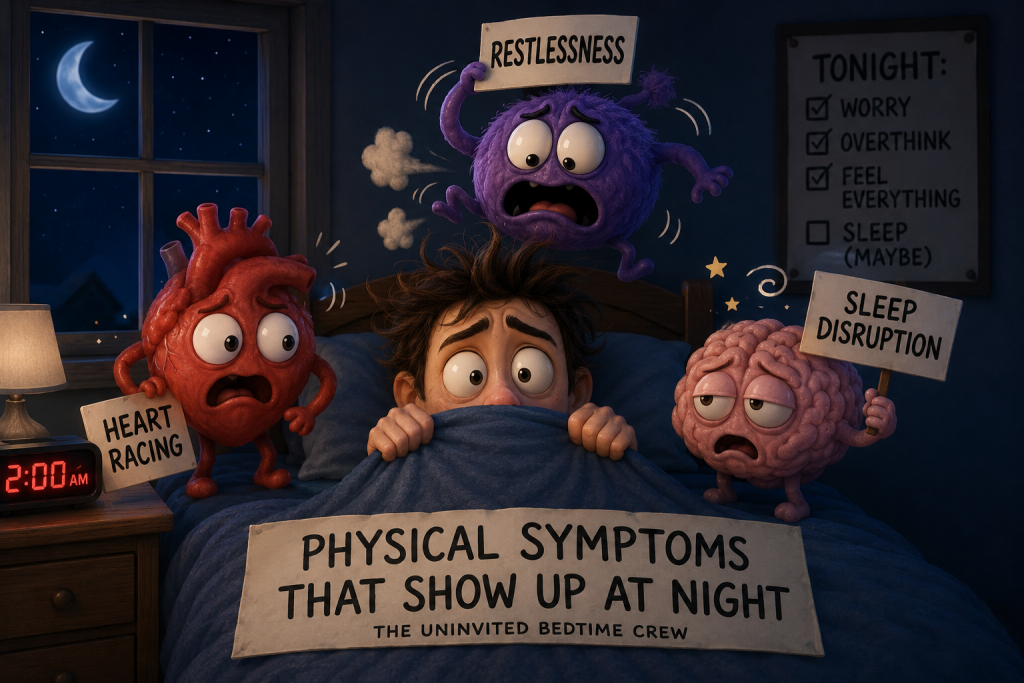
Physical Symptoms That Show Up at Night
Nighttime anxiety does not always stay in your thoughts.
Sometimes it moves into your body.
That is when things can get scary.
You may be lying in bed, trying to relax, and then your heart starts pounding. Your legs feel jumpy. Your chest feels tight. Your stomach turns. Your skin feels warm. Your body feels like it forgot how to be still.
Then your brain jumps in and says, “Well, this can’t be good.”
That is the moment many people start to panic.
The problem is not only the symptom. The problem is the story the brain attaches to the symptom.
A racing heart becomes danger.
Restlessness becomes “I will never sleep.”
A bad night becomes “Something is wrong with me.”
This is why the Brain Gets Loudest at night. At 2AM, physical symptoms feel bigger because there is nothing else going on. You are not walking around, talking, working, driving, cooking, or dealing with normal daytime noise. You are alone with your body, and suddenly every heartbeat feels like it has a microphone.
The body can be loud at night too.
Anxiety can cause real physical symptoms. That does not mean the danger is real. It means the body is reacting as if danger is near.
The National Institute of Mental Health explains anxiety disorders as conditions that can involve fear, worry, tension, restlessness, sleep trouble, and physical symptoms. Anxiety is not just “thinking too much.” It can affect the whole body.
This matters because many people blame themselves.
They think, “Why can’t I just calm down?”
But your body may be in alert mode. It may be acting like there is a threat even when you are safe in bed.
That alert system is not evil. It is there to protect you. But when it turns on at the wrong time, it can make sleep feel impossible.
Here is a simple way to understand it:
| What You Feel at Night | What Anxiety May Be Doing |
|---|---|
| Heart racing | Your body is preparing for action |
| Tight chest | Muscles may be tense and breathing may be shallow |
| Restless legs or body | Your nervous system may be keyed up |
| Upset stomach | Stress can affect digestion |
| Sweating or warmth | The body may be in fight-or-flight mode |
| Trouble sleeping | The brain may be staying alert for danger |
This does not mean every symptom is anxiety.
That is important.
If you have severe chest pain, fainting, trouble breathing, weakness on one side, confusion, new severe symptoms, or symptoms that feel dangerous, get medical help right away. It is always better to be safe with serious symptoms.
But if you know this pattern, and it often shows up when you are stressed, scared, or trying to sleep, it may be part of the nighttime anxiety cycle.
And that cycle can be changed.
Not by yelling at your body.
Not by forcing yourself to “just relax.”
Not by checking every symptom every thirty seconds like your body is a broken dashboard.
The first step is learning what these symptoms may mean, why they feel stronger at night, and how to respond without feeding the fear.
Heart Racing
A racing heart at night can feel awful.
It may feel like your heart is beating too fast, too hard, or too loud. You may feel it in your chest, throat, ears, or even through the pillow. Sometimes it feels like your whole body is pulsing.
And because it happens in bed, it can feel even scarier.
During the day, your heart can speed up and you may not notice as much. You are moving, talking, lifting things, walking, eating, or handling life. But at night, you are still. So when your heart beats harder, it stands out.
It feels like the main event.
That is when your brain may start asking questions:
- Why is my heart doing that?
- Am I okay?
- Is this anxiety?
- What if it is something else?
- Should I check my pulse?
- Why is it still happening?
- What if I can’t sleep now?
One heartbeat turns into a whole investigation.
And the investigation often makes it worse.
Stress and anxiety can bring on heart palpitations, and Sleep Foundation explains heart palpitations at night as a feeling of the heart racing, pounding, fluttering, or skipping beats. The same article notes that stress and anxiety can be connected to this experience.
That is helpful to know, but it does not always feel helpful in the moment.
In the moment, your heart is loud, your room is dark, and your brain is being dramatic.
The scary part is that a racing heart can make you feel like something bad is happening even when anxiety is the cause.
This is because anxiety can activate the body’s fight-or-flight system.
Fight-or-flight is the body’s emergency mode. It is the system that helps you react fast when there is danger. Your body may release stress hormones, your muscles may tighten, and your heart may beat faster to get you ready to move.
That is useful if you need to jump away from danger.
It is not so useful when the “danger” is your own thought at 2AM.
A racing heart can also wake you up from sleep. That can feel even more confusing because you may not know what started it. You open your eyes, your heart is pounding, and your brain fills in the blank with fear.
The Cleveland Clinic explains that nocturnal panic attacks can wake a person from sleep with fear, trouble breathing, sweating, and a racing heart. Not every racing heart at night is a panic attack, but this shows how real and physical nighttime anxiety can feel.
The problem is that fear feeds the symptom.
You feel your heart race.
Then you get scared.
Then your body releases more stress energy.
Then your heart races more.
Then you feel more scared.
That is the loop again.
Here is what usually does not help:
| Common Reaction | Why It Can Make Things Worse |
|---|---|
| Checking your pulse over and over | Keeps your attention locked on the symptom |
| Staring at the clock | Adds pressure and panic |
| Searching symptoms online at night | Often increases fear |
| Holding your breath | Can make the body feel more tense |
| Telling yourself “stop it” | Adds pressure instead of calm |
A better response is to lower the alarm.
Not prove the symptom away.
Not argue with your body.
Lower the alarm.
Try this:
- Place one hand on your chest.
- Breathe in gently through your nose.
- Breathe out longer than you breathe in.
- Unclench your jaw.
- Let your shoulders drop.
- Say, “My body is alarmed. I can help it settle.”
The long exhale matters because it tells the body you are not running from danger. You are slowing down.
You can also try counting the out-breath.
Breathe in for 3.
Breathe out for 5 or 6.
Do that for a few minutes.
Do not use it like a test. Do not ask, “Is it working yet?” every ten seconds.
That turns calming into another job.
Just breathe like you are gently proving to your body that there is no emergency.
If your heart symptoms are new, severe, or come with chest pain, fainting, shortness of breath, or pain spreading to your arm, jaw, neck, back, or shoulder, do not assume it is anxiety. The Cleveland Clinic gives a useful overview of how panic attack and heart attack symptoms can overlap, and it is wise to get medical help when symptoms are serious or unclear.
But if this is a familiar anxiety pattern for you, remind yourself:
“My heart is loud right now, but loud does not always mean danger.”
That line can help because the body speaks in volume, not truth.
Sometimes the heart is not warning you.
Sometimes it is reacting to a scared brain.
And if the Brain Gets Loudest at night, the heart can feel louder too.
Restlessness
Restlessness is one of the most annoying nighttime anxiety symptoms because it feels like your body forgot the assignment.
You are in bed.
The lights are off.
The room is quiet.
Your job is simple: sleep.
And your body says, “How about we rearrange every limb twelve times and feel uncomfortable in every position?”
Restlessness can feel different for different people.
Some people feel like they cannot get comfortable. Some feel tight or jumpy. Some keep moving their legs. Some feel trapped under the blanket. Some feel an inner buzzing, like their body is plugged into a charger it did not ask for.
It can make you feel like you want to crawl out of your own skin.
That sounds dramatic, but anyone who has felt it knows it is real.
Nighttime restlessness often shows up when the nervous system is still awake even though the body is tired. You may be exhausted, but not calm. That is a rough mix.
Tired does not always mean relaxed.
That is one of the biggest sleep lessons.
You can be very tired and still too alert to sleep.
This happens because anxiety can keep the body ready for action. Your muscles may stay tense. Your breathing may stay shallow. Your mind may keep scanning. Your body may feel like it needs to move, check, fix, or escape.
But there is nowhere to go.
So you toss and turn.
The Mayo Clinic’s overview of insomnia explains that insomnia can include trouble falling asleep, trouble staying asleep, waking too early, and feeling tired after sleep. It also notes that anxiety disorders can disrupt sleep.
That is exactly why restlessness can become a loop.
You feel restless.
Then you worry that you are restless.
Then you try harder to sleep.
Then your body gets more tense.
Then you feel even more restless.
It is like trying to hold a beach ball underwater. The harder you push, the harder it pushes back.
Restlessness is also one of those symptoms that makes people angry at themselves.
You may think:
- Why can’t I just lie still?
- Why is my body doing this?
- I was tired all day, so why am I awake now?
- I am going to ruin tomorrow.
- This is ridiculous.
That anger makes sense.
But it usually does not help.
The body does not calm down because it gets insulted.
It calms down when it feels safe.
So instead of treating restlessness like a problem you must beat, try treating it like extra energy that needs a gentle exit.
Here are some calmer ways to respond:
| Restless Feeling | Gentle Response |
|---|---|
| Tight shoulders | Slow shoulder rolls or light stretching |
| Jumpy legs | Gentle leg stretch or tense-and-release |
| Inner buzzing | Longer exhale breathing |
| Cannot get comfortable | Get up briefly and reset calmly |
| Mind-body tension | Body scan from feet to head |
| Feeling trapped | Sit up, breathe, and lower the pressure |
One useful method is progressive muscle relaxation.
That means you tighten one muscle group for a few seconds, then release it. You can start with your feet, then calves, thighs, hands, arms, shoulders, and face.
The point is not to do it perfectly.
The point is to teach your body the difference between tense and loose.
Many people are tense all day and do not notice it until night. Then when the world gets quiet, the body’s tension finally gets a chance to speak.
You may realize your jaw is tight.
Your shoulders are up.
Your stomach is clenched.
Your hands are curled.
Your legs are braced.
Your body may be lying in bed like it is preparing for a tax audit.
No wonder sleep does not show up easily.
A small reset can help.
Try this:
- Tighten your feet for 3 seconds.
- Release them.
- Tighten your legs for 3 seconds.
- Release them.
- Tighten your hands for 3 seconds.
- Release them.
- Lift your shoulders gently.
- Let them drop.
- Soften your jaw.
- Let your tongue rest.
Do this slowly.
Do not rush it like you are trying to win sleep.
Sleep is not a contest.
Restlessness can also be made worse by caffeine, alcohol, late heavy meals, bright screens, stress, and irregular sleep times. Sleep habits are not the whole answer for everyone, but they do matter. The Sleep Foundation’s guide to sleep hygiene explains how routines, environment, and daily habits can affect sleep quality.
This does not mean you need a perfect bedtime routine with candles, herbal tea, and a personality transplant.
It means your body needs signals.
Same time.
Lower lights.
Less stimulation.
Less doom-scrolling.
Less “let me just check one more thing” that turns into watching a man build a cabin in the woods for forty-five minutes.
Your body learns from patterns.
If the pattern before bed is stress, screens, snacks, arguments, bills, and panic about sleep, your body may stay alert.
If the pattern becomes slower and safer, your body can begin to understand that night is not a threat.
Restlessness is not proof that sleep is impossible.
It is a sign your system may need more time to power down.
That is annoying, yes.
But it is workable.
Sleep Disruption
Sleep disruption is what happens when sleep gets broken.
You may have trouble falling asleep. You may wake up over and over. You may wake up too early. You may fall asleep, then wake with a jolt. You may sleep for hours but still feel like you barely slept.
That kind of sleep can make a person feel worn down.
Not just tired.
Worn down.
Because sleep is supposed to be the reset. When sleep becomes stressful, the whole day can feel harder.
The Centers for Disease Control and Prevention explains sleep as important for health and emotional well-being. That is why poor sleep can affect mood, focus, patience, energy, and how well you handle stress.
When sleep is disrupted, anxiety can feel worse the next day.
Then the next night, you may worry about sleep again.
That is the loop.
Bad night.
Hard day.
Fear of another bad night.
More pressure.
More alertness.
Another bad night.
This is how sleep can start to feel like a battle.
And once sleep feels like a battle, bed can stop feeling safe.
You may begin to dread bedtime.
You may feel okay during the evening, then get nervous as bedtime gets closer.
You may think:
- What if it happens again?
- What if I wake up at 2AM?
- What if I panic?
- What if I can’t function tomorrow?
- What if this never gets better?
Now sleep has become the thing you want most and fear most at the same time.
That is a painful place to be.
The Sleep Foundation’s article on anxiety and sleep explains that anxiety and sleep problems can feed each other, with worry making sleep harder and poor sleep making anxiety symptoms worse.
That is why this problem needs kindness, not shame.
Many people treat a bad night like a personal failure.
But sleep is not something you force.
You can create better conditions for sleep. You can lower stimulation. You can calm the body. You can reduce pressure. You can build habits.
But you cannot bully yourself into deep rest.
The body does not sleep well under threat.
And “You better sleep or tomorrow is ruined” sounds like a threat.
Even if you are saying it to yourself.
Here are some common ways anxiety disrupts sleep:
| Sleep Problem | How Anxiety May Be Involved |
|---|---|
| Trouble falling asleep | Racing thoughts keep the mind alert |
| Waking during the night | The body may stay sensitive to stress signals |
| Waking with panic | Fear response can activate during sleep |
| Light sleep | The nervous system may not fully settle |
| Early waking | Stress hormones and worry may rise too soon |
| Feeling unrested | Poor sleep quality affects energy and mood |
One of the most frustrating parts is that the more you monitor sleep, the more pressure you create.
You check the clock.
You count hours.
You calculate how much time is left.
You judge whether you feel sleepy.
You try to guess how bad tomorrow will be.
That may feel natural, but it keeps your brain awake.
Clock-checking is like giving anxiety a calculator.
It will use it against you.
If possible, turn the clock away. Keep your phone out of easy reach. Do not give your brain a glowing screen and a fresh reason to panic.
Another helpful idea is “rest still counts.”
This matters because people often think, “If I am not asleep, this is useless.”
But lying quietly with your eyes closed can still give the body some rest. It may not replace full sleep, but it is not nothing.
That thought can lower pressure.
Instead of saying, “I must sleep right now,” try:
“Even if sleep takes time, resting my body is still helpful.”
That sentence is softer.
And softer is often more effective at night.
If you wake up and cannot fall back asleep, do not turn the bed into a wrestling ring. If you are awake for a while and getting more upset, some sleep experts suggest getting out of bed briefly and doing something calm in low light until you feel sleepy again. The Mayo Clinic discusses middle-of-the-night waking in its guide on how to stay asleep with insomnia, including steps like keeping lights dim and avoiding screens.
The key is to keep the reset boring.
Not exciting.
Not productive.
Not “I guess I’ll clean the fridge and reorganize my life.”
Just boring.
Read a dull page. Sit quietly. Breathe. Listen to something calm. Keep the lights low. Let your body know nothing dramatic is happening.
Sleep disruption can feel personal, but it is usually a pattern.
And patterns can soften.
A bad night does not mean you are back at zero.
A rough week does not mean you are broken.
A 2AM wake-up does not mean your brain wins forever.
It means your body and mind need practice feeling safe again at night.
That practice can include:
- A calmer wind-down routine
- Less clock-checking
- Lower light before bed
- Less caffeine later in the day
- A notebook for worries
- Gentle breathing
- Fewer scary searches at night
- A plan for what to do if you wake up
The plan matters because panic loves uncertainty.
If you already know what you will do when you wake up, waking up feels less like an emergency.
You can say:
“If I wake up, I will not panic. I will breathe, keep lights low, avoid checking the time, and let my body rest.”
That is simple.
Simple works better at night.
When the Brain Gets Loudest, it does not need a lecture. It needs a calm script.
This is also why a full guide can help. If this pattern keeps happening, Quiet the Mind: Sleep Help for Anxiety was built around the exact struggle of racing thoughts, fear of sleep, and the body symptoms that can make night feel harder than it should.
The most important thing to remember is this:
Your body is not betraying you.
It is reacting.
Your brain is not broken.
It is alarmed.
Your sleep is not ruined forever.
It is disrupted right now.
There is a difference.
Right now is not forever.
A hard night is not your whole life.
And the symptoms that feel so loud in the dark can become less scary when you understand what they are, respond with care, and stop letting every sensation turn into a midnight emergency.
For readers who want the book version to keep nearby when sleep anxiety hits, Quiet the Mind: Sleep Help for Anxiety is available on Amazon.
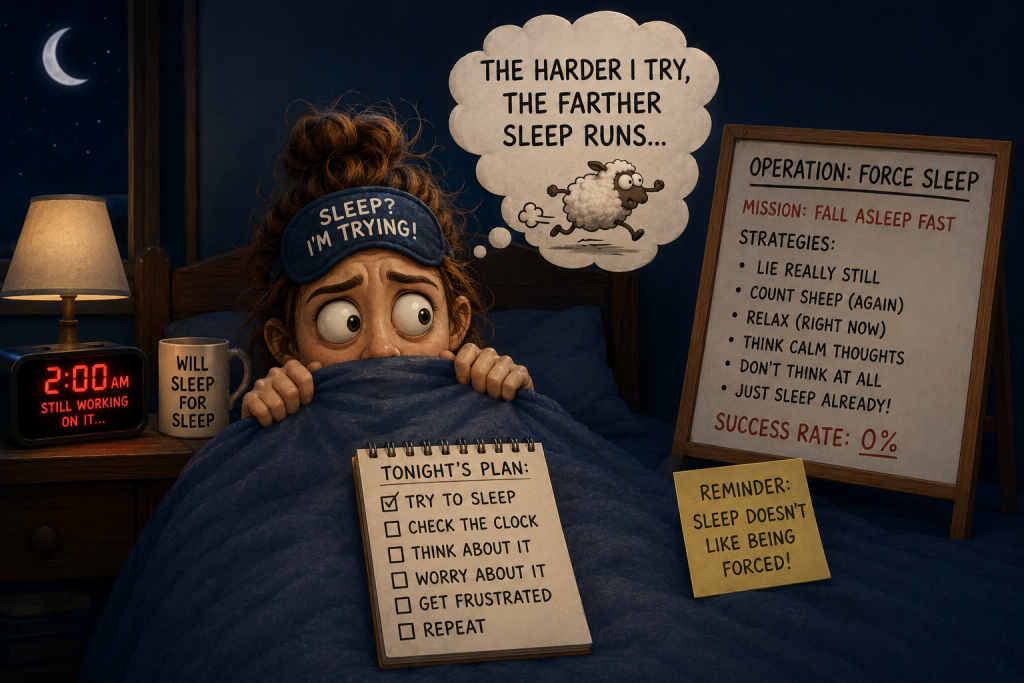
Why Sleep Becomes Harder When You Try to Force It
Sleep has a stubborn little attitude.
The harder you chase it, the more it seems to back away.
You can be exhausted. Your eyes can burn. Your body can feel heavy. You can know you need sleep. You can do all the math in your head and say, “If I fall asleep right now, I can still get five hours.”
Then sleep looks at that pressure and says, “No thanks.”
That is one of the most frustrating parts of nighttime anxiety.
You want sleep badly, so you try harder.
You lie still harder.
You breathe harder.
You relax harder.
You think calm thoughts harder.
You count sheep so hard those poor sheep need workers’ compensation.
But sleep does not work like a light switch. You cannot demand it into showing up. You can build the right conditions for it, but you cannot grab it by the collar and drag it into the room.
That is why the Brain Gets Loudest when sleep starts to feel like a job.
The moment you turn sleep into a task you must complete, your brain gets alert. It starts watching. It starts checking. It starts judging. It asks, “Am I sleepy yet? Is this working? Why am I still awake? How many hours are left?”
Now you are not resting.
You are performing.
And the audience is your own anxious brain.
Sleep needs safety, not pressure. Your body falls asleep best when it feels like it can let go. But if your mind is treating bedtime like an emergency, your body may stay ready for action.
This is why “try harder” often fails with sleep.
Trying harder works for many things. You can try harder to clean the kitchen. You can try harder to finish a project. You can try harder to carry groceries in one trip, even though that is how half of us almost lose a finger.
But sleep is different.
Sleep is more like trust.
It happens when your body feels safe enough to stop trying.
The Sleep Foundation explains anxiety and sleep as a two-way problem: stress and worry can make sleep harder, and poor sleep can make anxiety worse. That means the harder you panic about sleeping, the more awake you may feel.
That does not mean you are doing it wrong.
It means your nervous system is trying to protect you from a threat it thinks is real.
The threat may not be a bear at the door.
It may be tomorrow morning.
It may be a meeting.
It may be another bad night.
It may be the fear of feeling awful again.
Your brain hears, “I have to sleep or else,” and your body hears, “or else.”
That “or else” is what keeps you alert.
Here is the trap in plain terms:
| What You Want | What You Do | What Happens |
|---|---|---|
| You want sleep | You try to force it | The brain gets more alert |
| You want calm | You check if you are calm | You notice you are not calm |
| You want control | You monitor every feeling | The body feels watched |
| You want rest | You fear another bad night | The fear keeps you awake |
| You want relief | You fight your thoughts | The thoughts get louder |
This does not mean you should do nothing.
It means the goal changes.
Instead of forcing sleep, you create a place where sleep can return.
That is a softer goal.
And at night, softer usually works better.
Pressure to Fall Asleep
The pressure to fall asleep can become the very thing that keeps you awake.
It starts with a reasonable thought.
“I need sleep.”
That is true. Sleep matters.
But then anxiety adds pressure.
“I need sleep right now.”
Then it adds fear.
“If I do not sleep, tomorrow will be ruined.”
Then it adds judgment.
“I cannot believe this is happening again.”
Then it adds identity.
“What is wrong with me?”
Now you are not just awake.
You are awake and under attack from your own mind.
That is a lot for a tired person in pajamas.
The pressure to fall asleep turns bedtime into a test. You feel like you have to pass. Every minute awake feels like a point taken away. Every time you roll over, it feels like proof that something is wrong.
This is why clock-checking is so brutal.
The clock looks harmless. It is just numbers. But at night, those numbers can become emotional weapons.
2:03 AM.
2:21 AM.
2:48 AM.
3:10 AM.
Each time you check, your brain gets another reason to panic.
The Sleep Foundation explains that clock-watching can increase stress and make sleep less likely. That is exactly what many people feel. The clock does not give comfort. It gives pressure.
It makes you calculate.
“How many hours do I have left?”
“If I sleep now, is that enough?”
“What if I only get four hours?”
“What if I feel sick tomorrow?”
“What if I can’t work?”
“What if I can’t handle people?”
Now your brain is wide awake doing math no one asked for.
The pressure to fall asleep also makes your body feel watched.
Think about how hard it is to do something natural when someone is staring at you.
It is like when someone says, “Act normal,” and suddenly you forget how your arms work.
Sleep can be like that.
The more you stare at it, the stranger it gets.
You start checking for signs:
- Am I relaxed yet?
- Is my breathing slower?
- Do I feel sleepy?
- Did that technique work?
- Why did I just have another thought?
- Is my body heavy enough?
- Should I change positions?
That is not rest.
That is sleep surveillance.
Your brain becomes the night manager of a hotel nobody wants to stay in.
A better way is to remove the performance.
Instead of saying, “I must sleep,” say:
“I am going to rest my body and let sleep come when it comes.”
That may sound small, but it takes pressure off.
You are no longer demanding sleep. You are allowing rest.
Rest is something you can do.
Sleep is something that happens.
That difference matters.
Here is a simple table:
| Pressure Thought | Softer Rest Thought |
|---|---|
| “I have to sleep right now.” | “I can rest while sleep comes.” |
| “Tomorrow is ruined.” | “Tomorrow may be harder, but I can handle it one step at a time.” |
| “This is happening again.” | “This is a pattern, not a life sentence.” |
| “Why can’t I sleep?” | “My body needs safety, not pressure.” |
| “I need to fix this tonight.” | “I can make one calm choice right now.” |
This is not fake positivity.
You are not telling yourself, “Everything is perfect.”
You are telling yourself, “Panic is not helping.”
That is honest.
A quote from Dale Carnegie fits this well:
“Our fatigue is often caused not by work, but by worry, frustration and resentment.”
— Dale Carnegie, How to Stop Worrying and Start Living
That quote is not only about sleep, but it fits nighttime anxiety because worry is tiring. Fighting your own mind is tiring. Being awake is hard enough without adding shame to it.
Pressure also builds when sleep becomes linked to worth.
People may think, “A healthy person sleeps well,” or “A productive person sleeps well,” or “A normal person can just go to bed.”
But many normal people struggle with sleep.
The CDC explains that adults generally need at least seven hours of sleep per night, but needing sleep and forcing sleep are not the same thing.
You can care about sleep without making it a threat.
That is the balance.
You can take sleep seriously without turning bedtime into a courtroom.
One helpful move is to make your sleep goal less rigid.
Instead of:
“I must get eight hours.”
Try:
“I am giving my body a calm chance to rest.”
Instead of:
“I need to fall asleep in ten minutes.”
Try:
“I am allowed to be awake without panicking.”
That second one is powerful.
Because when you are allowed to be awake, wakefulness becomes less scary.
And when wakefulness becomes less scary, the body has a better chance to relax.
Sleep often returns when you stop chasing it with a net.
Fear of Another Bad Night
One bad night is hard.
Several bad nights can make bedtime feel like a threat.
This is where sleep anxiety really starts to dig in.
You may have a rough night, then spend the next day dreading the next one. You may feel tired, shaky, foggy, moody, or less patient. You may get through the day, but the whole time, part of your mind is thinking, “Please do not let tonight happen again.”
Then bedtime comes.
The room looks the same.
The pillow feels the same.
The clock is in the same place.
The memory of the bad night comes back.
Now you are not just trying to sleep.
You are trying to avoid a repeat.
That fear of another bad night can train your brain to treat bedtime like danger.
You may start feeling anxious before you even get into bed. Maybe your stomach tightens around 8PM. Maybe you get nervous brushing your teeth. Maybe the moment the lights go off, your brain says, “Here we go again.”
This is called anticipatory anxiety.
It means you are anxious about what might happen before it happens.
And with sleep, anticipatory anxiety can become a big problem because sleep needs less fear, not more.
The Mayo Clinic notes that cognitive behavioral therapy for insomnia, or CBT-I, can help treat long-term sleep problems. CBT-I often works by changing the thoughts, habits, and patterns that keep insomnia going.
That matters here because the fear of another bad night is not only about sleep.
It is about the pattern around sleep.
The brain remembers.
If bed has become the place where you worry, panic, check the clock, and feel trapped, the brain may start linking bed with stress.
That does not mean your bed is ruined.
It means your brain needs new proof.
It needs repeated nights where bed is treated as a safe place again.
This can take time.
But time is not failure.
Healing sleep anxiety is often less like flipping a switch and more like teaching a scared dog that the mailman is not a monster. You do not explain it once and expect everything to change. You show it again and again.
Here are common fear-of-another-bad-night thoughts:
| Fear Thought | What It Really Means |
|---|---|
| “What if I don’t sleep again?” | “I am scared of feeling awful tomorrow.” |
| “I can’t go through another night like that.” | “Last night felt overwhelming.” |
| “This is never going to stop.” | “I feel tired and discouraged.” |
| “Bedtime is coming.” | “My brain has linked night with stress.” |
| “I need to control tonight.” | “I want safety and relief.” |
When you translate the fear, it becomes less cruel.
The thought “I can’t go through this again” sounds final.
But underneath it may be a softer truth:
“I am tired, and I need comfort.”
That is easier to work with.
A practical way to reduce fear of another bad night is to make a simple night plan before anxiety gets loud.
Not a complicated plan.
Not a ten-step sleep boot camp.
A short, calm plan.
Example:
- I will lower lights one hour before bed.
- I will write down tomorrow’s main worries.
- I will keep the clock turned away.
- If I wake up, I will not check my phone.
- If I feel anxious, I will breathe slowly and remind myself I am safe.
- If I am awake too long and upset, I will get up briefly and do something boring in dim light.
The point is not to control sleep.
The point is to remove panic from the plan.
When your brain knows what to do, waking up feels less like an emergency.
The NHS offers sleep advice that includes building time to relax before bed, avoiding electronic devices before sleep, and using calming activities like reading, soft music, podcasts, or sleep meditation.
That kind of wind-down routine helps because it gives the brain a runway.
You are not going from full-speed life to instant sleep.
You are easing down.
And if you are afraid of another bad night, easing down matters.
Fear needs gentleness.
Not more pressure.
Try saying this before bed:
“Tonight does not have to be perfect. I only need to give my body a safe place to rest.”
That is a calmer target.
Perfect sleep is too much pressure.
Safe rest is more reachable.
Some nights will still be hard.
That is the truth.
But a hard night is not proof that nothing works. It may mean your system needs more time, less pressure, or more support.
And if poor sleep is lasting, severe, or affecting your daily life, it is worth talking with a doctor or sleep professional. There are real treatments for insomnia and anxiety-related sleep problems.
You do not have to just “deal with it.”
How Anxiety Trains the Brain to Stay Alert
The brain is always learning.
That is good news and bad news.
The bad news is that if you spend enough nights scared in bed, your brain can learn that bed equals alert.
The good news is that your brain can also learn something new.
Anxiety trains the brain through repetition.
If bedtime keeps being paired with worry, fear, checking, frustration, and panic, the brain may start preparing for those things before they even happen.
That is why you can feel anxious at the same time every night.
It is not random.
Your brain has learned the pattern.
It says, “This is the time we worry.”
Very helpful, brain. Thank you for your service.
The body also learns.
Maybe your chest tightens when you get into bed. Maybe your mind speeds up when the light turns off. Maybe your stomach flips when you see the clock. Maybe you feel tired on the couch but wide awake the second your head touches the pillow.
That last one is very common.
You feel sleepy in the living room.
Then you go to bed.
Suddenly, your brain opens a spreadsheet.
This can happen because your bed has become linked with effort and fear instead of rest.
Sleep experts often talk about stimulus control, which means rebuilding the link between bed and sleep. The Sleep Foundation explains CBT-I as a structured, evidence-based approach that can help people fall asleep faster, stay asleep, and feel more rested. CBT-I often includes tools that help change unhelpful sleep patterns.
The idea is simple:
Your brain links places with behaviors.
If you work in bed, scroll in bed, worry in bed, argue in bed, eat in bed, and panic in bed, your brain may not know bed means sleep.
It may think bed means “everything zone.”
But if bed becomes more closely linked with sleep and calm, the brain can relearn.
This is not about being strict for the sake of being strict.
It is about helping your brain get a clear message.
Bed is for sleep and rest.
Not life review.
Not doom-scrolling.
Not checking symptoms.
Not fixing every problem since childhood.
The alert brain loves checking.
Checking feels safe for one second, but it often keeps the alarm going.
You check the time.
You check your pulse.
You check if you feel sleepy.
You check tomorrow’s schedule.
You check your phone.
You check one symptom.
Then another.
Then another.
Each check tells the brain, “This might be dangerous. Keep watching.”
That is how anxiety trains alertness.
It rewards scanning with a tiny hit of relief.
But the relief does not last.
So you scan again.
This is the same reason reassurance can become tricky. It may help for a moment, but if you need it over and over, your brain may never learn, “I can handle uncertainty.”
And sleep involves uncertainty.
You cannot know the exact minute you will fall asleep.
You cannot know exactly how you will feel tomorrow.
You cannot control every wake-up.
The anxious brain hates that.
So it tries to control everything.
But sleep improves when you can let some control go.
Here is a table that shows how the brain gets trained:
| Repeated Night Habit | What the Brain Learns |
|---|---|
| Checking the clock | Time is a threat |
| Searching symptoms | Body feelings are dangerous |
| Forcing sleep | Sleep is a performance |
| Worrying in bed | Bed is a worry place |
| Using the phone in bed | Bed is a stimulation place |
| Resting calmly | Bed can be safe again |
The last one is the goal.
Resting calmly does not mean you feel calm every second.
It means you practice responding differently.
You wake up and do not grab the phone.
You feel anxious and do not start a full investigation.
You notice a thought and do not chase it.
You turn the clock away.
You breathe.
You let the body be awake without calling it a disaster.
That is how the brain relearns.
Slowly.
Night after night.
This is why gentle repetition matters more than one perfect routine.
One good night is nice.
But the brain learns from repeated signals.
If the Brain Gets Loudest at night, the answer is not to shout louder. The answer is to stop training it to treat bedtime like a threat.
You can give it new messages:
- The bed is not a battlefield.
- A thought is not an emergency.
- Being awake is uncomfortable, not dangerous.
- I do not need to solve tomorrow tonight.
- I can rest even before I sleep.
- My body can learn safety again.
For readers who want a fuller guide through this process, Quiet the Mind: Sleep Help for Anxiety walks through the fear, pressure, and racing thoughts that can make sleep feel harder than it should.
The biggest shift is this:
Stop making sleep prove you are okay.
You are okay before sleep arrives.
You are allowed to rest before you feel calm.
You are allowed to have thoughts without obeying them.
You are allowed to have a hard night without turning it into a life sentence.
Sleep becomes harder when you try to force it because force tells the body there is danger.
Safety tells the body it can let go.
That does not mean sleep will come instantly.
But it gives sleep a better place to land.
And sometimes that is the best first step.
Not perfect sleep.
Not instant sleep.
Not a magic fix.
Just a safer night, a softer mind, and one less reason for your brain to sound the alarm at 2AM.
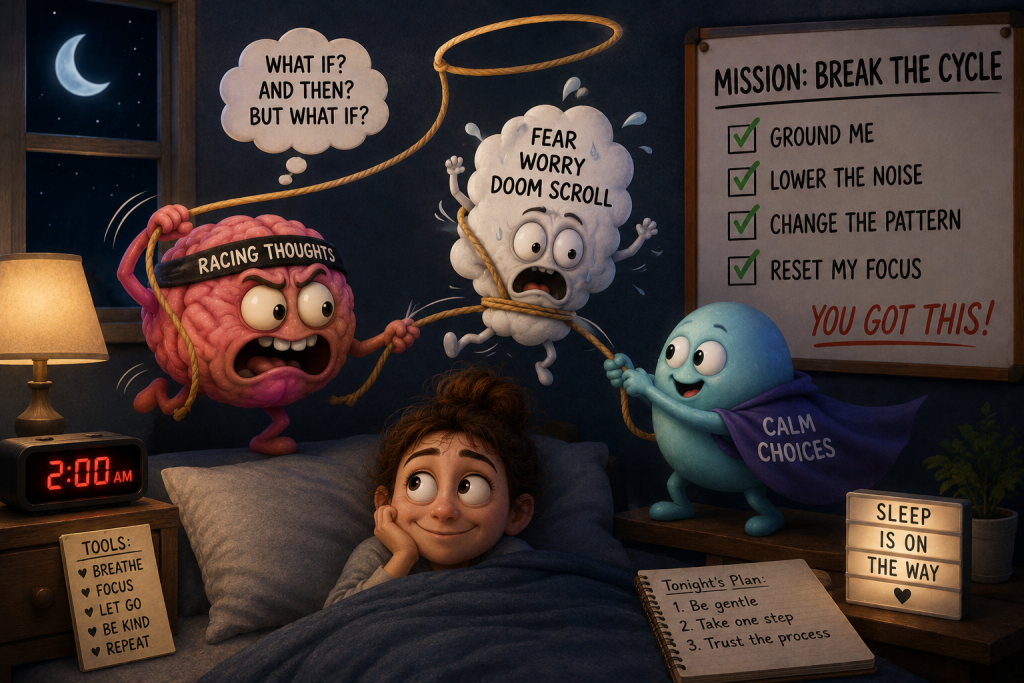
Breaking the Cycle
Breaking the nighttime anxiety cycle does not mean you suddenly become a perfect sleeper.
That would be nice, but let’s be real. If sleep were that easy, nobody would be lying in bed at 2AM negotiating with the ceiling fan.
Breaking the cycle means you stop feeding the pattern that keeps your brain and body on high alert.
That is the real goal.
When the Brain Gets Loudest, most people try to fight the noise. They argue with thoughts. They check the clock. They search symptoms. They force breathing exercises like they are trying to win a gold medal in relaxation. They get mad at themselves for not calming down fast enough.
But the anxious brain does not calm down well under attack.
It calms down when it feels safe.
This matters because nighttime anxiety is often a loop, not a one-time event. A thought shows up. The body reacts. The reaction scares you. The fear creates more thoughts. The thoughts make the body react again.
That loop can feel endless.
But it is not unbreakable.
You do not have to stop every thought. You do not have to feel calm instantly. You do not have to make your mind silent. The first goal is smaller than that.
You interrupt the loop.
You give the brain something else to do.
You lower the alarm in the body.
You stop treating every thought like an emergency.
The National Institute of Mental Health explains anxiety as something that can involve worry, fear, sleep problems, restlessness, and physical symptoms. That is important because nighttime anxiety is not just “bad thinking.” It can become a full mind-and-body pattern.
And patterns need practice.
Not shame.
Not panic.
Practice.
Think of it like teaching your brain a new bedtime habit. Right now, your brain may think bed means worry, scanning, checking, and replaying. You want to teach it that bed can mean safety, rest, and letting go.
That does not happen in one night. It happens through repeated small choices.
Here is the basic difference:
| Feeding the Cycle | Breaking the Cycle |
|---|---|
| Checking the clock again and again | Turning the clock away |
| Arguing with every thought | Naming the thought and letting it pass |
| Searching symptoms at night | Waiting until morning unless symptoms are urgent |
| Trying to force sleep | Resting the body without pressure |
| Doom-scrolling | Choosing low-stimulation calm |
| Saying “What is wrong with me?” | Saying “My system is alarmed, not broken.” |
Breaking the cycle starts when you stop adding fear to fear.
That sounds simple, but it is powerful.
Anxiety may still show up. Your brain may still toss a “what if” at you. Your body may still feel tense. But your response can change.
Instead of “Oh no, here we go again,” you can say:
“This is the loop. I know this pattern. I do not have to feed it.”
That one sentence creates distance.
Distance gives you a choice.
And choice is where the cycle begins to weaken.
Grounding Exercises
Grounding exercises help bring your attention back to the present moment.
That matters because anxiety usually pulls you away from now.
It drags you into tomorrow. It throws you into old memories. It makes you picture worst-case futures. It turns your bed into a mental time machine, except every destination is stressful and nobody packed snacks.
Grounding pulls you back.
Not with force.
With focus.
The goal is to remind your brain, “I am here. I am in this room. It is nighttime. I am not inside the fear story.”
One of the most common grounding tools is the 5-4-3-2-1 method. It uses your senses to slow the spiral. The University of Rochester Medical Center explains grounding with the 5-4-3-2-1 technique as a way to notice what you can see, feel, hear, smell, and taste.
At night, you can make it simple.
You do not need to turn on every light and inspect the room like a detective. You can do it quietly from bed.
Try this:
- Name 5 things you can see.
- Name 4 things you can feel.
- Name 3 things you can hear.
- Name 2 things you can smell.
- Name 1 thing you can taste.
If the room is dark, “see” can be simple. A shadow. The shape of a dresser. A line of light under the door. The ceiling. A pillow.
For “feel,” notice the blanket, the mattress, your shirt, your feet, your hands.
For “hear,” notice a fan, the heat kicking on, a car outside, your breathing, or the quiet itself.
The point is not to do it perfectly.
The point is to give your brain a job that is not panic.
An anxious mind wants to run ahead.
Grounding says, “Come back here.”
Here is a quick version you can use when your Brain Gets Loudest:
| Sense | Nighttime Example |
|---|---|
| See | The wall, blanket, window, door, lamp |
| Feel | Pillow, sheet, mattress, feet, hands |
| Hear | Fan, clock, traffic, breathing, quiet |
| Smell | Laundry, lotion, air, pillow, soap |
| Taste | Toothpaste, water, mint, tea, plain mouth |
Another grounding tool is pressure.
Not emotional pressure. Physical pressure.
You can press your feet into the mattress. You can gently press your hands together. You can hold a pillow to your chest. You can place a hand on your stomach and notice it rise and fall.
This gives your body a clear signal.
“I am here.”
It can also help when your thoughts feel floaty, fast, or unreal.
Some people like the phrase:
“Feet, sheets, room, now.”
It sounds almost too simple.
Good.
At 2AM, simple is your friend.
You do not need a ten-step plan when your brain is acting like a raccoon with a flashlight. You need something short enough to remember when you are tired.
Feet.
Sheets.
Room.
Now.
That is grounding.
You can also try object grounding.
Pick one object near your bed and describe it in your mind like you are explaining it to someone who has never seen it.
For example, a pillow.
“It is soft. It is rectangular. The case is cool. The edge has a seam. It is under my head. It is holding me up.”
That may sound boring.
That is the point.
Boring is bedtime gold.
Boring tells the brain nothing exciting is happening. Nothing needs to be solved right now. No emergency meeting is required.
Grounding is not meant to erase every feeling. It is meant to stop you from becoming the feeling.
There is a difference between:
“I am anxious.”
And:
“I am noticing anxiety in my body.”
The second one gives you space.
You are not the storm. You are the person noticing the storm.
That space may be small at first. But small space is still space.
Grounding also helps because anxiety often makes people scan their bodies in a fearful way. You may notice your heartbeat, breathing, stomach, or muscles and think, “What is wrong?”
Grounding moves attention outward and downward.
Out of the fear story.
Back into the room.
Back into the body in a calmer way.
If you use grounding and still feel anxious, that does not mean it failed. It means your nervous system may need more time. Keep the goal realistic.
The goal is not:
“I must feel calm right now.”
The goal is:
“I am practicing coming back.”
That is enough.
Reducing Mental Noise
Mental noise is the pileup of thoughts, worries, reminders, regrets, plans, fears, and random nonsense that shows up when you are trying to sleep.
It is your brain saying:
“Remember that bill?”
“Remember that awkward thing?”
“Remember tomorrow?”
“Remember your body exists?”
“Remember you once said something weird in 2014?”
Very helpful. Great timing.
Reducing mental noise does not mean making the mind empty. An empty mind is not a realistic goal for most people. The brain thinks. That is what it does.
The goal is to lower the volume.
You want fewer open loops.
An open loop is anything your brain thinks still needs attention. It could be a task, worry, idea, message, appointment, fear, or problem.
At night, open loops get louder because the brain has fewer distractions.
This is one reason journaling helps some people. Not fancy journaling. Not “Dear diary, today my soul became a moonbeam.” Just plain brain dumping.
The Sleep Foundation’s guide to sleep hygiene explains that bedtime routines and relaxing habits can support better sleep. A simple brain dump can be part of that routine because it gives your thoughts a place to go besides your pillow.
Try this before bed:
| Brain Dump Prompt | What to Write |
|---|---|
| What is on my mind? | List worries, tasks, reminders |
| What can wait until tomorrow? | Anything not urgent tonight |
| What is one next step? | Keep it small and realistic |
| What is not mine to solve tonight? | Other people’s moods, past mistakes, unknowns |
| What do I need to hear? | A calm sentence for yourself |
This is not about writing a masterpiece.
It can be messy.
It can have bad spelling.
It can look like a grocery list had a nervous breakdown.
That is fine.
The point is to get the noise out.
Your brain may keep repeating something because it is afraid you will forget. When you write it down, you give the brain proof that the thought has been saved.
You can say:
“This is written down. I do not have to keep holding it in my head.”
That can lower the pressure.
Another way to reduce mental noise is to create a “not tonight” list.
This is a list of things you are not allowed to solve from bed.
Examples:
- Money fears
- Life direction
- Relationship arguments
- Work problems
- Old regrets
- Health Googling
- Big decisions
- Tomorrow’s entire schedule
- Whether you are succeeding at life
You are not saying these things do not matter.
You are saying they do not belong in bed at 2AM.
That is a healthy boundary.
Some thoughts are daytime thoughts. They need light, food, movement, and a more awake brain.
Night thoughts often come with tired emotions and missing context.
So you can tell yourself:
“This may matter, but it does not need to be solved tonight.”
That sentence is honest and calming.
Reducing mental noise also means reducing outside noise that becomes inside noise.
Late-night scrolling is a big one.
A phone can feel like comfort, but it often feeds the brain more material. News, comments, emails, videos, messages, ads, and drama can all wake the mind back up.
Even “just one quick check” can become thirty minutes of feeding the alert system.
The NHS gives practical sleep advice that includes reducing screen use before bed and making time to relax. That is not boring advice. It is basic nervous system care.
Your brain cannot be fed chaos until 11:58PM and then be expected to turn into a sleepy little angel at midnight.
It needs a transition.
Here are simple ways to reduce mental noise before bed:
- Put tomorrow’s top three tasks on paper.
- Keep a notebook beside the bed.
- Set a “no problem-solving in bed” rule.
- Turn off bright screens earlier.
- Avoid intense news or arguments near bedtime.
- Use soft audio if silence makes thoughts louder.
- Keep the room cool, dark, and calm.
- Do the same short wind-down most nights.
Do not make the routine so perfect that it becomes another thing to fail at.
That is how anxiety sneaks in wearing pajamas.
Keep it doable.
A routine that is too hard will not last.
A simple one can.
For example:
- Wash up.
- Lower lights.
- Write worries down.
- Read two pages.
- Breathe slowly.
- Rest.
That is enough.
Reducing mental noise is not about becoming a monk on a mountaintop. It is about giving your tired brain fewer things to juggle in the dark.
If you want a deeper guide built around racing thoughts, fear of sleep, and practical bedtime tools, Quiet the Mind: Sleep Help for Anxiety covers this kind of nighttime overthinking in a calm, step-by-step way.
The goal is not silence.
The goal is less chaos.
And less chaos is a good start.
Interrupting the Spiral
Interrupting the spiral means catching the loop before it drags you all the way down.
You may not catch it at the first thought. That is okay.
Sometimes you catch it after ten thoughts.
Sometimes after thirty.
Sometimes after you have already planned three disasters, judged your whole life, and mentally moved to a cabin in the woods.
Still counts.
The moment you notice the spiral, you have a chance to change your next move.
That is the key.
You do not need to control the first thought.
You practice controlling the next response.
The spiral usually has a rhythm.
Thought.
Fear.
Body feeling.
More fear.
More thought.
More body checking.
More panic.
More pressure.
To interrupt it, you need to break one link in that chain.
Here are some ways to do that:
| Spiral Link | Interrupting Move |
|---|---|
| “What if?” thought | Say, “That is a fear question, not a fact.” |
| Clock-checking | Turn the clock away |
| Body scanning | Move attention to feet, blanket, room |
| Racing thoughts | Write one line: “Not solving this tonight.” |
| Panic breathing | Slow the exhale |
| Fear of no sleep | Say, “Rest still counts.” |
| Doom-scrolling | Put the phone out of reach |
The best interruption is usually boring, simple, and repeatable.
Not dramatic.
Not complicated.
Not a full personality overhaul at 2AM.
One small pattern break.
That is enough to begin.
A useful method is called labeling.
You label the thought instead of arguing with it.
For example:
- “That is catastrophic thinking.”
- “That is the anxiety loop.”
- “That is a fear spiral.”
- “That is a memory.”
- “That is a prediction.”
- “That is not a fact.”
- “That is my tired brain being loud.”
Labeling works because it creates distance.
You are not saying, “This terrible thing is true.”
You are saying, “I am having a thought about this terrible thing.”
Those are very different.
A quote from Viktor Frankl fits this idea well:
“Between stimulus and response there is a space. In that space is our power to choose our response.”
— commonly attributed to Viktor Frankl
That quote is often shared because it points to something important: the power is in the pause.
At night, anxiety wants you to react fast.
Check.
Panic.
Search.
Replay.
Fix.
Predict.
But you can pause.
Even for five seconds.
That pause gives you room to choose a calmer response.
Here is a simple 2AM spiral interrupter:
- Name it: “This is the anxiety spiral.”
- Ground it: “I am in my room. I am in bed. It is night.”
- Soften it: “This feels scary, but it is not automatically danger.”
- Redirect it: “Feet, sheets, room, now.”
- Repeat it: “I can rest even if sleep takes time.”
That may sound basic.
Good.
Your 2AM brain does not need a textbook. It needs a short script.
You can also use a “worry appointment.”
That means you tell your brain, “We will deal with this tomorrow at 10AM.”
Then actually write it down.
This helps because anxiety often fears being ignored. A worry appointment tells the brain the issue is not being thrown away. It is being moved to a better time.
Night is not a good time for most problem-solving.
Your brain is tired. Your emotions are louder. Your body may be tense. The world is dark. There is usually nothing useful you can do right then.
Morning gives you more tools.
Light.
Food.
Movement.
People.
Options.
Perspective.
So when a thought screams, “Solve this now,” you can answer:
“No. This gets daylight.”
That is a strong bedtime boundary.
Interrupting the spiral also means not believing every urgent feeling.
Anxiety loves urgency.
It says, “Figure this out right now.”
But not everything urgent is important.
Some urgency is just adrenaline.
Some urgency is just fear.
Some urgency is your nervous system trying to get certainty it cannot have.
The Mayo Clinic explains relaxation techniques as tools that can help lower stress by slowing breathing, lowering muscle tension, and calming the body. That matters because interrupting the spiral is not only mental. You often have to calm the body too.
Try pairing a thought label with a body action.
Example:
“This is a fear spiral.”
Then unclench your jaw.
“This is catastrophic thinking.”
Then breathe out slowly.
“This is my tired brain.”
Then press your feet into the mattress.
You are teaching the body and mind together.
Not danger.
Not emergency.
Not now.
Another way to interrupt the spiral is to use a boring redirect.
Pick one:
- Count backward from 300 by threes.
- Name animals from A to Z.
- Picture walking through a familiar grocery store.
- Imagine folding towels slowly.
- Listen to calm audio on low volume.
- Read a dull book in dim light.
- Repeat a simple phrase with each exhale.
The goal is not excitement.
The goal is to stop feeding fear.
A lot of people think they need the perfect technique. They do not.
They need a technique they will actually use.
The best tool is the one you can remember when you are tired, scared, and half-buried under a blanket.
If all you remember is “feet, sheets, room, now,” use that.
If all you remember is “rest still counts,” use that.
If all you remember is “not solving this tonight,” use that.
One calm sentence can be a pattern break.
And pattern breaks matter.
Because the more you interrupt the spiral, the more your brain learns that nighttime anxiety does not get to run the whole show.
It may still show up.
But it does not have to be handed the microphone.
The Brain Gets Loudest when fear has space, silence, and no pushback. Breaking the cycle means giving fear less fuel and giving your nervous system more safety.
Not once.
Not perfectly.
Again and again.
That is how nights change.
Not by force.
By practice.
Not by panic.
By repetition.
Not by trying to become someone who never worries.
By becoming someone who knows what to do when worry shows up.
That is enough to start breaking the cycle.
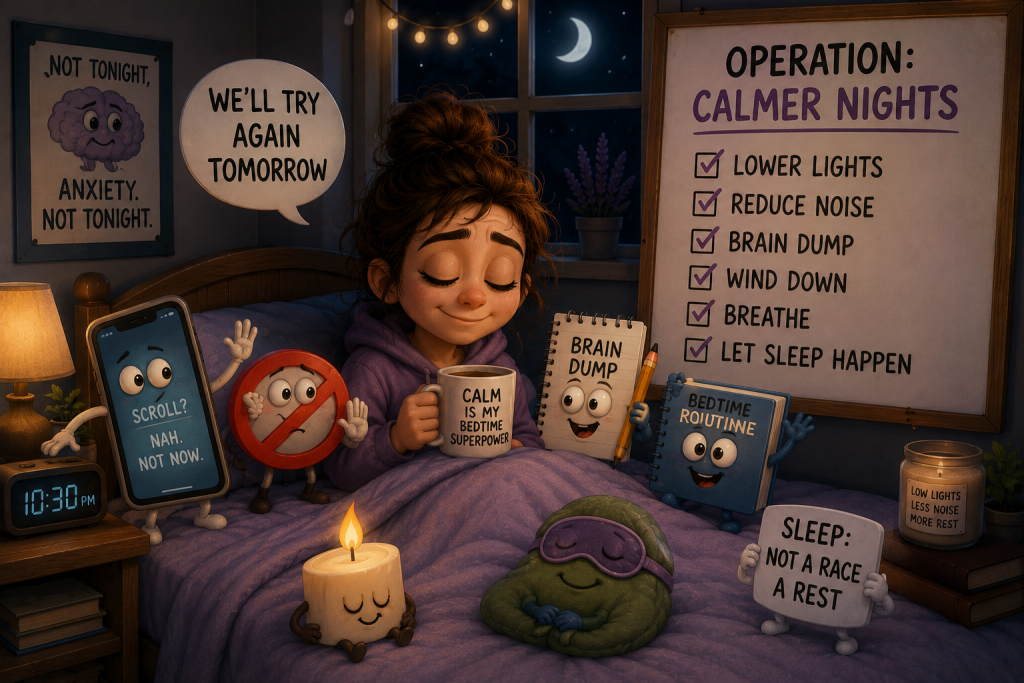
Creating a Calmer Nighttime Routine
A calmer nighttime routine is not about becoming a perfect sleep person.
Nobody needs a bedtime routine that feels like a second job.
You do not need silk pajamas, a $200 pillow, a lavender mist bottle named something like “Moon Peace,” and a personality that somehow enjoys folding fitted sheets.
A good nighttime routine is much simpler than that.
It is a set of small signals that tell your brain and body, “The day is ending. You are safe. You do not have to solve everything right now.”
That is the whole point.
When the Brain Gets Loudest at night, it is often because the mind did not get a clean ending to the day. The body may be in bed, but the brain is still at work. It is still replying to emails. Still replaying talks. Still worrying about bills. Still thinking about tomorrow. Still carrying the noise of the whole day into the dark.
So the goal of a nighttime routine is not to force sleep.
The goal is to create a bridge.
A bridge from busy to quiet.
From alert to calm.
From “I have to keep going” to “I can let go for now.”
The Sleep Foundation explains bedtime routines for adults as activities done in the same order each night, usually in the 30 to 60 minutes before bed. That does not mean the routine has to be complicated. In fact, simple is better because simple is easier to repeat.
And repeat is the key word.
Your brain learns from repeated signals.
If every night ends with scrolling, rushing, worrying, and collapsing into bed, your brain may learn that bedtime is stressful.
If every night ends with lower lights, fewer screens, a small brain dump, and a calm reset, your brain can slowly learn that bedtime is safe.
Not in one night.
Not perfectly.
But over time.
Here is the honest truth: a routine will not fix every sleep problem by itself. If you have long-term insomnia, trauma, panic attacks, medical symptoms, medication issues, pain, or severe anxiety, you may need more help than a routine can give.
But a calmer routine can still help create better conditions for sleep.
It can give your mind fewer reasons to race.
It can give your body fewer reasons to stay alert.
It can lower the noise before you ever put your head on the pillow.
A good routine should feel like a gentle landing, not a strict rulebook.
Here is a simple example:
| Time Before Bed | Calming Step | Why It Helps |
|---|---|---|
| 60 minutes | Lower lights and slow the room down | Tells the brain the day is winding down |
| 45 minutes | Put away stressful tasks | Reduces mental pressure |
| 30 minutes | Write down worries or tomorrow’s top tasks | Clears open loops |
| 20 minutes | Wash up, stretch, or breathe slowly | Helps the body shift down |
| 10 minutes | Read, listen to calm audio, or rest quietly | Gives the mind a softer place to land |
This is not a law.
It is a starting point.
Your real routine should fit your real life.
If you have kids, pets, work, pain, noise, a partner who thinks “quiet bedtime” means watching videos at full blast, or a brain that likes to start a podcast at midnight, your routine may need to be flexible.
That is okay.
The best routine is not the fanciest one.
It is the one you can actually do.
Limiting Stimulation
Limiting stimulation is one of the most useful things you can do before bed.
Not because you need to live like a monk.
Because your brain needs a chance to slow down.
Stimulation is anything that wakes the mind or body up. It can be bright screens, loud videos, heated conversations, intense news, stressful work, heavy meals, caffeine, alcohol, bright lights, or even trying to answer “one quick message” that turns into a full emotional event.
At night, stimulation is sneaky.
It often feels like relaxing.
You scroll because you want to unwind.
You watch videos because you want distraction.
You check email because you want tomorrow to feel less scary.
You read the news because you want to stay informed.
But your brain does not always experience those things as rest.
Sometimes it experiences them as more input.
More noise.
More emotion.
More problems.
More light.
More reasons to stay awake.
The CDC lists several habits that can support sleep, including keeping a regular sleep schedule, keeping the bedroom quiet and cool, turning off electronic devices before bed, avoiding caffeine later in the day, and avoiding large meals and alcohol before bedtime.
That is not exciting advice, but it is useful advice.
The body likes cues.
Light is a cue.
Noise is a cue.
Food is a cue.
Stress is a cue.
Phones are a cue.
When your brain gets a lot of “daytime cues” right before bed, it may not know that sleep is supposed to come next.
Screens are a big part of this for many people. The Sleep Foundation explains how electronics can affect sleep, including how device use before bed can be stimulating and may interfere with sleep for some people.
But let’s be fair.
Not all screen use feels the same.
Reading a calm article is not the same as watching breaking news. Listening to a boring sleep story is not the same as arguing with strangers in the comments. Watching a quiet cooking video is not the same as checking your bank account and then doom-scrolling the economy into your nervous system.
The problem is not only the screen.
It is what the screen brings into your head.
So instead of making a rule like “never use your phone at night,” make a better rule:
Do not feed your brain things it has to wrestle with before bed.
That means avoid:
- Angry comment sections
- Work emails
- Medical symptom searches
- Financial panic checks
- True crime right before sleep
- Arguments by text
- News rabbit holes
- Videos that keep auto-playing
- Anything that makes you say, “Just one more”
You know your own triggers.
Be honest about them.
If a certain app leaves your chest tight, it is not bedtime material.
If a certain topic makes your thoughts race, it is not bedtime material.
If a certain person’s messages make you feel like you need to draft a legal defense at 11:30PM, that can wait.
Here is a useful table:
| Bedtime Stimulation | Calmer Swap |
|---|---|
| Scrolling social media | Read a boring book |
| Checking work email | Write tomorrow’s task on paper |
| Watching intense shows | Listen to soft audio |
| Searching symptoms | Write the concern down for morning |
| Bright lights | Use warm, dim light |
| Heated texts | Reply tomorrow when calmer |
| Clock-checking | Turn the clock away |
Limiting stimulation does not mean removing all joy.
It means choosing things that do not wake up your alarm system.
A calmer night may include:
- Soft music
- A low-volume podcast
- Reading
- Stretching
- Warm shower
- Prayer or meditation
- Journaling
- Breathing
- Folding laundry slowly
- Sitting with dim light
- Petting the dog or cat
And yes, folding laundry can be calming if you do not turn it into a moral judgment about your whole life.
The key is to make the last part of your day less dramatic.
Your brain has enough drama already.
If your Brain Gets Loudest in the quiet, do not hand it extra material right before bed.
Give it less to chew on.
That alone can help.
Journaling and Brain Dumps
A brain dump is one of the simplest tools for nighttime anxiety.
It is not fancy journaling.
It is not poetry.
It is not something you need a leather notebook and a deep window stare for.
A brain dump is just taking what is spinning in your head and putting it somewhere else.
That somewhere else can be paper, a notes app, a planner, or a plain notebook. Paper is often best at night because it does not come with notifications, ads, and the temptation to suddenly research the lifespan of sea turtles at 1AM.
A brain dump works because the anxious mind hates open loops.
An open loop is anything unfinished. A task. A worry. A reminder. A bill. A conversation. A fear. A plan. A regret. An idea.
During the day, open loops hide under activity.
At night, they come out wearing tap shoes.
Your brain may repeat the same thought because it does not trust you to remember it tomorrow. So it keeps bringing it back.
“Don’t forget that appointment.”
“Don’t forget that bill.”
“Don’t forget that weird text.”
“Don’t forget that life might be falling apart.”
Thanks, brain.
A brain dump tells the mind, “It is saved. You do not have to hold it all night.”
The NHS sleep advice suggests building time to relax before bed and using calmer activities such as reading, soft music, podcasts, or sleep meditation. For many people, journaling fits into that same wind-down space because it helps move thoughts out of the mind before sleep.
Here is a simple brain dump format:
| Prompt | What to Write |
|---|---|
| What is bothering me? | Write the worry without judging it |
| What can I do tonight? | Only list something truly useful and small |
| What must wait? | Put tomorrow problems in tomorrow’s box |
| What is one next step? | Choose one tiny action for the next day |
| What do I need to hear? | Write one calm sentence to yourself |
Example:
| Worry | Can I Solve It Tonight? | Next Step |
|---|---|---|
| I forgot to call someone back | No | Call after lunch tomorrow |
| I am worried about money | No | Check account at 10AM |
| I feel tense | Yes | Stretch and breathe for five minutes |
| I am scared I will not sleep | Not by force | Rest my body and stop checking the clock |
That last row matters.
You cannot solve sleep by wrestling it.
You can only create better conditions.
Brain dumping is one of those conditions.
A good brain dump should be short. Five to ten minutes is enough. If you turn it into a three-hour emotional excavation, you may wake yourself up more.
Keep it plain.
Messy is allowed.
Bad spelling is allowed.
Half sentences are allowed.
The goal is not to write well.
The goal is to unload.
Here are a few brain dump lines you can copy:
- “What my brain keeps repeating is…”
- “What I cannot solve tonight is…”
- “What can wait until morning is…”
- “The next small step is…”
- “The truth I need right now is…”
- “I am allowed to rest before this is fixed.”
That last sentence is important.
Many people believe they can only rest once life is handled.
But life is rarely fully handled.
There is always another bill, message, chore, worry, idea, health concern, family issue, or future problem.
If you wait until every loose end is tied before resting, you will never rest.
So the bedtime boundary becomes:
“I do not need everything fixed before I let my body rest.”
That is not giving up.
That is being human.
Brain dumps also help with tomorrow anxiety.
If your brain keeps worrying about the next day, write down the top three things that actually matter.
Not twenty-seven things.
Three.
For example:
- Pay the bill.
- Reply to the email.
- Start the laundry.
That is enough.
A tired brain needs a short list.
Long lists can become threats.
Short lists become handles.
You can also make a “parking lot” page. This is where you put thoughts that are not urgent but keep showing up.
Book idea.
House project.
Random memory.
Something to buy.
A question to ask.
A worry to revisit.
Once it is parked, you can leave it there.
If it returns at 2AM, tell your brain:
“That is already written down.”
This works best when you keep the notebook near the bed.
That way, if a thought shows up after lights out, you can write one line without fully waking up.
Do not turn on bright lights.
Do not open your phone and accidentally fall into the internet basement.
Just write the line.
Then return to rest.
Brain dumping is not about making every thought disappear.
It is about making thoughts less sticky.
And when thoughts are less sticky, sleep has more room.
Preparing the Mind for Rest
Preparing the mind for rest is different from trying to force the mind to shut up.
That difference matters.
A lot of people go to bed and silently yell at their brain:
“Stop thinking.”
“Relax.”
“Sleep now.”
“Do not think about tomorrow.”
“Do not think about sleep.”
“Do not think about not thinking.”
And of course, the brain responds by thinking harder.
That is how brains work.
If someone says, “Do not think of a purple elephant,” now your brain is hosting a purple elephant in a tiny hat.
So instead of ordering the mind to stop, prepare it to slow.
A nighttime routine is really a slowing-down practice.
It gives the brain a rhythm.
The rhythm says:
The day is done.
Problems can wait.
The room is safe.
The body can rest.
Sleep can come when it comes.
The Mayo Clinic’s sleep tips include sticking to a sleep schedule, watching food and drink before bed, creating a restful environment, limiting naps, getting physical activity, and managing worries. These are not magic tricks. They are ways to support the body’s natural sleep system.
Managing worries is a big one.
Because if your brain thinks bedtime is the first quiet moment of the day, it may use that time to dump everything on you.
So give worry a place before bed.
Not in bed.
Before bed.
That small timing change can help.
A calmer routine might look like this:
| Step | What It Tells the Brain |
|---|---|
| Dim lights | Night is coming |
| Put away stressful tasks | Work is done for now |
| Write worries down | Nothing needs to be held all night |
| Wash up slowly | The body is shifting into rest |
| Stretch or breathe | The nervous system can soften |
| Read or listen calmly | The mind can land somewhere quiet |
| Rest without pressure | Sleep is allowed, not forced |
The words you use at night also matter.
Your brain is listening.
If you say, “I better sleep or tomorrow is ruined,” your body hears threat.
If you say, “I am giving myself a chance to rest,” your body hears safety.
Same night.
Different message.
Here are calmer phrases to use:
- “I do not need to solve my life tonight.”
- “Rest still helps.”
- “My body knows how to sleep.”
- “A thought is not an emergency.”
- “Tomorrow gets tomorrow’s energy.”
- “I am safe enough to soften.”
- “Sleep can come without being chased.”
That last one is key.
Sleep does not like being chased.
It likes being invited.
Preparing the mind for rest also means having a plan for the thoughts that show up.
Because they will.
A calmer routine does not mean you never have thoughts. It means you know what to do when they arrive.
Try this:
- If a task appears, write it down.
- If a fear appears, label it.
- If a memory appears, say, “That is a memory.”
- If a body sensation appears, breathe and give it time.
- If sleep pressure appears, say, “Rest is enough for now.”
- If tomorrow appears, say, “Tomorrow gets daylight.”
This is simple, but it keeps you from getting dragged.
When the Brain Gets Loudest, it wants you to follow every thought.
You do not have to.
You can notice, name, and return.
Again and again.
That is the practice.
A quote from Marcus Aurelius fits here:
“You have power over your mind — not outside events. Realize this, and you will find strength.”
— Marcus Aurelius, Meditations
That does not mean you can control every thought that appears.
You cannot.
It means you can practice your response.
That is where strength grows.
Not from having a silent mind.
From having a loud mind and still choosing calm actions.
Preparing the mind also means preparing the room.
Your bedroom does not have to look like a magazine. But it should help your body get the message.
The CDC notes that a good sleep environment should be quiet, relaxing, and cool. Small changes can help, like lowering light, reducing noise, cooling the room, and keeping the bed connected with sleep as much as possible.
Try asking:
- Is the room too bright?
- Is the room too warm?
- Is the phone too close?
- Is the clock visible?
- Is the bed being used for worry?
- Is there something small I can change tonight?
Do not turn this into another perfection project.
Just pick one change.
Turn the clock away.
Move the phone farther.
Lower the lights.
Keep a notebook nearby.
Put on soft audio.
Make the room cooler.
One change is enough to start.
A calmer routine works best when it feels kind.
Not strict.
Not scary.
Not like a punishment for having anxiety.
Kind.
Because the anxious brain is already on edge. It does not need a drill sergeant. It needs a steady guide.
If you want a fuller walk-through for bedtime anxiety, racing thoughts, and learning how to quiet the mind at night, Quiet the Mind: Sleep Help for Anxiety was created around this exact struggle.
A calming routine is not about controlling the whole night.
It is about making the first step softer.
And sometimes a softer first step changes everything.
You lower the lights.
You write the worry down.
You stop feeding the noise.
You tell your brain tomorrow can wait.
You let the body rest.
Sleep may come fast.
It may take time.
But either way, you are no longer treating the night like a fight.
You are treating it like a place to return to yourself.
That is how calmer nights are built.
Not by force.
By rhythm.
Not by panic.
By practice.
Not by perfection.
By small signals, repeated often enough that your brain finally starts to believe them.
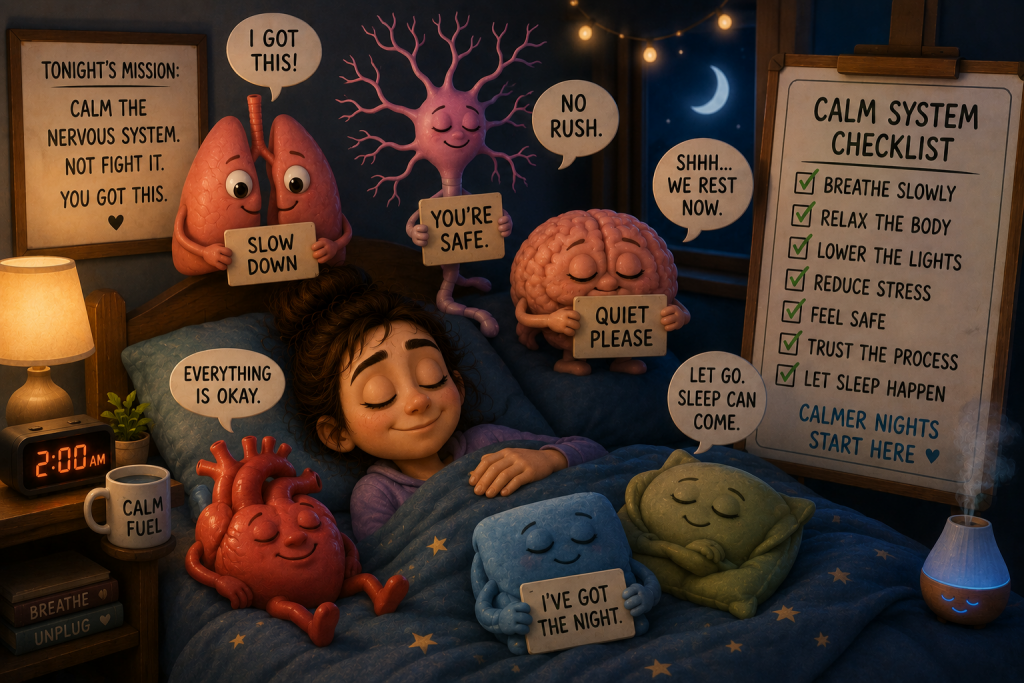
Learning to Calm the Nervous System
Learning to calm the nervous system is not about becoming emotionless.
It is not about turning into some floating bedtime monk who never worries, never gets annoyed, never checks the clock, and somehow falls asleep after three calm breaths.
That sounds nice, but most of us are not built like that.
Most of us are more like, “I breathed twice and now I’m wondering if I’m breathing correctly.”
That is normal.
Calming the nervous system means teaching your body that it does not have to stay on guard all night. It means giving your brain and body repeated proof that the bed is safe, the dark is safe, rest is safe, and every thought does not need a full emergency meeting.
When the Brain Gets Loudest, the nervous system is often part of the reason. The mind may be racing, but the body is reacting too. Muscles tighten. Breathing changes. The heart may beat harder. The stomach may feel off. The skin may feel warm. Your body may act like you need to run, fix, fight, check, or escape.
But you are in bed.
That mismatch is what makes nighttime anxiety feel so awful.
Your body is tired, but your nervous system is alert.
Your mind wants sleep, but your body is acting like something is wrong.
Your room is quiet, but your inner alarm is loud.
The nervous system is the body’s communication network. It helps manage things like breathing, heart rate, movement, digestion, stress response, and rest. When stress is high, the body can shift into a more alert state. When safety is felt, the body can move toward rest.
That does not mean you can snap your fingers and calm down.
If only.
The body does not always believe words right away. You may say, “I am safe,” but your body may answer, “Are we sure? Because I have a whole spreadsheet of reasons to panic.”
So calming the nervous system takes practice.
Small practice.
Gentle practice.
Repeated practice.
The Cleveland Clinic explains deep breathing as a tool that can help lower stress and support relaxation. That is useful because breathing is one of the few body functions that happens automatically, but can also be guided on purpose.
That gives you a doorway.
You may not be able to stop every thought.
You may not be able to force sleep.
You may not be able to command your heart to slow down.
But you can take one slower breath.
Then another.
And that can start sending a different message.
Here is the big idea:
| Alert Nervous System | Calmer Nervous System |
|---|---|
| Fast thoughts | Slower focus |
| Tight muscles | Softer body |
| Shallow breathing | Longer exhale |
| Clock-checking | Resting without watching time |
| Fear of symptoms | Gentle body awareness |
| “I must sleep now” | “I can rest now” |
The goal is not to become perfectly calm.
The goal is to become less afraid of feeling activated.
That matters because fear of anxiety often becomes part of the anxiety.
You feel anxious.
Then you fear the anxiety.
Then the fear makes the anxiety stronger.
Then your brain says, “See? This is bad.”
That is how the loop grows.
Calming the nervous system is how you stop adding more alarm to the alarm.
It is not a magic trick.
It is a training process.
Breathing Techniques
Breathing sounds too simple until you realize how often anxiety changes it.
When you are anxious, your breathing may become faster, higher, shorter, or tighter. You may breathe more from your chest than your belly. You may hold your breath without noticing. You may sigh a lot. You may feel like you cannot get a full breath.
Then you notice that.
Then you worry about it.
Then breathing becomes another thing your brain wants to monitor.
That is when people can get stuck.
Breathing, something the body has done since birth, suddenly feels like a project.
At night, this can feel especially scary. The room is quiet, your body is still, and every breath feels noticeable. You may start asking:
- Am I breathing right?
- Why does my chest feel tight?
- Am I getting enough air?
- Why do I keep sighing?
- What if I panic?
- What if this keeps me awake all night?
That is why breathing tools need to be gentle.
Do not turn breathing into a test.
Do not try to “perfect” it.
Do not lie there grading every inhale like a sleep coach with a clipboard.
The goal is not perfect breathing.
The goal is safer breathing.
A simple breathing method is longer-exhale breathing.
This means your out-breath is longer than your in-breath. For many people, the longer exhale can feel calming because it helps slow the body down.
Try this:
- Breathe in through your nose for 3 seconds.
- Breathe out slowly for 5 or 6 seconds.
- Pause gently if that feels okay.
- Repeat for a few minutes.
Do not force the breath.
Do not take huge dramatic breaths like you are about to blow up an air mattress.
Keep it soft.
Quiet.
Easy.
If 3 and 6 feels too long, use 2 and 4.
If counting makes you more anxious, skip the numbers and simply make the exhale a little longer than the inhale.
The University of Michigan Health page on breathing exercises explains several breathing methods, including belly breathing and pursed-lip breathing, that may help people relax and manage stress.
Belly breathing can be helpful at night because it gives your attention a calmer place to land.
Try this:
- Put one hand on your chest.
- Put one hand on your belly.
- Let the belly hand rise gently as you breathe in.
- Let it fall as you breathe out.
- Keep your shoulders loose.
Again, no forcing.
If your chest moves too, that is fine. You are not failing.
Anxiety loves to turn every tool into a pass-fail test.
Do not let it.
Another option is box breathing.
Box breathing uses an even pattern.
Example:
| Step | Count |
|---|---|
| Breathe in | 4 |
| Hold gently | 4 |
| Breathe out | 4 |
| Hold gently | 4 |
Some people love box breathing. Some people do not like holding their breath. If breath-holding makes you uncomfortable or more anxious, do not use it. Choose a softer method.
The best breathing technique is the one that helps you feel safer.
Not the one that looks best on paper.
Here is a quick comparison:
| Technique | Best For | Keep in Mind |
|---|---|---|
| Longer exhale | Racing thoughts, body tension | Keep the exhale soft |
| Belly breathing | Grounding attention | Do not force the belly |
| Box breathing | Structured focus | Skip holds if they feel bad |
| Pursed-lip breathing | Slowing the breath | Keep it gentle |
| Simple sigh | Releasing tension | Do not overdo it |
You can also use a simple phrase with breathing.
On the inhale, think:
“I am here.”
On the exhale, think:
“I can soften.”
Or:
Inhale: “Not danger.”
Exhale: “Just anxiety.”
Or:
Inhale: “I do not need to force this.”
Exhale: “Rest is enough.”
This gives the brain something calm to hold.
When the Brain Gets Loudest, it often needs a simple anchor. Breathing can be that anchor.
Not because breathing fixes everything.
Because breathing gives you a next step that is smaller than panic.
A useful reminder is:
“A calm breath is not meant to erase the night. It is meant to help me meet the night differently.”
That is the right size for the tool.
You do not need one breath to save the whole evening.
You just need one breath to interrupt the alarm.
Then another.
Then another.
Relaxing the Body
Relaxing the body at night can be harder than it sounds.
People say, “Just relax,” like your body has a button on the side.
It does not.
If it did, most of us would have worn that button out years ago.
The body often holds the day long after the day is over. You may not notice it while you are busy, but when you lie down, the tension speaks up.
Your jaw is tight.
Your shoulders are high.
Your hands are clenched.
Your stomach is pulled in.
Your legs are stiff.
Your forehead is working overtime for no reason.
Sometimes you may be lying in bed like you are preparing to defend yourself in court.
That is not rest.
That is bracing.
Bracing is when the body holds tension as if something is coming. It is common with stress and anxiety. The body may be trying to protect you, even when you are safe.
The Mayo Clinic explains relaxation techniques as methods that can help reduce stress by slowing heart rate, lowering blood pressure, slowing breathing, improving digestion, and reducing muscle tension.
One of the most useful body relaxation tools is progressive muscle relaxation.
That simply means you tense and release different muscles.
It helps because many people do not know what relaxed feels like anymore. Tensing first can make the release easier to notice.
Try this slowly:
| Body Area | What to Do |
|---|---|
| Feet | Curl toes gently, then release |
| Calves | Tighten legs lightly, then release |
| Thighs | Press legs down, then release |
| Hands | Make soft fists, then release |
| Arms | Tighten arms gently, then release |
| Shoulders | Lift toward ears, then drop |
| Jaw | Clench softly, then let go |
| Face | Squeeze eyes lightly, then soften |
Do not strain.
Do not push through pain.
Do not make it intense.
This is not a workout. Nobody is trying to get bedtime gains.
The point is to show the body, “We can let go now.”
You can also scan your body without tensing.
Start at your feet and slowly move upward.
Ask:
- Can my toes soften?
- Can my ankles soften?
- Can my calves soften?
- Can my knees soften?
- Can my stomach loosen?
- Can my shoulders drop?
- Can my jaw unclench?
- Can my face rest?
This is not a command.
It is an invitation.
That matters because the body does not always respond well to force.
Instead of saying, “Relax now,” try:
“Can this soften by one percent?”
One percent is enough.
A tiny release is still a release.
Here is the kind of body language that helps at night:
| Tense Body Message | Calmer Body Message |
|---|---|
| Jaw tight | Let the tongue rest |
| Shoulders raised | Let them drop toward the bed |
| Hands clenched | Open the fingers |
| Chest tight | Slow the exhale |
| Stomach clenched | Let the belly be soft |
| Legs restless | Press feet down, then release |
A warm shower or bath may also help some people. The body cools after warmth, and that cooling can support sleepiness for some. The Sleep Foundation discusses showering before bed and explains that timing and temperature may matter, with a warm shower or bath before bed helping some people relax.
Stretching can help too, but keep it gentle.
Bedtime is not the moment to attempt a yoga pose that requires a waiver.
Think simple:
- Neck rolls
- Shoulder rolls
- Gentle forward fold
- Calf stretch
- Child’s pose
- Light back stretch
- Hands over belly breathing
The goal is to tell the body, “The day is ending.”
Not, “Let’s start a new fitness journey at 11:47PM.”
Relaxing the body also means reducing the habit of checking the body.
This can be hard.
If you are anxious, you may scan for symptoms. Heartbeat. Breathing. Chest. Stomach. Neck. Head. Legs. Skin. Temperature. Everything.
The more you scan, the louder the body becomes.
That does not mean symptoms are fake. It means attention can turn up the volume.
A better approach is gentle awareness.
Fearful scanning asks:
“What is wrong?”
Gentle awareness asks:
“What needs softening?”
That change matters.
If your heart is racing, place a hand on your chest and breathe out slowly.
If your jaw is tight, let it loosen.
If your legs are restless, press them into the bed and release.
If your stomach is tight, place a hand there and let it be warm.
You are not hunting for danger.
You are offering safety.
That is a very different message.
A real quote from Seneca fits this whole struggle:
“We suffer more often in imagination than in reality.”
— Seneca
At night, the body can react to imagined danger as if it is real danger. The feeling is real, but the story may not be.
Relaxing the body helps you return to what is actually happening.
You are in bed.
You are breathing.
The room is quiet.
The body is tense, but it can soften.
The mind is loud, but it does not have to lead.
And if relaxation does not work right away, do not turn that into another problem.
Sometimes the body takes time.
Let that be okay.
The goal is not instant sleep.
The goal is teaching safety.
Creating Safe Sleep Habits
Safe sleep habits are not just about sleep rules.
They are about trust.
Your brain needs to trust that bedtime is not a trap. Your body needs to trust that the bed is not where you fight thoughts all night. Your nervous system needs to trust that darkness does not mean danger.
That trust is built through habit.
Small habit.
Repeated habit.
Kind habit.
This is why sleep hygiene matters, but it needs to be explained in a human way. Sleep hygiene is not about being perfect. It is about building habits that support sleep instead of fighting it.
The Sleep Foundation’s sleep hygiene guide explains that sleep hygiene includes both bedroom environment and daily routines that promote consistent, quality sleep.
That includes things like:
- Keeping a steady sleep schedule
- Getting light during the day
- Moving your body
- Limiting caffeine later in the day
- Creating a restful room
- Reducing screens before bed
- Building a wind-down routine
But let’s be honest.
If you are anxious at night, advice like “just have better sleep hygiene” can feel annoying.
Because you may already be trying.
You may be doing all the “right” things and still lying awake with a brain that sounds like a group chat nobody muted.
That does not mean habits are useless.
It means habits are part of the answer, not the whole answer.
Safe sleep habits are less about controlling sleep and more about creating steady cues.
Your body loves cues.
Same wake time.
Morning light.
Lower lights at night.
Cool room.
Less noise.
Less stress before bed.
Same wind-down.
Bed used mostly for sleep.
These cues say, “This is the rhythm.”
And rhythm helps the nervous system.
Here is a simple safe sleep habit table:
| Habit | Why It Helps |
|---|---|
| Wake up around the same time | Helps set the body clock |
| Get daylight earlier in the day | Supports natural sleep timing |
| Limit caffeine later | Reduces late alertness |
| Lower lights at night | Signals the body to wind down |
| Keep the room cool | Supports comfort and sleep |
| Turn the clock away | Reduces sleep pressure |
| Keep phone away from bed | Lowers stimulation and checking |
| Use a worry notebook | Moves thoughts out of the mind |
The CDC gives adult sleep tips that include consistent sleep and wake times, a quiet and cool room, turning off electronics before bed, avoiding large meals and alcohol before bedtime, avoiding caffeine later in the day, and being physically active during the day.
These are plain habits, but plain habits work best when repeated.
Do not try to change everything at once.
That is how people create a sleep routine so strict it becomes another source of anxiety.
Pick one or two.
Maybe this week you turn the clock away.
Maybe next week you move the phone farther from the bed.
Maybe you start writing tomorrow’s top three tasks before bed.
Maybe you lower lights thirty minutes earlier.
Maybe you stop searching symptoms after 9PM.
Small is better than dramatic.
Dramatic burns out.
Small repeats.
Here is a gentle habit-building plan:
| Week | Small Change |
|---|---|
| Week 1 | Turn the clock away and stop checking time |
| Week 2 | Write down worries before bed |
| Week 3 | Lower lights 30 minutes before sleep |
| Week 4 | Move phone away from bed |
| Week 5 | Add 5 minutes of breathing or stretching |
| Week 6 | Keep the same wake time most days |
You can adjust this.
Life is messy.
The point is to build a sleep environment that feels less like a battle zone.
Safe sleep habits also include what you say to yourself.
Your words become part of the room.
If every night includes, “Here we go again,” the brain hears threat.
If every night includes, “I can rest even if sleep takes time,” the brain hears safety.
Try these safe sleep statements:
- “The bed is not a battlefield.”
- “I can be awake without panicking.”
- “Rest still counts.”
- “My body knows how to sleep.”
- “I do not need to solve tomorrow tonight.”
- “Thoughts can pass without being followed.”
- “Tonight only needs to be softer, not perfect.”
That last one is worth keeping.
Softer, not perfect.
Safe sleep habits do not promise perfect sleep.
They help create a safer pattern.
That is enough.
If sleep anxiety keeps showing up, a practical guide like Quiet the Mind: Sleep Help for Anxiety can help turn these ideas into a calmer plan for nights when thoughts, body symptoms, and sleep pressure all show up at once.
Another safe habit is having a plan for waking up.
Many people only plan how to fall asleep. But if they wake up at 2AM, panic takes over.
Make the plan before the panic.
Example:
- I will not check the time.
- I will not grab my phone.
- I will take five slow breaths.
- I will remind myself, “This is a wake-up, not an emergency.”
- I will rest my body.
- If I stay awake and get upset, I will get up briefly and do something boring in dim light.
That plan gives your brain a path.
No path means panic makes one.
And panic is not a great travel agent.
The Brain Gets Loudest when the night feels uncertain, unsafe, and out of control. Safe sleep habits give the brain a rhythm it can learn.
Not control.
Rhythm.
Not perfection.
Practice.
Not a forced shutdown.
A safe landing.
That is how the nervous system starts to believe bedtime is not danger.
It learns through your repeated calm actions.
It learns when you stop checking the clock.
It learns when you stop fighting every thought.
It learns when you keep the room calmer.
It learns when you breathe instead of panic.
It learns when you rest even before sleep comes.
And slowly, the night can begin to feel less like a threat and more like a place to recover.
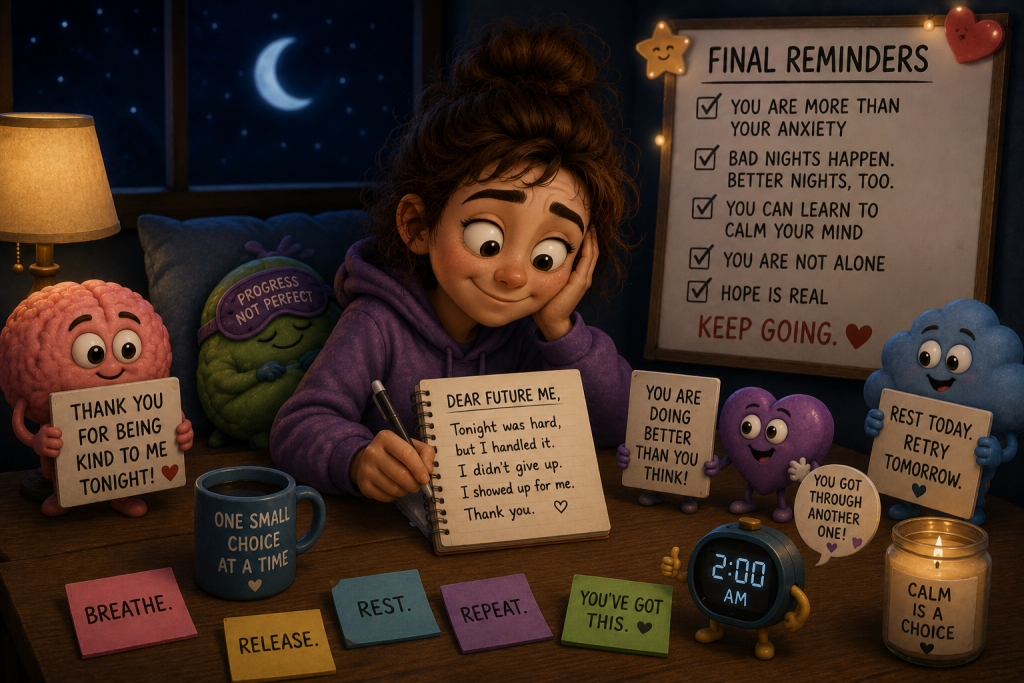
Final Thoughts
Nighttime anxiety has a way of making everything feel bigger than it is.
A thought that seems small at noon can feel massive at 2AM. A worry that feels manageable during the day can feel like a warning in the dark. A body feeling that would normally pass can become something your brain wants to study, fear, and review like it is preparing for a final exam.
That is why this whole topic matters.
When your Brain Gets Loudest, it can feel like your mind is telling the truth because it is speaking so loudly. But loud is not the same as true. Fast is not the same as wise. Scary is not the same as dangerous.
Sometimes your brain is not warning you.
Sometimes it is tired.
Sometimes it is stressed.
Sometimes it is replaying the day because it finally has quiet.
Sometimes it is trying to protect you, but doing it in the worst possible way, like a smoke alarm going off because you made toast.
Nighttime anxiety can feel lonely, but it is not rare. Many people struggle with racing thoughts, fear of sleep, body symptoms, and the heavy quiet that shows up when the day finally ends.
You are not strange for feeling this.
You are not weak because your mind races.
You are not broken because sleep sometimes feels hard.
You are a person with a brain and body that may need to relearn safety at night.
That is the heart of it.
A calmer night is not built by force. It is built by small repeated signals.
You lower the lights.
You write the worry down.
You breathe out slowly.
You stop checking the clock.
You remind yourself that rest still counts.
You let tomorrow wait until tomorrow.
You stop treating every thought like it deserves a meeting.
And little by little, the night can become less of a battle.
Here is the simple truth this whole post comes back to:
| Nighttime Fear Says | Calmer Truth Says |
|---|---|
| “This thought must mean something.” | “This is a thought, not proof.” |
| “I have to sleep right now.” | “I can rest while sleep comes.” |
| “Something is wrong with me.” | “My nervous system is alarmed, not broken.” |
| “Tomorrow is ruined.” | “Tomorrow may be harder, but I can handle it one step at a time.” |
| “This will never change.” | “My brain can learn calmer patterns.” |
That last one matters.
Your brain can learn.
Your body can learn.
Your nights can change.
Maybe not all at once. Maybe not perfectly. Maybe not every single night. But change does not have to be dramatic to be real.
Sometimes progress is one less clock check.
Sometimes it is one calmer breath.
Sometimes it is getting out of a spiral five minutes sooner than last time.
Sometimes it is saying, “This is anxiety,” instead of “This is who I am.”
That counts.
Your Thoughts Are Not Always Reality
Thoughts can feel real.
That is what makes anxiety so convincing.
At night, a thought can show up with a full dramatic soundtrack. It does not whisper. It storms in and acts like it has evidence.
“What if you do not sleep?”
“What if tomorrow goes badly?”
“What if that body feeling means something?”
“What if you never feel normal again?”
“What if you are falling behind?”
“What if everyone else has life figured out and you are the only one lying in bed arguing with your own brain?”
That is how nighttime anxiety talks.
It uses fear, speed, and pressure.
But a thought is not reality just because it feels strong.
A thought is a mental event. It is something your brain produces. Some thoughts are useful. Some are random. Some are old. Some are scared. Some are just noise.
The problem begins when you treat every thought like a fact.
If your brain says, “Tomorrow will be awful,” that is not a fact. That is a prediction.
If your brain says, “I will never sleep again,” that is not a fact. That is fear.
If your brain says, “Something is wrong with me,” that is not a diagnosis. That is a scared story.
The mind can make stories feel very real, especially when the body is tired and tense.
This is why it helps to separate facts from fear.
| Thought | Is It a Fact or Fear? | Calmer Response |
|---|---|---|
| “I am awake right now.” | Fact | “This is uncomfortable, but not an emergency.” |
| “I will be awake all night.” | Fear/prediction | “I do not know that. I can rest now.” |
| “My heart is beating fast.” | Fact | “My body may be anxious. I can slow my breathing.” |
| “Something terrible is happening.” | Fear/story | “I need facts, not panic.” |
| “Tomorrow is ruined.” | Fear/prediction | “Tomorrow gets handled tomorrow.” |
This is not about pretending nothing matters.
It is about not letting anxiety write the whole story.
One bad thought does not define you.
One bad night does not define you.
One anxious feeling does not define the truth.
A real quote from Epictetus fits this well:
“Men are disturbed not by things, but by the views which they take of things.”
— Epictetus, Enchiridion
That quote is old, but it still lands. The event and the story are not always the same.
The event may be: “I woke up at 2AM.”
The story may be: “This is terrible. I will never sleep. Tomorrow is ruined. I cannot handle this.”
The event is hard.
The story makes it heavier.
That does not mean you blame yourself. Anxiety stories often show up fast. You may not choose the first thought. But you can practice how you respond to it.
A helpful phrase is:
“This is a thought, not a command.”
Another is:
“This feels real because I am anxious and tired.”
And another:
“I can wait until morning before I believe this.”
That last one is powerful because nighttime thoughts often need daylight.
At night, your mind has less context. You may be tired, alone, tense, and half-awake. Your body may be reacting. Your brain may be scanning. The quiet may make everything feel louder.
Morning brings more balance.
Light helps.
Food helps.
Movement helps.
Talking helps.
Time helps.
So when a thought feels too real at 2AM, do not sign a contract with it.
Let it pass through.
Write it down if needed.
Tell it, “We can look at this in the morning.”
Most thoughts do not need to be solved from bed.
Especially the ones that show up wearing panic boots.
If your thought is about harming yourself or someone else, or you feel unsafe, that is different. That needs real support right away. But for the usual nighttime anxiety thoughts — the fear loops, sleep pressure, body scanning, and life review — most of them are not emergencies.
They are noise.
Loud noise, yes.
But still noise.
The more you practice seeing thoughts as thoughts, the less power they have.
They may still come.
But they do not get to run the night.
You Are Not Broken
If you have spent enough nights fighting your own mind, it is easy to start thinking something is wrong with you.
You may look at other people and imagine they just close their eyes and drift off like peaceful little phone commercials.
Maybe some do.
Good for them.
The rest of us are over here at 2AM wondering why our brain suddenly wants to review every choice since middle school.
You are not broken because sleep gets hard.
You are not broken because your mind races.
You are not broken because anxiety shows up in your body.
You are not broken because you need tools, routines, help, or time.
You are human.
And humans are not machines. We do not power down on command. We carry stress. We absorb noise. We hold fear. We replay pain. We worry about people we love. We worry about money, health, work, aging, mistakes, and whether we are doing enough.
Then night comes, and the noise finally catches up.
That is not brokenness.
That is overload.
There is a difference.
The National Institute of Mental Health explains anxiety disorders as conditions that can affect thoughts, feelings, sleep, and the body. That means anxiety is not a personal failure. It is something many people deal with, and help is real.
The Mayo Clinic also explains insomnia as a sleep problem that can include trouble falling asleep, staying asleep, waking too early, and not feeling rested. It can be linked with stress, anxiety, health issues, habits, and other factors.
That matters because it removes shame.
A hard night is not proof that you failed.
It may be a signal that your mind and body need more care, more support, or better patterns.
That is not weakness.
That is information.
Here is a better way to think about it:
| Shame Says | Truth Says |
|---|---|
| “I should be over this.” | “My nervous system may need practice.” |
| “Everyone else handles life better.” | “Many people struggle quietly.” |
| “I am broken.” | “I am overwhelmed, not broken.” |
| “I will never sleep well again.” | “Sleep patterns can change.” |
| “I should not need help.” | “Getting help is a smart step.” |
The word “broken” is heavy.
It makes people feel like they are beyond repair.
But nighttime anxiety is usually not a broken brain. It is often a trained pattern, an overworked nervous system, a body stuck in alert mode, or a mind that has not had enough safe space to slow down.
Patterns can change.
Nervous systems can settle.
Bodies can relearn safety.
Minds can get quieter.
This does not mean you never have another bad night. Everyone has bad nights. The goal is not perfection. The goal is recovery.
A bad night happens.
Then you respond with less fear.
Then you return to your routine.
Then you keep going.
That is how trust builds.
It also helps to stop judging your progress by one night.
One night is not the whole story.
If you had a rough night after several calmer ones, that does not mean you are back at zero.
It means you had a rough night.
That is all.
Anxiety loves to turn one setback into a prophecy.
Do not let it.
Say:
“This is one night, not my future.”
That line matters.
Because when the Brain Gets Loudest, it often talks in forever words.
Always.
Never.
Ruined.
Broken.
Hopeless.
Those words are usually anxiety talking.
Real life is more flexible than that.
You may have hard nights and still heal.
You may feel anxious and still be strong.
You may need help and still be capable.
You may struggle with sleep and still build a calmer life.
This is also why compassion matters. You cannot hate yourself into peace. You cannot shame yourself into better sleep. You cannot bully your nervous system into feeling safe.
You need firmness, yes.
But kind firmness.
The kind that says:
“I am not going to spiral all night, but I am also not going to attack myself for being scared.”
That is the middle ground.
You can be scared and kind.
You can be anxious and steady.
You can be awake and still rest.
You can be struggling and still be healing.
If this post has felt familiar, that is not proof that something is wrong with you. It is proof that you are not alone in a very human pattern.
And if you want a fuller guide for the nights when sleep anxiety keeps coming back, Quiet the Mind: Sleep Help for Anxiety was written for that exact quiet, heavy, overthinking part of the night.
A Calmer Night Can Be Learned
A calmer night is not something you either have or do not have.
It can be learned.
That is good news.
Because if your brain learned to treat bedtime like danger, it can also learn to treat bedtime like rest again.
The learning may be slow.
That is okay.
Slow still counts.
Your brain learns through repeated messages. Not one perfect night. Not one magic breathing trick. Not one strict routine that makes you feel like you are failing if you miss a step.
Repeated messages.
Like:
- The clock does not need to be checked.
- The phone does not need to be grabbed.
- The worry can be written down.
- The thought can pass.
- The body can soften.
- The night does not need to be solved.
- Rest still counts.
- I am safe enough to let go a little.
Every time you respond differently, you give your brain new evidence.
Small evidence.
But real evidence.
Here is what a calmer night may look like:
| Old Pattern | New Practice |
|---|---|
| Panic when awake | Remind yourself wakefulness is uncomfortable, not dangerous |
| Check the clock | Turn it away |
| Search symptoms | Use a body-calming tool unless symptoms are urgent |
| Replay the day | Brain dump before bed |
| Force sleep | Rest the body and let sleep come |
| Fight thoughts | Label thoughts and return to the present |
| Fear another bad night | Use a simple plan for wake-ups |
This is how you train calm.
Not by pretending anxiety is gone.
By responding to it differently when it appears.
The Sleep Foundation explains cognitive behavioral therapy for insomnia as an evidence-based approach that can help people change thoughts and behaviors that interfere with sleep. That is a strong reminder that sleep struggles are not hopeless. There are real methods that help people rebuild healthier sleep patterns.
You can start small tonight.
Not with a full life makeover.
Just one calmer choice.
Turn the clock away.
Write down the worry.
Lower the lights.
Put the phone farther away.
Take five slow breaths.
Tell yourself, “I do not need to solve this now.”
Pick one.
One small calm choice is better than one huge plan you cannot keep.
Here is a simple 10-minute reset:
| Minute | Action |
|---|---|
| 1 | Turn the clock away |
| 2 | Put the phone down |
| 3 | Write the main worry |
| 4 | Write one next step for tomorrow |
| 5 | Stretch shoulders and jaw |
| 6 | Breathe in gently |
| 7 | Breathe out longer |
| 8 | Notice the room |
| 9 | Say, “Rest still counts” |
| 10 | Let the body be heavy |
That is not a cure.
It is a signal.
And signals matter.
Your body needs signals that the day is ending. Your brain needs signals that worries can wait. Your nervous system needs signals that bedtime is not danger.
A calmer night can be learned through those signals.
The goal is not to never wake up at 2AM again.
The goal is to stop fearing 2AM so much.
That is a different kind of freedom.
Because if you wake up and think, “This is annoying, but I know what to do,” the night changes.
You are no longer helpless.
You are no longer trapped.
You are no longer at the mercy of every thought that bangs on the door.
You have tools.
You have practice.
You have a plan.
And yes, some nights will still be messy.
That is life.
But messy does not mean hopeless.
A bad night can be followed by a better one.
A spiral can be interrupted.
A fear can lose power.
A body can settle.
A brain can get quieter.
And even when your Brain Gets Loudest, you can learn not to believe every word it says.
That may be the biggest lesson of all.
The night can be loud, but you can become steady.
The thoughts can race, but you can slow your response.
The fear can rise, but you can stop feeding it.
The body can feel tense, but you can offer it safety.
You do not need to fix your whole life before sleep.
You do not need to become a different person.
You do not need to win a fight with your mind.
You only need to keep practicing calmer signals, one night at a time.
That is how a calmer night is learned.
Not by force.
Not by shame.
Not by panic.
By patience.
By repetition.
By kindness.
By remembering that thoughts are not always truth, anxiety is not your identity, and one hard night is not the end of your peace.
Key Takeaways: Brain Gets Loudest
- Your brain often gets loudest at night because the day gets quiet and distractions disappear.
- Nighttime anxiety can make thoughts feel urgent, scary, and more believable than they really are.
- Racing thoughts, fear spirals, and catastrophic thinking can create a loop that keeps the body alert.
- Physical symptoms like heart racing, restlessness, tight muscles, and sleep disruption can happen when anxiety activates the nervous system.
- Trying to force sleep often makes sleep harder because pressure tells the body there is danger.
- Grounding exercises, slower breathing, journaling, and brain dumps can help lower mental noise before bed.
- A calmer nighttime routine teaches the brain that bed is a safe place, not a place to worry, check, or panic.
- A calmer night can be learned through small repeated habits, not perfection, shame, or forcing yourself to sleep.
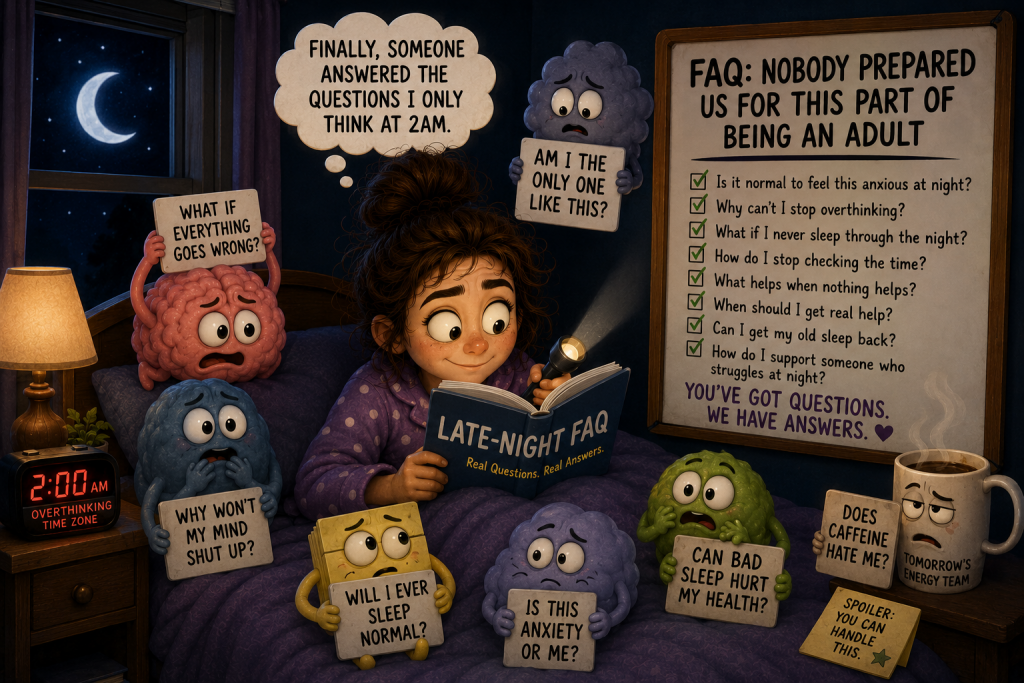
FAQ: Why Your Brain Gets Loudest at 2AM
Why does my brain get loudest at night?
Your brain often gets loudest at night because the day finally gets quiet.
During the day, your mind has distractions. You have work, chores, people, noise, screens, errands, and things to do. At night, those distractions disappear.
That quiet gives your brain room to bring up worries, old memories, body feelings, and tomorrow’s problems.
This does not mean every thought is true. It usually means your brain is tired, alert, and looking for something to solve.
Is nighttime anxiety normal?
Yes, nighttime anxiety is common.
Many people feel more anxious at night because the body is tired, the room is quiet, and the mind has fewer distractions. Worry can feel stronger when you are lying still in the dark.
But common does not mean you have to ignore it.
If nighttime anxiety keeps happening, affects your sleep often, or makes daily life harder, it may help to talk with a doctor, therapist, or sleep specialist.
Why do my thoughts feel more real at 2AM?
Thoughts can feel more real at 2AM because your body and brain are not at their best.
You may be tired, tense, half-awake, or scared. The room is dark. There is less outside noise. Your body may also be reacting with a racing heart, tight chest, or restless feeling.
That can make a thought feel like a warning, even when it is only anxiety.
A helpful reminder is this:
A thought can feel real without being true.
What should I do when I wake up anxious in the middle of the night?
Start by keeping things simple.
Do not grab your phone right away. Do not check the clock over and over. Do not start searching symptoms unless something feels truly urgent or dangerous.
Try this instead:
- Take a slow breath in.
- Breathe out longer than you breathe in.
- Press your feet gently into the bed.
- Name what is happening: “This is anxiety.”
- Remind yourself: “I can rest even if sleep takes time.”
The goal is not to force sleep. The goal is to help your body feel safe enough for sleep to return.
Can anxiety cause physical symptoms at night?
Yes, anxiety can cause real physical symptoms at night.
It can cause a racing heart, tight muscles, stomach discomfort, sweating, restlessness, shallow breathing, and trouble sleeping.
These symptoms can feel scary because you notice them more when the room is quiet.
Still, do not assume every symptom is anxiety. If you have chest pain, fainting, trouble breathing, sudden weakness, confusion, or symptoms that feel severe or new, get medical help.
How can I stop overthinking before bed?
You may not be able to stop every thought, but you can lower the noise.
A simple brain dump can help. Before bed, write down:
| What to Write | Why It Helps |
|---|---|
| Worries on your mind | Gets them out of your head |
| Tomorrow’s top tasks | Gives your brain a plan |
| What can wait | Lowers pressure |
| One calming reminder | Helps your mind settle |
You can also lower lights, avoid stressful scrolling, turn the clock away, and keep your routine simple.
The goal is not a perfect mind.
The goal is a quieter one.
Will I ever sleep normally again?
Yes, many people can improve their sleep over time.
A bad night does not mean you are broken. A rough week does not mean your sleep is ruined forever. Nighttime anxiety can become a pattern, but patterns can change.
A calmer night is learned through small repeated actions:
- Turning the clock away
- Writing worries down
- Breathing slowly
- Reducing late-night stimulation
- Letting rest count
- Not believing every anxious thought
- Getting support when needed
You do not need to fix everything in one night.
You only need to keep giving your brain and body safer signals, one night at a time.