
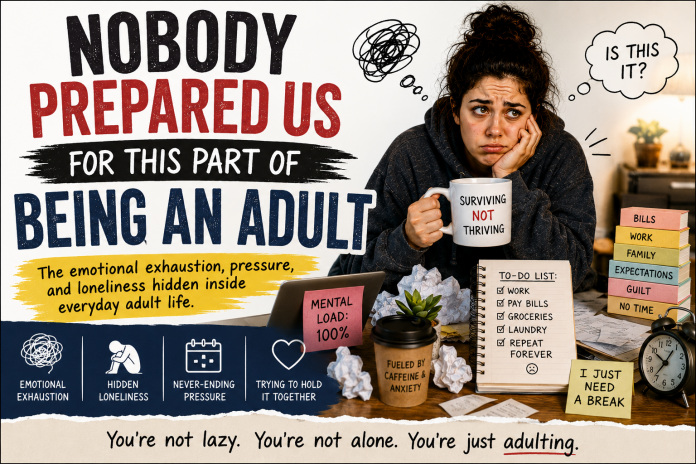
The emotional exhaustion, pressure, and loneliness hidden inside everyday adult life.
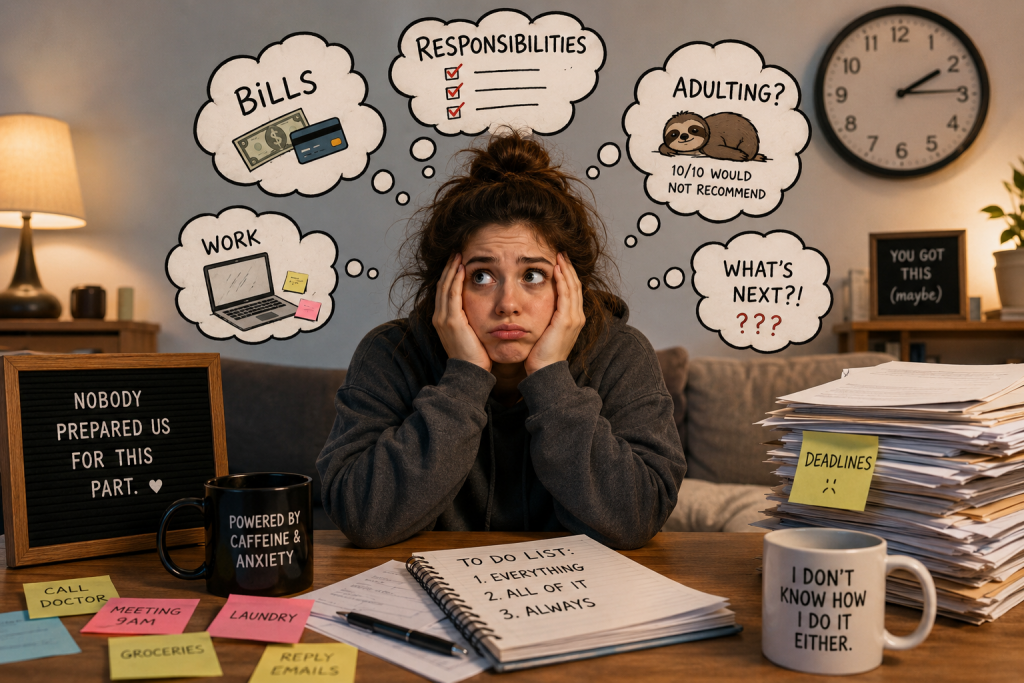
Nobody Prepared Us for This Part of Being an Adult
Being an adult sounds simple when you are younger.
You think it means freedom.
You think it means making your own rules, staying up late, buying what you want, and finally not having someone tell you what to do.
Then real life shows up with a bill in one hand, laundry in the other, and a tiny little panic button hidden somewhere behind your left eye.
That is the part nobody really explains.
Nobody sits you down and says, “Hey, one day you may have a decent life, people who love you, a roof over your head, and food in the fridge, but still feel like you are one bad week away from falling apart.”
Nobody tells you that being an adult is not just about working, paying bills, taking care of family, and keeping the house from turning into a crime scene.
It is also about carrying quiet pressure that nobody sees.
It is about smiling when you are tired.
It is about saying “I’m fine” when you are really doing math in your head about money, time, energy, health, work, family, and whether you forgot to switch the laundry again.
That is why this topic matters.
Because many people are not lazy.
They are not weak.
They are not failing.
They are just worn down by the hidden side of Being an Adult.
Why adulthood feels harder than expected
Adulthood feels harder than expected because most of us were prepared for tasks, not pressure.
We were told to get a job.
We were told to pay our bills.
We were told to be responsible.
We were told to grow up.
But very few people told us what it would feel like to carry all of that at the same time.
There is a big difference between knowing you will have bills and feeling the stress of bills every single month.
There is a big difference between knowing you will work and waking up tired, going to work anyway, coming home drained, and still having ten more things waiting for you.
There is a big difference between knowing life will be hard and realizing that some parts of adult life do not pause just because you are tired.
That is one of the hardest parts.
Adult life keeps moving even when you need a break.
The dishes do not care if you had a rough day.
The electric bill does not care if you are sad.
Your inbox does not care if you slept badly.
The dog still needs to go out.
The car still needs gas.
Your body still needs care.
Your family still needs you.
And somehow, through all of that, you are supposed to act normal.
This is why adulthood can feel so shocking.
It is not always one giant disaster.
Sometimes it is just too many small things stacked on top of each other.
One small problem is easy.
Five small problems are annoying.
Twenty small problems become a weight.
That weight is where many adults live.
They are not always in crisis.
They are just always managing something.
This is also why rest does not always feel restful.
You can sit on the couch and still feel tense.
You can sleep eight hours and wake up tired.
You can take a day off and spend half of it thinking about everything you should be doing.
That does not mean you are broken.
It means your brain has been living in “handle it” mode for too long.
The American Psychological Association explains burnout as being tied to emotional exhaustion, distance, and reduced effectiveness, especially when stress keeps going without enough recovery.
That matters because many adults are not just tired from work.
They are tired from life management.
They are tired from remembering.
They are tired from deciding.
They are tired from pretending they have more energy than they do.
A younger version of us may have pictured adulthood like a clean movie scene.
Nice apartment.
Good coffee.
Stable job.
Maybe a plant that somehow stays alive.
Real adulthood is often more like drinking cold coffee while standing in the kitchen, wondering why there are three different insurance emails, two missing socks, and one weird pain you are trying not to Google.
There is humor in that.
But there is also truth.
Being an adult can be funny and heavy at the same time.
You can laugh at how ridiculous life gets and still feel crushed by it.
That is why Nobody Told Me About This Part of Adult Life connects with this kind of stress. It is not about making adulthood look dramatic. It is about saying the quiet part out loud.
Many adults are doing better than they think.
They are showing up.
They are paying what they can.
They are helping people.
They are trying.
They are getting through days that no one claps for.
And sometimes, that alone is a lot.
The quiet pressure behind everyday responsibilities
Everyday responsibility does not always look serious from the outside.
It can look normal.
It can look boring.
It can look like grocery lists, school forms, work emails, oil changes, dinner plans, doctor visits, rent, trash day, birthday gifts, and remembering that one password you changed because the website said your old one was “not strong enough.”
But inside your head, all of that can feel loud.
The quiet pressure of adulthood comes from the fact that there is always something to keep track of.
You do not just do things.
You remember things before they happen.
You plan for things that might happen.
You worry about things that could happen.
You replay things that already happened.
That is a lot of invisible work.
This kind of hidden work is often called the mental load.
It means being the person who notices, plans, tracks, reminds, checks, fixes, and prepares.
Research on cognitive household labor has linked this kind of invisible planning and managing with higher stress, burnout, and mental health strain, especially when one person carries more of it than others.
And even when the mental load is shared, adult life still asks a lot.
You may be thinking about work while cooking dinner.
You may be thinking about money while driving.
You may be thinking about your family while trying to sleep.
You may be thinking about your health while trying to focus.
You may be thinking about the future while just trying to get through today.
That is the quiet pressure.
It is not always screaming.
Sometimes it whispers all day.
It says:
- Did you forget something?
- Are you doing enough?
- What if something goes wrong?
- Can you afford that?
- Are you falling behind?
- What needs to be handled next?
That kind of pressure can make even simple tasks feel heavier.
The laundry is not just laundry.
It is another sign that life does not stop.
The bill is not just a bill.
It is another reminder that staying alive has a monthly cost.
The appointment is not just an appointment.
It is another thing to fit into a day that already feels full.
This is why adults can get irritated by small stuff.
It is not always about the small thing.
It is about the pile under it.
A spilled drink might not matter much on a calm day.
But on a day when you are already behind, already tired, already worried, and already trying not to snap, that spilled drink can feel like the final boss in a game nobody asked to play.
And then you feel guilty for being upset.
That guilt becomes another weight.
So now you are not only tired.
You are tired and mad at yourself for being tired.
That is a brutal loop.
This is where many adults start hiding their stress.
They do not want to seem dramatic.
They do not want to worry anyone.
They do not want to explain the whole thing.
So they say, “It’s fine.”
But “fine” can mean a lot of things.
Sometimes “fine” means, “I do not have the words.”
Sometimes “fine” means, “I cannot talk about this without crying.”
Sometimes “fine” means, “Please do not ask me one more thing right now.”
Sometimes “fine” means, “I am holding it together with duct tape and caffeine.”
That quiet pressure is easy to miss because adult life rewards people who keep going.
People praise strength.
They praise hard work.
They praise being dependable.
But they do not always ask what it costs.
Here is a simple table that shows how normal adult tasks can carry hidden emotional weight.
| Everyday Responsibility | What People See | What It Can Feel Like Inside |
|---|---|---|
| Paying bills | Handling money | Fear, pressure, and “what if I can’t keep up?” |
| Going to work | Being responsible | Drained, trapped, or scared to fall behind |
| Caring for family | Being loving | Exhausted, needed, and sometimes unseen |
| Keeping a home running | Basic chores | A never-ending loop of tasks |
| Making decisions | Normal adult life | Mental fatigue from always choosing |
| Staying “fine” | Being strong | Hiding stress so no one worries |
This is why Being an Adult can feel so much harder than it looks.
The outside may look normal.
The inside may feel like a browser with 73 tabs open and one of them is playing music, but you cannot find which one.
That is not weakness.
That is overload.
When “being fine” becomes exhausting
At some point, “being fine” can become its own job.
You wake up and put on the face.
You answer messages.
You go to work.
You handle the calls.
You smile at people.
You make the joke.
You say, “Yeah, I’m good.”
Then you get home and feel like your whole body powers down.
That is not always physical tiredness.
Sometimes it is emotional tiredness.
You spent the day acting okay.
You spent the day being polite.
You spent the day keeping your tone even.
You spent the day not saying what you really felt because there was no safe place to put it.
That kind of “fine” is draining.
It is like wearing shoes that are half a size too small.
You can still walk.
You can still get things done.
But by the end of the day, you feel it.
Many adults become experts at hiding what hurts.
They can talk about the weather.
They can talk about work.
They can talk about dinner.
They can talk about the kids.
They can talk about sports, shows, gas prices, and the weird noise the car is making.
But when it comes to the deeper stuff, they shut the door.
Not because they do not care.
Because they are tired.
Because they do not want to be a burden.
Because they do not want advice.
Because they do not want someone to turn their pain into a lesson.
Because they have already heard “just stay positive” enough times to last three lifetimes.
Sometimes adults do not need a speech.
They need someone to sit beside them and say, “Yeah, that sounds heavy.”
That alone can matter.
The CDC’s information on social connection notes that connection can support stress, anxiety, depression, sleep, and overall well-being.
That is important because many adults are not just tired from tasks.
They are tired from carrying things alone.
Loneliness does not always mean no people are around.
You can be married and lonely.
You can have kids and lonely.
You can have coworkers and lonely.
You can be in a group chat and lonely.
You can have hundreds of online friends and still feel like nobody really knows what is going on inside you.
That kind of loneliness is sneaky.
It hides behind busyness.
It hides behind responsibility.
It hides behind jokes.
It hides behind “I’m just tired.”
And because everyone else seems busy too, you may not reach out.
You may think, “They have their own stuff.”
You may think, “I should be able to handle this.”
You may think, “Other people have it worse.”
That last one is common.
But pain is not a contest.
You do not have to win the suffering Olympics before your stress counts.
You are allowed to be tired even if someone else is more tired.
You are allowed to need support even if your life looks okay from the outside.
You are allowed to admit that Being an Adult feels heavy sometimes.
This does not mean you hate your life.
It does not mean you are ungrateful.
It does not mean you do not love your family.
It does not mean you want to quit everything and go live in the woods, although let’s be honest, the woods do start sounding pretty good after the third password reset of the week.
It just means you are human.
And humans were not built to carry everything without release.
There is a real quote often linked to Carl Jung that says:
“I am not what happened to me, I am what I choose to become.”
That idea fits adulthood well.
Because adulthood gives us plenty we did not ask for.
Stress.
Loss.
Bills.
Pressure.
Change.
Fear.
Responsibilities that feel bigger than we expected.
But somewhere inside all of that, we still get to choose how honest we become with ourselves.
We get to stop pretending everything is easy.
We get to stop shaming ourselves for needing rest.
We get to stop acting like every adult has it all figured out.
Most do not.
Most are guessing.
Some are just better at making the guessing look neat.
Why this topic matters more than people admit
This topic matters because a lot of adults are silently wondering if they are the only ones struggling.
They are not.
They may look calm in public and fall apart in private.
They may keep the house running and feel empty inside.
They may make everyone else laugh while feeling deeply worn out.
They may be doing everything “right” and still feel like life is too much.
That is why we need to talk about this part of adulthood more honestly.
Not in a dramatic way.
Not in a hopeless way.
Not in a “everything is awful forever” way.
But in a real way.
Because once people know they are not alone, shame loses some of its grip.
And shame is one of the heaviest parts.
Stress is hard enough.
But stress plus shame is worse.
It says, “I am tired.”
Then shame says, “You should not be.”
It says, “I need help.”
Then shame says, “You should handle it yourself.”
It says, “I feel behind.”
Then shame says, “Everyone else is doing better.”
That is how people end up suffering in silence.
They do not just feel overwhelmed.
They feel embarrassed about being overwhelmed.
That is the part we need to break.
Being an Adult is not supposed to mean being made of stone.
It is not supposed to mean never needing help.
It is not supposed to mean smiling through every hard day like some kind of motivational poster with a caffeine addiction.
Real adulthood is messier than that.
It is strong and tired.
It is grateful and frustrated.
It is proud and scared.
It is laughing at dumb things while worrying about serious things.
It is caring deeply while running low on energy.
It is wanting peace but still having to answer emails.
The book Nobody Told Me About This Part of Adult Life is built around this truth. It speaks to the emotional side of adulthood that many people feel but do not always say out loud.
And that matters because people do not always need another lecture about success.
Sometimes they need language for what they are already living.
They need to read something and think, “Yes. That. That is what I mean.”
They need to know that struggling does not mean they are failing.
They need to know that needing rest does not mean they are lazy.
They need to know that being overwhelmed does not mean they are weak.
They need to know that the hidden parts of adult life are still real, even when nobody claps for surviving them.
The truth is, many adults are carrying more than they admit.
Money stress.
Health worries.
Family pressure.
Work demands.
Old grief.
New fear.
Loneliness.
Regret.
Hope.
Exhaustion.
And the weird ache of wondering, “Is this really what life is supposed to feel like?”
That question deserves care.
It deserves more than “suck it up.”
It deserves more than “welcome to adulthood.”
It deserves more than jokes, even though jokes help.
It deserves honesty.
Because when we are honest about the weight, we can start being honest about what helps.
Not perfect fixes.
Not magic answers.
Not fake positivity.
Just real things.
More rest.
Better boundaries.
Safer conversations.
Less pretending.
More support.
More grace.
More room to be human.
Here is the quiet truth many people need to hear:
You can be responsible and still be tired.
You can be strong and still need help.
You can be thankful and still feel overwhelmed.
You can be loved and still feel lonely.
You can be an adult and still wish someone would tell you it is going to be okay.
That does not make you childish.
That makes you honest.
And maybe honesty is where the weight starts to loosen a little.
Not all at once.
Not in some big movie moment.
But slowly.
One real sentence at a time.
One deep breath.
One honest conversation.
One moment where you stop pretending you are fine and simply admit, “This is a lot.”
Because it is.
And if nobody prepared you for this part of Being an Adult, you are not alone.
A lot of us are learning it while living it.
A lot of us are tired.
A lot of us are trying.
And a lot of us are still here, still showing up, still doing our best with the tools we have.
That counts.
More than most people admit, that really counts.
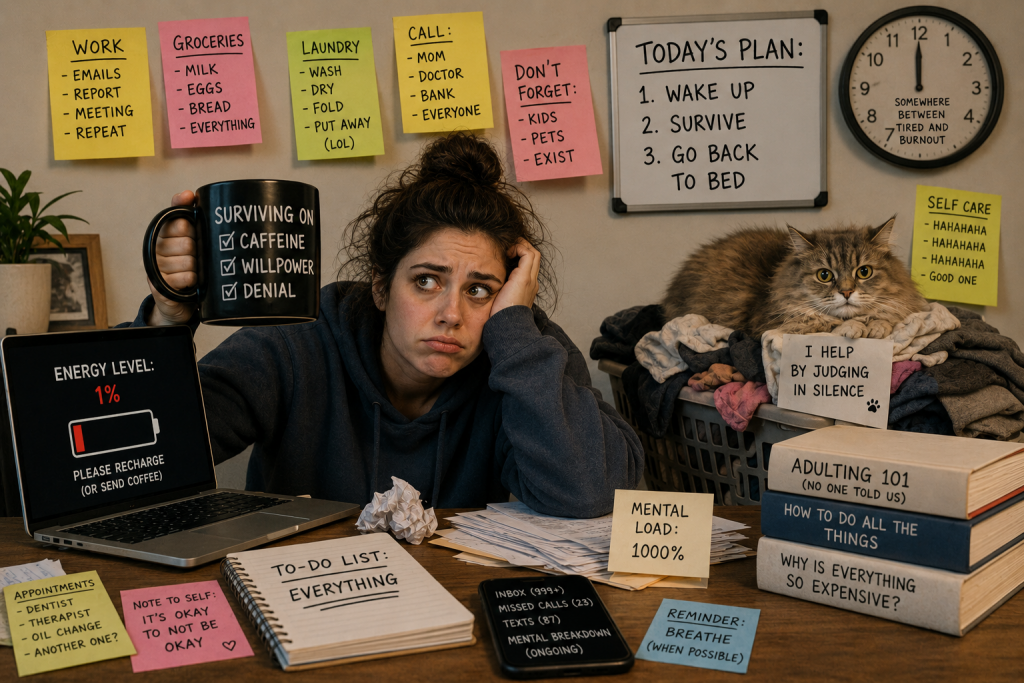
The Emotional Exhaustion of Adult Life
Emotional exhaustion is one of the strangest parts of Being an Adult because it does not always look like a breakdown.
Sometimes it looks like sitting in your car for five extra minutes before going inside.
Sometimes it looks like opening the fridge, staring at food, and still having no idea what to eat.
Sometimes it looks like hearing your phone buzz and feeling your whole soul whisper, “Please no.”
Sometimes it looks like being tired before the day even starts.
That is the part many people do not understand.
Adult tired is different.
It is not just “I stayed up too late” tired.
It is not just “I need a nap” tired.
It is the kind of tired that comes from always thinking, always planning, always worrying, always adjusting, and always trying to stay one step ahead of life before life trips you in public and charges you a late fee.
This is why Being an Adult can feel so heavy even when nothing huge is wrong.
A lot of adult stress comes from the fact that there is always something to handle.
Not once in a while.
Always.
There is always a bill coming.
There is always a chore waiting.
There is always a message to answer.
There is always a body part making a weird noise.
There is always laundry that somehow came back after you just did it.
There is always something you meant to do, forgot to do, need to do, or are now afraid to check because you are pretty sure it is already late.
That is the emotional exhaustion of adult life.
It is not one thing.
It is the pile.
Always having something to handle
One of the hardest parts of adult life is the feeling that nothing is ever fully done.
You can clean the kitchen.
Then people eat again.
Rude.
You can pay one bill.
Then another bill shows up like it was waiting around the corner with sunglasses on.
You can answer emails.
Then more emails arrive.
You can finally make a doctor appointment.
Then the doctor sends you five forms, three reminders, and a bill that looks like it was written by someone guessing numbers during a thunderstorm.
That is adult life for many people.
You are not just doing tasks.
You are chasing them.
You finish one thing and three more appear.
It can make life feel like a video game where every level is called “Handle This Too.”
This is why adults often feel tired in a way that is hard to explain.
It is not just the work itself.
It is the never-ending nature of the work.
There is no clean finish line.
At a job, you may clock out.
At home, you do not.
Even when you sit down, your mind may still be running.
Did I lock the door?
Did I pay that?
Did I text them back?
Did I move the clothes to the dryer?
What is for dinner?
Why is the car making that sound?
How much is left in the account?
When was the last oil change?
Did I forget someone’s birthday?
Why does my back hurt?
Is this stress or am I dying?
That last one hits different after 40.
This is where emotional exhaustion starts to build.
It builds because your brain does not get enough quiet space.
It is always scanning.
It is always checking.
It is always trying to protect you from the next problem.
The CDC explains that stress can show up through changes in sleep, appetite, energy, mood, and daily life, which makes sense because stress is not just a feeling.
It affects how you function.
It affects how you think.
It affects how you react.
It affects how much patience you have left when someone asks, “What’s for dinner?” after you have already made 37 decisions since breakfast.
Adult responsibility also carries a strange kind of pressure because you know many things depend on you.
Your choices matter.
Your money matters.
Your timing matters.
Your health matters.
Your mood can affect the whole house.
That is a lot to carry.
And because adults are expected to handle things, many people do not stop and say, “This is too much.”
They just keep going.
They keep working.
They keep driving.
They keep answering.
They keep cooking.
They keep cleaning.
They keep fixing.
They keep pretending they are not one minor inconvenience away from staring into the toaster like it has answers.
This is why the book Nobody Told Me About This Part of Adult Life speaks to something real. It is not about saying adult life is all bad. It is about admitting that the weight is real, even when life looks normal from the outside.
A person can have a good life and still feel emotionally exhausted.
That matters.
Because guilt often shows up when adults admit they are tired.
They think, “I should be grateful.”
And yes, gratitude matters.
But gratitude does not erase exhaustion.
You can be thankful for your home and still be tired of cleaning it.
You can love your family and still need quiet.
You can be glad you have a job and still feel drained by it.
You can know you are blessed and still whisper, “I cannot do one more thing today.”
That does not make you selfish.
It makes you human.
Here is what “always having something to handle” can feel like in real life:
| Adult Task | What It Looks Like | What It Can Feel Like |
|---|---|---|
| Paying bills | Normal responsibility | Constant pressure to keep up |
| Cleaning | Basic home care | A job that restarts every day |
| Work | Being dependable | Energy going out faster than it comes back |
| Family needs | Love and care | Being needed even when empty |
| Appointments | Staying healthy | One more thing to remember |
| Messages | Staying connected | Another demand on your attention |
| Planning meals | Simple daily task | A decision you are tired of making |
The table may look simple.
But living it every day is not simple.
It is death by a thousand tiny reminders.
None of them may be huge alone.
But together, they can make your chest feel tight and your brain feel full.
That is emotional exhaustion.
It is not always loud.
Sometimes it is just the quiet thought, “I am tired of being needed by everything.”
Feeling tired even after resting
One of the most frustrating parts of emotional exhaustion is resting and still not feeling better.
You sleep.
You sit.
You take a break.
You watch a show.
You scroll your phone until your thumb needs its own retirement plan.
But somehow, you still feel tired.
That can make you feel confused.
You may think, “What is wrong with me?”
You may wonder why a weekend did not fix you.
You may wonder why a nap helped your body but not your mood.
The reason is simple, but not easy.
Not all tiredness is physical.
Some tiredness comes from carrying too much stress for too long.
Your body may be still, but your mind may not be resting.
You may be lying down while thinking about money.
You may be sitting on the couch while replaying a hard conversation.
You may be trying to relax while feeling guilty for not doing something useful.
That is not real rest.
That is just being horizontal with anxiety.
There is a difference.
Real rest gives your body and mind room to stop performing.
Fake rest looks like rest on the outside, but inside you are still working.
You are still judging yourself.
You are still planning.
You are still worrying.
You are still bracing for the next problem.
That is why many adults say, “I rested, but I do not feel rested.”
They are not lying.
They are not being dramatic.
They are mentally overloaded.
The American Psychological Association says stress can affect many systems in the body, including muscles, breathing, heart function, digestion, hormones, and the nervous system.
That helps explain why emotional exhaustion can feel physical.
Stress is not just “in your head.”
Your head is attached to the rest of you.
Very rude design, honestly.
When life keeps you in stress mode, your body may stay tense even when nothing is happening at that exact second.
Your shoulders stay tight.
Your jaw stays clenched.
Your stomach feels off.
Your sleep gets weird.
Your patience gets thin.
Your brain gets foggy.
Your energy feels like an old phone battery that drops from 42% to 3% because you opened one app.
That is adult exhaustion.
And it can make normal rest feel weak.
A single evening off may not be enough if you have been running on fumes for months.
A nap may not fix years of pressure.
A vacation may not cure a life built around constant stress.
This does not mean rest is useless.
Rest matters.
But adults often need a deeper kind of rest than they give themselves.
They need rest from noise.
Rest from decisions.
Rest from being available.
Rest from pressure.
Rest from pretending.
Rest from being the strong one.
Rest from needing to earn every minute of peace.
That last one is huge.
Many adults feel like they have to earn rest by becoming completely empty first.
They only let themselves stop when they are burnt out.
They only relax after doing everything.
They only sit down when the house is clean, the work is done, the inbox is handled, the kids are settled, the dog is walked, the laundry is folded, and the moon is in the correct emotional position.
But life rarely gets that clean.
So rest keeps getting pushed away.
That creates a painful cycle.
You are tired, so tasks feel harder.
Tasks feel harder, so they take more energy.
You use more energy, so you get more tired.
Then you feel guilty for not doing enough.
Then guilt drains you too.
Now you are tired from the work and tired from beating yourself up about the work.
That is too much.
A real adult truth is this:
You do not need to be destroyed before you are allowed to rest.
You do not need to prove you are exhausted.
You do not need to wait until your body forces you to stop.
Rest is not a prize for suffering.
Rest is maintenance.
Even machines get maintenance.
And they do not even have to deal with family group chats.
If you are tired after resting, it may be a sign that your life needs more than a nap.
It may need better boundaries.
It may need fewer open loops.
It may need help.
It may need honest talks.
It may need medical support if stress, sleep, anxiety, or mood are affecting your daily life.
The CDC’s guidance on managing stress includes things like taking breaks from upsetting content, making time to unwind, connecting with others, journaling, spending time outdoors, and doing calming activities.
Those things sound simple.
But simple does not mean useless.
Simple is often what burned-out adults skip first.
They stop walking.
They stop talking.
They stop resting.
They stop eating well.
They stop doing small things that make them feel human.
Then they wonder why they feel like a haunted Roomba with bills.
The answer is not always to do more.
Sometimes the answer is to stop treating yourself like a machine.
The mental load nobody sees
The mental load is one of the biggest hidden parts of Being an Adult.
It is also one of the least appreciated.
The mental load is not just doing things.
It is remembering that things need to be done.
It is noticing.
It is tracking.
It is planning.
It is thinking ahead.
It is being the calendar, the alarm, the reminder, the safety net, and the backup plan.
It is knowing the milk is low before anyone else notices.
It is remembering that the car inspection is due.
It is knowing which kid needs what for school.
It is keeping track of appointments, medicine, bills, birthdays, groceries, passwords, pet food, work deadlines, and that one random thing you put in a “safe place” and will never see again.
The mental load is invisible work.
And invisible work still makes you tired.
That is the part people miss.
If someone walks into a clean house, they see the clean house.
They do not see the thinking behind it.
They do not see who noticed the mess.
They do not see who bought the supplies.
They do not see who planned the time.
They do not see who remembered company was coming.
They do not see who got up early, stayed up late, or gave up their own rest to make it happen.
The same thing happens at work.
People may see the finished task.
They may not see the mental juggling behind it.
They may not see the person answering messages while worrying about home.
They may not see the person smiling in a meeting while trying to figure out how to pay for a car repair.
They may not see the person who looks calm but has a brain doing backflips behind their eyes.
That is why the mental load can feel so lonely.
You are carrying work no one asked about.
And because no one sees it, no one thanks you for it.
This can build quiet resentment.
Not always loud anger.
Just a tired little voice inside that says, “Why am I the only one who notices?”
That feeling is real.
And it can happen in marriages, families, workplaces, friendships, caregiving, and even single adult life.
If you live alone, you may carry the whole mental load by yourself.
There is no one else to remember the toilet paper.
No one else to notice the sink.
No one else to say, “Hey, did you schedule that?”
It is all you.
And that can be heavy too.
Mental load also drains your decision-making.
Every day asks adults to make choice after choice.
What should I eat?
What should I do first?
Should I answer this now?
Can this wait?
What can I afford?
Should I call the doctor?
Should I rest or clean?
Should I say yes or no?
Should I push through or stop?
By the end of the day, even tiny choices can feel annoying.
That is why “What do you want for dinner?” can feel like a personal attack.
It is not really about dinner.
It is about one more decision.
One more thing to think about.
One more small demand dropped onto a brain already full of tabs.
This is where people start saying, “I do not care. Just pick something.”
And they mean it.
They are not trying to be difficult.
They are decision-tired.
They have spent all day choosing, fixing, adjusting, and remembering.
Their brain is closed.
Please try again tomorrow.
The mental load also keeps people from being present.
You may be with your family, but your mind is on tomorrow.
You may be watching a movie, but your brain is checking the budget.
You may be talking to someone, but half of you is thinking about the appointment you forgot to reschedule.
That can make you feel guilty.
You want to be present.
You want to enjoy your life.
You want to relax.
But your mind keeps dragging you back into management mode.
This is why adult stress is not always about being busy.
Sometimes it is about being mentally crowded.
Your calendar may not look full.
But your mind is packed.
That is one reason the emotional side of Nobody Told Me About This Part of Adult Life matters. It gives words to that hidden crowding, that constant sense of “I am responsible for too many things at once.”
Here are some examples of mental load adults carry that may not be obvious:
- Remembering when bills are due
- Knowing what food is in the house
- Tracking appointments and follow-ups
- Planning around work schedules
- Checking on family needs
- Thinking about money before spending
- Preparing for problems before they happen
- Managing everyone’s moods
- Keeping the home running
- Noticing what needs to be fixed
- Remembering birthdays, events, and deadlines
- Feeling responsible for the emotional tone of the house
That last one is a big one.
Some adults do not just manage tasks.
They manage feelings.
They try to keep peace.
They try not to upset anyone.
They try to make sure everyone else is okay.
They hold their own stress in because they do not want to add more stress to the room.
That is exhausting.
And because it often looks like “being nice” or “being responsible,” it can go unnoticed for years.
The mental load nobody sees may be one of the main reasons so many adults feel tired but cannot explain why.
They say, “I didn’t even do that much today.”
But they did.
They thought.
They tracked.
They worried.
They planned.
They remembered.
They braced.
They carried.
That counts.
Mental work is work.
Emotional work is work.
Invisible work is work.
And when nobody sees it, you may have to be the first person to admit that it is real.
Why small problems start to feel heavy
Small problems start to feel heavy when they land on top of a tired nervous system.
That is the plain truth.
A small problem on a rested day may feel annoying.
A small problem on an exhausted day may feel like life is personally throwing tomatoes at you.
The problem did not change.
Your capacity changed.
Capacity is the amount of stress, work, noise, emotion, and pressure you can hold before you start to bend.
When you have enough capacity, you can handle a lot.
You can laugh things off.
You can solve problems.
You can stay patient.
You can be flexible.
But when your capacity is low, every new thing feels bigger.
A late bill feels bigger.
A rude email feels bigger.
A messy kitchen feels bigger.
A traffic jam feels bigger.
A kid asking for help while you are cooking feels bigger.
A dog barking at absolutely nothing like he pays rent feels bigger.
This is not because you are weak.
It is because your system is already loaded.
Think of it like carrying grocery bags.
One bag is easy.
Two bags are fine.
Five bags are awkward.
Eight bags and a gallon of milk under your arm?
Now someone asks you to pick up a grape off the floor.
The grape is not heavy.
But you are already full.
That is what happens with adult stress.
The tiny thing is not the real issue.
It is the extra thing.
That is why people sometimes cry over something small.
They are not crying because the toast burned.
They are crying because the toast burned after a long week, poor sleep, money stress, family pressure, and three days of pretending they were okay.
The toast was just the messenger.
Poor toast never stood a chance.
This is why adults need to stop mocking themselves for reacting to small things.
Sometimes the reaction makes sense when you look at the whole load.
The National Institute of Mental Health explains that stress can be a physical and emotional response to pressure, challenge, or demand, and that long-term stress can affect health.
That matters because small problems feel heavier when your body and mind have been under pressure for too long.
When stress lasts, your brain can become more alert to threats.
You may start expecting trouble.
You may get jumpy.
You may get short-tempered.
You may feel like you cannot relax because as soon as you do, something else will happen.
That feeling can turn life into survival mode.
And in survival mode, everything feels urgent.
Even things that are not urgent feel urgent.
You may rush through the day.
You may feel behind even when you are doing enough.
You may snap at people you love.
You may avoid simple tasks because they feel too big.
You may feel embarrassed that you cannot “just handle it.”
But there is no “just” when you are emotionally exhausted.
“Just make the call.”
“Just clean the room.”
“Just go to bed earlier.”
“Just stop worrying.”
“Just ask for help.”
Those things sound simple from the outside.
But when someone is drained, simple can still feel hard.
That does not mean they are making excuses.
It means their inner battery is low.
And unlike a phone, people cannot always recharge by being plugged into a wall.
Although honestly, many adults would try it if it worked.
Small problems also feel heavy because adults often connect them to bigger fears.
The broken car is not just a broken car.
It becomes, “How much will this cost?”
Then, “Can I afford it?”
Then, “What if I cannot get to work?”
Then, “What if this sets me back?”
One problem becomes five fears.
The messy house is not just a messy house.
It becomes, “I can’t keep up.”
Then, “What is wrong with me?”
Then, “Everyone else handles this better.”
Then, “I am failing.”
One pile of dishes becomes a full identity crisis.
That is how adult stress works when it goes unchecked.
It turns tasks into proof.
Proof you are behind.
Proof you are not enough.
Proof you are failing.
But that proof is often false.
A hard day is not proof that you are bad at life.
A messy kitchen is not proof that you are broken.
An overdue task is not proof that you are a failure.
It is proof that you are human and living inside a life that asks a lot.
That is why compassion matters.
Not fake, cheesy compassion.
Real compassion.
The kind that says, “Of course this feels heavy. I have been carrying a lot.”
That one sentence can change the tone.
It does not magically pay the bills.
It does not fold the laundry.
It does not answer the email.
But it stops you from turning on yourself while you are already tired.
And that matters.
Because adult life is hard enough without becoming your own bully.
A helpful way to look at small problems is to ask, “What is this really sitting on top of?”
Here is a simple breakdown:
| Small Problem | Why It May Feel So Big |
|---|---|
| A bill arrives | It touches money fear and future worry |
| A messy room | It reminds you that life keeps piling up |
| A rude message | It hits an already tired emotional state |
| A delayed appointment | It adds one more thing to track |
| A broken appliance | It creates money stress and time stress |
| A bad night of sleep | It lowers patience for everything else |
| A simple decision | It lands on top of decision fatigue |
This is why Being an Adult can feel like carrying invisible bricks.
Each brick may not look like much.
But after a while, your arms shake.
And when someone adds one more tiny brick, you may finally say, “I can’t.”
That does not mean you cannot live your life.
It means you need support, rest, and fewer bricks where possible.
You need to stop treating exhaustion like a personal flaw.
You need to stop acting like being overwhelmed means you are doing adulthood wrong.
Many people feel this way.
They just do not say it out loud.
That is why honest books, honest conversations, and honest writing matter. A book like Nobody Told Me About This Part of Adult Life gives people permission to admit the truth without making it sound like failure.
Adult life can be beautiful.
It can be funny.
It can be meaningful.
It can be full of love.
But it can also be emotionally exhausting.
Both can be true.
You can be grateful and tired.
You can be capable and overwhelmed.
You can be strong and need a break.
You can be doing your best and still feel like your brain has too many tabs open.
That is not failure.
That is adulthood.
And maybe the first step is finally saying the thing many adults are thinking:
This is a lot.
Because it is.
And once we admit that, we can stop pretending we are weak for feeling it.
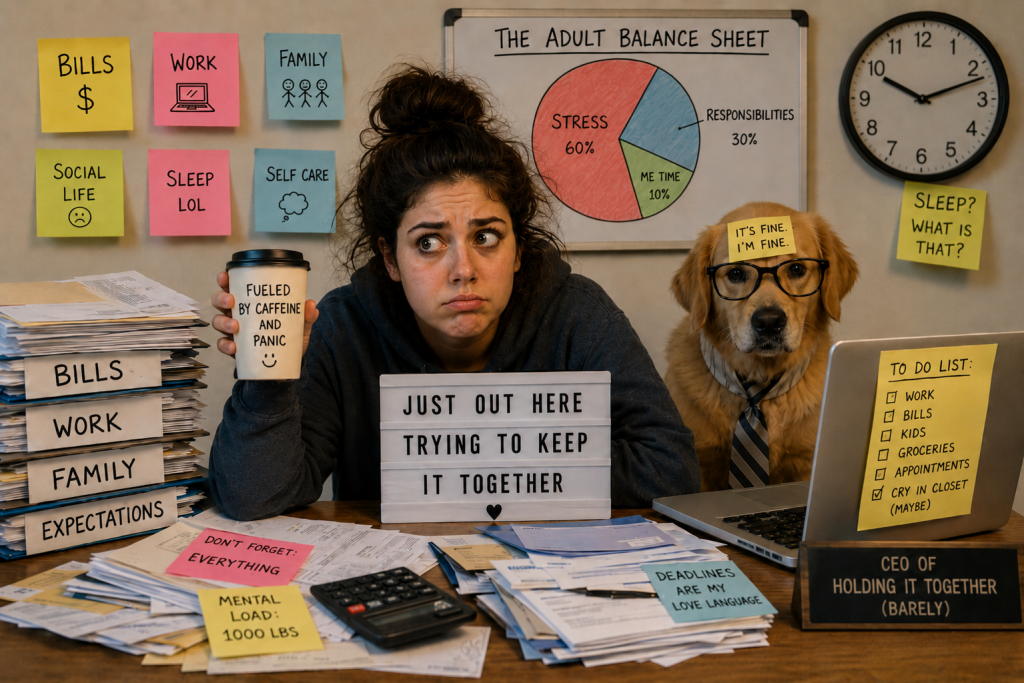
The Pressure to Keep Everything Together
There is a certain kind of pressure that comes with adult life that nobody really warns you about.
It is not just pressure to work.
It is not just pressure to pay bills.
It is not just pressure to be a good parent, partner, friend, worker, neighbor, and decent human who remembers trash day.
It is the pressure to keep everything together while acting like keeping everything together is normal.
That is the exhausting part.
People see the outside.
They see you going to work.
They see you paying for groceries.
They see you answering messages.
They see you showing up.
They see you making jokes.
They see you doing what needs to be done.
What they do not always see is the inside part.
They do not see the quiet panic when another bill comes in.
They do not see the way your stomach drops when the car makes a new noise.
They do not see you checking your bank account like it might personally insult you.
They do not see the mental math.
They do not see the late-night worry.
They do not see how tired you are of being the person who has to “figure it out.”
That is one of the hardest parts of Being an Adult.
You are expected to figure it out.
Need more money?
Figure it out.
Need more time?
Figure it out.
Need more energy?
Figure it out.
Need help?
Figure out how to ask for it without feeling like a burden.
Need rest?
Figure out how to rest without falling behind.
And somewhere in the middle of all that, you are supposed to be healthy, patient, kind, organized, emotionally stable, socially available, and somehow know what is for dinner every night until the end of time.
No wonder so many adults feel like they are barely holding it together.
They are not weak.
They are carrying too many roles at once.
Bills, work, family, and expectations
Most adult pressure does not come from one place.
It comes from several places at the same time.
Bills alone can be heavy.
Work alone can be heavy.
Family needs alone can be heavy.
Expectations alone can be heavy.
But when they all hit at once, it can feel like life handed you a backpack full of bricks and said, “Now smile. People are watching.”
Bills are one of the most common sources of adult stress because money touches almost everything.
Money decides where you live.
Money decides what you can fix.
Money decides what you can delay.
Money decides how much room you have to breathe.
Even when you are doing your best, money can feel like a race where the finish line keeps moving.
You pay the rent or mortgage.
Then the electric bill comes.
Then the phone bill.
Then insurance.
Then groceries.
Then gas.
Then a medical bill.
Then something breaks.
Then a kid needs something.
Then the dog needs something.
Then your car says, “Surprise, I too would like money.”
It can feel endless.
And money stress is not just about the numbers.
It is about the fear behind the numbers.
The fear of falling short.
The fear of not being ready.
The fear of one emergency wiping out everything you were trying to build.
The fear of having to say no to something your family needs.
The fear of looking irresponsible when you are actually trying hard.
The American Psychological Association has reported for years that money is a major source of stress for many adults, and that makes sense because money pressure does not stay in one corner of your life.
It follows you.
It comes to bed with you.
It sits in the passenger seat.
It stands behind you at the grocery store while you watch the total climb like it is training for the Olympics.
Work adds another layer.
A job can give you purpose, structure, income, and pride.
It can also drain the life out of you if the pressure never lets up.
Many adults work all day, come home tired, and then start their second shift.
Dinner.
Dishes.
Laundry.
Homework.
Appointments.
Pet care.
House repairs.
Messages.
Family needs.
By the time everything is “done,” it is late.
Then you sit down and realize you have about 14 minutes of personal time before sleep becomes another job you are failing at.
That is not laziness.
That is overload.
Work pressure is also emotional.
You may worry about being replaced.
You may worry about not doing enough.
You may worry about your boss, coworkers, hours, pay, deadlines, or the fact that everyone keeps using the phrase “circle back” like society has given up.
You may feel like you cannot complain because you know having a job matters.
That is a hard place to be.
You can be grateful for a paycheck and still be tired from the work.
Both can be true.
Family pressure can be even more complicated because it is tied to love.
You want to show up for your family.
You want to be reliable.
You want to help.
You want to protect people.
You want to be patient.
You want to be the person they can count on.
But being counted on can get heavy.
It can feel good to be needed.
It can also feel exhausting to be needed all the time.
This is especially true when you are already running low.
A child needs help.
A spouse needs support.
A parent needs care.
A friend needs you to listen.
Someone needs a ride.
Someone needs money.
Someone needs an answer.
Someone needs you to be calm because they are not calm.
And there you are, trying to be steady while your own battery is blinking red.
This is why adult pressure can feel so lonely.
You may love the people in your life deeply and still feel tired from being responsible.
That does not make you cold.
It makes you honest.
Expectations are the invisible layer on top of all of it.
They come from family.
They come from society.
They come from social media.
They come from old dreams.
They come from younger versions of ourselves who thought life would be much more organized by now.
Expectations say:
- You should have more money by now.
- You should own a home by now.
- You should be healthier by now.
- You should have a better job by now.
- You should be happier by now.
- You should have figured this out by now.
- You should not still be this tired.
Those “shoulds” are heavy.
They can turn a normal adult life into a constant report card.
The problem is, adulthood is not a clean report card.
It is messy.
Some people start over at 30.
Some start over at 40.
Some start over at 50.
Some people never had the help others had.
Some people lost time to illness, grief, divorce, debt, caregiving, trauma, job loss, addiction, anxiety, depression, or just plain survival.
So when we judge every adult by the same timeline, we miss the truth.
People are carrying different loads.
And not all loads are visible.
That is why Nobody Told Me About This Part of Adult Life hits such a real nerve. It is not about whining over normal responsibility. It is about naming the pressure that comes from trying to keep life together while feeling like you are always one step behind.
Here is a simple look at how adult pressure stacks up.
| Pressure Area | What It Demands | Why It Feels Heavy |
|---|---|---|
| Bills | Money, planning, due dates | One missed payment can create more stress |
| Work | Time, focus, performance | You may feel replaceable or trapped |
| Family | Care, patience, support | Love can still require a lot of energy |
| Health | Appointments, habits, worry | Your body becomes another thing to manage |
| Home | Cleaning, repairs, meals | The work keeps coming back |
| Expectations | Progress, success, stability | You feel judged by an invisible timeline |
Adult life is not hard because adults are bad at it.
It is hard because so many things need attention at the same time.
A person can only hold so much.
At some point, the pressure to keep everything together becomes its own kind of exhaustion.
The fear of falling behind
The fear of falling behind is one of the quietest pains in adult life.
It does not always show on your face.
You can laugh with people and still feel it.
You can go to work and still feel it.
You can pay your bills and still feel it.
You can be doing better than you used to and still feel like you are not where you should be.
That fear can follow you everywhere.
It shows up when you see someone buy a house.
It shows up when someone gets promoted.
It shows up when someone posts vacation pictures.
It shows up when someone announces a wedding, baby, business, new car, weight loss, dream job, kitchen remodel, or “big life update.”
You may be happy for them.
Really happy.
But somewhere inside, a small voice says, “What about me?”
That voice can hurt.
It can make you feel behind even when you are not.
The truth is, falling behind is often not as real as it feels.
Most of the time, you are comparing your full life to someone else’s best-looking piece of life.
You know your bills.
You know your fights.
You know your bad habits.
You know your fear.
You know your messy room.
You know your private doubts.
But with other people, you often see the edited version.
You see the new job, not the sleepless nights before it.
You see the house, not the debt or stress behind it.
You see the family photo, not the argument in the car.
You see the smiling selfie, not the anxiety five minutes earlier.
You see the success, not the years of failure that came first.
That kind of comparison is unfair, but most of us do it anyway.
Social media makes this worse because it gives us hundreds of tiny chances every day to feel like we are not enough.
Even if you know people are posting highlights, your brain may still compare.
That is human.
But it is also dangerous when you start using other people’s lives as proof that yours is wrong.
The U.S. Surgeon General has warned about the effects of loneliness and social disconnection, and part of that bigger problem is that many adults are surrounded by updates but still lacking real connection.
Seeing people is not the same as knowing people.
Watching someone’s life online is not the same as being close to them.
And comparing yourself to people you barely understand is like judging your whole house by someone else’s front porch.
The fear of falling behind also comes from old timelines.
Many of us grew up with an unspoken map.
Finish school.
Get a career.
Get married.
Buy a house.
Have kids.
Save money.
Stay healthy.
Move upward.
Be happy.
Do it all in the correct order.
Also, do not complain.
But real life does not follow that clean little map.
People lose jobs.
Relationships end.
Bodies change.
Parents get sick.
Kids need more than expected.
Mental health struggles show up.
Money gets tight.
Plans get delayed.
Dreams change.
Life interrupts.
And then people feel like they failed because they are not living the version of adulthood they pictured when they were younger.
That is a painful kind of grief.
It is not just fear.
It is disappointment.
You may not hate your life.
You may still love parts of it.
But you may also be mourning the life you thought you would have by now.
That is hard to admit because it can sound ungrateful.
But it is not ungrateful.
It is human.
You can be thankful for what you have and still feel sad about what did not happen.
You can love your family and still wonder who you might have been if life had gone another way.
You can be proud of surviving and still feel tired from all the detours.
The fear of falling behind gets worse when adults believe there is only one right pace.
There is not.
Some people build early.
Some build late.
Some rebuild many times.
Some take longer because they had more to heal from.
Some move slowly because they are carrying responsibilities others never had.
Some look “behind” because they refused to give up when life knocked them down.
That is not behind.
That is still moving.
And sometimes still moving is a victory.
Here are a few false beliefs that make adults feel behind.
| False Belief | Healthier Truth |
|---|---|
| I should have it all figured out by now. | Most adults are still learning as they go. |
| Everyone else is ahead of me. | You are seeing pieces, not the whole story. |
| Starting over means I failed. | Starting over can mean you refused to stay stuck. |
| My life should look different by now. | Life changes, and so do dreams, needs, and paths. |
| I am too late. | Many people build meaningful lives later than expected. |
One real quote that fits this well comes from Theodore Roosevelt:
“Comparison is the thief of joy.”
That line is often repeated because it is true.
Comparison steals peace by making your life look smaller than it is.
It takes the good things you worked for and says they are not enough.
It takes your progress and says it is too slow.
It takes your survival and says it does not count.
But it does count.
Every bill you paid counted.
Every hard day you survived counted.
Every time you tried again counted.
Every time you chose not to quit counted.
Every time you got back up after life embarrassed you in front of yourself counted.
The fear of falling behind is real, but it is not always telling the truth.
Sometimes it is just stress wearing a judge’s robe.
And that judge needs to sit down.
Comparing your life to everyone else’s
Comparison is one of the fastest ways to make adult life feel heavier.
You can wake up in a decent mood, open your phone, and within five minutes feel poor, old, tired, behind, boring, unhealthy, and somehow guilty for not making overnight oats in matching glass jars.
That is the power of comparison.
It turns normal life into a competition nobody officially signed up for.
And the worst part is, the rules keep changing.
One person makes you feel behind in money.
Another makes you feel behind in fitness.
Another makes you feel behind in parenting.
Another makes you feel behind in marriage.
Another makes you feel behind in travel.
Another makes you feel behind in career.
Another makes you feel behind because their living room does not look like a laundry basket exploded near a couch.
It never ends.
There will always be someone who seems to be doing better in one area.
Always.
That does not mean they are doing better in every area.
It means they are showing you one area.
That is a big difference.
The human brain is not great at remembering that when scrolling.
It sees a picture and fills in the blanks.
Nice house?
They must be happy.
Good body?
They must have confidence.
Cute family photo?
They must never fight.
New business?
They must be rich.
Vacation?
They must be free.
Clean kitchen?
They must have defeated the dishes forever.
None of that may be true.
People post moments.
They do not post the whole mess.
They may not post the argument, the debt, the fear, the panic, the health issue, the lonely night, the job stress, the family tension, or the 47 photos they took before one looked good.
That does not mean people are fake.
It means most people share what feels safe to share.
But if you compare your hidden life to their public life, you will almost always lose.
This is why comparison can become emotional poison.
It makes you question your own progress.
It makes you forget what you have survived.
It makes your normal day look like failure.
It makes rest feel lazy.
It makes your home feel not good enough.
It makes your body feel not good enough.
It makes your work feel not good enough.
It makes your whole life feel like it needs a filter.
This pressure is especially rough in adulthood because adults already carry real stress.
You may already be worried about bills, work, family, health, and the future.
Then comparison adds a second layer.
Now you are not just handling your life.
You are judging your life while handling it.
That is exhausting.
It is like trying to carry groceries while someone follows you around saying, “Other people carry groceries better.”
At some point, you want to throw the eggs.
Comparison also makes adults hide their struggles.
If you believe everyone else is doing great, you may feel ashamed to admit you are not.
You may think you are the only one who is overwhelmed.
You may think other people have cleaner homes, better marriages, calmer minds, bigger savings, stronger bodies, happier kids, and magical laundry systems that do not require crying.
But most people are dealing with something.
Some are just quiet about it.
That is why honest writing matters.
That is why books like Nobody Told Me About This Part of Adult Life matter.
They remind people that the private side of adulthood is not always polished.
It is not always pretty.
It is not always neat.
Sometimes it is just trying to make it through the week without snapping at the printer.
A helpful way to fight comparison is to name what you are actually seeing.
You are not seeing their whole life.
You are seeing a moment.
You are seeing a post.
You are seeing a result.
You are seeing a room after someone cleaned it.
You are seeing a smile after someone chose that photo.
You are seeing the part they were ready to share.
That is not wrong.
But it is incomplete.
And incomplete information should not be used to judge your whole life.
Here are a few comparison traps and better ways to answer them.
| Comparison Thought | Better Response |
|---|---|
| They are so far ahead of me. | I do not know what their full life looks like. |
| I should have more by now. | I am building at the pace my life allows. |
| Everyone else seems happier. | People often share highlights, not private struggles. |
| My life looks boring. | Peace can look boring from the outside. |
| I am failing. | I may be tired, but I am still trying. |
| I am not enough. | I am a human being, not a social media project. |
Comparison does not disappear overnight.
It is a habit.
But you can weaken it.
You can notice when it starts.
You can take breaks from accounts that make you feel bad about your life.
You can remind yourself that your worth is not measured by someone else’s timeline.
You can talk to real people instead of only watching people online.
You can come back to your own life and ask, “What actually matters to me?”
That question is powerful.
Because comparison often makes you chase things you do not even want.
You see someone else’s life and think you should want it.
But maybe you do not.
Maybe you do not want the bigger house if it means bigger stress.
Maybe you do not want the busier job if it means less peace.
Maybe you do not want the perfect-looking life if it costs your mental health.
Maybe what you really want is calmer mornings, better sleep, more laughter, less debt, more honest talks, and a life that does not make your chest feel tight every Sunday night.
That is worth paying attention to.
The goal is not to win adulthood.
There is no trophy for looking fine while quietly falling apart.
The goal is to build a life you can actually live inside.
Not a life that only looks good from the outside.
Why adults often hide how overwhelmed they are
Adults hide overwhelm for many reasons.
Some hide it because they do not want to worry anyone.
Some hide it because they were raised to keep going no matter what.
Some hide it because they think asking for help makes them weak.
Some hide it because people depend on them.
Some hide it because they tried opening up before and got dismissed.
Some hide it because they do not even know how to explain what they feel.
So they say the easiest thing.
“I’m fine.”
“I’m just tired.”
“It’s been a long week.”
“No big deal.”
“I’ll handle it.”
And sometimes they do handle it.
That is the problem.
Adults often become so good at handling things that nobody realizes they are struggling.
They become dependable.
They become useful.
They become the strong one.
They become the person everyone calls.
They become the person who knows what to do.
They become the person who keeps the house, the schedule, the mood, the money, the family, or the workplace from falling apart.
Then one day they look around and realize nobody is checking on them.
Not because nobody cares.
But because everyone assumes they are okay.
That can be a lonely place.
It can feel like you built a whole identity around being strong, and now strength has become a cage.
If you always say yes, people may stop asking if you have room.
If you always show up, people may stop wondering what it costs.
If you always make jokes, people may not hear the pain under them.
If you always say “I’m good,” people may believe you.
This is why hiding overwhelm can become dangerous.
Not always in a dramatic way.
Sometimes it is dangerous because it slowly disconnects you from support.
People cannot help with what they do not know.
They cannot comfort what you never show.
They cannot understand a need you keep burying.
Of course, not everyone deserves access to your stress.
Some people are not safe.
Some people turn your pain into gossip.
Some people respond with advice when you needed kindness.
Some people make everything about them.
Some people will hear “I’m struggling” and answer with “Well, everyone is.”
That is not helpful.
So yes, choose carefully.
But hiding from everyone is different from being selective.
Everyone needs at least one safe place to be real.
A person.
A journal.
A support group.
A therapist.
A doctor.
A faith leader.
A private note in your phone that says what you cannot say out loud yet.
Something.
Because pressure needs somewhere to go.
When adults hide overwhelm for too long, it often leaks out in other ways.
It may come out as anger.
It may come out as silence.
It may come out as sarcasm.
It may come out as overeating, overspending, overworking, or over-scrolling.
It may come out as sleeping too much or not sleeping enough.
It may come out as losing interest in things that used to feel good.
It may come out as snapping at someone over something small and then feeling awful afterward.
The Mayo Clinic explains that stress can affect the body, mood, and behavior, including symptoms like headaches, sleep trouble, anxiety, irritability, sadness, and changes in eating or social habits.
That matters because hidden stress does not always stay hidden.
The body keeps score in its own annoying little way.
You may not say, “I am overwhelmed.”
But your jaw may say it.
Your shoulders may say it.
Your stomach may say it.
Your sleep may say it.
Your short temper may say it.
Your sudden need to sit in a quiet room and stare at a wall may definitely say it.
Hiding overwhelm can also make people feel fake.
You are one person in public and another person in private.
Outside, you are calm.
Inside, you are spinning.
Outside, you are helpful.
Inside, you are resentful.
Outside, you are joking.
Inside, you are wondering how long you can keep going like this.
That split is exhausting.
And many adults live there for years.
The pressure to look okay becomes part of the pressure itself.
A real quote from Brené Brown fits here:
“Vulnerability sounds like truth and feels like courage.”
That is true because being honest about overwhelm can feel scary.
It can feel like taking off armor.
It can feel like giving someone proof that you are not as together as they thought.
But the right people will not use that truth against you.
The right people will understand.
They may even say, “Me too.”
That is when the shame starts to break.
Because shame grows in silence.
It loves secrecy.
It loves the belief that you are the only one.
Honesty cuts through that.
Not with a huge speech.
Sometimes with one simple sentence.
“I’m overwhelmed.”
“I need help.”
“I’m not okay today.”
“I can’t handle one more thing right now.”
“I need a break.”
Those sentences are not weakness.
They are warning lights.
And warning lights are useful.
Nobody looks at a car dashboard and says, “Wow, what a weak engine for needing maintenance.”
They fix the problem.
But adults often treat their own warning lights like personal failures.
They ignore them.
They cover them.
They keep driving.
Then they act shocked when they break down on the side of life with smoke coming out of their emotional hood.
That is why this part of adulthood needs more honesty.
The goal is not to fall apart in front of everyone.
The goal is to stop pretending you are not carrying anything.
There is a difference.
You can be private without being alone.
You can be strong without being silent.
You can be responsible without being crushed.
You can help others without disappearing.
You can admit life is heavy without making your whole identity pain.
That is the healthier version of adulthood.
Not perfect.
Not polished.
Not fake.
Just honest enough to breathe.
If you are hiding how overwhelmed you are, you are not the only one.
Many adults are walking around with full hearts, tired minds, tight shoulders, and smiles that took effort.
Many are trying not to scare their families.
Many are trying not to disappoint anyone.
Many are trying not to become the problem.
But needing help does not make you the problem.
It makes you a person.
And people need support.
That is not a flaw in adulthood.
That is part of being alive.
This is one reason Nobody Told Me About This Part of Adult Life belongs in conversations about stress, pressure, and emotional burnout. Adult life is not just about what we manage. It is about what managing everything does to us.
The pressure to keep everything together is real.
But so is the need to be held together sometimes.
You do not always have to be the glue.
Sometimes you are allowed to be the tired human at the table, holding cold coffee, looking at the bills, and saying, “I need a minute.”
That minute matters.
And you deserve it.
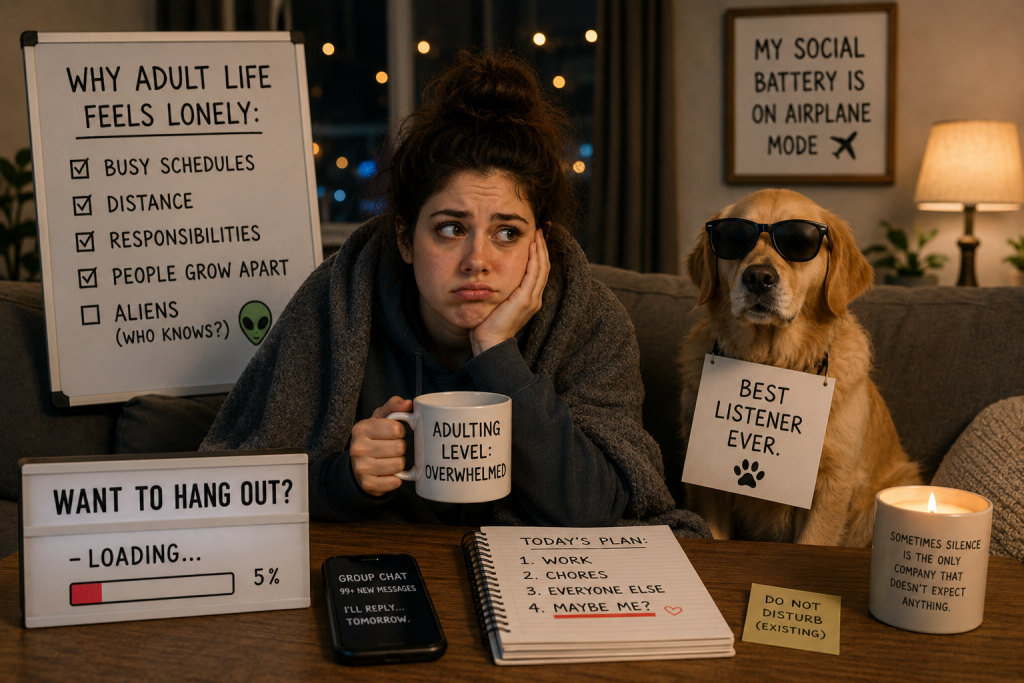
The Loneliness Hidden Inside Responsibility
Loneliness in adult life does not always look like sitting alone in a dark room.
Sometimes it looks like being surrounded by people who need you.
Sometimes it looks like answering messages all day, but never saying what you really feel.
Sometimes it looks like having a family, coworkers, neighbors, online friends, and a full calendar, yet still feeling like nobody truly sees how heavy things have become.
That is one of the sneakiest parts of adult responsibility.
You can be needed and lonely at the same time.
You can be loved and lonely at the same time.
You can be busy and lonely at the same time.
You can be the person everyone counts on and still feel like there is no safe place to put your own stress.
That kind of loneliness is hard to explain because it does not always make sense from the outside.
People may look at your life and think, “How can you feel lonely? You have people around you.”
But being around people is not the same as being known.
Talking is not the same as being understood.
Being useful is not the same as being supported.
That is where many adults get stuck.
They become useful.
They become dependable.
They become the strong one.
They become the person who remembers, handles, fixes, drives, pays, plans, checks, and keeps going.
And because they keep going, people assume they are okay.
That assumption can feel very lonely.
The CDC explains that social connection can support health and lower the risk of depression, anxiety, heart disease, stroke, dementia, and other serious concerns. That matters because loneliness is not just a sad feeling. It can affect the body, the mind, and the way people move through daily life.
This is why the loneliness hidden inside responsibility deserves more honesty.
It is not always about having no one.
Sometimes it is about having no room to be honest with the people you do have.
Being surrounded by people but still feeling alone
One of the most confusing parts of adult loneliness is feeling alone when people are right there.
You can be in a house full of noise and still feel alone.
You can sit at a dinner table and still feel far away.
You can be at work all day, talking to people, answering questions, making small talk, and still go home feeling like no one actually knows you.
That kind of loneliness is not about the number of people around you.
It is about the depth of connection.
A person can hear you talk and still not hear what you mean.
A person can ask how you are and still not be ready for the real answer.
A person can love you and still miss the signs that you are worn down.
That does not always mean they are bad people.
Sometimes they are tired too.
Sometimes they are carrying their own stress.
Sometimes everyone in the house is silently drowning in a different corner, politely waving at each other like, “Good luck over there.”
That is adult life sometimes.
Messy.
Busy.
Full of love.
Still lonely.
Being surrounded by people can even make loneliness feel worse because it creates a strange kind of guilt.
You think, “I should not feel this way.”
You think, “I have people.”
You think, “Other people have it worse.”
You think, “Maybe I am just being dramatic.”
But loneliness is not always logical.
It is not a math problem.
You do not add up the people in your life and then decide if you are allowed to feel alone.
Loneliness is a signal.
It often means something is missing.
Not always a person.
Sometimes it is honesty.
Sometimes it is rest.
Sometimes it is emotional safety.
Sometimes it is the feeling of being seen without having to perform.
Adults often lose that because adult life teaches people to function more than feel.
You go to work.
You pay bills.
You make appointments.
You take care of people.
You answer what needs answering.
You become good at moving through the day.
But being good at functioning can hide how disconnected you feel inside.
It is possible to be very responsible and very lonely.
In fact, responsibility can make loneliness worse because responsibility often forces people to hide their needs.
A parent may not want to scare their kids.
A partner may not want to add stress to the marriage.
A worker may not want to seem unprofessional.
A friend may not want to be “too much.”
A caregiver may feel there is no space for their own feelings because someone else’s needs are bigger.
So they carry it.
They tell themselves, “Later.”
Later I will rest.
Later I will talk.
Later I will cry.
Later I will ask for help.
Later I will be honest.
But later keeps moving.
Then months pass.
Then years pass.
And suddenly a person realizes they have been living near people, but not really letting anyone close to the truth.
This does not happen all at once.
It happens slowly.
You share less because people are busy.
You stop calling because you do not want to bother anyone.
You keep answers short because explaining everything feels tiring.
You pretend you are okay because it is faster.
Then one day someone asks, “How have you been?” and you honestly do not know how to answer without opening a box you may not be able to close.
So you say, “Good.”
That one word can feel like a locked door.
The CDC notes that lack of social connection is common, with about one in three adults in the United States reporting loneliness. That number matters because it proves something many people need to hear: if you feel lonely as an adult, you are not some rare broken case. You are part of a very real human problem.
And yet, many adults keep treating loneliness like a personal failure.
They think they should have more friends.
They think they should be better at staying in touch.
They think they should not feel alone because they have family.
They think they should be past this by now.
But loneliness does not care how old you are.
It does not care if you have a job, kids, a marriage, a house, or a dog that judges you from the couch.
Loneliness can show up anywhere there is a gap between what you carry and what you can share.
That gap is the painful part.
Here is a simple way to understand it.
| What Life Looks Like | What It Can Feel Like Inside |
|---|---|
| A busy home | No quiet space to be honest |
| A full workday | Lots of talk, little connection |
| A relationship | Loved, but not always understood |
| Parenting | Needed all day, seen less as a person |
| Caregiving | Responsible for others, emotionally alone |
| Online connection | Many updates, few real conversations |
That table is important because many adults judge loneliness by what their life looks like.
But loneliness is not about looks.
It is about connection.
Real connection sounds different.
It sounds like, “Tell me what’s really going on.”
It sounds like, “You do not have to fix this before you talk about it.”
It sounds like, “I can listen without turning this into advice.”
It sounds like, “You are not a burden.”
It sounds like, “I get it.”
That kind of connection can be rare in adult life, but it is needed.
People do not only need help doing things.
They need help being human.
That is one reason Nobody Told Me About This Part of Adult Life matters. It gives words to the loneliness that can hide behind being responsible, busy, useful, and “fine.”
Because many people are not lonely because nobody loves them.
They are lonely because nobody knows how much they are holding.
Why adulthood can make friendships harder
Friendship is different when you are young.
You do not always have to plan it.
It happens around you.
School puts people near you.
Sports put people near you.
Jobs when you are younger may feel more social.
Neighborhoods feel smaller.
Time feels bigger.
You can spend hours doing nothing with someone and somehow that counts as a full event.
Then adult life shows up and says, “That was cute. Anyway, here are bills, work schedules, kids, health issues, aging parents, debt, tiredness, and a group chat nobody answers for three weeks.”
Adult friendships get harder because adult life gets crowded.
Not always bad crowded.
Just full.
People work different hours.
People move away.
People get married.
People have kids.
People divorce.
People care for family.
People take second jobs.
People deal with health problems.
People get tired.
People change.
People disappear into their own lives, not because they stopped caring, but because surviving the week took all the energy they had.
That can hurt even when you understand it.
You may still love your old friends.
You may still think about them.
You may still laugh at memories.
But staying close takes more effort than it used to.
And effort is hard when everyone is exhausted.
Adult friendship often requires planning.
Planning requires energy.
Energy is already low.
So people drift.
Not because anyone did something wrong.
Because life got loud.
This is why “We should get together soon” becomes the official national anthem of adult friendship.
People mean it.
They really do.
But then life happens.
A kid gets sick.
Work runs late.
Money gets tight.
Someone feels too drained.
Someone forgets to reply.
Someone sees the message, plans to answer later, and then later becomes next Thursday.
Nobody hates anybody.
Everyone is just tired.
Friendships also get harder because adults may become more guarded.
When you are younger, it can be easier to open up.
You have less history.
Less disappointment.
Less fear of being judged.
As adults, people often carry old hurts.
They may have been betrayed.
They may have lost friends.
They may have outgrown people.
They may have trusted the wrong person.
They may have learned that some people use private pain as public entertainment.
So they become careful.
That caution makes sense.
But it can also make connection harder.
You may want close friendship but fear the risk.
You may want to be known but not want to explain your whole backstory.
You may want support but not want to seem needy.
You may want to text someone but think, “They are probably busy.”
Then you do nothing.
And the silence grows.
The American Psychological Association has written about social isolation and how loneliness is linked with depression, poor sleep quality, and other health concerns. That is important because adult friendship is not just a cute extra. Real connection is part of how people stay well.
But the modern adult schedule does not always make room for that.
A lot of adults are living in maintenance mode.
They maintain the job.
Maintain the bills.
Maintain the house.
Maintain the family.
Maintain the body.
Maintain the car.
Maintain the inbox.
By the time friendship asks to be maintained too, people may feel tapped out.
The sad part is friendship could help with that exhaustion.
But exhaustion often keeps people from reaching for friendship.
That is the loop.
You feel lonely, but too tired to reach out.
You need people, but do not have the energy to plan.
You want deeper talks, but small talk is easier.
You want to reconnect, but the longer it has been, the harder the first message feels.
So how do adults make friendship less impossible?
They lower the pressure.
Not every friendship has to be a big dinner.
Not every hangout has to be a planned event.
Not every call has to be long.
Not every text needs the perfect words.
Sometimes friendship looks like:
- “Thinking of you.”
- “No need to reply fast.”
- “This made me laugh.”
- “Want to walk this week?”
- “I miss you.”
- “Life has been a lot. Can we catch up soon?”
- “I have no energy to be interesting, but I’d still like to see you.”
That last one may be the most adult sentence ever written.
Sometimes adults do not need exciting friendship.
They need low-pressure friendship.
They need the kind where you can show up tired.
The kind where the house does not have to be perfect.
The kind where nobody cares if dinner is pizza.
The kind where you can sit on the porch, complain about your backs, laugh at dumb memories, and call it healing.
Friendship does not always need more sparkle.
Sometimes it needs less performance.
That is a big lesson in adult life.
The older you get, the more you may value people who let you be real.
Not impressive.
Not polished.
Not always funny.
Just real.
Here is a simple look at why adult friendship gets harder and what can help.
| Why Friendship Gets Harder | What Can Help |
|---|---|
| Busy schedules | Plan smaller, easier meetups |
| Low energy | Choose low-pressure connection |
| Distance | Use calls, voice notes, or simple texts |
| Family responsibilities | Include real life instead of waiting for perfect timing |
| Fear of bothering people | Send short, honest messages |
| Drifting apart | Restart gently without guilt |
| Feeling awkward | Admit it instead of pretending |
A lot of adult friendships do not need to end.
They just need a softer way back.
People are often more open than we think.
They may be sitting on their side of life feeling lonely too.
They may also be wondering if too much time has passed.
They may also be afraid to reach first.
Someone has to go first.
It does not always have to be you.
But sometimes it can be.
A simple message can reopen a door.
Not every door will open.
That is okay.
Some friendships were for a season.
Some people cannot meet you where you are now.
Some relationships fade because life changes.
That hurts, but it does not mean you failed.
It means you are alive and your life is moving.
Still, adult friendship is worth protecting where it is healthy.
Because having someone who knows the real version of you matters.
Someone who remembers who you were before the bills got loud.
Someone who can hear one sentence and know there is more underneath.
Someone who does not need you to perform.
Someone who can laugh with you about the absurd parts of adulthood and sit with you through the heavy ones.
That kind of friendship is not small.
It is medicine for the soul, even if it comes with bad coffee and a messy kitchen.
Carrying stress without wanting to burden others
One of the loneliest things adults do is carry stress quietly because they do not want to burden anyone else.
They tell themselves it is kindness.
And sometimes it is.
You do not want to dump everything on your spouse after their hard day.
You do not want to worry your kids.
You do not want to call a friend who is already dealing with their own mess.
You do not want to make your parents afraid.
You do not want coworkers to see you struggle.
You do not want to be “that person.”
So you hold it.
You hold the money stress.
You hold the health worry.
You hold the work fear.
You hold the family tension.
You hold the grief.
You hold the resentment.
You hold the guilt.
You hold the thought that maybe you are not doing enough, even though you are doing a lot.
At first, holding it may feel strong.
After a while, it feels heavy.
Then it starts to feel normal.
That is where people get stuck.
They get so used to being quiet about their stress that silence becomes their default setting.
Someone asks how they are, and the truth rises up for half a second.
Then the old habit shuts it down.
“I’m good.”
That answer may protect others from worry.
But it also protects you from support.
That is the painful trade.
You cannot be comforted for pain you never reveal.
You cannot be helped with a weight you never show.
You cannot be fully known if the hardest parts of your life are always hidden behind “I’m fine.”
Of course, nobody should be forced to share everything with everyone.
Privacy matters.
Boundaries matter.
Timing matters.
Safe people matter.
But carrying everything alone is not the same as having boundaries.
Sometimes it is fear wearing a responsible outfit.
You may fear being judged.
You may fear being dismissed.
You may fear someone will try to fix you.
You may fear they will make it about themselves.
You may fear they will say, “That’s nothing.”
You may fear they will not care.
Those fears may come from real experiences.
Many adults have opened up before and regretted it.
Maybe someone laughed.
Maybe someone gave bad advice.
Maybe someone used their pain against them.
Maybe someone got uncomfortable and changed the subject.
So now they keep things in.
That makes sense.
But the answer is not to never open up again.
The answer is to choose better places for the truth.
Some people earn deeper access.
Some do not.
Not everyone gets the whole story.
But someone safe should get more than the mask.
Stress becomes more dangerous when it has nowhere to go.
The National Institute of Mental Health notes that self-care and support can play a role in mental health and quality of life. That does not mean talking fixes everything. But it does mean people are not built to carry life alone without care, support, and healthy outlets.
Adults often say, “I do not want to be a burden.”
That sentence sounds kind, but sometimes it hides a deeper belief.
The belief is, “My needs are too much.”
That belief can come from childhood.
It can come from past relationships.
It can come from being the strong one for too long.
It can come from always being praised for needing less.
But needing support does not make you a burden.
It makes you a person.
Burden is not the same as honesty.
There is a difference between dumping everything on someone with no care for their limits and saying, “I am having a hard time. Do you have space to listen?”
That one question is powerful.
It respects the other person.
It also respects you.
It gives the conversation a doorway instead of a flood.
Here are some softer ways to share stress without feeling like you are dropping a truckload on someone’s porch:
- “I do not need you to fix this. I just need to say it out loud.”
- “Do you have the energy to listen for a few minutes?”
- “I have been carrying something and could use a safe ear.”
- “I am overwhelmed, but I am not looking for advice right now.”
- “Can I be honest for a second?”
- “I know you have your own stuff too, so tell me if now is not a good time.”
- “I just need someone to know I am not as okay as I look.”
Those sentences can feel scary.
But they can also open a real connection.
They let people help in a clear way.
A lot of people want to help but do not know how.
When you tell them what you need, you make it easier.
You may need listening.
You may need advice.
You may need a ride.
You may need a break.
You may need someone to sit with you.
You may need someone to remind you that you are not failing.
Different needs require different support.
The problem is, many adults wait until they are near collapse before they say anything.
Then the need comes out as anger, panic, tears, or shutdown.
That does not make them bad.
It means they waited too long because they thought they had to.
A healthier path is to let some stress out before it becomes too much.
Small honesty is better than total breakdown.
A five-minute honest talk can prevent weeks of quiet resentment.
A simple “I need help tonight” can protect a relationship from silent bitterness.
A text that says “I am having a rough day” can remind you that you are not alone.
This also matters in families.
People who love you may not know what you are carrying unless you tell them.
They may see the tasks getting done and assume you are okay.
They may not see the cost.
They may not know you are tired of being the one who notices everything.
They may not know you need help unless you say it clearly.
Not with hints.
Not with angry sighs.
Not with slamming the cabinet in a way that suggests the plates have personally betrayed you.
With words.
Clear words are hard, but they help.
Here is a simple table showing the difference between silent carrying and healthy sharing.
| Silent Carrying | Healthier Sharing |
|---|---|
| “I’ll just deal with it.” | “I need help with this.” |
| “Nobody wants to hear this.” | “Can you listen for a few minutes?” |
| “I should be stronger.” | “This has been heavy for me.” |
| “I do not want to bother anyone.” | “I need some support right now.” |
| “It is fine.” | “It is not fine, but I am trying.” |
| “They should notice.” | “I need to tell them clearly.” |
Adult life gets lonely when people confuse silence with strength.
Real strength is not always silent.
Sometimes strength is saying, “I cannot keep carrying this by myself.”
Sometimes strength is asking for help before resentment turns you cold.
Sometimes strength is letting someone love the real version of you, not just the useful version.
That is not weakness.
That is connection.
And connection is one of the things that makes adult life less heavy.
The silence behind “I’m good”
“I’m good” may be the most overworked sentence in adult life.
It does too much.
It answers questions.
It ends conversations.
It protects privacy.
It hides pain.
It keeps people moving.
It lets everyone pretend things are okay for a little longer.
Sometimes “I’m good” is true.
Sometimes it means, “I am actually fine.”
Other times, it means something very different.
It can mean, “I am too tired to explain.”
It can mean, “I do not trust this moment with the truth.”
It can mean, “If I start talking, I might cry.”
It can mean, “I do not want advice.”
It can mean, “I am not okay, but I do not know what I need.”
It can mean, “Please notice that I am not good, because I do not know how to say it.”
That is the silence behind the phrase.
Adults use “I’m good” because it is easy.
It is socially safe.
It does not make people uncomfortable.
It does not slow the day down.
It does not require a full emotional report.
It is the verbal version of stuffing everything into a closet before company comes over.
The problem is, the closet gets full.
At some point, all that hidden stress starts leaning against the door.
And one day someone asks one small question, or one tiny thing goes wrong, and the whole closet falls open.
Then people act surprised.
But the pain was not sudden.
It was stored.
Adults store pain in strange places.
They store it in jokes.
They store it in busyness.
They store it in work.
They store it in scrolling.
They store it in silence.
They store it in helping everyone else.
They store it in saying “I’m good” so many times that even they start to believe it should be true.
This is why honest self-checks matter.
Not dramatic ones.
Just real ones.
Instead of asking, “Am I okay?” ask better questions.
What am I avoiding?
What feels heavy right now?
What do I keep pretending does not bother me?
What do I need but keep dismissing?
Who feels safe enough to tell the truth to?
What would I say if I knew nobody would judge me?
Those questions can bring the hidden stuff closer to the surface.
And once something has a name, it can be handled with more care.
The silence behind “I’m good” can also be a sign that a person does not feel emotionally safe.
Emotional safety means you can be honest without being mocked, punished, dismissed, or turned into a problem.
Without emotional safety, people edit themselves.
They shrink the truth.
They make pain sound smaller.
They say, “It’s not a big deal,” even when it is.
They say, “I’m just tired,” because tired sounds easier than lonely, scared, sad, or overwhelmed.
The problem is that “just tired” often becomes the cover story for everything.
Sometimes you are not just tired.
Sometimes you are lonely.
Sometimes you are burned out.
Sometimes you are grieving.
Sometimes you are scared about money.
Sometimes you are carrying years of pressure.
Sometimes you are trying to be strong for everyone and losing touch with yourself.
The Harvard Study of Adult Development has long pointed to the importance of warm relationships for health and happiness. That does not mean every person needs a huge social circle. It means meaningful connection matters.
And meaningful connection usually requires more truth than “I’m good.”
Not with everyone.
Not all the time.
But somewhere.
With someone.
Even if it starts small.
You do not have to hand someone your whole heart at once.
You can start with a crack in the door.
“I have been more tired than usual.”
“I have been feeling kind of alone lately.”
“I am not sure why, but life feels heavy right now.”
“I do not need a solution. I just needed to say that.”
Those are small sentences.
But they are real.
And real sentences can break long silences.
This is also why readers connect with honest books and honest posts. When a piece of writing says what they have been hiding, it gives them language. It helps them feel less strange. It reminds them they are not the only adult silently wondering why life feels so heavy.
That is the heart behind Nobody Told Me About This Part of Adult Life. It is not about making adult life sound hopeless. It is about making the hidden parts less lonely.
Because once the hidden thing is named, it becomes less shameful.
Once someone says, “Me too,” the room changes.
The silence loses power.
The mask gets lighter.
And maybe the next time someone asks how you are, you do not have to give the full answer, but you can give a truer one.
“I’m hanging in.”
“I’ve been better.”
“Honestly, it’s been a lot.”
“I could use a break.”
“I’m trying.”
Those answers are still simple.
But they are more human.
They let a little truth breathe.
That little truth may be enough to start a better conversation.
The loneliness hidden inside responsibility does not always need a huge fix.
Sometimes it starts changing when one person stops pretending they are fine.
Sometimes it changes when one friend reaches out.
Sometimes it changes when a partner finally says, “I did not know you felt that way.”
Sometimes it changes when someone says, “I thought it was just me.”
It is not just you.
Many adults are surrounded by people and still aching to be understood.
Many are carrying stress quietly because they do not want to burden others.
Many are missing friends they have not called because life got too full.
Many are saying “I’m good” while hoping someone will hear the pause after it.
That loneliness is real.
But it is not a life sentence.
Connection can be rebuilt.
Friendships can be softened back open.
Truth can be shared in small pieces.
Support can be asked for before the breaking point.
And being responsible does not have to mean being alone.
You are allowed to be needed and still have needs.
You are allowed to love people and still need support from them.
You are allowed to be strong and still say, “I need someone right now.”
That is not failing adulthood.
That is finally telling the truth about it.
Why Adult Life Can Feel Like Survival Mode
Survival mode is not always dramatic.
It does not always look like a movie scene where someone is running from danger.
Sometimes survival mode looks like waking up, staring at the ceiling, and thinking, “Alright. Let’s do this again.”
Sometimes it looks like drinking coffee while already feeling tired.
Sometimes it looks like getting through work, getting through dinner, getting through messages, getting through chores, getting through bedtime, and then realizing you never actually felt present for any of it.
You were there.
You did the things.
But inside, you were just trying to make it to the next hour.
That is survival mode.
It is when life stops feeling like something you are living and starts feeling like something you are managing.
It is when your main goal becomes “get through today.”
Not grow.
Not dream.
Not enjoy.
Not feel deeply.
Just get through it.
And the tricky part is, a lot of adults do not notice when survival mode becomes normal.
They think they are just busy.
They think they are just tired.
They think this is simply what grown-up life feels like.
But there is a difference between normal responsibility and constant emotional bracing.
Normal responsibility says, “I have things to do.”
Survival mode says, “If one more thing happens, I might crack.”
That is a very different feeling.
And many adults are living much closer to that edge than they admit.
Living from one problem to the next
One of the clearest signs of survival mode is living from one problem to the next.
You wake up and already know there is something waiting.
A bill.
A work issue.
A family need.
A health worry.
A car problem.
A house problem.
A message you have been avoiding.
A task you forgot.
A conversation you do not want to have.
You handle one thing, then another thing appears.
You fix one problem, then life hands you a fresh one like it came with a subscription plan.
This is why adult life can start to feel less like living and more like damage control.
You are not planning from a place of peace.
You are reacting from a place of pressure.
Something happens.
You respond.
Something breaks.
You fix it.
Someone needs you.
You show up.
A bill arrives.
You adjust.
Work gets stressful.
You push through.
Then another thing comes.
Then another.
Then another.
After a while, your brain starts expecting trouble.
Even during calm moments, you may not feel calm.
You may feel suspicious.
You may sit down and think, “What am I forgetting?”
That thought alone can ruin rest.
Because even when nothing is happening, your mind is waiting for something to happen.
That is survival mode doing its thing.
It teaches your body to stay ready.
Ready for the next bill.
Ready for the next bad call.
Ready for the next disappointment.
Ready for the next person needing something.
Ready for the next little disaster with a very annoying sense of timing.
The National Institute of Mental Health explains that stress is how the brain and body respond to demands or challenges, and that long-term stress can affect health. That matters because adult survival mode is often not one big event. It is long-term pressure that keeps repeating.
One problem does not usually break a person.
The pattern does.
It is the feeling that there is never enough time between problems to truly recover.
That is what wears people down.
A flat tire is stressful.
A flat tire after a bad week, poor sleep, high bills, work stress, and family tension feels like the universe is throwing chairs.
The tire may be the same problem.
But the person dealing with it is not in the same condition.
That is why small things can hit so hard in survival mode.
They land on top of everything else.
Many adults start living in short emotional sprints.
Get through Monday.
Get through the meeting.
Get through the appointment.
Get through dinner.
Get through the week.
Get through the month.
Get through this bill cycle.
Get through this rough patch.
The problem is, some rough patches do not end quickly.
They stretch.
Then “just get through this” becomes the way you live.
You stop asking what you want.
You stop asking what would make life better.
You stop asking what you need.
You only ask, “What has to be handled next?”
That question is useful in a crisis.
It is not a great long-term way to live.
Because if your whole life becomes “what’s next,” you lose touch with “what matters.”
You may still be functioning.
You may still look responsible.
You may still get compliments for being strong.
But inside, you may feel like a tired machine with bills.
That is not a full life.
That is survival.
Here is what living from one problem to the next can look like.
| Survival Mode Pattern | What It Looks Like | What It Feels Like |
|---|---|---|
| Constant reacting | Handling problems as they appear | No room to breathe |
| Always bracing | Expecting something to go wrong | Tense even during calm moments |
| Short-term thinking | Just trying to get through today | Future feels too heavy to plan |
| Emotional shutdown | Not feeling much beyond stress | Numb, flat, or disconnected |
| No recovery time | Moving from one issue to another | Tired even after resting |
| Problem stacking | Small issues piling up | Everything feels bigger than it is |
The hard part is that adults often praise survival mode.
They call it discipline.
They call it toughness.
They call it being responsible.
And sometimes it is.
There are seasons where you have to push through.
There are times when life is hard and you simply have to keep moving.
That does not make you weak.
That makes you human.
But living that way forever comes at a cost.
If every day is treated like an emergency, your body and mind do not get a chance to stand down.
You may begin to forget what normal calm feels like.
You may feel guilty when things are quiet.
You may not know how to rest without waiting for the next problem.
This is where honest writing helps.
A book like Nobody Told Me About This Part of Adult Life does not pretend adulthood is simple. It names the hidden parts, including the way adults can spend years surviving while everyone thinks they are fine.
And that matters.
Because once you can name survival mode, you can stop mistaking it for your personality.
You are not naturally impatient.
You may be overloaded.
You are not lazy.
You may be drained.
You are not cold.
You may be emotionally shut down from carrying too much.
You are not bad at adult life.
You may be stuck in a pattern where every day asks more from you than it gives back.
That pattern can change.
Not overnight.
Not with one magical morning routine.
But with small steps that give you more room to breathe.
Constant decision-making and stress
Adult life is full of decisions.
Some are big.
Some are tiny.
Some are so tiny they should not even count, but somehow they still drain your brain.
What should we eat?
What bill should I pay first?
Should I answer this now?
Do I need to call the doctor?
Can this wait?
Should I save money or fix the thing?
Should I rest or clean?
Should I say yes?
Should I say no?
Should I bring this up?
Should I let it go?
Should I buy the cheaper one or the one that might last longer?
Should I worry about this weird pain or pretend my body is just being dramatic again?
Decision after decision after decision.
That is adult life.
And while each choice may seem small, the pile gets heavy.
This is called decision fatigue.
It is what happens when the brain gets tired from making too many choices.
You may start the day clear and patient.
By evening, someone asks what you want for dinner and you feel personally attacked by the concept of food.
It is not about dinner.
It is about one more decision.
One more choice.
One more thing that requires thought when your brain is already running on fumes.
This is why many adults end up saying, “I don’t care. Pick anything.”
And they mean it.
They are not trying to be difficult.
They are out of decision energy.
The American Psychological Association explains that stress can affect the body in many ways, including muscles, breathing, hormones, digestion, and the nervous system. That matters because constant stress and constant decision-making do not stay in the mind only.
They show up in the body.
Tight shoulders.
Clenched jaw.
Headaches.
Stomach trouble.
Trouble sleeping.
Low energy.
Short patience.
Feeling wired and tired at the same time.
That “wired and tired” feeling is one of the strangest parts of survival mode.
You are exhausted, but you cannot relax.
You want to sleep, but your brain starts hosting a town hall meeting at 11:47 p.m.
Agenda items include:
- Money
- Work
- That one awkward thing you said in 2013
- Whether the car needs brakes
- The future
- Death
- Dinner tomorrow
- Why you are like this
Very helpful.
Thank you, brain.
Constant decision-making also makes adults feel responsible for outcomes they cannot fully control.
You make the best choice you can.
Then you worry.
What if I picked wrong?
What if this backfires?
What if I missed something?
What if I should have known better?
That kind of pressure is exhausting because adult decisions often carry real consequences.
A bad money choice can hurt.
A bad job choice can change your life.
A bad health choice can scare you.
A bad relationship choice can leave marks.
So adults learn to think hard.
Then overthink.
Then double-check.
Then question themselves.
Then mentally rehearse every possible disaster.
That is survival mode dressed up as “being careful.”
Some caution is wise.
Constant fear is not.
But when life has hit you before, it makes sense that your mind tries to protect you.
It says, “We are not getting surprised again.”
So it scans for problems.
It plans.
It predicts.
It prepares.
It worries.
The problem is, worry feels like work, but it is often not the same as solving.
Worry can make you feel like you are doing something.
But sometimes you are only spinning.
That spinning can steal energy you need for real action.
One helpful question is:
“What is the next small real thing I can do?”
Not the next perfect thing.
Not the next forever plan.
Not the complete life rescue mission.
Just the next small real thing.
Pay the one bill.
Send the one message.
Wash the one load.
Write the one list.
Make the one call.
Step outside for five minutes.
Drink water like an actual mammal.
Adults in survival mode often need smaller steps because big plans can feel insulting when you are already overwhelmed.
Someone saying “just change your life” is not helpful when you are trying to find clean socks and not cry in the grocery store.
Small steps work better because they reduce the number of choices.
They give your brain a handle.
Here is a simple table for lowering decision stress.
| Decision Stress | Smaller Way to Handle It |
|---|---|
| “What do I do with this whole mess?” | Pick one area or one task |
| “How do I fix my life?” | Ask what would make today 5% easier |
| “What if I choose wrong?” | Choose the best option with what you know now |
| “Everything matters.” | Decide what actually matters today |
| “I need a full plan.” | Write the next three steps only |
| “I can’t think.” | Pause, breathe, eat, or rest before choosing |
This may sound simple.
But simple is powerful when your brain is tired.
A tired brain does not need more pressure.
It needs fewer open loops.
An open loop is anything your mind keeps coming back to because it is unfinished.
Bills.
Calls.
Emails.
Appointments.
Projects.
Repairs.
Hard talks.
All of those can stay open in your mind.
The more open loops you have, the more your brain keeps checking them.
That creates mental noise.
One reason adults feel stressed is not only because they have too much to do.
It is because they have too much unfinished in their head.
Writing things down can help.
Not because a list magically fixes life.
But because a list can move some of the pressure out of your brain and onto paper.
Your brain is not meant to be a junk drawer for every bill, thought, fear, and grocery item.
It needs space.
That is why people often feel a tiny bit better after making a list, even before doing the list.
The chaos has a shape now.
And once chaos has a shape, it feels slightly less like a monster under the bed.
Decision-making will always be part of adulthood.
But survival mode makes every decision feel like a threat.
The goal is not to remove every choice.
That is impossible.
The goal is to reduce the number of choices that do not need to be hard.
Have a simple dinner plan.
Automate what you can.
Use routines.
Repeat what works.
Stop making every day a custom-built emotional obstacle course.
You do not need to reinvent your whole life every morning.
Sometimes the kindest thing you can do is make a few parts of life boring on purpose.
Same breakfast.
Same bill day.
Same laundry day.
Same wind-down routine.
Same place for keys.
Same list system.
Boring is not failure.
Boring can be peace.
And peace is underrated when your nervous system has been living like a raccoon in a thunderstorm.
Feeling like there is never enough time
One of the loudest feelings in adult survival mode is the feeling that there is never enough time.
Not enough time to work.
Not enough time to rest.
Not enough time to clean.
Not enough time to cook.
Not enough time to sleep.
Not enough time to call people back.
Not enough time to exercise.
Not enough time to think.
Not enough time to be a person outside of your tasks.
Even when you technically have time, it may not feel usable.
You may have an hour at night, but you are too tired to enjoy it.
You may have a weekend, but it gets eaten by errands.
You may have a quiet moment, but your mind fills it with guilt.
This is why adult time feels different.
It is not only about hours.
It is about energy inside those hours.
A free hour after a draining day is not the same as a free hour when you feel rested.
A day off filled with chores is not the same as a real break.
A lunch break spent answering messages and worrying about bills is not the same as rest.
Adults often talk about needing more time.
But many also need more protected time.
Time that is not swallowed by tasks.
Time that is not used to catch up.
Time that is not spent preparing for the next demand.
Time where nobody needs anything for a minute.
That kind of time can feel almost impossible to get.
Especially for parents, caregivers, people working multiple jobs, people dealing with health issues, or anyone living paycheck to paycheck.
When survival mode takes over, the future also starts to shrink.
You stop thinking months ahead.
You stop dreaming as much.
You stop setting big goals because the day-to-day is already eating your energy.
Your life becomes a series of immediate needs.
Today’s bills.
Today’s work.
Today’s dinner.
Today’s problem.
Today’s tired.
There is nothing wrong with focusing on today during hard times.
Sometimes that is exactly what you have to do.
But when every season becomes “just get through today,” the soul starts to feel cramped.
People need more than tasks.
They need hope.
They need space.
They need little things to look forward to.
They need moments that are not about being useful.
That is where many adults feel starved.
Not for food.
Not for stuff.
For breathing room.
The CDC’s guidance on managing stress includes making time to unwind, taking breaks, connecting with others, and caring for the body. That sounds basic, but in survival mode, basic needs are often the first things to get pushed aside.
People skip meals.
They delay appointments.
They ignore sleep.
They stop moving.
They stop talking.
They stop having fun.
They stop doing small things that make them feel like themselves.
Then they wonder why life feels flat.
It feels flat because survival mode removes color.
Everything becomes duty.
Everything becomes “must.”
I must work.
I must pay.
I must clean.
I must answer.
I must show up.
I must handle it.
That many “musts” can make life feel like a hallway with no windows.
This is why adults need small pockets of “want” again.
What do I want to listen to?
What would make this room feel nicer?
Who do I miss?
What would make me laugh?
What meal sounds good?
What can I do for ten minutes that is not productive?
What would make today feel less like a treadmill?
These questions may seem small, but they matter.
Survival mode makes people forget they are allowed to want things.
Not huge things.
Not selfish things.
Just human things.
A quiet cup of coffee.
A walk.
A song.
A nap.
A real conversation.
A clean corner.
A chapter of a book.
A drive with no purpose.
A laugh that is not forced.
A night where dinner is easy and nobody acts like frozen pizza is a moral failure.
Sometimes reclaiming your life starts with tiny pockets of time that belong to you.
Not the whole day.
Maybe ten minutes.
Maybe twenty.
Maybe one hour a week.
But something.
Something that reminds your nervous system that life is not only danger, duty, and deadlines.
Here is a simple way to think about time in survival mode.
| Time Problem | What It Often Means | A Small Shift |
|---|---|---|
| “I have no time.” | Too many demands and not enough support | Pick one thing to simplify |
| “I waste time scrolling.” | Brain is trying to escape | Choose a real rest break first |
| “I can’t relax.” | Mind is still in threat mode | Make a short shutdown routine |
| “My days disappear.” | Life is all tasks, no anchors | Add one small daily anchor |
| “I feel behind all day.” | Expectations are too high for your capacity | Cut or delay one non-urgent thing |
| “I never get time for me.” | Your needs are last every day | Schedule a small non-negotiable pause |
A daily anchor is something small that helps you feel grounded.
It does not have to be impressive.
It could be:
- Coffee outside for five minutes
- A short walk
- Writing one honest sentence
- Stretching before bed
- Reading two pages
- Playing one song before work
- Sitting in the car quietly before going inside
- Taking a shower without rushing
- Turning your phone off for ten minutes
These things do not solve all adult problems.
But they remind you that you exist outside of problems.
That matters.
The feeling of never enough time can also come from saying yes too often.
Adults say yes for many reasons.
They do not want to disappoint people.
They do not want conflict.
They want to be helpful.
They feel guilty.
They think they “should.”
But every yes spends time and energy.
And if you keep saying yes to everything, you may end up saying no to your own peace without noticing.
A healthier adult life often requires smaller, clearer no’s.
“No, I can’t today.”
“I need to rest tonight.”
“That does not work for me.”
“I can help, but not right now.”
“I can do this part, but not all of it.”
These sentences can feel uncomfortable at first.
But they protect the little time you do have.
And sometimes protecting time is protecting your mind.
The truth is, you may not be able to create a perfect schedule.
Most adults cannot.
Life is too messy.
But you may be able to create slightly more breathing room.
And when you are in survival mode, slightly matters.
Five percent easier matters.
Ten minutes of quiet matters.
One less decision matters.
One honest no matters.
One simple dinner matters.
One clear list matters.
One person knowing you are overwhelmed matters.
Small things matter because survival mode is often built out of small pressures.
So healing may also start with small relief.
How survival mode slowly becomes normal
Survival mode becomes normal when people live under pressure for so long that they stop questioning it.
At first, they know they are stressed.
They say, “This is just a hard week.”
Then it becomes a hard month.
Then a hard season.
Then life keeps throwing things at them.
Eventually, their body and mind adapt.
They get used to being tense.
They get used to being tired.
They get used to rushing.
They get used to not sleeping well.
They get used to feeling behind.
They get used to having no space.
They get used to saying, “It is what it is.”
That sentence can be useful.
It can also become a trap.
Because not everything that is normal is healthy.
And not everything you are used to is okay.
Sometimes adults do not realize how stressed they were until life gets quiet for a moment and their body finally crashes.
They take a day off and get sick.
They sit still and feel sad.
They go on vacation and cannot relax.
They finally get a quiet night and feel restless instead of peaceful.
That can be confusing.
But it makes sense.
When your system has been running on high alert, quiet can feel strange.
Your body may not trust it at first.
It may keep scanning for the next problem.
It may feel safer to stay busy because busy keeps feelings away.
That is another way survival mode becomes normal.
Busyness becomes a shield.
If you stay busy, you do not have to feel everything.
If you keep moving, you do not have to face how tired you are.
If you keep handling things, you do not have to ask whether the way you are living is hurting you.
But feelings do not vanish just because you outrun them.
They wait.
Usually at night.
Very rude.
Survival mode also becomes normal because people around you may be living the same way.
If everyone is tired, tired starts to look normal.
If everyone is overwhelmed, overwhelm starts to look normal.
If everyone jokes about burnout, burnout starts to look normal.
If everyone is too busy for real connection, loneliness starts to look normal.
That does not mean it is good.
It means the culture around adult life often rewards over-functioning.
People praise the person who never stops.
They admire the one who keeps working.
They call people strong when they push past their limits.
But they do not always ask whether that strength is costing too much.
The Mayo Clinic’s overview of stress symptoms explains that stress may affect the body, mood, and behavior, including sleep problems, anxiety, lack of motivation, irritability, and changes in eating or social habits. That is important because survival mode is not just an attitude. It can change how you live.
You may stop reaching out.
You may stop caring about things you used to enjoy.
You may become more guarded.
You may lose patience faster.
You may feel numb.
You may feel like every request is too much.
You may start living on autopilot.
Autopilot can help for a while.
It gets you through.
It helps you function.
It lets you keep moving when you do not have time to fall apart.
But autopilot is not meant to be a permanent address.
You are supposed to come back to yourself.
That is the part many adults miss.
They survive so long that they forget they are allowed to live.
They forget that joy matters.
They forget that rest matters.
They forget that connection matters.
They forget that their own needs count too.
They become excellent at managing life and terrible at feeling alive inside it.
That is a sad trade.
And many people do not even notice they made it.
Survival mode slowly becomes normal through small compromises.
You skip rest once.
Then again.
You stop calling friends.
You stop making plans.
You stop cooking meals you enjoy.
You stop going outside.
You stop reading.
You stop laughing as much.
You stop telling the truth.
You stop expecting life to feel good.
You tell yourself, “This is just adulthood.”
But it is not all adulthood.
It is stressed adulthood.
It is overloaded adulthood.
It is unsupported adulthood.
It is adult life without enough recovery.
There is a difference.
The goal is not to escape every responsibility.
That is not real.
Bills exist.
Work exists.
Family needs exist.
Bodies need care.
Homes need cleaning.
Life comes with problems.
But responsibility should not erase your whole self.
A healthier adult life does not mean no stress.
It means stress has places to go.
It means rest is allowed before collapse.
It means help is asked for before resentment.
It means small routines support you instead of punishing you.
It means you stop treating constant exhaustion like proof that you are doing life correctly.
Here are some signs survival mode may have become normal.
| Sign | What It May Mean |
|---|---|
| You feel guilty when resting | Your worth may feel tied to productivity |
| You cannot enjoy quiet | Your body may still be bracing |
| You snap over small things | Your stress load may be too high |
| You avoid people you love | Connection may feel like another demand |
| You feel numb often | Your mind may be protecting you from overload |
| You only think about today’s problems | The future may feel too heavy |
| You say “I’m fine” automatically | Honesty may not feel safe or easy |
Seeing yourself in that table does not mean you are broken.
It means something needs care.
And care does not have to start with a huge life change.
It can start with admitting the truth.
“I have been surviving more than living.”
That sentence can hurt.
But it can also open a door.
From there, you can ask:
What is draining me the most?
What can I simplify?
Where do I need help?
What am I pretending is fine?
What small thing would give me relief this week?
Who can I be more honest with?
What would help me feel like myself again?
These questions are not magic.
But they can interrupt the automatic pattern.
They can help you notice where survival mode has been running the show.
They can help you make one small change instead of waiting for your whole life to fall apart.
That is the heart of Nobody Told Me About This Part of Adult Life. It is not about pretending adult life is easy. It is about helping people see that constant survival is not the same as failure. It is a sign that the weight has been too much for too long.
You do not have to shame yourself for surviving.
Surviving got you here.
Survival mode may have protected you during hard seasons.
It may have helped you get through things no one saw.
It may have kept your life moving when you had no extra strength.
So do not hate that part of yourself.
Thank it.
Then ask if it can step back a little.
Because you deserve more than getting through the day.
You deserve moments where your shoulders drop.
You deserve laughter that does not feel forced.
You deserve rest that does not require total collapse first.
You deserve connection that does not make you perform.
You deserve a life that has room for more than problems.
Maybe not all at once.
Maybe not perfectly.
But little by little, survival mode can loosen.
One small honest choice at a time.
One boundary.
One real rest.
One simpler plan.
One conversation.
One quiet moment where you remember, “I am still in here.”
And that matters.
Because adult life can feel like survival mode.
But it does not have to stay there forever.
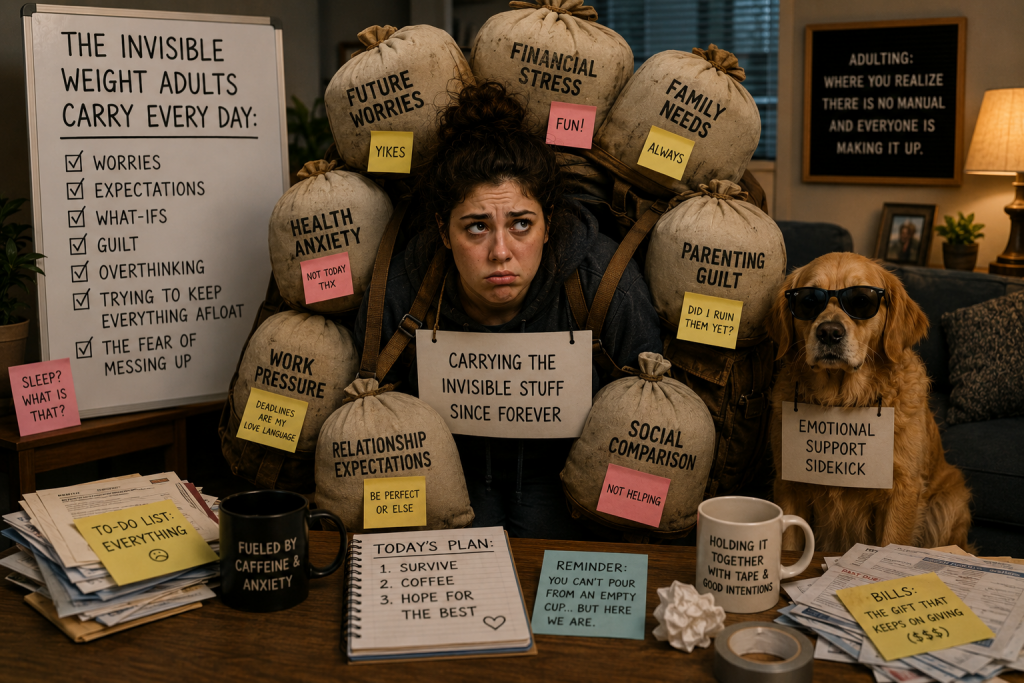
The Invisible Weight Adults Carry Every Day
The invisible weight adults carry every day is hard to explain because most of it cannot be seen.
You cannot always see worry.
You cannot always see fear.
You cannot always see the mental math someone is doing while they smile in a checkout line.
You cannot always see the old grief they are carrying into a normal Tuesday.
You cannot always see the way their chest tightens when they think about money, health, family, work, and the future all at once.
That is why this kind of weight gets missed.
People notice what is obvious.
They notice if you are late.
They notice if the house is messy.
They notice if you forgot something.
They notice if you seem quiet.
They notice if you snap.
But they may not notice the load you were carrying before any of that happened.
They may not know you woke up tired.
They may not know you checked your bank account before getting out of bed.
They may not know you are worried about someone you love.
They may not know your body has been hurting.
They may not know you are scared of falling behind.
They may not know you have been holding everything together with caffeine, duct tape, and the emotional power of “we’ll see.”
That is the invisible weight.
It is the stuff adults carry while still doing the visible things.
Working.
Driving.
Cooking.
Cleaning.
Answering.
Paying.
Planning.
Helping.
Showing up.
Trying again.
And because much of that weight is hidden, many adults start to believe they should be able to carry more than they actually can.
They think, “It is not that bad.”
They think, “Other people have it worse.”
They think, “I should be stronger.”
They think, “This is just life.”
Yes, some of it is life.
But that does not mean it is light.
A backpack full of bricks is still heavy even if everybody else is wearing one too.
That is one of the most honest truths about Being an Adult. A lot of the hardest parts are not dramatic enough for people to notice, but they still shape how tired, tense, and alone a person feels.
Worrying about money, health, and the future
Money worry is one of the most common invisible weights adults carry.
It may not show on your face, but it can follow you all day.
You can be at work and think about money.
You can be making dinner and think about money.
You can be trying to sleep and think about money.
You can be laughing with someone and still have a quiet little calculator running in the back of your mind like a haunted accountant.
Money is not just paper, numbers, or a banking app.
Money is safety.
Money is choices.
Money is time.
Money is repair.
Money is food.
Money is medicine.
Money is gas.
Money is housing.
Money is whether one emergency becomes a bad day or a full life crisis.
That is why money worry feels so deep.
It touches survival.
It touches dignity.
It touches the fear of needing help.
It touches the fear of letting people down.
Even people who are working hard can feel trapped by money stress.
They may pay one bill and watch another show up.
They may get a raise and still feel behind because groceries, insurance, rent, taxes, gas, and everything else decided to start acting brand new.
They may do the right thing over and over and still not feel safe.
That kind of stress can make adult life feel like walking on thin ice while holding a grocery bag full of responsibilities.
Health worry is another invisible weight.
When you are younger, you may treat your body like a rental car with no deposit.
You stay up late.
You eat whatever.
You ignore pain.
You bounce back.
Then adult life shows up and suddenly your body has opinions.
Your back has opinions.
Your knees have opinions.
Your stomach has opinions.
Your sleep has opinions.
Even your left eyebrow may start doing weird things for no reason, just to keep the plot interesting.
Health worry can become especially heavy because it mixes fear with uncertainty.
Is this stress?
Is this serious?
Should I call the doctor?
Can I afford the doctor?
Will this get worse?
What if I am not okay?
The National Institute of Mental Health explains that stress can affect both the brain and body, which matters because adults often feel stress physically before they even understand what is going on emotionally.
You may think you are “just tired,” but your body may be carrying tension for months.
You may think you are “just busy,” but your sleep, mood, stomach, and patience may be telling a bigger story.
The Mayo Clinic lists common stress effects, including headaches, sleep problems, upset stomach, anxiety, sadness, irritability, and changes in eating or social habits.
That is important because invisible weight does not always stay invisible.
It can show up in the body.
A tight jaw.
A sore neck.
A racing mind.
A heavy chest.
A stomach that acts like it read the news and took it personally.
Stress has a way of becoming physical when it has nowhere else to go.
Then there is future worry.
That one is tricky because the future has not happened yet, but somehow it still manages to stress people out today.
Adults worry about retirement.
They worry about kids.
They worry about aging parents.
They worry about jobs.
They worry about rent.
They worry about health.
They worry about whether they are making the right choices now for a future version of themselves who will probably still be confused, just with better reading glasses.
Future worry can feel endless because there is always something unknown.
And the unknown gives the brain too much room to create horror stories.
What if something happens?
What if I cannot handle it?
What if I lose what I have?
What if I never get ahead?
What if I am stuck like this?
What if I run out of time?
Those questions can drain a person even when nothing bad is happening in the moment.
That is the strange thing about worry.
It borrows pain from a future that may never arrive.
But the body often reacts as if it is already here.
That is why adults can feel exhausted by thoughts alone.
They did not run a race.
They ran through twenty possible futures before breakfast.
Here is a simple table showing common invisible worries and why they feel so heavy.
| Invisible Worry | Why It Feels Heavy |
|---|---|
| Money | It affects safety, choices, food, housing, and emergencies |
| Health | It brings fear, uncertainty, and a loss of control |
| The future | It creates stress over things that have not happened yet |
| Family needs | Love makes the responsibility feel personal |
| Work stability | Income, identity, and security may all feel tied to it |
| Aging | Time feels more real, and the body changes |
| Emergency costs | One surprise can shake the whole budget |
This is why adults need more compassion for themselves.
You may be carrying more than you think.
You may not be weak.
You may be weighed down.
There is a difference.
And if your body feels tired, tense, foggy, or short on patience, it may be worth asking, “What weight have I been carrying that I keep pretending is normal?”
That question can open the door to real care.
Not instant answers.
Not magic fixes.
But care.
And care matters.
Being strong for everyone else
Being strong for everyone else sounds noble.
And sometimes it is.
Families need strong people.
Children need steady people.
Partners need support.
Friends need someone to answer the phone.
Workplaces need people who can handle pressure.
Communities need helpers.
But being strong for everyone else can become painful when there is no place where you get to be tired.
That is where many adults get stuck.
They become the strong one.
The calm one.
The dependable one.
The fixer.
The listener.
The helper.
The person who handles the paperwork, makes the calls, remembers the appointments, notices the problem, checks on everyone, and somehow still has to figure out what is for dinner.
People trust them.
People need them.
People lean on them.
And that can feel meaningful.
But it can also feel lonely.
Because when everyone sees you as strong, they may forget you need support too.
They may forget to ask deeper questions.
They may assume you are fine because you are still functioning.
They may mistake your ability to keep going for proof that you are not hurting.
This is one of the quiet dangers of being “the strong one.”
Your strength can hide your stress.
You may even hide it from yourself.
You tell yourself, “I have to keep going.”
You tell yourself, “People need me.”
You tell yourself, “I cannot fall apart.”
You tell yourself, “Now is not the time.”
And maybe that is true for a while.
There are moments when life demands that you stand up.
But if “now is not the time” becomes every day for years, something inside you starts paying the price.
The strong one may become resentful.
Not because they do not love people.
Because they are tired of being needed more than they are seen.
They may become quiet.
They may stop sharing.
They may start snapping over small things.
They may feel guilty for wanting a break.
They may wonder why helping everyone else does not feel as good as it used to.
That does not mean they became selfish.
It means their giving has not been balanced with receiving.
A cup can only pour for so long before it is empty.
And no, buying a bigger coffee mug does not count as emotional support, although it does help spiritually.
The CDC’s stress management guidance includes making time to unwind, connecting with others, and taking care of the body. Those may sound basic, but strong people often ignore the basics first.
They skip rest because someone else needs them.
They skip meals because they are busy.
They skip checkups because there is no time.
They skip honest talks because they do not want to worry anyone.
They skip their own needs so often that those needs start feeling optional.
But human needs are not optional.
They only get louder when ignored.
Being strong for everyone else can also create identity pressure.
If you have always been the strong one, you may not know who you are when you need help.
You may feel embarrassed.
You may feel exposed.
You may feel like you are letting people down.
You may think, “I am supposed to be better than this.”
But strength does not mean never needing support.
Strength means knowing when the load is too much and being honest enough to say so.
That is not weakness.
That is wisdom.
A real quote often credited to Winston Churchill says:
“Success is not final, failure is not fatal: it is the courage to continue that counts.”
That quote fits here because adult strength is not about looking perfect.
It is about continuing with courage.
And sometimes courage looks like admitting, “I cannot carry this alone anymore.”
Strong people often need permission to be human.
So here it is.
You are allowed to need rest.
You are allowed to be helped.
You are allowed to say no.
You are allowed to not answer every call.
You are allowed to cry.
You are allowed to disappoint people sometimes.
You are allowed to stop being the emotional emergency room for everyone in your life.
You are allowed to be more than useful.
Here is what the strong-one role can look like from the outside and inside.
| What Others See | What the Strong One May Feel |
|---|---|
| Reliable | Exhausted from always being counted on |
| Calm | Afraid to show stress |
| Helpful | Tired of always giving |
| Organized | Mentally overloaded |
| Patient | Secretly close to snapping |
| Capable | Unsure where to put their own fear |
| Supportive | Lonely when no one supports them back |
This is why strong people need safe people.
Not crowds.
Not everyone.
Just a few safe people who can hear the truth without turning it into judgment.
Someone who can say, “You do not have to be strong with me right now.”
That sentence can feel like taking off a backpack.
A person who is always strong may not even know how badly they needed to hear it.
The book Nobody Told Me About This Part of Adult Life speaks to this kind of hidden pressure because many adults are not falling apart on the outside. They are quietly paying the cost of being dependable for too long without enough care in return.
Being strong is not bad.
Strength is beautiful when it is healthy.
But strength should not become a prison.
You can be strong and honest.
Strong and tired.
Strong and supported.
Strong and still need someone to check on you.
That balance matters.
Because being the strong one should not mean being the forgotten one.
Feeling responsible for things you cannot fully control
One of the heaviest parts of adult life is feeling responsible for things you cannot fully control.
That kind of pressure can drive a person crazy.
You can influence many things.
You can plan.
You can prepare.
You can save.
You can talk.
You can work.
You can help.
You can try your best.
But you cannot control everything.
You cannot control the economy.
You cannot control every health issue.
You cannot control how other adults behave.
You cannot control whether your child always makes good choices.
You cannot control every outcome at work.
You cannot control the past.
You cannot control traffic, weather, aging, other people’s moods, or the exact moment your washing machine decides to retire with no notice.
Still, many adults feel responsible anyway.
They feel responsible for everyone being happy.
Responsible for things going smoothly.
Responsible for avoiding conflict.
Responsible for preventing mistakes.
Responsible for keeping the family stable.
Responsible for making the right choice every time.
Responsible for fixing problems before anyone else even sees them.
That is too much.
It creates a life where your nervous system is always on duty.
You are not just living.
You are monitoring.
Checking.
Predicting.
Preventing.
Managing.
Overthinking.
You may believe if you think hard enough, worry enough, plan enough, and stay alert enough, you can stop bad things from happening.
But life does not work that way.
Some things happen no matter how careful you are.
That truth can feel scary.
It can also be freeing.
Because if you cannot control everything, then not everything is your fault.
That sentence matters.
Not everything is your fault.
Not every bad mood is your fault.
Not every family problem is your fault.
Not every delay is your fault.
Not every struggle your child has is your fault.
Not every relationship issue is yours to fix.
Not every emergency could have been prevented if you had just tried harder.
Adults often blame themselves because blame feels like control.
If it is my fault, then maybe I can stop it next time.
But some things are not that simple.
Some things are painful without being personal failure.
The American Psychological Association explains that stress affects many parts of the body, which is important here because trying to control the uncontrollable can keep the body stuck in long-term tension.
You may not notice it at first.
Then one day your shoulders are up by your ears.
Your jaw hurts.
Your stomach is tight.
Your sleep is broken.
Your patience is gone.
Your brain keeps making lists of things that might go wrong.
That is what happens when responsibility turns into over-responsibility.
Healthy responsibility says, “I will do my part.”
Over-responsibility says, “I must make sure nothing goes wrong.”
Those are not the same.
Healthy responsibility is adult.
Over-responsibility is exhausting.
It asks you to play manager of the universe with a tired brain and a phone battery at 12%.
No one can do that job.
Many adults learn over-responsibility early.
Maybe they grew up in a home where they had to watch everyone’s mood.
Maybe they were praised for being mature too young.
Maybe they had to care for others before they were ready.
Maybe mistakes were punished harshly.
Maybe love felt tied to being useful.
Maybe chaos taught them to stay alert.
Then as adults, they keep carrying that same pattern.
They feel responsible for peace.
Responsible for outcomes.
Responsible for other people’s comfort.
Responsible for things far outside their control.
It may have started as survival.
But later, it becomes a weight.
Letting go of over-responsibility does not mean becoming careless.
It means learning the difference between your part and everything else.
Your part may be:
- Speaking honestly
- Planning wisely
- Paying what you can
- Taking care of your body
- Asking for help
- Setting a boundary
- Showing up with love
- Making the best choice with the information you have
Everything else may include:
- Other people’s reactions
- The final outcome
- The past
- Random emergencies
- Other adults’ choices
- Things you could not know
- Things nobody could fully prevent
That line matters.
Without that line, life becomes one giant blame trap.
Here is a table that can help.
| Situation | Your Part | Not Fully Yours to Control |
|---|---|---|
| Family conflict | Speak clearly, stay respectful, set limits | How others react |
| Money stress | Budget, plan, ask for support, make choices | Rising costs, emergencies, job market |
| Health worry | Get care, follow advice, build habits | Every symptom or outcome |
| Parenting | Love, guide, teach, protect where possible | Every choice your child makes |
| Work pressure | Do your job, communicate, improve | Company changes, layoffs, other people’s behavior |
| Relationship stress | Be honest, listen, set boundaries | Whether someone else grows or changes |
Adults often need to repeat this:
“I am responsible for my part. I am not responsible for controlling everything.”
That sounds simple.
It is not easy.
But it helps.
It helps because it gives the mind a stopping point.
Without a stopping point, worry keeps going.
It keeps asking, “What else? What else? What else?”
A stopping point says, “I have done what I can for now.”
That sentence can be a form of rest.
Not perfect rest.
But enough to loosen your grip.
Over-responsibility also makes it hard to enjoy life.
If you feel responsible for everything, you cannot fully relax.
Something might go wrong.
Someone might need you.
A problem might appear.
So even good moments feel unsafe.
You may be physically present but mentally on guard.
At a birthday party, you are thinking about money.
During a movie, you are thinking about work.
At dinner, you are thinking about an appointment.
In bed, you are thinking about every possible thing you did not do.
That is not peace.
That is invisible labor.
And it is heavy.
A healthier adult life includes learning to set some of that down.
Not all at once.
Not forever.
Just for a moment.
A moment where you say, “This is not mine to solve tonight.”
A moment where you let someone else be responsible.
A moment where you allow a problem to wait until morning.
A moment where you trust that the world will not fall apart because you rested for twenty minutes.
It may feel uncomfortable at first.
That does not mean it is wrong.
It means your nervous system is learning a new way.
Why invisible stress still affects your body and mind
Invisible stress still affects your body and mind because hidden does not mean harmless.
Just because nobody sees what you carry does not mean your body ignores it.
Your body is listening all the time.
It listens to the worry.
It listens to the pressure.
It listens to the fear.
It listens to the late nights.
It listens to the tight jaw.
It listens to the constant “what if.”
It listens when you pretend you are fine.
And eventually, it starts talking back.
Sometimes through headaches.
Sometimes through stomach problems.
Sometimes through sleep trouble.
Sometimes through muscle tension.
Sometimes through low energy.
Sometimes through anxiety.
Sometimes through sadness.
Sometimes through irritability.
Sometimes through that strange feeling where you are not exactly sick, but you also do not feel like a fully operational human being.
The Mayo Clinic explains that stress symptoms can affect your body, mood, and behavior. That is a key point for adults because many people separate emotional stress from physical health when the two are often connected.
You may say, “It is just stress.”
But “just stress” can still change how you sleep, eat, think, react, and feel in your body.
Stress can make normal problems feel larger.
It can make patience shorter.
It can make your mind foggier.
It can make small tasks feel bigger.
It can make you want to pull away from people.
It can make you feel like you are not yourself.
And because invisible stress builds slowly, many adults do not notice the change until they are already worn down.
They may not notice they stopped laughing as much.
They may not notice they stopped reaching out.
They may not notice they are always tired.
They may not notice their body is tense all day.
They may not notice they are living in a constant low-level state of dread.
Then one day they wonder, “Why do I feel like this?”
The answer may be that the invisible weight has been sitting there too long.
Stress is not only about what happens.
It is also about how long it lasts and whether you get enough recovery.
A hard day is one thing.
A hard year is another.
A hard decade with no real support can change a person.
This does not mean you are damaged forever.
It means your system needs care.
Not shame.
Care.
A lot of adults respond to stress by getting harder on themselves.
They say:
- “I need to stop being lazy.”
- “I need to toughen up.”
- “I need to quit complaining.”
- “I should be able to handle this.”
- “I have no reason to feel this way.”
That kind of self-talk may feel like discipline, but often it just adds more weight.
Now you are stressed and being mean to yourself about being stressed.
That is like seeing someone drowning and yelling, “Swim better.”
Not helpful.
A better question is, “What is my stress trying to tell me?”
Maybe it is telling you that you need rest.
Maybe it is telling you that something needs to change.
Maybe it is telling you that you need help.
Maybe it is telling you that a boundary is overdue.
Maybe it is telling you that your body needs care.
Maybe it is telling you that you have been alone with too much for too long.
Your stress may not be the enemy.
It may be a signal.
An annoying signal, yes.
A signal that often shows up at the worst possible time, also yes.
But still a signal.
The CDC’s guidance on managing stress points to steps like taking breaks, caring for the body, making time to unwind, and connecting with others. Those steps are not fancy, but they are often exactly what overloaded adults stop doing.
The basics matter more than people want to admit.
Sleep.
Food.
Water.
Movement.
Sunlight.
Connection.
Quiet.
Medical care when needed.
Less doom-scrolling.
More honest conversations.
These things may not solve every problem, but they give your body and mind a better chance.
Here is a simple table showing how invisible stress can show up.
| Invisible Stress | Possible Body or Mind Signal |
|---|---|
| Money worry | Tight chest, racing thoughts, trouble sleeping |
| Health fear | Body scanning, panic, tension, doctor avoidance |
| Family pressure | Irritability, guilt, emotional shutdown |
| Work stress | Headaches, fatigue, dread, short patience |
| Over-responsibility | Anxiety, control habits, trouble relaxing |
| Loneliness | Sadness, numbness, pulling away |
| Long-term overload | Burnout, low motivation, feeling unlike yourself |
This table is not a diagnosis.
It is a reminder.
The body often speaks when the mouth keeps saying, “I’m fine.”
That is why adults need to take their stress seriously before it becomes a full collapse.
You do not have to wait until you break.
You do not have to wait until your body forces you to stop.
You do not have to wait until every part of you is drained before you admit the weight is real.
One of the kindest things you can do is notice the early signs.
When your patience is lower.
When sleep gets worse.
When you avoid people.
When your body feels tense.
When you keep forgetting things.
When everything feels urgent.
When you feel numb.
When the idea of one more task makes you want to fake your own disappearance and start a new life as a quiet forest mushroom.
That may be your system asking for care.
Not perfection.
Care.
Maybe that means making one appointment.
Maybe it means asking someone for help.
Maybe it means making your week simpler.
Maybe it means saying no.
Maybe it means getting outside.
Maybe it means reading something honest that helps you feel less alone, like Nobody Told Me About This Part of Adult Life.
Maybe it means admitting, “I am carrying too much.”
That sentence is not failure.
It is awareness.
And awareness is where change starts.
The invisible weight adults carry every day may not disappear overnight.
Money will still matter.
Health will still matter.
Family will still matter.
The future will still be uncertain.
Responsibilities will still exist.
But you can begin to carry the weight differently.
You can stop pretending it is light.
You can name what is heavy.
You can share more of it with safe people.
You can stop taking blame for what is not yours.
You can care for your body before it screams.
You can build small routines that give your mind less chaos.
You can allow rest before collapse.
You can remember that strength does not mean carrying everything alone.
Most adults are carrying invisible things.
That does not make them weak.
It makes them human.
And maybe the most healing thing we can do is stop acting like unseen weight does not count.
It counts.
Your stress counts.
Your tired counts.
Your effort counts.
Your private battles count.
Even if no one saw them.
Even if no one clapped.
Even if you handled them quietly and went right back to doing dishes.
It still counted.
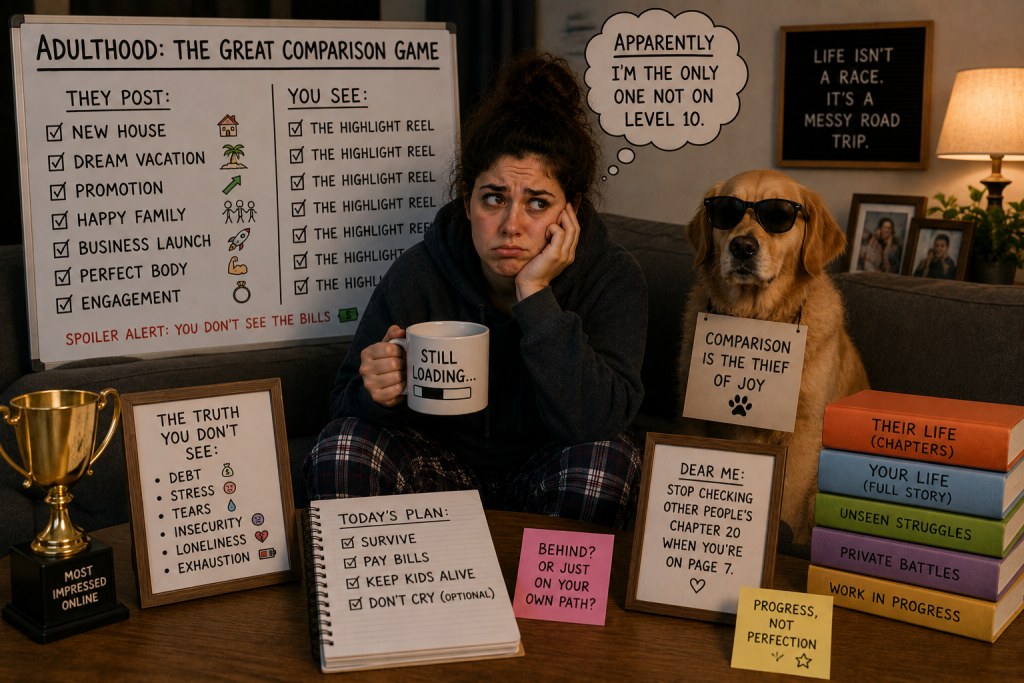
Why So Many Adults Feel Behind in Life
Feeling behind in life is one of the most painful parts of adulthood because it can follow you even when you are trying hard.
You can be working.
You can be paying bills.
You can be raising kids.
You can be helping family.
You can be surviving things other people never see.
And still, somewhere in the back of your mind, there is that little voice saying, “You should be further along by now.”
That voice can be brutal.
It does not care what you have been through.
It does not care how many times life knocked you sideways.
It does not care that you had to restart.
It does not care that you did not get the same help, money, support, health, timing, or easy breaks that someone else got.
It just points at your life and says, “Not enough.”
That is why this feeling is so unfair.
Most adults are not behind because they are lazy.
They are not behind because they did not care.
They are not behind because they wanted life to be messy.
They feel behind because life did not move in a straight line.
And honestly, life almost never does.
The idea that everyone should hit the same life goals at the same ages is one of the biggest traps in Being an Adult.
It turns real people into scorecards.
It makes adulthood feel like a race.
It makes every birthday feel like a progress report.
It makes other people’s good news feel like proof that you are losing.
That is a heavy way to live.
And it is not the truth.
The pressure of timelines and milestones
Most of us grew up with some kind of timeline in our heads.
Maybe nobody handed it to us on paper.
Maybe nobody sat us down and said, “Here is the official schedule for your entire life.”
But we still got the message.
By this age, you should finish school.
By this age, you should have a good job.
By this age, you should be married.
By this age, you should have kids.
By this age, you should own a house.
By this age, you should have money saved.
By this age, you should know who you are.
By this age, your back should not sound like a bowl of cereal when you stand up, but apparently that one is negotiable.
These timelines get into people’s heads early.
They come from family.
They come from school.
They come from movies.
They come from social media.
They come from culture.
They come from the little comments people make without thinking.
“You’re still renting?”
“No kids yet?”
“Still at that job?”
“You’re starting over now?”
“Don’t wait too long.”
Those comments may be short, but they can stick.
They can make a person feel like their life is being judged by an invisible clock.
That clock is loud.
It says, “Hurry up.”
It says, “You are late.”
It says, “Everyone else is getting there first.”
It says, “You missed your chance.”
But life is not that simple.
People do not all begin from the same place.
Some people start with money.
Some start with debt.
Some start with family support.
Some start by escaping family damage.
Some start healthy.
Some start already carrying illness, anxiety, grief, or trauma.
Some get lucky breaks.
Some get hit with one setback after another.
So how could the timeline be the same for everyone?
It cannot.
That is the part people forget.
Milestones can be good when they are used as hopes.
They become harmful when they turn into weapons.
A milestone is not supposed to be a stick you use to beat yourself.
It is just a point on a map.
And maps change.
Roads close.
Storms happen.
Cars break down.
Sometimes you take the wrong exit and end up emotionally parked outside a gas station at midnight wondering how everybody else got a better GPS.
That does not mean the trip is over.
It means the road is different.
The pressure of timelines can create deep shame because people often feel like they have to explain themselves.
Why am I not married?
Why did that job not work?
Why did I start over?
Why do I not own a house?
Why do I still feel unsure?
Why am I still tired?
Why am I not happier?
But you do not owe everyone a full report on your private life.
You do not have to turn your pain into a public PowerPoint.
Sometimes the answer is simply, “Life happened.”
And life does happen.
The American Psychological Association’s work on stress points out that stress can come from many parts of life, including work, money, health, family, and major changes. Those are not small things. They can delay goals, change plans, and make even simple progress harder.
That matters because people often judge the outcome without seeing the obstacles.
They see that you are not where you “should” be.
They do not see what you had to survive just to be where you are.
Maybe you lost years to anxiety.
Maybe you lost money to emergencies.
Maybe you lost time caring for someone else.
Maybe you lost confidence after a hard relationship.
Maybe you lost health for a while.
Maybe you lost direction because life hit too hard.
Maybe you were not behind at all.
Maybe you were healing.
Maybe you were rebuilding.
Maybe you were carrying more than anyone knew.
Here is a simple way to think about timelines.
| Timeline Pressure | What It Makes You Think | A Truer Way to See It |
|---|---|---|
| “I should own a house by now.” | I failed financially. | Housing, wages, debt, and life costs affect timing. |
| “I should be married by now.” | I am unwanted or late. | Relationships do not follow one perfect schedule. |
| “I should have a better career.” | I wasted my chance. | Careers change, restart, and grow at different speeds. |
| “I should have kids by now.” | I am missing life. | Family paths are deeply personal and often complex. |
| “I should feel settled.” | Something is wrong with me. | Many adults are still learning, healing, and adjusting. |
| “I should have more money saved.” | I am irresponsible. | Emergencies, wages, debt, and family needs can change saving. |
The word “should” causes a lot of damage.
Sometimes it helps.
“I should pay that bill.”
“I should call the doctor.”
“I should stop eating cheese straight from the fridge like a raccoon in pajama pants.”
Fair enough.
But many “shoulds” are just shame in a nice outfit.
They do not guide you.
They punish you.
A better question is not, “Where should I be by now?”
A better question is, “What is the next honest step from where I actually am?”
That question brings you back to reality.
Not the fantasy timeline.
Not someone else’s life.
Not the version of adulthood you imagined at 18 when you thought 35 was ancient and 50 was basically a historical landmark.
Reality.
Where am I?
What do I need?
What can I do next?
That is where real progress starts.
Not from shame.
From truth.
Career, marriage, parenting, and success expectations
Career, marriage, parenting, and success are some of the biggest areas where adults feel behind.
These are the life areas people ask about.
They are also the areas people compare most.
What do you do for work?
Are you seeing anyone?
Are you married?
Do you have kids?
How are the kids?
Did you buy a house?
Are you still at the same job?
When are you going to retire?
These questions can sound normal.
Sometimes they are normal.
But when you already feel behind, they can hit like emotional dodgeballs.
A career can be a huge source of pressure because work is tied to money, identity, respect, and security.
People often ask, “What do you do?” as if your job title explains your whole value as a human.
It does not.
A job is not a soul.
A paycheck is not a personality.
A career path is not the full measure of a life.
Still, career pressure is real.
You may feel behind if you are not earning what you thought you would.
You may feel behind if you changed fields.
You may feel behind if you stayed too long in a job that drains you.
You may feel behind if people younger than you seem more successful.
You may feel behind if you are still trying to figure out what you want.
That feeling can be painful because work takes up so much life.
If work is not where you hoped it would be, it can make your whole life feel stuck.
But careers are rarely straight lines now.
People switch jobs.
People start over.
People learn new skills later.
People leave careers that looked good on paper but felt terrible in real life.
People get laid off.
People rebuild.
People burn out.
People choose peace over status.
That is not always failure.
Sometimes it is survival.
Sometimes it is wisdom.
Sometimes it is finally listening to yourself.
Marriage brings another kind of expectation.
Society often treats marriage like proof that someone is chosen, stable, and on track.
That can make single adults feel behind.
It can make divorced adults feel like they failed.
It can make married adults feel pressure to pretend everything is perfect.
It can make people stay in unhealthy relationships because the label looks better than the truth.
That is dangerous.
A relationship is not successful just because it exists.
A marriage is not healthy just because it lasted.
Being single is not failure.
Divorce is not always failure.
Starting over is not failure.
Being alone can be painful, yes.
But being with the wrong person can be lonely too.
Adult life is full of these quiet truths people do not say at family gatherings because someone is always near the potato salad pretending not to listen.
Parenting expectations may be even heavier.
Parents can feel behind in every direction.
They may feel they should be more patient.
More fun.
More organized.
More involved.
More financially stable.
More emotionally healed.
More able to give their kids the life they wanted to give them.
And when they fall short, the guilt can be crushing.
Parenting is love mixed with fear.
You love your child, and because you love them, every mistake feels bigger.
Every struggle feels personal.
Every delay feels like something you should have prevented.
But parents are human.
They are raising children while also carrying bills, stress, work, health concerns, family history, and their own unmet needs.
That is not easy.
The CDC’s information on parenting stress offers basic support around parenting and healthy child development, but even the best advice can feel hard when a parent is exhausted.
Parents do not just need tips.
They need support.
They need rest.
They need forgiveness.
They need to know that one bad day does not erase their love.
Success expectations may be the trickiest of all because success keeps changing.
When you are younger, success may mean money, status, a nice house, a better car, big vacations, or people being impressed by you.
Then life humbles you.
Suddenly success may mean peace.
A stable home.
A good night of sleep.
A paid bill.
A healthy meal.
A real laugh.
A day without panic.
A relationship that feels safe.
A body that feels cared for.
A quiet evening where nobody needs anything urgent.
That kind of success may not look flashy online, but it is real.
In fact, it may be more real than the version of success people perform for others.
The CDC explains that social connection supports health and well-being, which is worth remembering because success without connection can still feel empty.
A person can have money and feel alone.
A person can have a title and feel trapped.
A person can have a nice house and feel emotionally cold inside it.
A person can “win” on paper and still not feel okay.
So maybe the better question is not, “Do I look successful?”
Maybe the better question is, “Does my life feel livable?”
That question matters.
Here is a simple table that shows how expectations can twist the truth.
| Life Area | Common Expectation | More Honest Truth |
|---|---|---|
| Career | You should climb higher every year. | Some seasons are for building, healing, learning, or surviving. |
| Marriage | Being married means you are on track. | A healthy relationship matters more than a label. |
| Parenting | Good parents always know what to do. | Good parents keep learning and repair when they mess up. |
| Money | Success means having plenty. | Stability, safety, and peace matter more than showing off. |
| Home | Adults should have a perfect space. | A lived-in home is not a moral failure. |
| Happiness | Adults should be happy if life looks good. | A life can look fine and still feel heavy. |
One real quote from Henry David Thoreau fits here:
“The mass of men lead lives of quiet desperation.”
That line still lands because many adults do exactly that.
They do not always fall apart.
They do not always announce their pain.
They just keep going quietly while feeling like the life they are living does not match the life they were told they should want.
That is why honest writing matters.
A book like Nobody Told Me About This Part of Adult Life speaks to people who are tired of pretending the usual milestones tell the whole story.
They do not.
A milestone can be beautiful.
A marriage can be beautiful.
A career can be beautiful.
Parenting can be beautiful.
Money can make life safer.
A home can be a blessing.
But none of these things prove a person is okay.
And not having them does not prove a person is failing.
Life is bigger than a checklist.
People are bigger than their timelines.
Feeling stuck while others seem ahead
Feeling stuck while others seem ahead is one of the most common adult pains.
It can feel like everyone else got a secret instruction manual, and you somehow received a crumpled receipt, a broken pen, and a vague warning about taxes.
You watch people move forward.
New homes.
New jobs.
New babies.
New businesses.
New cars.
New bodies.
New vacations.
New kitchen counters that look like nobody has ever made a sandwich there.
Meanwhile, you feel like you are still trying to get through the same problems.
Still tired.
Still paying things off.
Still figuring yourself out.
Still trying to fix habits.
Still trying to get your life in order.
Still wondering why everyone else seems to be on Chapter 20 while you are on page 7 looking for the table of contents.
That feeling can be painful.
It can also be misleading.
Because you are not seeing the whole story.
You are seeing movement.
You are seeing results.
You are seeing announcements.
You are seeing highlight reels.
You are not seeing the private cost.
You are not seeing the debt.
You are not seeing the fights.
You are not seeing the lonely nights.
You are not seeing the panic.
You are not seeing the health issues.
You are not seeing the family stress.
You are not seeing the self-doubt.
You are not seeing the parts they do not know how to talk about.
The American Psychological Association’s social media topic page notes that heavy social media use can interfere with sleep, physical activity, and in-person social interactions. That matters because adults often compare themselves while scrolling at the exact time they are tired, lonely, or trying to escape stress.
That is not a fair mental setup.
You are comparing your worn-out private life to someone else’s polished public moment.
That is like comparing your behind-the-scenes blooper reel to someone else’s movie trailer.
Of course you feel behind.
The comparison is rigged.
Feeling stuck also hurts because stuckness can make time feel wasted.
You may feel like you are repeating the same year.
Same job stress.
Same money stress.
Same relationship problem.
Same body worry.
Same clutter.
Same goals.
Same promise that next month will be different.
That can wear down hope.
You may start thinking, “Maybe this is just who I am.”
But stuck is not always permanent.
Sometimes stuck means you do not have enough support.
Sometimes it means the next step is not clear.
Sometimes it means your nervous system is tired.
Sometimes it means your life is too full of demands to make room for change.
Sometimes it means you are trying to climb while carrying a backpack full of bricks.
If you do not account for the bricks, you will blame your legs.
That is what adults do all the time.
They say, “Why can’t I move faster?”
But they do not ask, “What am I carrying?”
Maybe you are carrying grief.
Maybe debt.
Maybe caregiving.
Maybe anxiety.
Maybe burnout.
Maybe chronic stress.
Maybe old shame.
Maybe a body that needs care.
Maybe a family role that drains you.
Maybe a marriage that feels lonely.
Maybe a job that eats your energy.
Those things affect movement.
They affect motivation.
They affect focus.
They affect what progress looks like.
This is why small progress still counts.
If you are carrying a lot, small steps are not nothing.
They are proof that some part of you is still trying.
Paying one bill counts.
Making one appointment counts.
Walking for ten minutes counts.
Cleaning one corner counts.
Sending one honest message counts.
Saying no once counts.
Resting before collapse counts.
Applying for one job counts.
Writing one page counts.
Making one healthier choice counts.
Those steps may not look impressive to other people.
But they can be huge inside a hard season.
Here is a table that compares what feeling stuck says with what may actually be true.
| Feeling Stuck Says | What May Actually Be True |
|---|---|
| “I am not moving.” | You may be moving slowly because life is heavy. |
| “Everyone else is ahead.” | You are seeing their visible wins, not their hidden struggles. |
| “I keep failing.” | You may need a smaller plan and more support. |
| “I should be able to do more.” | Your capacity may be lower from stress or exhaustion. |
| “Nothing is changing.” | Small changes may be happening below the surface. |
| “It is too late.” | You may need a new starting point, not an ending. |
Feeling stuck can also be a sign that your goals need to become more honest.
Sometimes adults are chasing goals they think they should want.
A bigger house.
A higher title.
A perfect body.
A packed social life.
A business that looks impressive.
A lifestyle that photographs well.
But when they stop and get honest, they may want different things.
Less stress.
More sleep.
More peace.
A smaller home that feels safe.
A job that does not destroy them.
A body that feels cared for, not punished.
A few real friends instead of a crowd.
A life that does not require constant performance.
Maybe you are not stuck because you are failing.
Maybe you are stuck because your soul is tired of chasing the wrong scoreboard.
That is worth thinking about.
A lot of adult growth starts when people stop asking, “How do I catch up to them?” and start asking, “What life am I actually trying to build?”
That question can change everything.
Because catching up to someone else may take you somewhere you do not even want to go.
You may not want their life.
You may want their confidence.
Their rest.
Their freedom.
Their sense of safety.
Their ability to enjoy what they have.
Those are deeper wants.
And they may require a very different path.
Feeling stuck is painful, but it can also be information.
It may be telling you that the old plan no longer fits.
It may be telling you that you need help.
It may be telling you that you are tired.
It may be telling you that comparison has stolen your view of your own progress.
It may be telling you that your life needs less pressure and more truth.
You do not have to move fast to move.
You do not have to impress everyone to improve your life.
You do not have to catch up to people whose full story you do not know.
You are allowed to move at the pace your real life allows.
Not the pace social media suggests.
Not the pace your family expects.
Not the pace your younger self imagined before they knew how expensive tires were.
Your pace.
That does not mean giving up.
It means building from reality.
Why being “behind” is often not the truth
Being “behind” feels real, but it is often not the truth.
It is often a story built from comparison, shame, old timelines, and missing information.
You feel behind because you expected life to look one way.
You feel behind because someone else’s life looks more polished.
You feel behind because you are tired.
You feel behind because your goals changed.
You feel behind because you are judging yourself by milestones that may not even fit your real values anymore.
But behind what?
Behind whom?
Behind which exact version of life?
There is no single adult race.
There is no official finish line.
There is no scoreboard in the sky saying, “Congratulations, you completed adulthood correctly.”
Most people are guessing.
Some are just guessing with better lighting.
That is the truth.
People who look ahead may feel behind too.
The person with the house may feel behind in health.
The person with the marriage may feel lonely.
The person with the career may feel trapped.
The person with kids may feel like they lost themselves.
The person who travels may feel rootless.
The person with money may feel empty.
The person who looks confident may be fighting anxiety every morning.
You do not know.
That is why judging your life by someone else’s outside view is so dangerous.
You are comparing incomplete stories.
Nobody’s life is only what you see.
The CDC’s work on social connection explains that loneliness is the feeling of being alone, disconnected, or not close to others, while social isolation is about lacking relationships, contact, or support. That distinction matters because a person can look socially successful and still feel deeply alone.
The outside does not always tell the truth.
That applies to success too.
A person can look ahead and feel lost.
A person can look behind and be building something real.
A person can look ordinary and be living with more peace than someone who looks impressive.
This is why “behind” is often too simple a word.
Maybe you are not behind.
Maybe you are recovering.
Maybe you are learning.
Maybe you are parenting.
Maybe you are caring for someone.
Maybe you are healing from something that changed you.
Maybe you are rebuilding after a loss.
Maybe you are getting honest.
Maybe you are choosing a quieter life.
Maybe you are starting over in a way nobody understands yet.
Maybe you are planting seeds in a season where nothing looks grown.
Seeds do not look impressive.
But they are not failure.
They are beginnings.
Adults need to give themselves more credit for invisible progress.
Not all progress can be photographed.
Some progress is not snapping back when you want to.
Some progress is staying calm in a moment that used to break you.
Some progress is paying the minimum because that is all you can do this month.
Some progress is asking for help.
Some progress is ending a pattern.
Some progress is resting without calling yourself lazy.
Some progress is telling the truth.
Some progress is surviving a hard year and still having a little softness left.
That counts.
It may not get likes.
It may not come with a promotion.
It may not impress people who only measure success by money, status, or milestones.
But it counts.
Here is a better way to measure adult progress.
| Old Measure | Better Measure |
|---|---|
| How much money do I have? | Am I making choices that create more stability? |
| Am I married? | Do I have honest, safe, loving connection? |
| Do I own a home? | Does my living space support my peace where possible? |
| Do I have a perfect career? | Does my work support my life without destroying me? |
| Do I look successful? | Do I feel more grounded than before? |
| Am I where others are? | Am I moving toward a life that fits me? |
| Did I hit the milestone on time? | Did I keep going with what life gave me? |
That last one is important.
“On time” is a harsh idea when life itself is unpredictable.
Who decides the time?
Who decides the exact age?
Who decides what success is supposed to look like?
At some point, adults have to stop letting other people’s timelines bully their real lives.
That does not mean you stop growing.
It means you grow from a place of honesty instead of shame.
Shame says, “You are behind, so hurry up and prove your worth.”
Honesty says, “This is where I am. What is the next good step?”
That is healthier.
That is more useful.
That is kinder.
And it usually works better.
Because shame may push people for a short time, but it burns them out.
Honesty gives people a place to stand.
If you feel behind, it may help to ask yourself:
- Whose timeline am I using?
- Do I even want the life I am comparing myself to?
- What have I survived that affected my pace?
- What progress am I ignoring because it is not flashy?
- What would make my life feel more peaceful right now?
- What is one real next step from here?
These questions bring you back to your own life.
That is where you belong.
Not inside someone else’s highlight reel.
Not inside your younger self’s perfect plan.
Not inside society’s checklist.
Your life.
Messy, honest, unfinished, still moving.
The message inside Nobody Told Me About This Part of Adult Life fits here because so many adults feel behind when they are actually just human. They are tired, stretched, delayed, healing, learning, and doing their best inside lives that look easier from the outside than they feel on the inside.
Being behind is often not the truth.
The truth may be that you are moving slower because you are carrying more.
The truth may be that your path changed.
The truth may be that your timeline was never fair to begin with.
The truth may be that your life is not a race, even if the world keeps acting like it is.
You are allowed to have a different pace.
You are allowed to start again.
You are allowed to change your mind.
You are allowed to build quietly.
You are allowed to grieve what did not happen and still be proud of what did.
You are allowed to stop measuring your worth by a checklist you never agreed to.
And maybe, instead of asking, “Why am I so behind?” you can start asking, “What am I still becoming?”
That question has more hope in it.
It leaves room.
It leaves breath.
It leaves space for the fact that you are not done.
You are not finished.
You are not a failed version of someone else’s timeline.
You are a person still living, still learning, still adjusting, still trying.
And that is not behind.
That is life.
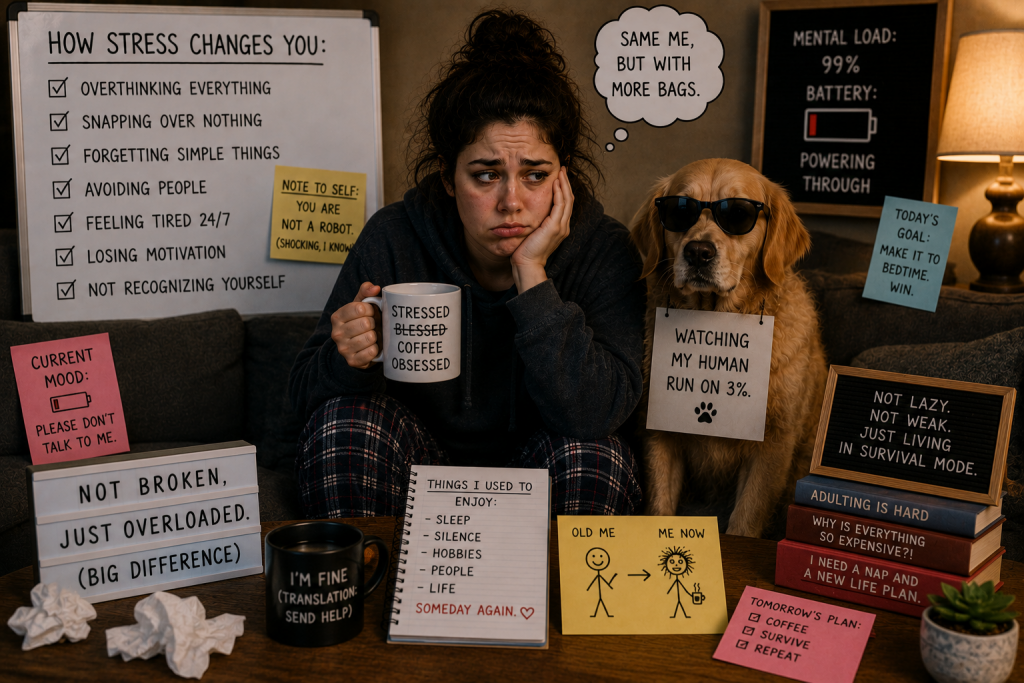
How Adult Stress Changes You
Adult stress does not always change you all at once.
It usually works slowly.
At first, you are just tired.
Then you get quieter.
Then you stop reaching out as much.
Then little things bother you more.
Then you feel guilty because you are not acting like yourself.
Then one day you realize the person you used to be feels farther away than they should.
That is one of the hardest parts of stress.
It does not only affect your schedule.
It affects your mood, your body, your patience, your hope, your relationships, and the way you see yourself.
Stress can make a kind person sharp.
It can make a social person withdraw.
It can make a motivated person feel stuck.
It can make a hopeful person feel numb.
It can make a calm person feel on edge.
It can make a person who used to laugh easily sit in silence and wonder why everything feels so heavy now.
This is not because they became bad.
It is because stress changes the way people carry life.
When adult life keeps asking more from you than you have to give, your mind and body start protecting themselves.
Sometimes that protection looks like pulling away.
Sometimes it looks like snapping.
Sometimes it looks like not caring.
Sometimes it looks like losing interest in things you used to enjoy.
Sometimes it looks like becoming a version of yourself you do not fully recognize.
That can be scary.
But it is not hopeless.
The first step is understanding what stress has been doing, instead of blaming yourself for every change.
Because sometimes the problem is not your personality.
Sometimes the problem is the pressure you have been living under for too long.
The American Psychological Association explains how stress affects the body, including muscles, breathing, hormones, digestion, and the nervous system. That matters because stress is not just a bad mood. It is a whole-body response that can change how you think, feel, and act.
This is why honest conversations about Being an Adult matter so much.
People need to know they are not weak because stress changed them.
They may just be overdue for care, rest, support, and a life that does not demand constant survival.
Becoming more guarded or withdrawn
One way adult stress changes people is by making them more guarded.
You may not even notice it at first.
You just start sharing less.
You answer messages later.
You avoid certain calls.
You stop explaining how you feel because explaining feels like one more job.
You tell people, “I’m good,” because it is faster than opening the emotional storage closet and watching everything fall out.
That is how withdrawal begins.
It does not always look dramatic.
It may look like staying home more often.
It may look like scrolling instead of texting back.
It may look like choosing silence because you do not have the energy to be misunderstood.
It may look like sitting in the car a little longer before going inside.
It may look like needing people, but also feeling too tired to deal with people.
That is a strange place to be.
You can miss people and avoid them at the same time.
You can want support and still not answer the phone.
You can feel lonely and still cancel plans.
This confuses people from the outside.
They may think you do not care.
They may think you are distant.
They may think you changed for no reason.
But often, there is a reason.
Stress makes connection feel like work.
And when your mind is already full, even good people can feel like one more demand.
That does not mean you do not love them.
It means your social battery is low.
Very low.
Possibly blinking red while making that sad old smoke detector beep every 45 seconds.
Being guarded can also come from disappointment.
Adult life teaches people that not everyone can handle the truth.
Maybe you opened up before and someone dismissed it.
Maybe you shared something painful and got advice you did not ask for.
Maybe someone turned your struggle into gossip.
Maybe someone compared your pain to theirs.
Maybe someone said, “Well, everyone is stressed.”
That kind of response can make a person close up.
Not because they are cold.
Because they are trying not to get hurt again.
A guarded person is often a hurt person with better locks.
The problem is that those locks can also keep out the people who might actually help.
That is the hard part.
Protection can become isolation.
You may start thinking, “Nobody gets it.”
Sometimes that is partly true.
Not everyone will get it.
But some people might.
And if you shut every door, even the safe people cannot come in.
The CDC explains that social connection can support mental and physical health. That is important because withdrawal may feel safer in the short term, but long-term isolation can make stress feel even heavier.
Humans need connection.
Not constant noise.
Not fake small talk.
Not forced plans when you are drained.
But real connection.
The kind where you do not have to perform.
The kind where you can say, “I am not doing great,” without someone making you regret it.
Stress can make you guarded in relationships too.
You may stop asking for what you need.
You may stop bringing up hard topics.
You may avoid conflict because you have no energy for another fight.
You may act like things do not bother you, then feel resentful because they do.
This can create distance between people who actually care about each other.
One person feels shut out.
The other feels unseen.
Both may feel alone.
That is how adult stress quietly damages connection.
Not always with one huge argument.
Sometimes with a thousand small silences.
Here is a simple look at how stress can lead to withdrawal.
| Stress Response | What It Looks Like | What May Be Underneath |
|---|---|---|
| Not replying | Ignoring texts or calls | Low energy, overwhelm, fear of explaining |
| Staying home | Canceling plans | Exhaustion or social burnout |
| Saying “I’m fine” | Avoiding deeper truth | Fear of being judged or dismissed |
| Pulling away | Less affection or less sharing | Emotional overload |
| Avoiding conflict | Keeping things inside | Fear of one more hard conversation |
| Acting cold | Short answers or distance | Self-protection, not lack of care |
The way back does not have to be huge.
You do not need to tell everyone everything.
You do not need to become social overnight.
You do not need to accept every invite to prove you are okay.
You can start small.
Send one honest message.
Answer one safe person.
Say, “I have been overwhelmed and quiet lately. It is not you.”
That sentence can save a lot of confusion.
You can also name your limits.
“I want to see you, but I do not have energy for a big night.”
“I can talk, but I do not want advice right now.”
“I am not ignoring you. I am just really drained.”
“I care about you. I am struggling to keep up.”
Those words help people understand your distance without guessing.
And they help you stay connected without pretending.
Being guarded does not mean you are broken.
It means some part of you learned that openness can be risky.
That part deserves respect.
But it may also need reminding that not every person is unsafe.
Some people can meet you gently.
Some people can listen.
Some people can sit with the truth.
And adult life feels less lonely when at least one person knows the real version of what you are carrying.
Losing patience, energy, or motivation
Stress has a way of draining the very things adults need most.
Patience.
Energy.
Motivation.
The cruel part is that people often need those things most when life is hardest.
You need patience when the house is loud.
You need energy when there are ten things to do.
You need motivation when life feels stuck.
But stress takes all three and hides them somewhere between the laundry pile and the unpaid bill.
That is why you may feel like a different person under stress.
You may snap over things that would not usually bother you.
You may feel tired after doing almost nothing.
You may look at a simple task and feel like it weighs 500 pounds.
You may tell yourself, “I need to get it together,” but your body feels like it already left the meeting.
This is not always laziness.
Sometimes it is depletion.
Depletion means your system has been using more energy than it has been getting back.
Adults often keep pushing through depletion because there is no clear pause button.
Bills do not pause.
Kids do not pause.
Work does not pause.
Appointments do not pause.
The dog does not care that your mental battery is at 3%. The dog needs to go out now because apparently the grass has a deadline.
So you keep going.
And because you keep going, people assume you are fine.
But inside, you may be running on fumes.
This is where patience starts to disappear.
Patience is not endless.
It is tied to capacity.
When you are rested, supported, and calm, you may be able to respond with care.
When you are exhausted, stressed, hungry, worried, and overstimulated, the same situation may make you snap.
That does not excuse hurtful behavior.
But it does explain why stress makes people reactive.
A noisy room feels louder.
A small mistake feels bigger.
A simple question feels like an attack.
A delay feels personal.
A mess feels impossible.
Then you react.
Then you feel guilty.
Then guilt becomes more stress.
Now you are not only overwhelmed.
You are ashamed of how overwhelmed made you act.
That loop is exhausting.
The Mayo Clinic explains that stress can affect mood and behavior, including irritability, sadness, anxiety, lack of motivation, overeating or undereating, and social withdrawal. That is useful because many adults blame their character when stress is clearly affecting their behavior.
Energy loss is another major sign.
Adult stress can make rest feel broken.
You may sleep and still feel tired.
You may sit down and still feel tense.
You may take a day off and spend half of it thinking about what you should be doing.
That is not real recovery.
That is your body resting while your mind keeps running laps.
Stress can also steal physical energy because your body is spending energy staying alert.
Worry takes energy.
Tension takes energy.
Overthinking takes energy.
Pretending takes energy.
Being polite when you want to scream into a throw pillow takes energy.
By the time you finally have a free moment, there may be nothing left for the things you actually enjoy.
That is why adults often stop doing hobbies.
Not because they stopped caring.
Because hobbies require energy too.
Even fun can feel like work when you are depleted.
Motivation also changes under stress.
People often think motivation disappears because they are lazy.
But motivation often disappears because the brain is overwhelmed.
When your mind is full of pressure, fear, and decisions, it becomes harder to start things.
Even simple things.
Make the call.
Clean the room.
Exercise.
Cook.
Read.
Apply for the job.
Start the project.
The task may be simple, but the emotional wall in front of it is not.
This is why telling stressed adults to “just do it” can sound like nonsense.
They know what needs doing.
That is the problem.
They know too much needs doing.
Their brain looks at the whole pile and says, “Absolutely not. We live here now.”
A better approach is to make the task smaller.
Not “clean the whole house.”
Clear one counter.
Not “fix my health.”
Drink water and take a walk.
Not “change my life.”
Make one appointment.
Not “catch up on everything.”
Pick the next thing.
Small steps work because they lower the starting cost.
And when stress has taken your motivation, starting is often the hardest part.
Here is a simple table for understanding stress-related changes.
| What Changes | How It May Show Up | What May Help |
|---|---|---|
| Patience | Snapping, irritation, low tolerance | Pausing before responding, taking breaks, naming overload |
| Energy | Feeling tired even after rest | Better sleep routines, less pressure, body care |
| Motivation | Avoiding tasks or feeling stuck | Smaller steps, fewer choices, simple routines |
| Focus | Brain fog, forgetting, scattered thoughts | Lists, quiet time, one-task focus |
| Mood | Sadness, anxiety, anger | Support, movement, honest conversations |
| Hope | Feeling like nothing will change | Small wins, realistic goals, connection |
One real quote from Marcus Aurelius fits this part of adult stress:
“You have power over your mind — not outside events. Realize this, and you will find strength.”
That does not mean we can think our way out of every problem.
Bills are still bills.
Stress is still stress.
Hard life events are still hard.
But it does point to something useful.
When you cannot control all of life, you can still begin with your next response.
One pause.
One breath.
One smaller task.
One honest sentence.
One repair after snapping.
One choice not to turn stress into self-hate.
That matters.
Stress may change your patience, energy, and motivation.
But those changes do not have to define you forever.
They can be signals.
They can show you where you are overloaded.
They can point to what needs support.
They can remind you that you are not a machine.
You are a person.
And people need recovery.
Feeling numb instead of emotional
One of the strangest ways adult stress changes people is by making them feel numb.
At first, stress may feel loud.
You worry.
You cry.
You get angry.
You overthink.
You panic.
You feel everything at once.
Then, after a while, it may feel like something shuts off.
You stop reacting the way you used to.
Good news feels flat.
Bad news feels expected.
Things that should make you happy barely reach you.
Things that should make you sad feel far away.
You are not peaceful.
You are just disconnected.
That numb feeling can be scary because it may make you wonder what is wrong with you.
You may think, “Why do I not care?”
But often, numbness is not a lack of caring.
It is emotional overload.
Your mind can only feel so much for so long before it starts turning down the volume.
Numbness can be the brain’s way of saying, “This is too much. We are going to dim the lights for a while.”
That may protect you short term.
But long term, it can make life feel empty.
You may still do what needs to be done.
You may still work.
You may still smile.
You may still answer messages.
You may still function.
But inside, everything feels muted.
Like life is happening behind glass.
That is a lonely feeling.
It is also common in long-term stress, burnout, grief, depression, and emotional exhaustion.
It does not mean you are broken.
It means something inside you is asking for care.
The National Institute of Mental Health’s information on depression includes symptoms like loss of interest, fatigue, sleep changes, trouble concentrating, and feelings of hopelessness. Feeling numb does not always mean depression, but when numbness lasts or affects daily life, it is worth taking seriously and talking to a health professional.
Adult numbness can sneak in because adults are often rewarded for not feeling.
People praise you when you stay calm.
They praise you when you keep working.
They praise you when you do not complain.
They praise you when you “handle it.”
But sometimes “handling it” means you are pushing feelings down so hard that they stop coming up normally.
You may tell yourself:
Not now.
I have to work.
I have to take care of the kids.
I have to pay bills.
I have to help everyone else.
I do not have time to fall apart.
Those sentences may be true in the moment.
But if every feeling gets told “not now,” eventually your emotions may stop trusting that there will ever be a “now.”
So they go quiet.
Numbness can also happen after disappointment.
If you have hoped and been let down too many times, your mind may try to protect you by hoping less.
If you have cared and been hurt, you may care more carefully.
If you have been overwhelmed for years, you may stop expecting life to feel good.
That can feel safer.
But it also makes joy harder to reach.
Joy requires openness.
So does grief.
So does love.
So does hope.
When stress closes you off from pain, it may also close you off from the good stuff.
That is the unfair part.
You cannot numb only the bad feelings forever.
The good ones get quieter too.
This is why adults may start saying things like:
“I don’t know what I feel.”
“I’m just tired.”
“I don’t care anymore.”
“Nothing sounds fun.”
“I feel like I’m just existing.”
“I should be happy, but I’m not.”
Those sentences deserve attention.
Not judgment.
Attention.
Sometimes the way back from numbness starts very small.
You do not force big feelings.
You notice tiny ones.
A song you like.
A warm shower.
A funny video.
A quiet walk.
A good cup of coffee.
A small moment with a pet.
A real laugh.
A page of a book that says something you needed to hear.
A conversation where you do not have to pretend.
Those tiny moments are not silly.
They are signals.
They remind your system that feeling is still possible.
Here is a table showing how numbness can look in adult life.
| Numbness May Look Like | What It May Mean |
|---|---|
| Nothing sounds enjoyable | Your mind may be overloaded or burned out |
| You avoid deep talks | You may not have energy to feel more |
| You feel distant from people | Stress may be creating emotional shutdown |
| You stop caring about goals | Hope may feel too risky or tiring |
| You move through days on autopilot | Survival mode may have become normal |
| You cannot cry even when sad | Feelings may be pushed down or blocked |
| You feel flat after good news | Your system may need recovery and support |
Numbness is not always something you can fix with one good night of sleep.
Sometimes it needs time.
Sometimes it needs therapy.
Sometimes it needs medical care.
Sometimes it needs fewer demands.
Sometimes it needs safe connection.
Sometimes it needs honest grief.
Sometimes it needs permission to stop pretending everything is okay.
The key is not to shame yourself for feeling numb.
Shame only adds another layer.
Instead, ask what numbness may be protecting you from.
What has been too much?
What have you not had space to feel?
What did you have to push through?
What support have you been missing?
What part of you feels tired of hoping?
Those questions are gentle doors.
You do not have to kick them open.
You can open them slowly.
And if opening them feels too heavy, that is a sign to get support.
You do not have to do the deep work alone.
Books can help.
Journaling can help.
Walking can help.
Rest can help.
But sometimes you need a real person, a counselor, a doctor, or someone trained to help you sort through what has been building inside.
That is not weakness.
That is care.
The emotional side of Nobody Told Me About This Part of Adult Life fits here because adult life can turn people into quiet survivors. They may not look like they are falling apart, but inside, they may feel faded, tired, and far from themselves.
Numbness is not the end of your story.
It is a signal.
A quiet one.
A heavy one.
But still a signal.
It says, “Something has been too much for too long.”
And that truth deserves a response.
Not panic.
Not shame.
Care.
Why stress can make you feel unlike yourself
One of the saddest parts of adult stress is feeling unlike yourself.
You may look in the mirror and think, “Where did I go?”
You may notice you do not laugh the same.
You do not talk the same.
You do not dream the same.
You do not have the same energy.
You may feel more guarded, more irritated, more tired, more numb, or more distant than you used to be.
That can make you grieve yourself while still being alive.
It is a strange kind of loss.
You are still here, but the old version of you feels harder to reach.
Stress can make you feel unlike yourself because it changes your focus.
When life feels safe, there is room for personality.
Humor.
Curiosity.
Creativity.
Patience.
Play.
Love.
Rest.
But when life feels like constant pressure, your mind starts focusing on survival.
What needs to be paid?
What needs to be fixed?
Who needs me?
What could go wrong?
How do I get through today?
Survival thinking leaves less room for the parts of you that make life feel like yours.
You may still be responsible.
You may still be productive.
You may still be doing what needs doing.
But the personal parts start fading.
That is why stress can make adulthood feel so flat.
You are living, but not fully feeling your own life.
Stress can also change how you see yourself.
If you are overwhelmed long enough, you may start thinking you are the problem.
You may say:
“I am lazy.”
“I am angry.”
“I am boring.”
“I am negative.”
“I am not fun anymore.”
“I am bad at life.”
But those labels may not be fair.
Maybe you are not lazy.
Maybe you are exhausted.
Maybe you are not angry.
Maybe you are overloaded.
Maybe you are not boring.
Maybe you have had no room for joy.
Maybe you are not negative.
Maybe you are grieving.
Maybe you are not bad at life.
Maybe life has been asking too much without enough support.
That difference matters.
Because labels can become cages.
If you call yourself lazy, you may shame yourself.
If you recognize exhaustion, you may care for yourself.
If you call yourself angry, you may hate yourself.
If you recognize overload, you may set a boundary.
If you call yourself broken, you may give up.
If you recognize stress, you may seek help.
The Cleveland Clinic explains burnout as a state that can include exhaustion, mental distance, and reduced performance, often from long-term stress. That idea is useful because many adults who feel unlike themselves may not be failing. They may be burned out.
Burnout can make you feel like someone turned down your inner light.
Not off.
Just dim.
You may still care, but caring feels harder.
You may still love people, but you need more space.
You may still want a better life, but the effort feels huge.
You may still have dreams, but they feel buried under bills and brain fog.
That does not mean the real you is gone.
It means the real you may be covered.
Covered by stress.
Covered by lack of sleep.
Covered by pressure.
Covered by disappointment.
Covered by the need to keep going when you needed to stop.
The way back is usually not one giant breakthrough.
It is small returns.
Returning to rest.
Returning to honesty.
Returning to simple joy.
Returning to safe people.
Returning to your body.
Returning to things that make you feel like a person, not a task machine.
Returning to boundaries.
Returning to hope, even if it is tiny.
Here is a table that shows how stress can make you misread yourself.
| What You Think | What May Actually Be Happening |
|---|---|
| “I am not myself anymore.” | Stress may be covering parts of you. |
| “I am lazy.” | You may be depleted or burned out. |
| “I am mean now.” | Your patience may be worn down. |
| “I do not care.” | You may be emotionally numb from overload. |
| “I am boring.” | You may not have room for joy or play. |
| “I have no motivation.” | Your brain may be overwhelmed by too much. |
| “I am failing.” | You may need support, rest, and smaller steps. |
Feeling unlike yourself can be painful, but it can also become a turning point.
Not because you shame yourself into changing.
But because you finally admit the truth.
“I miss myself.”
That sentence is powerful.
It is sad, but it is also loving.
It means you still remember that there is more to you than stress.
You remember there is a version of you who laughs.
A version who hopes.
A version who cares.
A version who dreams.
A version who feels light sometimes.
A version who is not only surviving.
That version may not return all at once.
But it can be invited back.
One choice at a time.
Maybe you start with sleep.
Maybe you start with a walk.
Maybe you start with therapy.
Maybe you start with saying no.
Maybe you start with reading something that tells the truth about adult life.
Maybe you start with a quiet cup of coffee and no phone.
Maybe you start with one honest talk.
Maybe you start with forgiving yourself for not being okay.
There is a real quote from Maya Angelou that fits this kind of healing:
“Do the best you can until you know better. Then when you know better, do better.”
That is such an adult truth.
You did what you could with what you had.
You survived with the tools you knew.
You handled life the best way you knew how.
Now, if you know stress has changed you, you can begin to care for yourself differently.
Not perfectly.
Not all at once.
Differently.
You can stop pretending that constant pressure has no cost.
You can stop calling every stress response a personality flaw.
You can stop treating exhaustion like weakness.
You can stop acting like you have to earn the right to feel human.
Adult stress changes people.
But change is not always permanent.
The guarded part can soften with safety.
The tired part can recover with rest.
The numb part can feel again with care.
The unmotivated part can move with smaller steps.
The lonely part can reconnect with honesty.
The version of you that feels lost may not be gone.
It may just be waiting underneath the pressure.
And maybe the path back starts with one simple truth:
You are not broken.
You are overloaded.
And there is a difference.
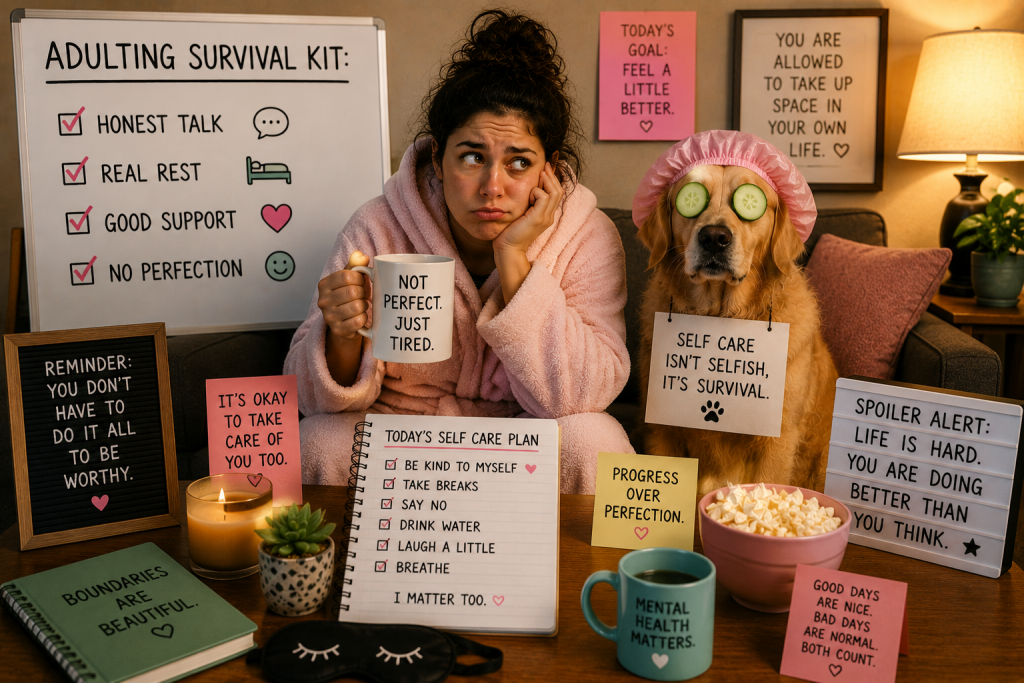
What Adults Actually Need More Of
Adults do not always need another lecture.
Most adults already know they should sleep more, drink water, move their bodies, save money, answer messages, eat better, clean the house, be patient, show up on time, stop overthinking, and somehow become peaceful while the world keeps acting like a raccoon got into the wiring.
They know.
That is the problem.
Knowing is not always enough when a person is tired, stretched thin, lonely, and trying to keep life from falling off the table.
What many adults need is not more shame.
They do not need another person telling them to “just be positive.”
They do not need another fake-perfect checklist that makes real life feel like a personal failure.
They do not need advice that sounds good on a coffee mug but falls apart the second a bill, a sick kid, a work problem, and a bad night of sleep all show up at once.
What adults actually need more of is honesty, rest, support, and permission to be human.
That sounds simple.
It is not.
Because adult life trains many people to push past their limits.
It trains them to be useful.
It trains them to keep going.
It trains them to say, “I’m fine.”
It trains them to earn rest by becoming completely exhausted first.
It trains them to hide stress so nobody worries.
It trains them to act like needing help is weakness.
Then people wonder why so many adults feel worn down.
They are not failing because life is hard.
They are tired because they have been trying to survive hard things without enough care, enough truth, or enough room to breathe.
That is why the emotional side of Being an Adult matters so much.
It is not just about responsibilities.
It is about what those responsibilities do to people when they are carried alone for too long.
Honest conversations without judgment
One of the biggest things adults need more of is honest conversation.
Not forced therapy talk.
Not fake deep conversations where everyone says the right words but nobody means them.
Not dramatic oversharing with people who have not earned trust.
Just real, safe, human honesty.
The kind where someone can say, “I am overwhelmed,” and not be treated like they are weak.
The kind where someone can say, “I am lonely,” and not be told, “But you have people.”
The kind where someone can say, “I feel behind,” and not get a speech about working harder.
The kind where someone can say, “I’m tired of being strong,” and the other person does not panic, judge, fix, or run.
Adults need spaces where the truth is allowed to land.
That is rare.
A lot of adult conversations stay on the surface because surface is safer.
How’s work?
How are the kids?
How’s the house?
What’s new?
Busy lately?
Those questions are not bad.
But they often become scripts.
Everyone knows their line.
“Good.”
“Busy.”
“Can’t complain.”
“Same old.”
“Just tired.”
And then the real answer stays hidden.
The problem is that hidden stress does not disappear.
It just gets carried longer.
Honest conversation gives the weight somewhere to go.
It does not always fix the problem, but it can make the person feel less alone with it.
That matters.
The CDC explains that social connection can support health and well-being, including stress, anxiety, depression, sleep, and overall health. That is not just a nice idea. It is a real reminder that people are not built to carry life alone.
But honest conversation needs safety.
Not everyone is safe.
Some people turn pain into gossip.
Some people use your honesty against you later.
Some people make everything about themselves.
Some people cannot listen without trying to fix.
Some people respond to your deepest pain with, “Well, everybody’s got problems.”
Those are not the people who get the full story.
You can be honest and still have boundaries.
You can share carefully.
You can choose who gets access to the soft parts of your life.
That is not being fake.
That is being wise.
A safe conversation does not require perfect words.
It may sound simple:
- “I do not need advice. I just need someone to listen.”
- “I have been carrying more than I let on.”
- “I am not okay today, but I am trying.”
- “Can I be honest for a minute?”
- “I need support, not a solution right now.”
- “I feel embarrassed saying this, but life feels heavy.”
- “I am tired of pretending I am fine.”
Those sentences can feel scary.
But they can also change the whole room.
Because once one person gets honest, another person may breathe out and say, “Me too.”
That is where shame starts losing power.
Shame grows in silence.
It loves secrecy.
It loves making people feel like they are the only ones struggling.
Honest conversation breaks that spell.
It says, “No, this is not just you.”
That is one reason honest books and real writing matter. A book like Nobody Told Me About This Part of Adult Life can give people words for things they have been feeling but could not explain.
Sometimes a person does not need a full answer.
They need language.
They need to read one sentence and think, “That is it. That is what I have been trying to say.”
That kind of honesty is powerful.
Here is a simple table showing the difference between surface talk and honest talk.
| Surface Talk | Honest Talk |
|---|---|
| “I’m fine.” | “I have been overwhelmed lately.” |
| “Just busy.” | “I feel like I never get a break.” |
| “Can’t complain.” | “I am grateful, but I am also tired.” |
| “Same old.” | “I feel stuck and I do not know what to do next.” |
| “It’s nothing.” | “It matters to me, even if I feel silly saying it.” |
| “I’ll handle it.” | “I could use help with this.” |
Honest conversation is not about dumping pain on everyone around you.
It is about not forcing yourself to live behind a mask forever.
It is about finding safe places where your truth can breathe.
And adults need that more than most people admit.
Rest that does not feel earned by exhaustion
Adults need more rest that does not require total collapse first.
That may sound obvious, but many people do not live that way.
They treat rest like a reward.
They only let themselves sit down after everything is done.
They only sleep when their body forces them.
They only take a break when they are so drained they cannot keep going.
They only admit they are tired after becoming completely empty.
That is not rest.
That is emergency shutdown.
There is a big difference.
Rest should not be something you earn by suffering.
Rest is part of being alive.
Phones need charging.
Cars need gas.
Plants need water.
Dogs need naps in the middle of the floor where everyone must step around them like tiny kings.
Humans need recovery too.
But adults often feel guilty resting because there is always more to do.
The dishes are there.
The emails are there.
The bills are there.
The laundry is there.
The weird pile of papers you keep moving from one spot to another like it is a sacred family artifact is still there.
So people keep going.
They say, “I will rest after I catch up.”
But adult life rarely gives a clean catch-up point.
There is always something.
If rest only happens when everything is done, rest may never happen.
This is how adults burn out.
They wait too long.
They ignore the early signs.
They push through tiredness.
They call themselves lazy for needing a break.
Then when they finally stop, they do not feel peaceful.
They feel guilty.
That guilt ruins the rest.
You can be lying on the couch, but if your mind is yelling at you for not being productive, your body may be still while your nervous system is still at work.
That is fake rest.
Real rest allows you to stop performing.
It gives your body and mind permission to stand down.
It does not have to be fancy.
It does not need candles, spa music, a matching robe, and a cucumber water situation.
Although honestly, if the dog gets cucumber slices first, we have questions.
Real rest can be simple.
A quiet room.
A walk.
A nap.
A shower.
Ten minutes without your phone.
Sitting outside.
Reading.
Breathing.
Watching something funny without turning it into a moral failure.
Going to bed earlier.
Saying no to a plan because your body is done.
The National Institute of Mental Health’s guide to caring for your mental health includes basic care like regular exercise, healthy meals, sleep, relaxing activities, goals, gratitude, and connection. The basics matter because stressed adults often skip them first.
Rest also has to fit real life.
Telling an overwhelmed adult to “just take a vacation” is not always helpful.
Some people cannot afford that.
Some people cannot leave responsibilities.
Some people would spend the whole vacation worrying about money.
So rest has to be more honest than that.
It has to exist inside normal days.
Small rest counts.
Five minutes counts.
A quiet cup of coffee counts.
Leaving the room before you snap counts.
Turning your phone over counts.
Going to bed instead of doing one more thing counts.
Choosing an easy dinner counts.
Not making every day harder than it has to be counts.
Here is a simple table of rest that actually fits adult life.
| Type of Rest | What It Can Look Like |
|---|---|
| Physical rest | Sleep, naps, stretching, sitting down without guilt |
| Mental rest | Writing a list, reducing choices, taking a screen break |
| Emotional rest | Being honest, crying, talking to someone safe |
| Social rest | Saying no, leaving early, choosing quiet |
| Sensory rest | Less noise, dim lights, no phone for a while |
| Creative rest | Music, art, reading, cooking, making something |
| Spiritual rest | Prayer, nature, meaning, stillness, reflection |
Adults often need more than sleep.
Sleep matters, but emotional exhaustion may need other forms of rest too.
A person can sleep and still be tired if they are lonely.
A person can nap and still be drained if they feel unsupported.
A person can sit down and still feel tense if they are carrying too many decisions.
That is why rest has to match the need.
If you are socially drained, you may need quiet.
If you are mentally overloaded, you may need fewer choices.
If you are emotionally heavy, you may need honesty.
If your body is tired, you may need sleep.
If your soul feels flat, you may need meaning, laughter, or beauty.
Rest is not one thing.
And it is not weakness.
It is maintenance.
A real quote from Anne Lamott says:
“Almost everything will work again if you unplug it for a few minutes, including you.”
That line works because it is funny and true.
Adults are not machines, but even machines need to stop sometimes.
You do not have to earn rest by falling apart.
You are allowed to rest because you are human.
That is enough.
Support that feels safe and real
Adults need support that feels safe and real.
Not support that comes with judgment.
Not support that keeps score.
Not support that makes you regret asking.
Not support that says, “Sure, I’ll help,” then reminds you about it for the next eight years.
Real support feels different.
It feels steady.
It feels respectful.
It feels like you can be honest without being treated like a problem.
It feels like someone can see you struggling and not make you feel small.
That kind of support can be life-changing.
Many adults are surrounded by people but still unsupported.
They may have family.
They may have coworkers.
They may have social media friends.
They may have group chats.
But when life gets heavy, they may not know who they can actually call.
That is a lonely feeling.
Support is not just having people around.
Support is having people who can show up in a way that helps.
Sometimes support is emotional.
Someone listens.
Someone checks in.
Someone says, “That sounds hard.”
Someone lets you be honest.
Sometimes support is practical.
Someone brings food.
Someone watches the kids.
Someone helps with a ride.
Someone sits with you at an appointment.
Someone helps you make a plan.
Sometimes support is professional.
A therapist.
A doctor.
A support group.
A financial counselor.
A crisis line.
A coach.
A trusted leader.
Different kinds of stress need different kinds of support.
A friend may help you feel less alone.
A doctor may help with symptoms.
A therapist may help with patterns.
A financial counselor may help with money decisions.
A support group may help you feel understood.
No one person has to be everything.
That is important.
Adults sometimes put too much pressure on one relationship to carry all their needs.
A spouse cannot be your only friend, only therapist, only support system, only problem-solver, only listener, and also remember where the scissors went.
That is too much for one person.
Healthy support is often a small circle, not one overloaded person.
The Substance Abuse and Mental Health Services Administration’s national helpline can help people find support for mental health or substance use concerns, and 988 Lifeline is available for people in emotional distress or crisis. Those resources matter because sometimes support needs to be bigger than a friend or family member.
There is no shame in needing trained help.
There is no shame in calling a line.
There is no shame in talking to a professional.
There is no shame in saying, “This is more than I can handle alone.”
That is not failure.
That is care.
Safe support also respects boundaries.
A safe person does not force you to share more than you are ready to share.
They do not turn your pain into entertainment.
They do not make you feel guilty for needing help.
They do not act like your stress is annoying.
They do not punish you for being honest.
They can say, “I care about you, and I can listen.”
They can also say, “I care about you, but I do not have the capacity tonight. Can we talk tomorrow?”
That is still safe.
Real support includes honesty on both sides.
Support does not mean one person becomes an emotional trash can.
It means people care in a way that is clear, kind, and sustainable.
Here is a simple table of what safe support looks like.
| Unsafe Support | Safe Support |
|---|---|
| Judges your feelings | Lets you be honest |
| Gives advice before listening | Asks what you need |
| Makes your pain about them | Stays present with you |
| Shares your private story | Respects your privacy |
| Keeps score | Helps without using it against you |
| Dismisses your stress | Takes your stress seriously |
| Pushes you to “get over it” | Gives you room to process |
Support also has to be asked for clearly when possible.
That can be hard.
Many adults expect people to notice.
They think, “Can’t they see I’m drowning?”
Maybe they can.
Maybe they cannot.
People are often trapped in their own stress too.
Clear asks help.
Instead of silently hoping someone understands, try saying:
- “Can you help me with dinner tonight?”
- “Can you listen for ten minutes?”
- “Can you take this one task off my plate?”
- “Can you check in on me tomorrow?”
- “Can we talk without trying to fix it right away?”
- “Can you sit with me while I make this call?”
- “I need help, but I feel embarrassed asking.”
That last sentence is often enough to soften the moment.
It tells the truth.
And truth creates connection.
A book like Nobody Told Me About This Part of Adult Life matters because it helps adults feel less alone with the hidden stress they may not know how to share yet.
Sometimes support starts with one sentence.
Sometimes it starts with a book.
Sometimes it starts with admitting, “I cannot keep pretending this is light.”
That is a brave place to begin.
Permission to be human, not perfect
Adults need more permission to be human, not perfect.
That may be the biggest need of all.
Because so much adult stress comes from trying to look okay while being tired, scared, lonely, unsure, and overwhelmed.
People want to be good parents.
Good partners.
Good workers.
Good friends.
Good children to aging parents.
Good neighbors.
Good people.
That is not wrong.
But trying to be good can turn painful when it becomes trying to be perfect.
Perfectly patient.
Perfectly stable.
Perfectly productive.
Perfectly healthy.
Perfectly kind.
Perfectly organized.
Perfectly healed.
Perfectly calm.
Perfectly available.
Perfectly grateful.
Perfectly okay.
No one can live that way.
Not for long.
Perfection is exhausting because it does not allow room for real life.
Real life has bad moods.
Late bills.
Messy rooms.
Hard talks.
Forgotten appointments.
Tired dinners.
Snapped answers.
Laundry piles that look like they are forming a union.
Days where you do your best and your best still looks like cereal for dinner and going to bed before anyone asks another question.
That is human.
Not failure.
Human.
Perfection tells adults they must earn love by never needing too much.
Humanity says, “I have needs too.”
Perfection says, “Do not mess up.”
Humanity says, “Repair when you do.”
Perfection says, “Always be strong.”
Humanity says, “Strong people need rest too.”
Perfection says, “Keep everyone happy.”
Humanity says, “Other people’s feelings are not fully yours to manage.”
Perfection says, “You should be further along.”
Humanity says, “You are still becoming.”
The American Psychological Association explains that perfectionism can involve setting high standards and being overly critical of yourself. That matters because many adults are not only stressed by life. They are stressed by the belief that they should handle life without showing cracks.
But cracks are not always signs of failure.
Sometimes cracks are signs that the pressure has been too much.
Sometimes cracks are where honesty starts.
Sometimes cracks let the light in.
There is a real quote from Leonard Cohen that says:
“There is a crack in everything, that’s how the light gets in.”
That line has lasted because it tells a truth many people need.
Being cracked does not mean being ruined.
Being tired does not mean being weak.
Being imperfect does not mean being unworthy.
Adults need to hear that more.
You are allowed to have limits.
You are allowed to change your mind.
You are allowed to need help.
You are allowed to have a messy house sometimes.
You are allowed to not answer right away.
You are allowed to rest without explaining your entire medical and emotional history.
You are allowed to say no.
You are allowed to start over.
You are allowed to be proud of small wins.
You are allowed to be grateful and still tired.
You are allowed to love your life and still need a break from parts of it.
You are allowed to be a work in progress.
Here is a simple table for replacing perfection with humanity.
| Perfection Says | Humanity Says |
|---|---|
| “I should handle everything.” | “I can ask for help.” |
| “I should never lose patience.” | “I can repair and try again.” |
| “Rest means I am lazy.” | “Rest helps me keep going.” |
| “My home should always be clean.” | “My home is lived in by real people.” |
| “I should be happy all the time.” | “All feelings are part of being human.” |
| “I am behind.” | “My path is different, not worthless.” |
| “I need to be fine.” | “I am allowed to be honest.” |
Permission to be human also means letting go of the idea that every season must be productive.
Some seasons are for building.
Some are for healing.
Some are for surviving.
Some are for grieving.
Some are for learning.
Some are for resting.
Some are for starting again.
Not every season looks impressive.
But that does not make it empty.
A healing season may look quiet.
A survival season may look messy.
A rebuilding season may look slow.
A grieving season may look unproductive.
But those seasons still matter.
They are part of life.
Adults often judge themselves too harshly during quiet or difficult seasons because they are not producing visible results.
But inner work is still work.
Healing is work.
Resting is work when your body has been trained to panic at stillness.
Setting boundaries is work.
Being honest is work.
Repairing your life is work.
Learning how to be kinder to yourself is work.
None of that may look flashy, but it changes the way you live.
This is why the message behind Nobody Told Me About This Part of Adult Life is so needed. Adult life is not just about pushing through. It is about learning how to stay human while carrying real responsibilities.
That is the balance.
You still have bills.
You still have work.
You still have family.
You still have tasks.
You still have hard days.
But you also have a right to exist beyond what you do for everyone else.
You matter when the dishes are done.
You matter when they are not.
You matter when you are productive.
You matter when you are resting.
You matter when you are strong.
You matter when you are tired.
You matter when you are confident.
You matter when you are unsure.
You do not become worthy after you fix every part of your life.
You are worthy while you are still figuring it out.
That is what adults need more of.
Not more pressure.
Not more shame.
Not more fake perfection.
More honest conversations.
More real rest.
More safe support.
More permission to be human.
Because life is already heavy enough.
Nobody needs to carry the extra weight of pretending they are made of stone.
You are allowed to be soft and still strong.
You are allowed to be tired and still trying.
You are allowed to be unfinished and still valuable.
You are allowed to be human.
That is not a weakness.
That is the whole point.
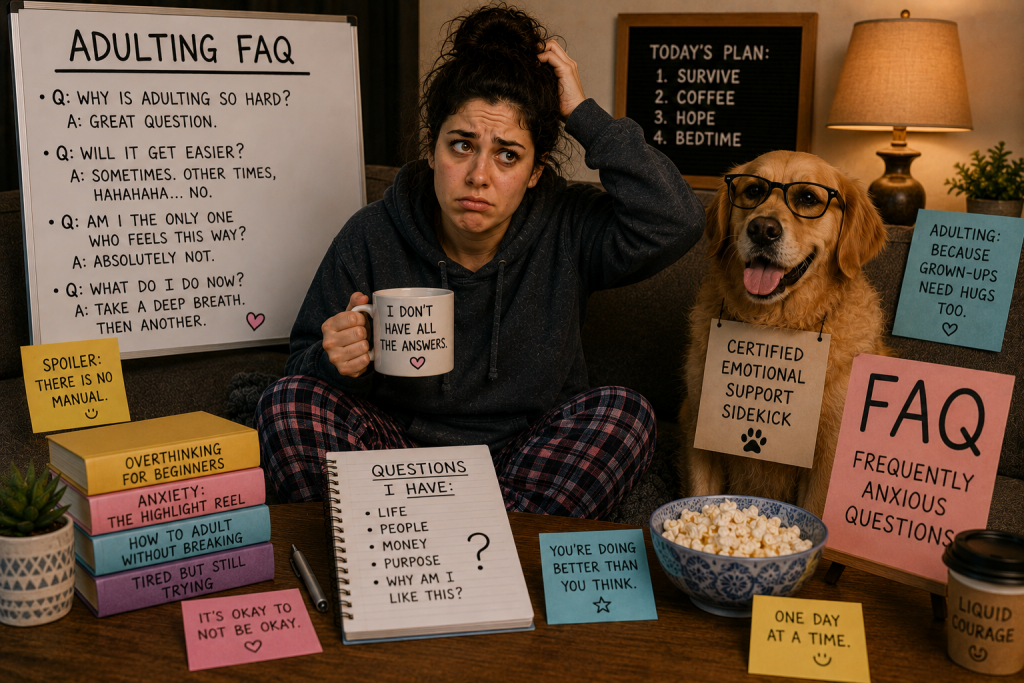
FAQ: Nobody Prepared Us for This Part of Being an Adult
Why does adulthood feel so emotionally exhausting?
Adulthood feels emotionally exhausting because there is always something to handle.
Even when life looks normal from the outside, your mind may be carrying bills, work stress, family needs, health worries, chores, and future fears all at once.
That kind of pressure adds up.
You may not be dealing with one huge crisis.
You may just be dealing with too many small things that never fully stop.
This is why adult tired can feel different from regular tired.
It is not only about needing sleep.
It is about needing relief from thinking, planning, remembering, fixing, answering, and being responsible for so much every day.
Many adults feel worn out because they are always “on.”
They work, care for others, manage money, keep the house going, and still try to act fine.
That can make rest feel hard, even when they finally have time to sit down.
Emotional exhaustion often comes from carrying more than people can see.
You may be doing your best and still feel drained.
That does not mean you are weak.
It means adult life can be heavy, especially when you do not have enough support, rest, or honest space to talk about it.
Is it normal to feel lonely as an adult?
Yes, it is normal to feel lonely as an adult.
Loneliness does not always mean you have no people around you.
You can have family, coworkers, friends, a partner, children, and still feel alone inside.
Adult loneliness often comes from feeling unseen.
You may be surrounded by people who need you, but still feel like nobody knows what you are carrying.
You may talk to people every day, but never say what is really going on.
That kind of loneliness can feel confusing because your life may look full from the outside.
Adult friendships can also become harder.
People get busy.
Schedules change.
Families grow.
Jobs take energy.
Friends move away.
Everyone may still care, but staying close takes more effort than it used to.
That does not mean you failed at friendship.
It means adult life often makes connection harder to maintain.
Loneliness is a signal that you may need more real connection, not just more people around.
A simple honest message, a low-pressure visit, or a real conversation with someone safe can help.
You do not need a huge social circle.
You need a few places where you can be honest without feeling judged.
Why do I feel behind in life even when I am trying?
You may feel behind because adulthood often comes with invisible timelines.
People feel pressure to have the right job, home, marriage, family, income, body, and confidence by a certain age.
When real life does not match that timeline, it can feel like failure.
But life does not move the same way for everyone.
Some people start with more help.
Some people deal with illness, debt, grief, divorce, family stress, job loss, anxiety, or years of survival mode.
Those things affect progress.
They affect time.
They affect energy.
They affect what a person can build and when.
Feeling behind does not always mean you are behind.
Sometimes it means you are comparing your full life to someone else’s public highlight reel.
You see their wins, but not their bills, stress, fear, mistakes, or private pain.
That comparison can make your own progress look smaller than it really is.
Trying counts.
Surviving hard seasons counts.
Starting over counts.
Healing counts.
Moving slowly while carrying a lot still counts.
Your life is not a race, even if the world makes it feel that way.
A better question is not, “Why am I behind?”
A better question is, “What is the next honest step from where I am right now?”
How do I stop feeling overwhelmed by adult responsibilities?
Start by making the load visible.
A lot of adult overwhelm gets worse because everything stays trapped in your head.
Write down what you are carrying.
Bills.
Appointments.
Work stress.
Family needs.
Chores.
Health worries.
Money pressure.
Hard conversations.
Future fears.
Once it is on paper, it may still be hard, but it becomes clearer.
Then pick the next small thing.
Not the whole life fix.
Not the perfect plan.
Just the next real step.
Pay one bill.
Send one message.
Make one call.
Clear one space.
Ask one person for help.
Take one break.
Adult overwhelm often gets worse when every task feels urgent.
Not everything is urgent.
Some things can wait.
Some things can be simplified.
Some things can be shared.
Some things can be done imperfectly.
You also need rest before you completely crash.
Rest is not something you earn by becoming exhausted.
It is part of staying well.
A short walk, quiet time, an easier dinner, a phone break, or saying no to one extra thing can help create breathing room.
If overwhelm is affecting your sleep, mood, health, relationships, or ability to function, it may also help to talk to a doctor, counselor, or trusted support person.
You do not have to carry everything alone.
What can help make adult life feel less heavy?
Adult life feels less heavy when you stop pretending everything is fine and start giving yourself real support.
That can mean honest conversations.
It can mean safer boundaries.
It can mean more rest.
It can mean asking for help before you hit a breaking point.
It can mean letting go of the idea that you have to be perfect to be worthy.
Small things can help more than people think.
A simple routine.
A shorter to-do list.
A walk.
A quiet morning.
A real talk with someone safe.
A break from social media.
A better sleep habit.
A clear no.
A small yes to something that makes you feel human again.
The goal is not to remove every adult responsibility.
That is not realistic.
Bills, work, family, chores, and stress will still exist.
The goal is to stop carrying them in a way that erases you.
You need room to breathe.
You need moments that are not about being useful.
You need people who see more than what you do for them.
You need permission to be tired without calling yourself weak.
Adult life may still be hard, but it can feel less lonely when you are honest about the weight.
Struggling does not mean you are failing.
It means you are human, and humans need care too.
Key Takeaways: Being An Adult
- Being an Adult often feels harder than expected because responsibilities never fully stop.
- Emotional exhaustion can come from bills, work, family needs, health worries, and constant decision-making.
- Many adults feel lonely even when surrounded by people because they do not feel truly seen or understood.
- Survival mode can become normal when life feels like one problem after another with no real recovery time.
- Adults often grieve the life, dreams, energy, or version of themselves they expected to have by now.
- Feeling behind is often caused by comparison, timelines, and social pressure, not actual failure.
- Stress can change patience, motivation, energy, mood, and the way people see themselves.
- Adults need more honest conversations, real rest, safe support, and permission to be human instead of perfect.