

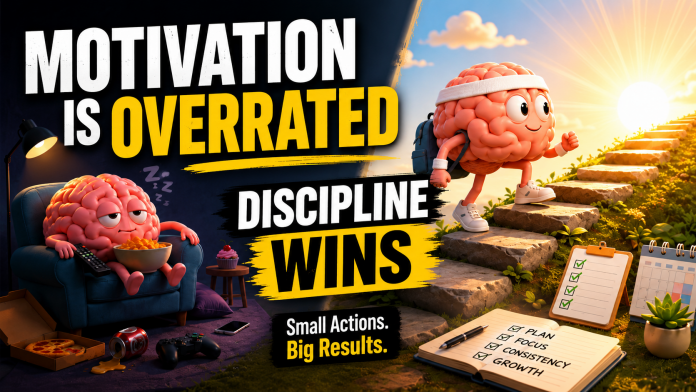
Why discipline, systems, and consistency matter far more than temporary inspiration.
The Motivation Myth
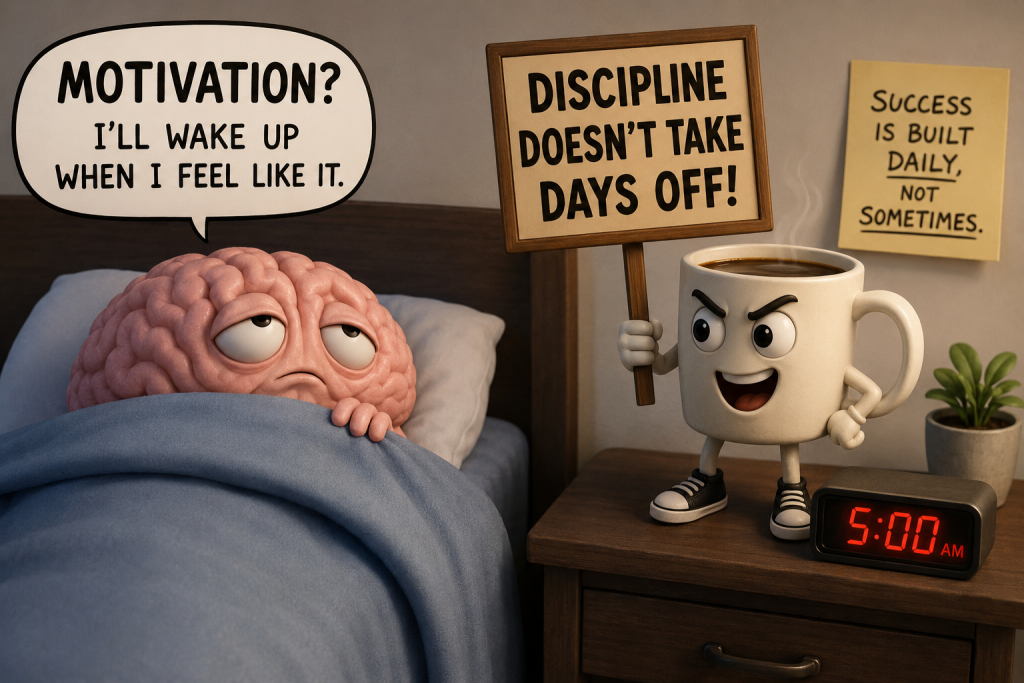
Most people are taught to wait for motivation before they start.
They wait to feel ready.
They wait to feel excited.
They wait for the perfect mood, the perfect morning, the perfect plan, or the perfect burst of energy.
That sounds nice.
It also keeps a lot of people stuck.
The truth is simple: discipline over motivation is what creates real change. Motivation can help you begin, but it cannot be trusted to carry you every day. It comes and goes. Some days it shows up strong. Other days it disappears like it never knew your name.
Discipline is different.
Discipline is not about being perfect. It is not about acting like a robot. It is not about grinding yourself into the ground until you burn out.
Discipline means you do the next right thing even when your mood is not helping you.
That is where real progress starts.
A lot of people think successful people are motivated all the time. They picture writers waking up excited to write, athletes jumping out of bed ready to train, business owners feeling fired up every hour, and healthy people loving every workout and every meal choice.
That is not real life.
Even people who love what they do have tired days. They get bored. They get distracted. They get discouraged. They question themselves. They do not always feel inspired.
The difference is that they have built habits, systems, routines, and personal standards that keep them moving when their emotions are low.
Motivation feels good, but it is not a plan.
It is a spark.
A spark can light a fire, but it cannot keep the fire burning by itself. You still need wood. You still need air. You still need care.
In life, that “wood” is your daily action. That “air” is your routine. That “care” is your system.
This is why the motivation myth is so dangerous. It makes you believe the feeling must come first. It tells you that if you do not feel like doing something, maybe you should wait.
But waiting becomes a habit too.
You wait one day.
Then two.
Then a week.
Then a month.
Soon, the goal is still sitting there, but your confidence is lower because deep down, you know you have not been keeping your word to yourself.
That does not mean you are lazy.
It means you were taught the wrong order.
You do not need to feel ready before you begin. Many times, the feeling comes after the action.
You write a few lines, then you feel a little more like writing.
You walk for five minutes, then your body wakes up.
You clean one corner of the room, then the rest feels less impossible.
You send one email, then the workday feels less heavy.
Action often creates motivation.
Motivation does not always create action.
That is the shift that matters.
Motivation Is Overrated
Motivation is not bad.
It has a place.
It can give you a strong start. It can help you picture a better future. It can make a hard goal feel possible for a moment. A good song, a powerful speech, a new notebook, a fresh plan, or an exciting idea can all give you that “I can do this” feeling.
The problem is not motivation itself.
The problem is depending on it.
Motivation is overrated because people often treat it like the engine when it is really more like the horn.
It makes noise.
It gets attention.
It can wake you up.
But it does not drive the car.
Your daily choices drive the car.
This matters in almost every area of life. A person does not build strength by feeling motivated once. They build strength by training again and again.
A writer does not finish a book by feeling inspired for one afternoon. They finish by writing when the first draft is messy and boring.
A person does not save money because they felt excited on New Year’s Day. They save money because they created rules, limits, and repeatable choices.
That is why discipline over motivation is such a powerful idea. It takes success out of the emotional weather. You stop asking, “Do I feel like it?” and start asking, “What is the next small thing I said I would do?”
There is a big difference between those two questions.
“Do I feel like it?” gives your mood the final vote.
“What is the next small thing?” gives your future the final vote.
This does not mean you ignore your feelings. Feelings matter. If you are exhausted, sick, grieving, burned out, or overwhelmed, you may need rest.
Discipline is not abuse.
Real discipline includes recovery. It includes sleep. It includes pacing yourself. It includes being honest about what your body and mind can handle.
But there is a difference between needing rest and avoiding effort.
There is a difference between healing and hiding.
There is a difference between being kind to yourself and letting every mood become a stop sign.
Motivation is overrated because it is too easy to confuse comfort with wisdom.
Your brain may say, “Not today.”
But sometimes what it really means is, “This feels hard.”
Your brain may say, “Start tomorrow.”
But sometimes what it really means is, “I want the reward without the discomfort.”
That is normal.
Everyone does it.
The human brain likes easy rewards. It likes comfort. It likes familiar patterns. It likes saving energy.
That is why scrolling feels easier than studying.
That is why ordering junk food feels easier than cooking.
That is why saying “I’ll start Monday” feels easier than doing ten minutes right now.
But easy does not always mean helpful.
| Motivation Says | Discipline Says |
|---|---|
| “I’ll do it when I feel ready.” | “I’ll do one small part now.” |
| “I need a big burst of energy.” | “I need a repeatable plan.” |
| “Today does not feel right.” | “Today still counts.” |
| “If I miss a day, I failed.” | “I return as soon as possible.” |
| “I need to be inspired.” | “I need to be consistent.” |
James Clear said:
“You do not rise to the level of your goals. You fall to the level of your systems.”
That quote matters because it removes the fantasy. Goals matter, but goals alone do not save you. A goal is where you want to go. A system is how you keep walking when the road feels boring.
You can read the quote on James Clear’s official quote page.
Here is the plain truth:
- “I want to get in shape” is a goal.
- “Every Monday, Wednesday, and Friday, I walk for 20 minutes after coffee” is a system.
- “I want to write a book” is a goal.
- “Every weekday, I write 300 words before checking social media” is a system.
- “I want to stop feeling behind in life” is a goal.
- “Every Sunday night, I plan my top three tasks for the week” is a system.
Motivation loves the goal.
Discipline builds the system.
The Problem With Waiting to Feel Motivated
Waiting to feel motivated seems harmless at first.
It even sounds smart.
You tell yourself, “I will do better work when I am in the right mood.”
You tell yourself, “I just need to get inspired again.”
You tell yourself, “Once I feel more confident, I will start.”
But confidence does not grow from waiting.
Confidence grows from proof.
Every time you take action, even a tiny action, you give yourself proof. You prove that you can begin. You prove that you can keep a promise. You prove that your mood does not have to be in charge of your whole day.
Every time you wait, you also give yourself proof. You prove that discomfort can stop you. You prove that delay is your normal pattern. You prove that your goals are optional when your mood changes.
That may sound harsh, but it is not meant to shame you.
It is meant to wake you up.
The goal is not to beat yourself up. The goal is to see the pattern clearly.
Waiting to feel motivated creates three big problems.
- It gives your emotions too much power. Your feelings change all day. If your actions depend on your feelings, your progress will always be unstable.
- It makes starting feel bigger than it is. The longer you wait, the more dramatic the task becomes in your mind. A simple task starts to feel like a mountain.
- It trains you to delay. Each delay makes the next delay easier. Soon, waiting becomes the routine.
This is why action must be made small enough to start.
Behavior scientist BJ Fogg explains that behavior happens when motivation, ability, and a prompt come together at the same time. His Fogg Behavior Model from Stanford Behavior Design Lab is useful because it shows that motivation is only one part of action. Ability matters too. Prompts matter too.
In plain English, that means this:
If you are not doing something, do not only ask, “Why am I not motivated?”
Ask better questions.
- Is the task too big?
- Is the first step unclear?
- Is my environment working against me?
- Do I have a clear time to do it?
- Do I need a reminder?
- Can I make this easier to begin?
A lot of people blame themselves for being unmotivated when the real problem is that the task is too vague.
“Get healthy” is vague.
“Walk for ten minutes after lunch” is clear.
“Be more productive” is vague.
“Write tomorrow’s top three tasks before bed” is clear.
“Fix my life” is vague.
“Spend 15 minutes cleaning the kitchen counter” is clear.
The more vague the goal is, the more motivation you need.
The clearer the first step is, the less motivation you need.
That is one of the secrets of discipline. Discipline is not always about pushing harder. Many times, discipline is about making the right action easier to do.
You do not need to become a superhero.
You need to lower the starting line.
If you want to read more, do not start with “I must read one book a week.” Start with one page.
If you want to exercise, do not start with a punishing plan that makes you dread tomorrow. Start with a short walk.
If you want to write, do not demand a perfect chapter. Start with one messy paragraph.
Small starts are not weak.
Small starts are how people beat resistance.
The person who does five minutes today has done more than the person who waited for the perfect mood.
The person who writes one paragraph today is closer than the person who only talked about writing a book.
The person who saves five dollars today has started a different pattern than the person who says, “I’ll save when I make more money.”
Waiting feels safe, but it often costs more than action.
| Vague Goal | Better First Step |
|---|---|
| Get healthy | Walk for 10 minutes after lunch |
| Write a book | Write 100 rough words today |
| Save money | Move $5 into savings every Friday |
| Clean the house | Clear one counter before bed |
| Be more organized | Write tomorrow’s top 3 tasks tonight |
The first step should be so clear that you do not need a debate with yourself.
That is the point.
When a task is too big, your brain looks for escape.
When a task is small and clear, your brain has less room to argue.
This is why discipline over motivation works so well. It does not ask your mood for permission. It gives your mind a simple command:
Do the next small thing.
Not the whole dream.
Not the whole mountain.
Not the perfect version.
Just the next small thing.
Motivation Is Temporary
Motivation is temporary because it is a feeling, and feelings move.
They rise and fall.
They change with sleep, stress, food, weather, money, family issues, health, and even one bad text message.
That is why it is risky to build your future on a feeling that can disappear before lunch.
You may feel motivated on Sunday night and completely drained on Monday morning.
You may feel excited after watching a video, then lose that energy when the real work begins.
You may feel ready when you buy the planner, the running shoes, the course, or the notebook, but the real test comes after the new feeling fades.
And it always fades.
That does not mean your goal is wrong.
It means motivation did its job and then stepped aside.
This is where many people quit. They think losing motivation means they lost the dream. They think, “Maybe I do not want it enough.”
But that is not always true.
Sometimes it only means the exciting part is over and the steady part has begun.
The steady part is where success is built.
Habit research helps explain this. A review from the National Library of Medicine says simple advice about repeating behavior in the same context can help actions become habits over time. You can read the full article here: Making health habitual: the psychology of habit-formation and general practice.
The key idea is easy to understand:
The more often you repeat a helpful action in the same situation, the less you have to argue with yourself about it.
At first, it takes effort.
Later, it becomes normal.
That is the real win.
Not feeling pumped up.
Not being excited every second.
Not needing a huge emotional push.
The win is building a life where the right action becomes the normal action.
Think about brushing your teeth.
Most people do not need a motivational speech for it. They do not need a vision board. They do not need to feel passionate about toothpaste.
They do it because it is part of the routine.
That is what you want with your important goals.
You want writing to become part of the routine.
You want walking to become part of the routine.
You want planning to become part of the routine.
You want saving, learning, cleaning, stretching, studying, praying, practicing, or creating to become part of the routine.
The goal is not to feel motivated forever.
The goal is to need motivation less.
That is why discipline over motivation is not just a catchy phrase. It is a better way to live. It means you are no longer waiting for the perfect mood to give you permission. It means you build simple rules that support the person you are trying to become.
Here is a practical way to start:
- Pick one goal. Do not try to rebuild your whole life in one day.
- Choose one tiny action. Make it so small you can do it even on a low-energy day.
- Attach it to a clear time or trigger. For example, “after breakfast” or “before I open YouTube.”
- Track it simply. A checkmark on paper is enough.
- Return fast when you miss. Missing once is normal. Waiting three weeks to restart is the real danger.
| Goal | Tiny Daily Action | Simple Trigger |
|---|---|---|
| Write more | Write 100 words | After morning coffee |
| Move more | Walk 10 minutes | After lunch |
| Read more | Read 2 pages | Before bed |
| Save money | Move $5 | Every Friday |
| Clean more | Clear one surface | After dinner |
Do not laugh at small actions.
Small actions are how big changes sneak past fear.
A small action is easier to repeat. A repeated action builds trust. Trust builds confidence. Confidence makes bigger action feel possible.
That is the real path.
Motivation says, “Wait until you feel strong.”
Discipline says, “Start small, and strength will grow.”
Motivation says, “You need to be excited.”
Discipline says, “You need to be honest and consistent.”
Motivation says, “Tomorrow will be easier.”
Discipline says, “Do one small thing today.”
The motivation myth tells you that success begins with a feeling.
Real life proves something better:
Success begins with a choice small enough to make right now.
That choice may not look impressive. It may not feel exciting. Nobody may clap for it. Nobody may even notice.
But you will know.
And the more often you keep that promise to yourself, the less you will need motivation to carry you.
That is the beginning of real change.
Beyond Feelings — Discipline Wins
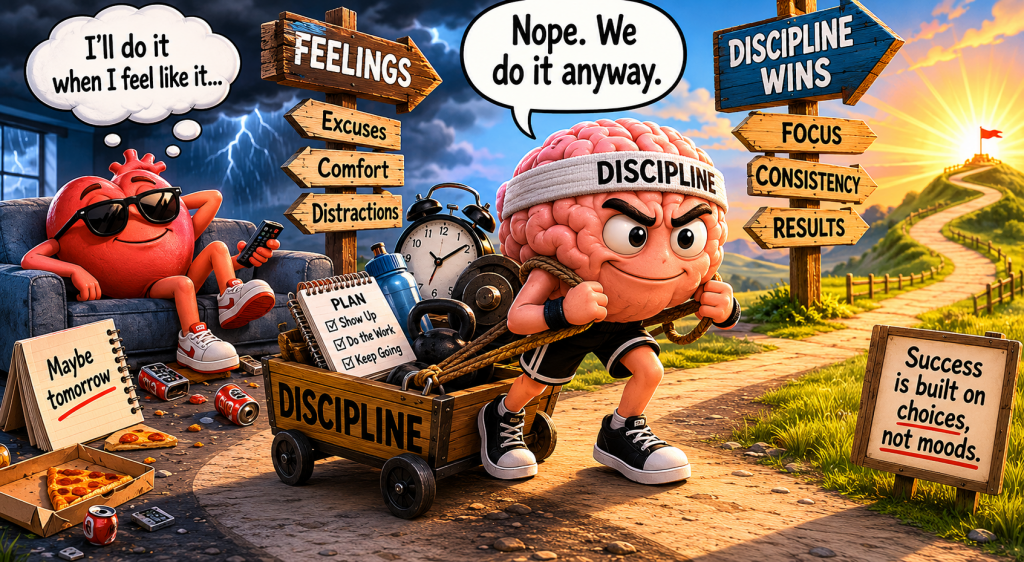
Feelings are real.
They matter.
They can tell you when something hurts, when something excites you, when something scares you, and when something needs your attention.
But feelings are not always good leaders.
That is the hard part.
A lot of people let their emotions run the whole day. If they feel good, they work. If they feel tired, they stop. If they feel excited, they begin. If they feel nervous, they wait. If they feel confident, they move forward. If they feel unsure, they freeze.
That sounds normal because most of us have done it.
But it is also why so many goals never become real.
If you only act when your emotions agree with your plans, your progress will always be shaky. You will have strong days, weak days, good weeks, lost months, fresh starts, and long breaks.
That is why discipline over motivation matters so much.
Discipline does not mean you have no feelings.
Discipline means your feelings do not get to be the boss every time.
You can feel tired and still take one small step.
You can feel nervous and still send the email.
You can feel bored and still write the paragraph.
You can feel unsure and still practice.
You can feel unmotivated and still show up.
That is not fake.
That is strength.
The goal is not to become cold or emotionless. The goal is to stop making your future wait for your mood to improve. When discipline wins, you stop treating every feeling like a command. You learn how to listen to your emotions without handing them the keys.
There is a big difference between saying, “I feel tired, so I will rest in a healthy way,” and saying, “I feel tired, so I will abandon everything that matters to me.”
There is a difference between saying, “I feel anxious, so I will slow down and take one clear step,” and saying, “I feel anxious, so I cannot do anything.”
There is a difference between saying, “I feel bored, so I will make the task smaller,” and saying, “I feel bored, so this goal must not matter.”
Discipline gives you that space.
It lets you feel what you feel while still choosing what you do next.
That is where real change lives.
Emotional Dependency
Emotional dependency happens when your actions depend too much on your mood.
It is when you need to feel inspired before you write.
It is when you need to feel confident before you try.
It is when you need to feel calm before you make a decision.
It is when you need to feel excited before you keep a promise to yourself.
On the surface, that may not sound like a big deal. It may even sound kind. You may think, “I am just listening to myself.”
And yes, you should listen to yourself.
But listening is not the same as obeying every feeling.
Sometimes your feelings are giving you helpful information. Sometimes they are just reacting to fear, stress, hunger, bad sleep, old habits, or the pull of comfort.
If you treat every emotion like truth, you will be dragged around all day.
One hour you feel focused.
The next hour you feel tired.
Then you feel guilty.
Then you feel motivated again.
Then you feel overwhelmed.
Then you feel behind.
Then you promise to start tomorrow.
That cycle is exhausting.
It is also common.
Emotional dependency turns your life into a weather report. You wake up and check your mood like people check the sky.
Do I feel good today?
Do I feel ready today?
Do I feel brave today?
Do I feel inspired today?
If the answer is yes, you move.
If the answer is no, you wait.
That is a dangerous way to live because moods are unstable. Even a good mood can be knocked down by a bad phone call, a poor night of sleep, a stressful bill, a messy room, or one rude comment online.
When your goals depend on your mood, your goals are not really in charge.
Your mood is.
The APA Dictionary of Psychology defines self-regulation as control of behavior through things like self-monitoring, self-evaluation, and self-reinforcement. In simple words, that means watching your actions, checking whether they match your goals, and rewarding the right behavior when you follow through.
That is the opposite of emotional dependency.
Emotional dependency says, “I act when I feel like it.”
Self-regulation says, “I guide myself toward what matters.”
Here is what emotional dependency often looks like in real life:
| Emotional Dependency Pattern | What It Sounds Like | What It Often Leads To |
|---|---|---|
| Waiting for the right mood | “I’ll do it when I feel better.” | Delay and guilt |
| Needing excitement | “This feels boring now.” | Quitting too early |
| Needing confidence first | “I’m not ready yet.” | Staying stuck |
| Avoiding discomfort | “This feels too hard.” | No growth |
| Starting only when inspired | “I need motivation first.” | Inconsistent progress |
The problem is not having feelings.
The problem is letting feelings decide everything.
A person who depends on motivation will always be looking for another push. They will need another video, another speech, another planner, another new start, another challenge, another Monday, another burst of energy.
But the person who builds discipline learns a different skill.
They learn how to move without the drama.
They learn how to do the small boring thing.
They learn how to keep going when the feeling is average.
They learn how to work with emotions instead of being ruled by them.
This is where discipline over motivation becomes more than a nice phrase. It becomes a daily survival tool.
Because life will not always hand you the mood you want.
You may want peace and get stress.
You may want energy and get fatigue.
You may want confidence and get doubt.
You may want support and get silence.
You may want a clear path and get confusion.
Discipline helps you move anyway.
Not perfectly.
Not loudly.
Not with some movie-scene speech playing in the background.
Just honestly.
One step.
Then another.
Then another.
That is how people change.
Discipline Changes Everything
Discipline changes everything because it gives your life structure when your feelings are messy.
It helps you stop waiting for a magical version of yourself to show up.
You do not need the “perfect you” to begin.
You need the honest you.
The tired you.
The unsure you.
The busy you.
The real you.
That version of you can still take action.
This is important because many people believe they need to become a different person before they can build a better life. They think they need more confidence, more energy, more courage, more focus, more time, or more talent.
But discipline works in the opposite direction.
You do not become disciplined because life gets easy.
You become disciplined by practicing small actions while life is still imperfect.
Discipline changes how you see yourself. Every time you follow through, even in a small way, you build trust with yourself. That trust matters.
When you keep breaking promises to yourself, you start to doubt yourself.
When you keep small promises, you start to respect yourself.
That respect is powerful.
It is not loud. It is not flashy. But it is real.
Self-respect is built when you know you can count on yourself.
That does not mean you never miss a day. Everyone misses days. Everyone has off days. Everyone drops the ball sometimes.
The difference is what happens next.
A motivation-based person often says, “I messed up, so I might as well quit.”
A discipline-based person says, “I missed once. I return now.”
That one change can save months of progress.
Discipline also removes a lot of decision stress. When you have no system, every action becomes a debate.
Should I work out today?
Should I write today?
Should I clean today?
Should I practice today?
Should I save money today?
Every question becomes another chance to negotiate with yourself.
That gets tiring fast.
Discipline makes the decision before the mood shows up.
For example:
| Without Discipline | With Discipline |
|---|---|
| “Should I write today?” | “I write 300 words after coffee.” |
| “Should I walk today?” | “I walk for 10 minutes after lunch.” |
| “Should I clean today?” | “I clear the sink after dinner.” |
| “Should I study today?” | “I study for 20 minutes at 7 PM.” |
| “Should I save money?” | “I move $10 every Friday.” |
The less you argue with yourself, the more energy you have for the actual work.
That is one reason systems are so useful. A system is a repeatable way to act. It does not depend on a perfect mood. It gives you a clear next step.
This fits well with the Fogg Behavior Model from Stanford Behavior Design Lab, which explains that behavior happens when motivation, ability, and a prompt come together. This is helpful because it reminds us that motivation is not the whole story. If a task is too hard, too vague, or has no clear trigger, it becomes easier to avoid.
Discipline changes that by making the next action clear.
It lowers the starting line.
It makes the task doable.
It creates a prompt.
It makes progress less emotional.
That is why small disciplined actions beat big emotional plans.
A big emotional plan says, “I am going to change my whole life this week.”
A disciplined plan says, “I am going to walk after lunch today.”
A big emotional plan says, “I am going to write the whole book fast.”
A disciplined plan says, “I am going to write 300 words before I check my phone.”
A big emotional plan says, “I am done wasting time forever.”
A disciplined plan says, “I am putting my phone in another room for 30 minutes.”
The disciplined plan may look smaller.
But it is stronger because you can repeat it.
That is the part people miss.
Success is not built by one huge emotional moment. It is built by repeatable action that survives normal life.
Discipline changes your relationship with discomfort too.
Instead of seeing discomfort as a stop sign, you start seeing it as part of the process.
Writing feels awkward sometimes.
Working out feels hard sometimes.
Saving money feels annoying sometimes.
Learning feels slow sometimes.
Cleaning feels boring sometimes.
Building anything meaningful will include discomfort.
That does not mean something is wrong.
It means you are doing real work.
This is where discipline becomes freeing. It stops you from asking, “Why does this feel hard?” every time something takes effort.
Of course it feels hard.
It matters.
Of course you feel resistance.
You are changing a pattern.
Of course your brain wants the easy road.
The easy road is familiar.
Discipline lets you notice the feeling without quitting because of it.
That is not punishment.
That is maturity.
Showing Up Anyway
Showing up anyway is where discipline becomes real.
It is easy to talk about discipline when you feel good.
It is easy to make plans when the house is quiet, the coffee is hot, and your brain is fresh.
It is easy to say, “This time will be different,” when you are excited.
The real test comes later.
When you are tired.
When you are bored.
When nobody is watching.
When the results are slow.
When the first draft is ugly.
When the scale does not move.
When the room gets messy again.
When the business is not growing fast.
When the video gets no views.
When the habit feels old.
When the goal stops feeling new.
That is where showing up anyway matters.
Showing up anyway does not mean doing the biggest possible version of the task. That is where people get confused.
If your plan is to exercise for an hour but your body is drained, showing up may mean a ten-minute walk.
If your plan is to write 1,000 words but your brain feels heavy, showing up may mean 150 rough words.
If your plan is to deep-clean the house but your day falls apart, showing up may mean clearing one counter.
If your plan is to study for two hours but you are exhausted, showing up may mean reviewing notes for 15 minutes.
The point is not to punish yourself.
The point is to keep the identity alive.
You are telling yourself, “I am still the kind of person who returns.”
That matters more than people think.
Many people fail because they turn one bad day into a whole bad season. They miss one workout and stop for a month. They skip one writing day and abandon the book. They overspend once and give up on budgeting. They eat one poor meal and decide the whole week is ruined.
That is not discipline.
That is all-or-nothing thinking.
Discipline is calmer than that.
Discipline says:
- Missed one day? Return tomorrow.
- Low energy? Do the smaller version.
- Bad mood? Take one useful step.
- Fell behind? Restart without drama.
- Lost focus? Make the next action clear.
Showing up anyway teaches you that progress does not require perfect conditions.
It only requires a next step.
And sometimes that next step is very small.
That is okay.
Small does not mean pointless.
Small means repeatable.
Small means realistic.
Small means you are still in the game.
Research on habit formation supports the power of repeated action. A review from the National Library of Medicine explains that repeating simple behaviors in the same setting can help them become more automatic over time. You can read it here: Making health habitual: the psychology of habit-formation and general practice.
That is why showing up anyway matters so much. Every repeat sends a message to your brain: this is what we do now.
Not what we do when excited.
Not what we do when life is perfect.
Not what we do when we feel amazing.
What we do now.
That is how a habit becomes part of you.
Here is a simple way to use this idea:
| Hard Day Problem | Smaller Way to Show Up |
|---|---|
| Too tired to work out | Stretch for 5 minutes |
| Too overwhelmed to write | Write 5 messy sentences |
| Too busy to clean | Put away 10 items |
| Too stressed to plan | Write only tomorrow’s top task |
| Too distracted to study | Read one page and take one note |
This is the secret: never make the only option the perfect version.
The perfect version is often too heavy.
The small version keeps you moving.
That is discipline over motivation in real life. Not fancy. Not dramatic. Not perfect.
Just steady.
Just honest.
Just enough to keep your promise alive.
A quote often connected with this idea comes from author Octavia E. Butler:
“First forget inspiration. Habit is more dependable. Habit will sustain you whether you’re inspired or not.”
You can find this quote listed by The Marginalian in its collection of Octavia Butler’s advice on writing.
That quote is powerful because it tells the truth.
Inspiration is wonderful when it visits.
But habit stays.
Discipline stays.
Systems stay.
That is why the person who keeps showing up has an advantage over the person who only works when inspired.
The inspired person may sprint.
The disciplined person keeps walking.
Over time, walking wins.
This is not about becoming hard on yourself. It is about becoming dependable. It is about learning that your dreams deserve more than whatever mood you woke up with today.
Your future should not have to beg your feelings for permission.
You can feel tired and still do the small version.
You can feel nervous and still begin.
You can feel bored and still keep the promise.
You can feel unmotivated and still choose one useful action.
That is how discipline wins.
Not all at once.
Not with fireworks.
Not with perfect days.
Discipline wins when you show up anyway.
The Power of Small Actions
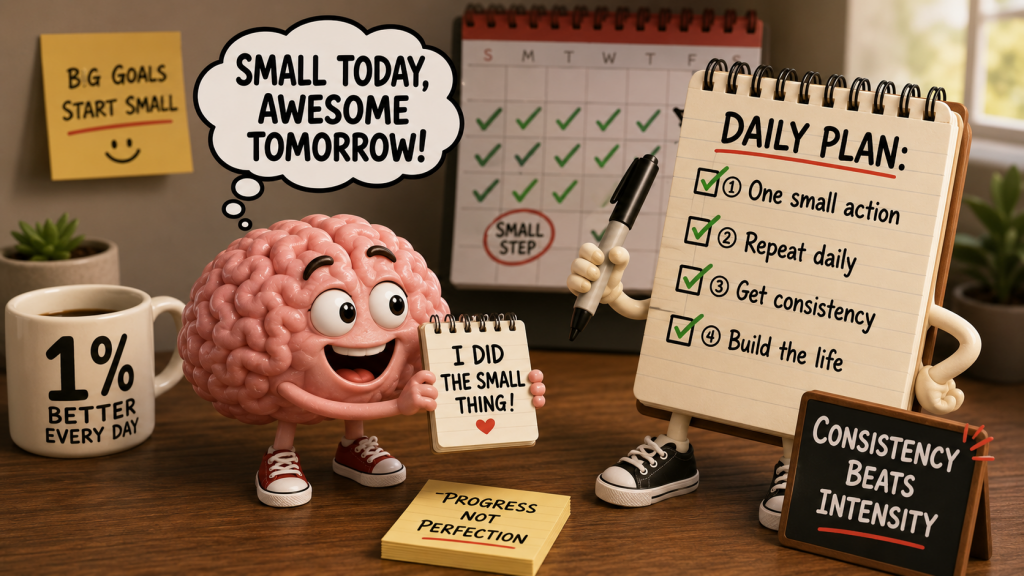
Big goals can scare people.
Small actions do not.
That is why small actions matter so much.
When most people want to change their life, they think too big at the start. They want a full life makeover. They want to fix their health, money, work, home, habits, sleep, confidence, and mindset all at once.
It sounds powerful.
But it usually becomes too heavy.
The first few days may feel exciting. Then real life shows up. You get tired. You get busy. You miss a day. The plan feels too big. Then the old voice comes back.
“I knew I could not do this.”
But that is not always true.
Maybe you could do it.
Maybe the plan was just too big to repeat.
That is where discipline over motivation becomes practical. It does not ask you to become a new person overnight. It asks you to take one small action today and repeat it tomorrow.
Small actions are not impressive at first. They do not make a dramatic story. Nobody cheers because you walked for ten minutes, wrote one paragraph, cleaned one shelf, saved five dollars, or drank one glass of water.
But those small actions are how real change begins.
They are proof.
They are votes.
They are tiny pieces of evidence that say, “I am becoming the kind of person who follows through.”
That matters more than a perfect plan.
A small action lowers fear. It lowers pressure. It lowers the chance that you quit before you even begin.
You may not feel ready to write a whole book, but you can write 100 words.
You may not feel ready to clean the whole house, but you can clear one counter.
You may not feel ready to fix your whole body, but you can walk around the block.
You may not feel ready to change your whole money life, but you can skip one useless purchase.
You may not feel ready to rebuild your confidence, but you can keep one promise today.
That is the power of small actions.
They make progress possible on normal days.
Not perfect days.
Normal days.
The kind of days where the laundry is still there, the bills still exist, the phone keeps buzzing, your energy is not great, and life does not slow down just because you have goals.
A lot of people think they need a big emotional push to get started. But many times, they only need a smaller first step.
That idea fits the Fogg Behavior Model, which explains that behavior happens when motivation, ability, and a prompt come together. In simple words, if something is easy enough, clear enough, and tied to a reminder, you are more likely to do it.
That is why small actions work.
They make the “ability” part easier.
You do not need a huge mood shift to do something small. You do not need to feel like a superhero. You do not need the perfect time.
You just need a clear next step that is small enough to start.
| Big Goal | Small Action That Starts It |
|---|---|
| Get healthier | Walk for 10 minutes after lunch |
| Write a book | Write 100 rough words today |
| Save more money | Move $5 into savings this week |
| Clean the house | Clear one table or counter |
| Learn a skill | Watch one lesson and take one note |
| Be more organized | Write tomorrow’s top 3 tasks |
| Build confidence | Keep one small promise to yourself |
Small actions are not the opposite of big dreams.
Small actions are how big dreams get built.
Small Daily Actions
Small daily actions are powerful because they are easy to repeat.
That is the secret.
The action does not need to be huge. It needs to be repeatable.
A lot of people fail because they design a plan for their most motivated self. They make a plan for the version of them that slept great, has extra time, feels brave, and wants to work hard.
But that version of you does not show up every day.
Some days, you will be tired.
Some days, you will be annoyed.
Some days, you will be busy.
Some days, you will not feel inspired at all.
So the real question is not, “What can I do on my best day?”
The real question is, “What can I still do on a normal hard day?”
That is where the truth lives.
If your plan only works when life is easy, it is not a strong plan. It is a wish.
A small daily action gives you something you can actually do. It gives you a starting point that does not need drama.
For example, if you want to write daily, your small action could be:
- Write 100 words.
- Open the document.
- Write one bad paragraph.
- Fix one sentence from yesterday.
- Make a three-bullet outline.
If you want to move more, your small action could be:
- Walk for five minutes.
- Stretch your back and legs.
- Do ten slow bodyweight squats.
- Take the stairs once.
- Park a little farther away.
If you want to clean more, your small action could be:
- Wash five dishes.
- Clear one counter.
- Throw away obvious trash.
- Put away ten items.
- Make the bed.
These actions may seem too small, but that is the point.
Small actions are easy to begin.
And beginning is usually the hardest part.
Once you begin, you often do more. But even if you do not, you still kept the habit alive. You still proved something to yourself. You still stayed in motion.
That matters.
James Clear wrote:
“Success is the product of daily habits—not once-in-a-lifetime transformations.”
You can find that quote on James Clear’s official quote page.
That quote is useful because it cuts through the fantasy. Most success does not come from one huge moment. It comes from repeated choices that look small while you are making them.
This is why discipline over motivation works better than waiting for inspiration.
Motivation wants a big feeling.
Discipline wants a small action.
Motivation says, “Do it when you feel ready.”
Discipline says, “Make it small enough to do now.”
That is a much better plan.
Small daily actions also protect you from the all-or-nothing trap. The all-or-nothing trap says if you cannot do the perfect version, you might as well do nothing.
That is how people lose momentum.
They planned to work out for an hour, but they only had ten minutes, so they skipped it.
They planned to write a full chapter, but they only had energy for one page, so they wrote nothing.
They planned to deep-clean the room, but it felt too big, so they left the mess alone.
They planned to eat perfectly, made one poor choice, and decided the whole day was ruined.
Small daily actions break that pattern.
They give you a smaller way to win.
| All-or-Nothing Thinking | Small Action Thinking |
|---|---|
| “I cannot work out for an hour, so I will skip it.” | “I can walk for 10 minutes.” |
| “I cannot write a chapter, so why bother?” | “I can write one paragraph.” |
| “I cannot clean the whole house.” | “I can clean one surface.” |
| “I already messed up today.” | “I can make the next choice better.” |
| “I do not have time.” | “I can do the smallest useful version.” |
This is how people become consistent.
Not by being perfect.
By returning to the small action.
The National Library of Medicine review Making health habitual: the psychology of habit-formation and general practice explains that repeating a behavior in the same setting helps automaticity develop over time. In plain English, when you keep doing the same helpful action in the same kind of situation, your brain starts to treat it as normal.
That is what you want.
You do not want every good choice to feel like a battle.
You want the good choice to become the regular choice.
You want the action to become part of your day.
You want the routine to carry you when motivation is weak.
That starts with small daily actions.
Not because small is magical.
Because small is repeatable.
And repeatable is powerful.
Why Consistency Wins
Consistency wins because time rewards what you repeat.
Not what you talk about.
Not what you plan once.
Not what you do only when you feel fired up.
What you repeat.
That is why one small action done often can beat one huge effort done once.
A person who walks ten minutes a day for a year will usually do better than someone who destroys themselves in one brutal workout and then quits.
A person who writes 300 words a day will finish more than someone who waits for the perfect weekend to write 10,000 words.
A person who saves a small amount every week will often build more stability than someone who keeps saying, “I’ll start when I have extra money.”
Consistency is not flashy, but it is strong.
It works because it gives your effort time to stack.
Think about bricks.
One brick does not build a house.
But one brick placed every day changes the view.
At first, it looks like nothing.
Then it looks like a wall.
Then it looks like a room.
Then one day, you realize the house is real.
That is what consistency does.
Small actions become visible after they have had time to collect.
The hard part is that most people quit before the results are obvious. They want the wall to look like a house after three bricks. When it does not, they think the bricks are not working.
But the bricks are working.
They just need more time.
This is why discipline over motivation is so important. Motivation gets bored when results are slow. Discipline keeps placing the brick.
Motivation says, “This is taking too long.”
Discipline says, “Keep going. The stack is growing.”
Motivation says, “I do not see results yet.”
Discipline says, “Results are built before they are seen.”
Motivation says, “This feels too small.”
Discipline says, “Small repeated is not small anymore.”
Consistency also helps because it reduces the need to restart.
Starting over takes energy. It takes mental effort. It often comes with guilt. When you stop for a long time, the goal starts to feel far away again.
But when you stay consistent, even in a small way, you do not keep falling back to zero.
You stay connected to the goal.
That connection matters.
A tiny habit keeps the door open.
A tiny workout keeps you connected to your health.
A tiny writing session keeps you connected to your book.
A tiny cleaning routine keeps you connected to your home.
A tiny money habit keeps you connected to your future.
This does not mean you never rest. Rest is part of a good system. But rest is different from quitting.
Rest says, “I am recovering so I can continue.”
Quitting says, “I am done because this got uncomfortable.”
Consistency includes smart rest. It includes smaller days. It includes adjusting the plan when life changes. It includes staying honest instead of pretending you can run at full speed forever.
That is another reason consistency wins. It is more realistic.
A plan based on intensity usually burns hot and fast.
A plan based on consistency can last.
| Intensity-Based Plan | Consistency-Based Plan |
|---|---|
| Big effort for a short time | Small effort repeated often |
| Depends on high energy | Works with normal energy |
| Easy to quit when tired | Easier to keep going |
| Feels exciting at first | Builds trust over time |
| Often leads to burnout | Often leads to steady progress |
Consistency is not about doing the same exact amount every day. It is about keeping the pattern alive.
Some days are full-effort days.
Some days are small-effort days.
Some days are recovery days.
But the main pattern stays the same:
You return.
That is the habit.
That is the skill.
That is the real win.
The American Psychological Association has written about how habits can shape behavior and why changing habits often means changing the cues, routines, and rewards around them. Their article Harnessing the power of habits is a helpful read if you want to understand why repeated behavior matters so much.
In simple terms, your life is shaped by what you repeat.
If you repeat delay, delay gets easier.
If you repeat excuses, excuses get easier.
If you repeat scrolling, scrolling gets easier.
But if you repeat action, action gets easier.
If you repeat planning, planning gets easier.
If you repeat walking, walking gets easier.
If you repeat writing, writing gets easier.
That is why consistency wins.
You are always practicing something.
The question is, are you practicing the life you want or the life you keep complaining about?
That may sound blunt, but it is useful.
Because every day gives you a chance to cast another vote.
Not a perfect vote.
A small vote.
A real vote.
A vote for the kind of person you are becoming.
Keep Going Even When You Do Not Feel Like It
There will be days when you do not feel like it.
That is not a failure.
That is normal.
You will not always feel like writing.
You will not always feel like walking.
You will not always feel like cleaning.
You will not always feel like saving money.
You will not always feel like being patient, focused, brave, or organized.
If your plan depends on always feeling like it, your plan will break.
This is where small actions save you again.
When you do not feel like it, do the smaller version.
Not the fake version.
Not nothing.
The smaller version.
If you planned to write 1,000 words, write 100.
If you planned to walk 30 minutes, walk five.
If you planned to clean the whole room, clean one corner.
If you planned to study for an hour, study for ten minutes.
If you planned to cook a full healthy meal, make the simplest decent option you can.
The smaller version keeps your promise alive.
And sometimes that is enough.
People often think discipline means forcing yourself to do the maximum every day. That is not true. That is how people burn out.
Real discipline is flexible.
It asks, “What is the best useful action I can take today, with the energy I actually have?”
That question is honest.
It does not let you quit easily.
But it also does not pretend you are a machine.
That balance matters.
Because some days really are hard. You may be tired. You may be stressed. You may be dealing with family issues, pain, health problems, money pressure, or mental overload. On those days, the goal is not to crush yourself.
The goal is to stay connected.
Do the smallest honest version.
That is how you keep going without becoming cruel to yourself.
Here is a simple “low-energy plan” you can use:
| If You Do Not Feel Like It | Do This Instead |
|---|---|
| You do not want to write | Write 5 sentences |
| You do not want to exercise | Walk to the end of the street |
| You do not want to clean | Pick up 10 things |
| You do not want to plan | Write one task for tomorrow |
| You do not want to study | Review one page |
| You do not want to cook | Make the easiest healthy meal available |
| You do not want to work | Set a timer for 10 minutes and begin |
This works because starting changes the situation.
Before you start, the task lives in your head. It feels big there. It grows teeth. It turns into a monster.
After you start, it becomes real. You can see it. You can touch it. You can finish a piece of it.
That changes how your brain feels about it.
You may still not love it.
But it becomes less scary.
This is why the first tiny action matters so much. It breaks the spell of avoidance.
Avoidance makes things look bigger.
Action makes them smaller.
That is the power of discipline over motivation.
It teaches you to stop waiting for the mood to change first. You take the small action, and many times, the mood changes after.
Not always.
But often enough to matter.
Keep going even when you do not feel like it does not mean ignoring every warning sign. If your body is sick, rest. If your mind is overloaded, simplify. If you are burned out, recover. If you are hurt, be wise.
But do not confuse every low mood with a stop sign.
Sometimes a low mood just means you need a smaller step.
Sometimes boredom just means the habit is becoming normal.
Sometimes resistance just means you are at the edge of growth.
Sometimes “I do not feel like it” is just the old pattern trying to stay alive.
You do not have to fight it with anger.
You can answer it with action.
Quiet action.
Small action.
Honest action.
A simple way to do this is to create a “minimum day” rule.
A minimum day rule means you decide ahead of time what counts on your hardest days.
For example:
- My minimum writing day is 100 words.
- My minimum exercise day is 5 minutes of walking.
- My minimum cleaning day is one cleared surface.
- My minimum reading day is 2 pages.
- My minimum planning day is one written task.
This rule protects you from quitting.
It also protects you from being too hard on yourself.
You do not need every day to be amazing.
You need enough days where you do not fully abandon the path.
That is how progress survives real life.
The truth is, there will always be a reason to wait.
You can always find one.
Too tired.
Too busy.
Too late.
Too early.
Too stressed.
Too behind.
Too unsure.
Too distracted.
Too much going on.
Some of those reasons may be real. But they do not always have to become the final answer.
You can still choose one small thing.
You can still show up in a smaller way.
You can still keep the chain alive.
You can still remind yourself, “I am not doing this because I feel perfect. I am doing this because it matters.”
That is how people become steady.
Not by winning every day.
By returning every day they can.
Not by feeling motivated all the time.
By building small actions that survive low motivation.
Not by being perfect.
By refusing to turn one hard day into a lost life.
Small daily actions are not weak.
Consistency is not boring.
Keeping going when you do not feel like it is not fake.
It is one of the strongest skills you can build.
Because once you learn how to act without needing the perfect mood, you become harder to stop.
Building Momentum
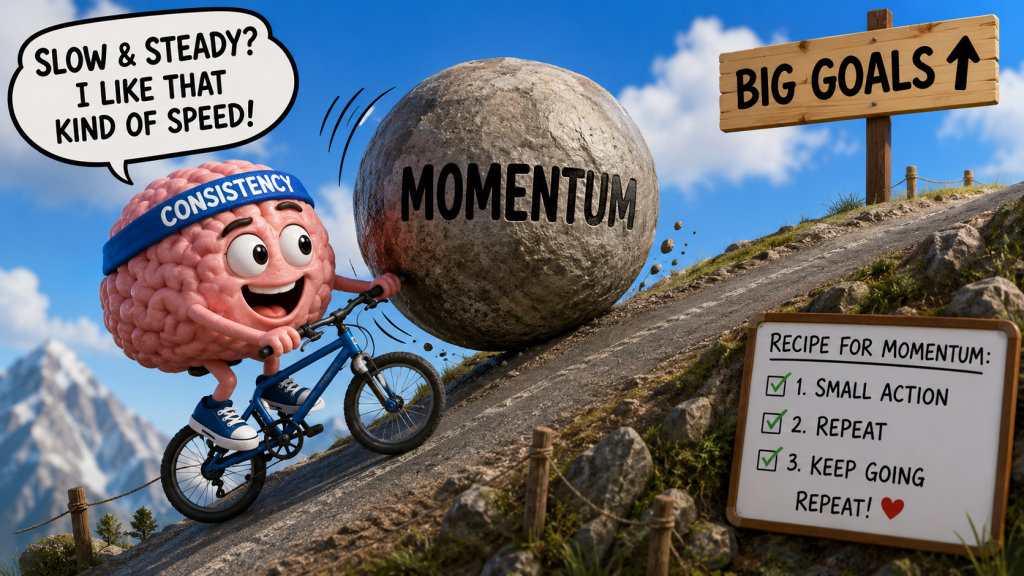
Momentum is one of the most useful forces in personal growth.
It is also one of the most misunderstood.
Most people think momentum means everything suddenly feels easy. They picture themselves waking up with perfect energy, clear focus, and a strong desire to do the work. They imagine a smooth streak where every day feels better than the day before.
That sounds nice.
But real momentum is not always that pretty.
Real momentum often starts small. It can begin with one quiet choice. One page read. One walk taken. One dish washed. One paragraph written. One honest conversation. One small promise kept.
At first, it may not feel like much.
But if you keep repeating it, something begins to change.
The action gets less scary.
The task feels less heavy.
The goal starts to feel more real.
Your confidence begins to grow because you are no longer just thinking about change. You are proving change to yourself.
That is why discipline over motivation is so important. Motivation can help you start, but momentum helps you continue. It gives your actions weight. It makes the next step easier because the last step already happened.
Think about pushing a heavy cart.
The first push is the hardest. The cart does not want to move. You lean into it. You struggle. You may even wonder if it is worth it. But once the wheels start turning, the cart becomes easier to push.
Your habits work the same way.
The first workout feels hard.
The first writing session feels awkward.
The first week of saving money feels tight.
The first cleaning routine feels annoying.
The first attempt to change your schedule feels clumsy.
Then, after enough repeats, the action starts to feel more normal.
Not always easy.
But more normal.
That is momentum.
It is not magic.
It is repeated movement.
Momentum matters because it helps you escape the stop-start cycle. That cycle is where many people lose years. They get excited, begin strong, miss a few days, feel guilty, quit, wait, restart, and repeat the whole thing again later.
That cycle is exhausting.
Momentum helps break it because it teaches you to keep going with smaller, steadier action. You stop needing a dramatic new beginning every month. You stop waiting for a life-changing feeling. You start trusting the process of doing the next small thing.
This is where progress becomes practical.
You do not need to fix your whole life today.
You need to create enough movement that tomorrow is easier to enter.
That may sound simple, but it is powerful.
A person who takes one small step today has a better starting point tomorrow than a person who waits. That step may be tiny, but it changes the story.
Yesterday, you avoided it.
Today, you touched it.
Tomorrow, it may feel less impossible.
That is how momentum grows.
Small action creates proof.
Proof creates belief.
Belief creates more action.
More action creates stronger momentum.
This is the quiet engine behind long-term success. It is not about being hyped up all the time. It is about creating a pattern where progress starts feeding itself.
| No Momentum | Growing Momentum |
|---|---|
| You wait to feel ready | You take one small action |
| The goal feels far away | The goal starts to feel possible |
| You keep restarting | You keep returning |
| You doubt yourself more | You trust yourself more |
| Action feels heavy | Action becomes more normal |
Momentum is not built by one giant leap.
It is built by showing up enough times that your brain starts to believe, “This is what I do now.”
Momentum Builds Confidence
Confidence does not come from pretending.
It comes from evidence.
That is one of the biggest truths people miss.
You can tell yourself, “I am confident,” all day long. You can write it in a notebook. You can repeat it in the mirror. You can put it on a sticky note.
That may help a little.
But real confidence grows when you have proof that you can act.
If you want to feel like a writer, write.
If you want to feel like a healthier person, move.
If you want to feel like a stronger person, keep one hard promise.
If you want to feel like an organized person, create one organized corner.
If you want to feel like someone who follows through, follow through on something small.
Confidence is not always something you wait for.
Many times, confidence is something you earn through action.
That is why momentum matters. Every small win becomes evidence. Every repeat tells your brain, “I can do this again.”
This connects to the idea of self-efficacy. The American Psychological Association explains that Albert Bandura’s theory of self-efficacy is about how a person’s belief in their own ability can affect behavior, effort, and resilience. You can read more about it on the APA page, Self-efficacy: The theory at the heart of human agency.
In plain English, self-efficacy means you believe you can handle the task in front of you.
Not because you are perfect.
Not because everything is easy.
But because you have seen yourself try, learn, adjust, and continue.
That belief grows through experience.
If you avoid everything hard, confidence shrinks.
If you take small useful actions, confidence grows.
This is why discipline over motivation is such a strong approach. It gives confidence something real to stand on. You are not trying to hype yourself into believing. You are giving yourself proof.
One walk gives proof.
One paragraph gives proof.
One cleaned surface gives proof.
One saved dollar gives proof.
One finished task gives proof.
The proof may be small, but small proof still counts.
Think of confidence like a jar.
Each time you keep a small promise, you drop a coin in the jar.
At first, it does not look like much.
But over time, the jar gets heavier.
Then one day, when life gets hard, you are not empty. You have evidence stored up. You can say, “I have done hard things before. I can take the next step.”
That is momentum building confidence.
Here is what that can look like:
| Small Action | Confidence Message It Sends |
|---|---|
| Writing 100 words | “I can create even when it is messy.” |
| Walking 10 minutes | “I can take care of my body today.” |
| Saving $5 | “I can make a wise money choice.” |
| Cleaning one counter | “I can bring order to one part of my life.” |
| Planning tomorrow | “I can guide my day instead of drifting.” |
This matters because many people wait for confidence before they move.
But movement often comes first.
You do not need full confidence to begin. You only need enough willingness to take the next small step.
Confidence follows action.
Not every time right away.
Not always loudly.
But with enough repeats, it shows up.
You start thinking, “Maybe I can do this.”
Then later, “I have done this before.”
Then later, “This is part of who I am.”
That is a powerful shift.
Momentum also helps because it makes mistakes less dramatic. When you have no momentum, one mistake feels like the end. You miss one day and think, “There I go again. I ruined it.”
But when you have momentum, one mistake becomes just one bump.
You do not have to rebuild your whole identity after one bad day. You simply return to the next action.
That is confidence too.
Not the confidence that says, “I will never mess up.”
The stronger confidence says, “If I mess up, I know how to come back.”
That kind of confidence is more useful because it is real.
Life is not clean. Habits are not perfect. Goals are not always smooth. You will have days when you feel behind, tired, distracted, or disappointed.
Momentum does not remove all of that.
Momentum helps you keep moving through it.
And each time you keep moving, your confidence gets stronger.
The Harvard Business School page for Teresa Amabile and Steven Kramer’s book, The Progress Principle, describes how progress in meaningful work can create better inner work lives. Their related Harvard Business Review article, The Power of Small Wins, also points to the value of seeing progress.
That idea matters outside the workplace too.
People need to see progress.
Not just dream about it.
Not just talk about it.
See it.
That is why tracking small wins can help. You do not need a fancy app. A notebook, calendar, checklist, or simple note on your phone can work.
When you see the marks add up, your brain gets a message:
“I am moving.”
And when you believe you are moving, you are less likely to quit.
The Psychology of Progress
Progress changes how a person feels about effort.
That is why it matters so much.
When you feel like nothing is changing, effort becomes heavy. You start thinking, “Why bother?” You wonder if the goal is too far away. You question whether the work is worth it.
But when you can see progress, even a little, effort feels different.
You may still be tired.
You may still have a long way to go.
But now you have proof that the work is doing something.
That proof gives energy.
This is the psychology of progress.
People are more likely to keep going when they can see that their actions matter. That does not mean results have to be huge. It means they need to be noticed.
A small win can help you keep going because it gives your brain a reward. It says, “Something happened because I acted.”
That is powerful.
This is why tiny wins are not silly. They are fuel.
A checked box.
A crossed-off task.
A finished paragraph.
A clean sink.
A short walk.
A saved receipt.
A completed lesson.
A small bill paid.
These things may not look life-changing from the outside, but they can change the way you feel on the inside.
They create forward motion.
They reduce helplessness.
They make the goal feel less like a fantasy and more like a project.
That is a big deal.
The brain does not only need the final result. It needs signs along the way. Without signs, the road feels endless.
Imagine driving across the country with no road signs, no mile markers, no map, and no gas stations. Even if you were moving, you might feel lost. You might wonder if you were going the wrong way.
Goals can feel like that too.
That is why progress markers matter.
They help you see that you are not standing still.
For a goal like writing, progress markers could be:
- Words written
- Pages finished
- Days shown up
- Chapters outlined
- Draft sections completed
For a health goal, progress markers could be:
- Walks completed
- Meals planned
- Water intake improved
- Sleep routine followed
- Energy level noticed
For a money goal, progress markers could be:
- Dollars saved
- Bills paid on time
- Spending tracked
- One subscription canceled
- One impulse buy avoided
The progress marker should be close enough to control.
That matters.
If you only track the final result, you may get discouraged. The final result can take time. But if you track actions, you can see progress sooner.
For example, if your only health marker is weight loss, you may get frustrated when the scale moves slowly. But if you also track walks, meals, water, and sleep, you can see that you are building the pattern.
That keeps momentum alive.
| Goal | Slow Result to Track | Better Progress Marker |
|---|---|---|
| Write a book | Finished book | Words written each day |
| Get healthier | Weight change | Walks, meals, sleep, water |
| Save money | Large savings account | Weekly savings habit |
| Build confidence | Feeling brave all the time | Promises kept |
| Clean home | Perfect house | One area improved daily |
This is another reason discipline over motivation works. Discipline focuses on controllable progress. Motivation often wants the reward now. Discipline says, “Track the action. The result will follow.”
The psychology of progress also explains why people should not wait until the finish line to feel proud.
You should notice progress along the way.
Not in a fake way.
Not by pretending everything is perfect.
But by being honest enough to say, “That was better than yesterday.”
That kind of honesty matters.
Many people are hard on themselves because they only look at what is left to do. They do not look at what they already did.
They see the dirty laundry, not the clean kitchen.
They see the chapters left, not the pages written.
They see the money still owed, not the debt already paid down.
They see the weight they still want to lose, not the walks they have taken.
They see the mistakes, not the returns.
That mindset kills momentum.
You do not need to lie to yourself. You can still see what needs work. But you also need to see what is working.
Progress is not only about the finish line.
Progress is also about direction.
Are you facing the right way?
Are you returning faster?
Are you doing the small thing more often?
Are you quitting less?
Are you recovering better after bad days?
Are you keeping more promises than before?
If yes, that counts.
That is progress.
A helpful quote from Teresa Amabile and Steven Kramer is:
“Of all the things that can boost emotions, motivation, and perceptions during a workday, the single most important is making progress in meaningful work.”
That quote is listed in Harvard Business Review’s article, The Power of Small Wins.
The reason it hits so hard is because it is simple and true.
Progress makes people feel alive because it tells them their effort matters.
That is why you should build visible progress into your life.
Use a checklist.
Use a habit tracker.
Use a notebook.
Use a calendar.
Use a whiteboard.
Use anything simple that lets you see yourself moving.
Do not make it complicated. The tracker should help you, not become another job.
The goal is not to worship the checklist.
The goal is to remind yourself, “I am building something.”
That reminder can help on the days when motivation is low.
Because when your feelings say, “Nothing is happening,” your record can answer, “Yes, it is. Look.”
That is how momentum protects you.
It gives you proof when your mood gets dramatic.
It shows you that small actions are not wasted.
It reminds you that discipline works even when motivation is quiet.
Momentum is not built by waiting.
It is built by movement.
And once you start moving, even slowly, the next step becomes easier to believe in.
Identity Through Repetition

The way you see yourself matters.
Not in a fluffy way.
Not in a fake mirror-talk way.
In a real, daily-life way.
If you see yourself as someone who always quits, you will expect yourself to quit.
If you see yourself as someone who cannot stay consistent, you will look for proof that you are inconsistent.
If you see yourself as someone who never follows through, one bad day will feel like the whole story.
That is why identity matters so much.
Your identity is the story you believe about who you are.
Some of that story comes from your past. Some of it comes from what people said about you. Some of it comes from mistakes you made. Some of it comes from things you survived. Some of it comes from habits you repeated for years without thinking about them.
But here is the good news:
Your identity is not frozen.
You can build a new one through repeated action.
This is where discipline over motivation becomes deeper than just “try harder.” Discipline is not only about getting more done. It is about slowly teaching yourself, “This is who I am now.”
That lesson does not come from one big speech.
It comes from repetition.
Every time you write, you are voting for the identity of a writer.
Every time you walk, you are voting for the identity of a person who takes care of their body.
Every time you save money, you are voting for the identity of a person who plans ahead.
Every time you clean one small area, you are voting for the identity of a person who creates order.
Every time you return after a bad day, you are voting for the identity of a person who does not stay down.
That does not mean one action changes everything overnight. It does not. One workout does not make you fit. One paragraph does not finish the book. One saved dollar does not fix your money. One clean counter does not make your whole house organized.
But one action does something very important.
It starts the evidence.
That evidence matters because your brain believes what you show it over and over.
If you keep showing your brain that you quit, it believes quitting is your pattern.
If you keep showing your brain that you return, it starts to believe returning is your pattern.
This is why small repeated actions are so powerful. They do not only change your schedule. They change your self-image.
A person who says, “I am trying to write,” feels different from a person who says, “I write every morning, even if it is only a little.”
A person who says, “I need to get healthier,” feels different from a person who says, “I walk after lunch.”
A person who says, “I am bad with money,” feels different from a person who says, “I check my spending every Friday.”
The first person is hoping.
The second person is building.
That is the power of identity through repetition.
| Old Identity Story | Repeated Action | New Identity Story |
|---|---|---|
| “I always quit.” | Return after missing a day | “I come back fast.” |
| “I am not disciplined.” | Keep one small daily promise | “I can trust myself.” |
| “I am not a writer.” | Write 100 words a day | “I am someone who writes.” |
| “I am bad with money.” | Track spending weekly | “I pay attention to my money.” |
| “I am lazy.” | Take one useful action daily | “I show up even when it is small.” |
James Clear wrote:
“Every action you take is a vote for the type of person you wish to become.”
You can read that quote on James Clear’s official quote page.
That line works because it is simple and true.
Your habits are not just tasks.
They are votes.
And the more votes you cast, the stronger the identity becomes.
Building Identity Through Repetition
You do not build a new identity by saying it once.
You build it by proving it.
That may sound hard, but it is actually freeing.
It means you do not have to feel like a new person before you start acting like one. You can begin with a small action and let the identity grow from there.
This is a big reason discipline over motivation works better than waiting to feel inspired. Motivation wants you to feel different first. Discipline lets you act different first.
Then your self-image catches up.
Think about the phrase, “I am not the kind of person who does that.”
People say that about many things.
Some say, “I am not the kind of person who wakes up early.”
Some say, “I am not the kind of person who works out.”
Some say, “I am not the kind of person who finishes projects.”
Some say, “I am not the kind of person who saves money.”
Some say, “I am not the kind of person who can stay focused.”
But where did those beliefs come from?
Usually, from repeated evidence.
You skipped workouts, so you believed you were not a workout person.
You stopped writing, so you believed you were not a writer.
You avoided money, so you believed you were bad with money.
You delayed tasks, so you believed you were not disciplined.
That does not mean those beliefs are true forever.
It means they were trained.
And what is trained can often be retrained.
You retrain identity by creating new evidence.
Not giant evidence.
Small evidence.
Daily evidence.
Repeated evidence.
James Clear’s article on identity-based habits explains that lasting habits are tied to the type of person you believe you are. In plain language, your actions and your self-image feed each other. What you do shapes who you think you are. Who you think you are shapes what you keep doing.
That is why repetition matters.
Repetition gives your brain a new story to work with.
At first, the new story may feel false.
If you have spent years saying, “I never follow through,” then saying, “I am disciplined” may feel like a lie.
So do not start with a giant statement your brain rejects.
Start smaller.
Say, “I am becoming someone who follows through.”
That is honest.
That leaves room for growth.
Then prove it with one small action.
Do that again.
And again.
And again.
Over time, the words start to feel more believable because your actions are backing them up.
| Instead of Saying | Say This Instead | Prove It With |
|---|---|---|
| “I am a failure.” | “I am learning to return.” | Restart after one missed day |
| “I am lazy.” | “I am becoming more consistent.” | Do one small task today |
| “I am not a writer.” | “I am becoming someone who writes.” | Write one paragraph |
| “I am unhealthy.” | “I am becoming someone who moves.” | Walk for 10 minutes |
| “I am messy.” | “I am becoming someone who creates order.” | Clear one surface |
This is not fake positivity.
Fake positivity ignores reality.
This is honest rebuilding.
You are not pretending the old pattern never existed. You are choosing not to keep feeding it.
That is a huge difference.
A lot of people get stuck because they use their past as a life sentence.
They say:
- “I have always been this way.”
- “I always mess things up.”
- “I never stick with anything.”
- “I am just not disciplined.”
- “This is just who I am.”
But those sentences are not facts carved into stone.
They are stories built from repeated experience.
And new experience can build a new story.
This is one reason tiny habits can be so powerful. The Fogg Behavior Model explains that behavior happens when motivation, ability, and a prompt come together. If the action is easier to do, you are more likely to repeat it. And if you repeat it enough, it can become part of your normal life.
That is where identity begins to shift.
You stop asking, “Can I become disciplined?”
You start seeing, “I did the disciplined thing today.”
That one sentence is powerful.
Because identity does not need perfection.
It needs evidence.
Tiny Wins Matter
Tiny wins matter because they give your brain proof that change is possible.
Many people ignore tiny wins because they seem too small.
They say things like:
“It was only five minutes.”
“It was only one page.”
“It was only one walk.”
“It was only ten dollars.”
“It was only one drawer.”
But that word only steals credit from the work.
Do not do that.
Tiny wins are not meaningless.
They are how bigger wins begin.
If you have been stuck for a long time, a tiny win can be a big deal. It may not impress anyone else, but it can change how you feel about yourself.
A tiny win says, “I moved.”
A tiny win says, “I did not stay frozen.”
A tiny win says, “I kept a promise.”
A tiny win says, “I can do this again.”
That matters.
The Harvard Business Review article The Power of Small Wins explains how progress in meaningful work can boost emotions, motivation, and how people see their work. The idea is useful far beyond the office. People need to feel that their effort is creating movement.
Tiny wins help you see that movement.
They make progress visible.
And visible progress builds hope.
This is why tracking small wins can help so much. You do not need anything fancy. A paper calendar works. A notebook works. A notes app works. A whiteboard works.
The tool does not matter.
The proof matters.
When you see the checkmarks, you see evidence. When you see the evidence, you start to believe the new identity is real.
Here are simple tiny wins worth tracking:
| Goal Area | Tiny Win to Track |
|---|---|
| Writing | Wrote 100 words |
| Health | Walked for 10 minutes |
| Money | Saved or tracked $5 |
| Home | Cleared one small area |
| Learning | Read 2 pages or watched one lesson |
| Focus | Worked 10 minutes without checking phone |
| Confidence | Did one thing I was avoiding |
Tiny wins also help when your mood is low.
Motivation may be gone, but a tiny win still gives you a way forward. It lets you say, “I do not have to do everything. I just have to do the next small thing.”
That sentence can save a hard day.
It keeps you from turning low energy into total failure.
It keeps you from turning one missed habit into a lost month.
It keeps you from turning a bad mood into a broken identity.
That is why discipline over motivation is so useful. It gives you a way to win even when the feeling is not there.
You do not need to feel amazing to get a tiny win.
You do not need perfect confidence.
You do not need a clean schedule.
You do not need a new life.
You just need one small action that points in the right direction.
That action may seem tiny, but it casts a vote.
And votes add up.
The real problem is that many people only respect big wins. They only celebrate the finished book, the lost weight, the paid-off debt, the clean house, the new job, the big launch, or the final result.
But if you wait until the finish line to feel proud, the journey becomes miserable.
You need small honest pride along the way.
Not ego.
Not bragging.
Just quiet respect for the fact that you showed up.
That respect helps you keep going.
A tiny win is not the whole victory.
It is the next brick.
And bricks matter.
You cannot build a wall without them.
Tiny wins also teach patience. They remind you that real change is usually slow before it is obvious. The first few wins may not change your outside life much, but they begin changing your inside life.
You start to see yourself differently.
You start to trust yourself more.
You start to recover faster after bad days.
You start to choose action sooner.
You start to believe that maybe this time can be different.
That belief is not random.
It is earned.
Earned belief is stronger than hype.
Hype fades when life gets boring.
Earned belief stays because it is built on proof.
This is the kind of confidence that lasts.
Not the loud kind that needs attention.
The quiet kind that says, “I know how to show up.”
That is the identity you are building through repetition.
Not perfect.
Not flawless.
Not always motivated.
But steady.
And steady is powerful.
Protecting Your Progress
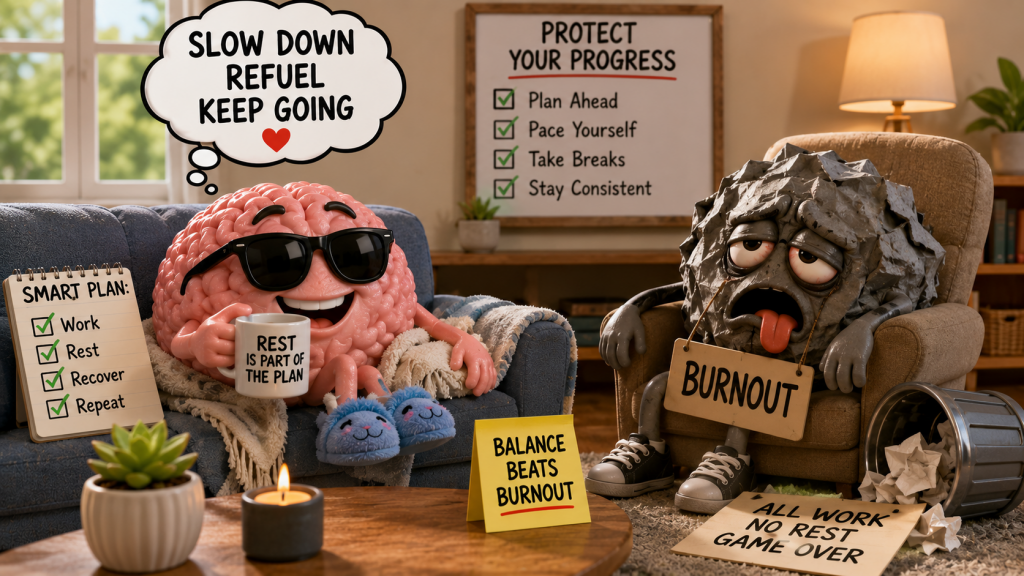
Progress is not only something you build.
Progress is something you protect.
That part matters.
A lot of people start strong. They get excited. They make a plan. They buy the notebook. They set the goal. They tell themselves, “This time is different.”
And sometimes it is different.
For a while.
Then they push too hard.
They do too much too fast.
They ignore rest.
They fill every hour.
They say yes to too many things.
They turn discipline into punishment.
Then the same thing happens again.
They crash.
They stop.
They feel guilty.
They call themselves lazy.
They start over later with another huge plan.
That cycle is not discipline.
That is burnout wearing a fake mustache.
Real discipline is not just about doing more. Real discipline is about building a life you can keep living. It is about creating progress that does not fall apart the second your energy drops.
That is why discipline over motivation needs balance. If you only use discipline to push harder, you will eventually run out of gas. But if you use discipline to build smart systems, protect your energy, and keep your pace steady, you can last much longer.
There is a huge difference between being committed and being reckless.
Being committed means you keep showing up.
Being reckless means you ignore every warning sign until your body and mind force you to stop.
Being committed means you work, rest, adjust, and return.
Being reckless means you act like rest is weakness.
Rest is not weakness.
Rest is part of progress.
You do not protect your progress by pretending you are a machine. You protect your progress by learning your limits, planning around real life, and building systems that do not depend on emotional energy every single day.
The World Health Organization describes burnout as an occupational phenomenon, not a medical condition, and says it comes from chronic workplace stress that has not been successfully managed. You can read the WHO’s explanation here: Burn-out an “occupational phenomenon”: International Classification of Diseases.
That matters because burnout is not just “being tired.”
Tired can often be fixed with sleep.
Burnout is deeper.
Burnout can make you feel drained, cynical, detached, and less effective. It can make the work you once cared about feel heavy and empty. It can make even small tasks feel like too much.
So when we talk about discipline, we need to be honest.
The goal is not to grind until you break.
The goal is to build progress you can keep.
That means protecting your body, your mind, your time, your focus, and your energy.
It means knowing when to push and when to pause.
It means having a plan for hard days.
It means making progress without turning your whole life into a punishment.
| Fake Discipline | Real Discipline |
|---|---|
| “I must do everything perfectly.” | “I need a system I can repeat.” |
| “Rest is weakness.” | “Rest helps me continue.” |
| “If I miss a day, I failed.” | “If I miss a day, I return quickly.” |
| “I should always push harder.” | “I should pace myself wisely.” |
| “My mood decides everything.” | “My system guides me.” |
This is where a lot of people get confused.
They think protecting progress means slowing down too much.
It does not.
Protecting progress means removing the things that make you quit.
That may mean taking breaks before you crash.
It may mean building smaller habits.
It may mean saying no to extra tasks.
It may mean sleeping more.
It may mean changing your environment.
It may mean tracking your energy.
It may mean creating a plan that works when life gets messy.
That is not weakness.
That is strategy.
A person who burns out and quits is not ahead of the person who moves slowly and keeps going.
The slow person may look less impressive at first.
But steady progress has a way of winning.
Avoiding Burnout
Burnout often does not arrive all at once.
It builds.
At first, you may just feel a little tired.
Then you start feeling annoyed.
Then the thing you used to care about starts feeling heavy.
Then simple tasks feel harder.
Then your patience gets shorter.
Then you need more time to recover.
Then you start avoiding the work.
Then you feel guilty for avoiding it.
Then the guilt makes the stress worse.
That is how burnout sneaks in.
It does not always show up with a giant warning sign. Sometimes it shows up as a quiet loss of energy and care.
That is why avoiding burnout needs to be part of your success plan from the beginning. You cannot wait until you are completely drained and then hope one nap fixes everything.
Burnout prevention is not just for big jobs, careers, or offices. It can happen with creative work, family responsibilities, personal goals, caregiving, school, business, fitness, and even self-improvement.
Yes, even trying to improve your life can burn you out if you turn it into a never-ending list of demands.
That is why discipline over motivation must include rest.
Not lazy rest.
Not avoidance rest.
Real rest.
The kind of rest that lets you come back better.
The National Institute of Mental Health recommends basic mental health care steps like regular exercise, healthy meals, enough sleep, relaxing activities, goal-setting, gratitude, and staying connected with others. You can read their guidance here: Caring for Your Mental Health.
That advice may sound simple, but simple does not mean weak.
Simple things hold people together.
Sleep matters.
Food matters.
Movement matters.
Breaks matter.
People matter.
Quiet matters.
A lot of people want advanced productivity tricks while ignoring the basics that keep a human being functioning.
That is like trying to drive faster with no gas in the tank.
You may move for a little while, but you will not get far.
Here are some warning signs that you may be pushing too hard:
- You feel tired even after normal rest.
- You are more irritated than usual.
- You keep avoiding work you usually care about.
- You feel numb, bored, or detached from your goal.
- Small tasks feel much bigger than they are.
- You are sleeping poorly or staying wired at night.
- You feel guilty any time you rest.
- You keep using pressure instead of planning.
- You need a huge emotional push to do basic things.
These signs do not mean you are weak.
They mean you need to pay attention.
Burnout prevention starts with honesty. You need to ask yourself what your current pace is costing you.
A goal that destroys your health, family, sleep, or peace may not be a good system yet. It may need a better plan.
That does not mean the goal is wrong.
It means the method needs work.
| Burnout Pattern | Better Protection Plan |
|---|---|
| Working until you crash | Stop before total exhaustion |
| Trying to change everything at once | Pick one or two habits first |
| Skipping sleep to get more done | Protect sleep as part of the plan |
| Saying yes to everything | Say no to low-value demands |
| Using guilt as fuel | Use clear systems and small steps |
| Never taking breaks | Schedule recovery before you need it |
The CDC’s National Institute for Occupational Safety and Health explains that fatigue can come from stress, demanding tasks, long hours, and disrupted sleep. Their page on Fatigue and Work explains that fatigue can affect more than just sleepiness.
That point matters because tired people do not always make good choices.
When you are exhausted, it is harder to stay patient.
It is harder to think clearly.
It is harder to make healthy choices.
It is harder to stay consistent.
It is harder to care.
That is why rest is not the enemy of discipline.
Rest supports discipline.
A tired brain wants shortcuts. A rested brain can follow the plan.
A tired body wants escape. A cared-for body can keep moving.
A tired person often quits. A rested person can return.
This does not mean every day needs to be easy. Growth often takes effort. Some days will be hard. Some seasons will ask more from you.
But hard is not the same as harmful.
You need to know the difference.
Hard work can leave you tired but proud.
Burnout leaves you empty and detached.
Hard work can stretch you.
Burnout can flatten you.
Hard work can be recovered from.
Burnout can make you feel like you cannot return.
That is why protecting progress matters.
You are not trying to win one day.
You are trying to build a life.
Creating Systems Instead of Relying on Emotion
Systems protect progress because they reduce the need for emotional fuel.
If you need to feel motivated every time you act, your progress is always at risk.
But if you have a system, the system carries part of the weight.
A system is a repeatable way to do something.
It tells you what to do, when to do it, and how to make it easier.
A system removes some of the daily debate.
Instead of asking, “Do I feel like writing?” your system says, “Write 200 words after coffee.”
Instead of asking, “Should I work out today?” your system says, “Walk after lunch.”
Instead of asking, “Should I clean?” your system says, “Clear the sink after dinner.”
Instead of asking, “Should I plan?” your system says, “Write tomorrow’s top three tasks before bed.”
That is powerful because emotions change.
Systems stay.
This is why discipline over motivation should not be understood as just forcing yourself through everything. A better way to see it is this:
Discipline is the choice to build systems that make the right action easier to repeat.
That is the real skill.
A good system does not depend on a perfect mood. It does not need you to wake up inspired. It does not ask you to restart your whole life every Monday.
It gives you a path.
And when you drift, it gives you a way back.
James Clear wrote:
“You do not rise to the level of your goals. You fall to the level of your systems.”
You can read that quote on James Clear’s official quote page.
That line is useful because it tells the truth. A goal may inspire you, but your system decides what happens on a normal Tuesday when you are tired and nobody is clapping.
Systems also protect you from making every day a fresh emotional battle.
Without a system, you must decide again and again:
- Should I start?
- When should I start?
- How much should I do?
- What counts as enough?
- What do I do if I miss a day?
- What do I do when I feel tired?
- Where do I begin?
That is too much mental work.
A system answers those questions before your mood gets involved.
Here is what a simple system can include:
| System Part | What It Does | Example |
|---|---|---|
| Clear action | Removes confusion | “Write 200 words” |
| Set time | Removes guessing | “After breakfast” |
| Easy setup | Removes friction | “Keep notebook on desk” |
| Minimum version | Protects hard days | “Write 3 sentences if tired” |
| Reset rule | Prevents quitting | “Miss one day, return next day” |
That last part is important.
Every good system needs a reset rule.
A reset rule tells you what to do when you mess up.
Because you will mess up.
Not because you are weak.
Because you are human.
Life will interrupt you. You will get sick. You will get busy. You will forget. Something will take longer than expected. Some days will not go as planned.
A bad system acts like one missed day is a disaster.
A good system expects missed days and gives you a path back.
For example:
- If I miss one workout, I take a 10-minute walk the next day.
- If I skip writing, I write 100 words the next morning.
- If I overspend, I track the purchase and return to the plan.
- If the house gets messy, I clean one surface before bed.
- If I lose focus, I set a 10-minute timer and restart.
That is how systems protect progress.
They stop one slip from becoming a spiral.
They stop one missed day from becoming a missed month.
They stop guilt from taking over.
They make returning normal.
A system should also include recovery. If your system has no rest in it, it is not a complete system.
It is a countdown to burnout.
The National Center for Complementary and Integrative Health explains that relaxation techniques can help bring about the body’s relaxation response, which can include slower breathing, lower blood pressure, and a reduced heart rate. You can read more here: Relaxation Techniques: What You Need To Know.
That does not mean you need to make rest complicated.
Rest can be simple.
- Take a short walk.
- Sit quietly for five minutes.
- Breathe slowly.
- Stretch.
- Turn off screens before bed.
- Take a real lunch break.
- Spend time outside.
- Write down what is stressing you.
- Have one evening with no extra demands.
These are not wasted moments.
They are maintenance.
A car needs maintenance.
A house needs maintenance.
A body and mind need maintenance too.
If you refuse maintenance, something eventually breaks.
Systems help you avoid that.
They let you build progress with rhythm instead of panic.
Here is a simple weekly system for protecting progress:
| Day or Time | System Action |
|---|---|
| Sunday evening | Pick the top 3 goals for the week |
| Each morning | Choose the most important small action |
| Midday | Take a short reset break |
| Evening | Review what worked and what felt heavy |
| Friday | Check progress and adjust the plan |
| Weekend | Rest, recover, and prepare lightly |
This does not need to be perfect.
The point is to stop living only by reaction.
When you live by reaction, your day gets stolen by whatever is loudest.
When you live by system, your values get a place on the schedule.
That is how progress survives.
Motivation may get you excited.
But systems help you keep going after the excitement fades.
Motivation may help you dream.
But systems help you repeat.
Motivation may help you start.
But systems help you protect what you have already built.
That is why discipline wins.
Not harsh discipline.
Not joyless discipline.
Not burnout discipline.
Smart discipline.
The kind that knows work matters, rest matters, and consistency needs protection.
Because the goal is not to burn bright for a week.
The goal is to keep the fire alive.
Practical Systems for Success
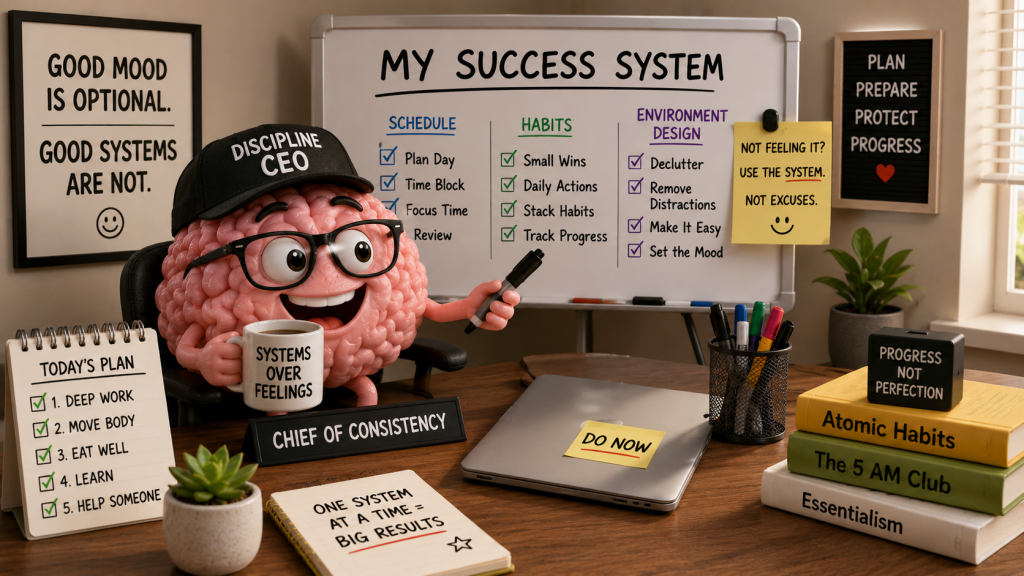
A goal without a system is easy to lose.
You may want the goal badly. You may care about it. You may think about it all the time. You may even talk about it with real passion.
But if there is no system behind it, the goal has to survive on mood, memory, and hope.
That is not enough.
Hope is good, but it does not tell you what to do at 8:00 on a tired Monday morning.
Motivation feels nice, but it does not clear your schedule.
A dream can point you in the right direction, but it cannot remove distractions, build habits, plan your day, or make the first step easier.
That is what systems are for.
A system is a simple plan you can repeat. It tells you when to act, what to do, where to do it, and how to make it easier to start.
That is why discipline over motivation works best when it is tied to practical systems. Discipline should not be a random fight with yourself every day. It should not feel like waking up and trying to win a wrestling match with your own brain.
A good system makes discipline easier.
It gives your day structure.
It lowers the number of choices you have to make.
It removes some of the drama.
It helps you act before your mood gets a chance to talk you out of it.
That matters because most people do not fail because they are bad people. They fail because their plan is too loose. They depend on good intentions instead of clear systems.
They say, “I need to write more.”
But they do not decide when.
They say, “I need to exercise.”
But they do not decide where.
They say, “I need to stop wasting time.”
But they leave every distraction right in front of them.
They say, “I need to be consistent.”
But they do not build a routine that protects consistency.
Then they blame themselves when nothing changes.
The truth is, if your environment, schedule, and habits are all working against you, motivation will not save you for long.
You need a better setup.
| Goal | Weak Plan | Practical System |
|---|---|---|
| Write more | “I’ll write when I can.” | “I write 300 words after coffee.” |
| Move more | “I should exercise.” | “I walk for 10 minutes after lunch.” |
| Read more | “I need to read more books.” | “I read 2 pages before bed.” |
| Save money | “I should spend less.” | “I move $10 every Friday.” |
| Stay focused | “I need to stop scrolling.” | “Phone goes in another room for 30 minutes.” |
Systems do not need to be fancy.
In fact, simple systems are usually better.
If your system is too complicated, you will avoid it. If it needs too many tools, you will delay it. If it takes too much energy to understand, you will not use it on hard days.
A good system should feel clear enough to follow when your brain is tired.
That is the test.
If you can only follow your system when you feel amazing, it is not strong enough yet.
A better system helps you on average days.
Messy days.
Busy days.
Low-energy days.
Real days.
That is why this section matters. This is where discipline over motivation becomes something you can actually use. Not just a phrase. Not just a quote. Not just an idea.
A working plan.
Scheduling
Scheduling is one of the simplest ways to turn a goal into action.
A lot of people write long to-do lists and then wonder why they still feel behind. The problem is that a to-do list shows what needs to be done, but it does not always show when it will be done.
That leaves too much room for delay.
You look at the list.
You feel overwhelmed.
You pick the easiest thing.
You avoid the important thing.
Then the day disappears.
A schedule helps because it gives time a job.
Instead of saying, “I need to work on this sometime,” you say, “I will work on this from 9:00 to 9:30.”
That small change matters.
Time that is not planned usually gets taken by something else. It gets taken by scrolling, chores, random messages, extra tasks, other people’s needs, or plain old drifting.
A schedule protects your important work before the day gets crowded.
This does not mean every minute of your life needs to be planned. That would be too much for most people. A useful schedule is not a prison. It is a map.
And a map helps you stop wandering.
Harvard Business Review has written about timeboxing, which means putting tasks directly on your calendar instead of leaving them as a loose list. In the article How Timeboxing Works and Why It Will Make You More Productive, the idea is simple: give important work a place in your calendar so it has a better chance of getting done.
That fits perfectly with discipline over motivation because a schedule lowers the need for emotional debate.
If the task is already on the calendar, you do not need to ask, “Do I feel like doing this?”
You ask, “What did I already decide?”
That is a stronger question.
Scheduling also helps you see the truth about your time. Many people do not have a motivation problem. They have a calendar problem.
They want to do ten important things, but their day only has space for three.
That creates guilt.
A schedule helps you face reality.
If something does not fit, you can adjust the plan instead of pretending you will somehow do everything.
Here is a simple scheduling system:
| Step | What To Do | Example |
|---|---|---|
| Pick your top task | Choose the one task that matters most | Write 300 words |
| Give it a time | Put it on the calendar | 8:30 AM after coffee |
| Make it short | Start with a block you can handle | 25 minutes |
| Protect the block | Remove easy distractions | Phone in another room |
| Review it later | Check what worked | Did the time fit my real day? |
A good schedule should include three kinds of time.
- Focus time: time for the important task.
- Life time: meals, chores, family, errands, appointments.
- Recovery time: rest, breaks, sleep, quiet, fun.
Many people only schedule work. Then they wonder why they burn out.
A healthy schedule includes recovery because people are not machines.
You can be disciplined and still need rest.
You can be serious about your goals and still need breaks.
You can work hard and still protect your energy.
That is not weakness.
That is how you keep going.
One mistake people make is building a schedule for a perfect day. They plan as if nothing will go wrong. No interruptions. No low energy. No traffic. No family needs. No extra mess. No slow start.
Then real life happens, and the schedule breaks before lunch.
A better schedule leaves room.
Give yourself buffer time.
Make the first version smaller.
Do not stack every block back-to-back.
Leave space for life.
A schedule that survives real life is better than a perfect schedule you quit after two days.
Here is a simple example:
| Time | Task |
|---|---|
| 8:00 AM | Coffee and quick plan |
| 8:30 AM | Main focus task |
| 9:00 AM | Break or reset |
| 9:15 AM | Smaller task |
| 12:00 PM | Lunch and walk |
| 3:00 PM | Review top task |
| Evening | Prep tomorrow’s first step |
The details can change, but the idea stays the same.
Put the important thing somewhere real.
If your goal matters, it needs a place in your day.
Not someday.
Not whenever.
A real place.
That is scheduling.
Habits
Habits are the actions you repeat until they start to feel normal.
That is why habits are so powerful.
A habit can help you without needing a big speech every day. Once a habit is built, it takes less mental energy to repeat. You do not have to start from zero every time.
That is the dream.
Not to feel motivated forever.
To need motivation less.
This is why habits are one of the best tools for discipline over motivation. A habit turns the right action into the normal action.
At first, you may have to remind yourself.
Later, it becomes part of the day.
Think about brushing your teeth. Most people do not need to feel inspired to do it. They do it because it belongs in the routine.
That is what you want for your goals.
You want writing to belong in the routine.
You want walking to belong in the routine.
You want planning to belong in the routine.
You want saving money to belong in the routine.
You want cleaning small areas to belong in the routine.
BJ Fogg’s Fogg Behavior Model explains that behavior happens when motivation, ability, and a prompt come together at the same time. That is useful because it shows why motivation is not the only piece. If a habit is too hard, unclear, or has no prompt, it is easier to skip.
So make the habit easy.
Make it clear.
Give it a trigger.
A trigger is something that reminds you to act.
For example:
- After I pour my coffee, I write 100 words.
- After I brush my teeth, I stretch for one minute.
- After I eat lunch, I walk for ten minutes.
- After I close my laptop, I plan tomorrow.
- After I get paid, I move money to savings.
This is sometimes called habit stacking. It means you attach a new habit to something you already do.
That makes the new habit easier to remember.
The old habit becomes the doorway to the new habit.
| Current Habit | New Habit To Add |
|---|---|
| Pour coffee | Write 100 words |
| Brush teeth | Stretch for 1 minute |
| Eat lunch | Walk for 10 minutes |
| Finish dinner | Clear the sink |
| Get paid | Move money to savings |
| Sit at desk | Write top 3 tasks |
| Plug in phone at night | Read 2 pages |
Habits also work better when they are small at the start.
People often try to build giant habits too fast.
They say:
- “I will work out for an hour every day.”
- “I will write 2,000 words every morning.”
- “I will completely change my diet today.”
- “I will clean the whole house every night.”
- “I will never waste time again.”
That may feel exciting, but it is usually too much.
A better habit is small enough to repeat even when life is annoying.
Small habits build trust.
Trust builds consistency.
Consistency builds results.
Here is a better way to build habits:
| Instead of Starting With | Start With |
|---|---|
| One-hour workout | 10-minute walk |
| Full chapter | 100 words |
| Perfect diet | One better meal |
| Whole-house cleaning | One clean surface |
| Two-hour study session | 15 minutes |
| No phone all day | 30-minute phone-free block |
The National Library of Medicine article Making health habitual: the psychology of habit-formation and general practice explains that repeating a behavior in the same context can help it become more automatic over time.
In plain English, repeat the action in the same kind of moment.
After coffee.
After lunch.
Before bed.
After work.
Every Friday.
Same cue. Same action. Same pattern.
That is how the habit gets a place in your life.
Another helpful habit rule is this:
Never miss twice if you can help it.
Missing once happens.
You get sick. You get busy. You forget. The day goes sideways.
But missing twice can become the start of a new pattern.
So if you miss today, return tomorrow in the smallest possible way.
Not with guilt.
Not with drama.
Just return.
That is a strong habit skill.
A habit is not broken because you missed once.
A habit is protected when you return fast.
Environment Design
Your environment shapes your behavior more than most people want to admit.
You may think you are making free choices all day, but your surroundings are constantly nudging you.
If your phone is next to you, you are more likely to check it.
If junk food is on the counter, you are more likely to eat it.
If your notebook is open on your desk, you are more likely to write.
If your walking shoes are by the door, you are more likely to walk.
If your room is messy, your mind may feel more scattered.
If your tools are ready, starting feels easier.
This is why environment design matters.
Environment design means setting up your space so the right action is easier and the wrong action is harder.
That is not cheating.
That is wisdom.
A lot of people try to win with willpower while their environment is built for failure.
They want to focus, but their phone is buzzing beside them.
They want to eat better, but the easiest food is junk.
They want to write, but their desk is covered in clutter.
They want to sleep better, but the TV and phone keep pulling them in.
They want to save money, but shopping apps are one tap away.
Then they blame themselves for not being stronger.
But why make the fight harder than it needs to be?
The better plan is to design the space.
The research article Behavior Change discusses behavior change strategies and explains that changing cues can affect behavior. In simple words, the things around you can trigger actions. That means your setup matters.
This fits perfectly with discipline over motivation because your environment can support discipline before you feel motivated.
You can prepare the night before.
You can remove distractions.
You can make the first step obvious.
You can make the bad habit less convenient.
You can make the good habit easier to start.
| Goal | Helpful Environment Change |
|---|---|
| Write more | Keep notebook open on desk |
| Walk more | Put shoes by the door |
| Eat better | Keep easy healthy food visible |
| Focus better | Put phone in another room |
| Sleep better | Charge phone away from bed |
| Save money | Delete shopping apps or remove saved cards |
| Clean more | Keep cleaning wipes where mess happens |
Environment design is powerful because it works before the debate begins.
If the phone is already in another room, you do not need to resist it every five seconds.
If your workout clothes are already out, starting is easier.
If your writing file is already open, writing feels closer.
If tomorrow’s top task is already written down, you wake up with less confusion.
A good environment lowers friction.
Friction is anything that makes the right action harder.
Too many steps.
Too much clutter.
Too many choices.
Too many distractions.
Too much setup.
Too much searching.
The more friction there is, the more motivation you need.
So reduce the friction.
Make the good action easy.
Make the bad action annoying.
For example:
| Bad Habit You Want Less Of | Add Friction |
|---|---|
| Scrolling at night | Charge phone across the room |
| Snacking without thinking | Keep snacks out of sight |
| Impulse shopping | Remove saved payment info |
| Skipping workouts | Keep shoes and clothes ready |
| Avoiding writing | Leave document open |
| Watching too much TV | Put remote in a drawer |
You do not have to redesign your whole house.
Start with one area.
If your goal is writing, design your writing spot.
If your goal is fitness, design your walking or workout setup.
If your goal is focus, design your desk.
If your goal is sleep, design your bedroom.
One small environment change can remove a lot of daily struggle.
Here is a simple environment design checklist:
- Make the right action visible.
- Make the first step easy.
- Remove one major distraction.
- Put needed tools close by.
- Move tempting distractions farther away.
- Prepare the space before you need it.
- Keep the system simple enough to use on tired days.
The point is not to create a perfect space.
The point is to create a helpful space.
A perfect space is nice, but a helpful space is enough.
Do not wait until your desk looks like a magazine photo.
Clear one spot.
Do not wait until your kitchen is perfect.
Put one healthy option where you can see it.
Do not wait until your whole room is spotless.
Move your phone away from the bed.
Do not wait until you have the perfect planner.
Write tomorrow’s first task on a sticky note.
That is how systems work.
Small changes.
Clear cues.
Less friction.
More follow-through.
This is the practical side of success.
Not hype.
Not magic.
Not waiting for the perfect mood.
A schedule tells your time where to go.
A habit tells your body what to repeat.
An environment tells your brain what is easy.
Together, they make success less dependent on emotion.
That is why discipline over motivation works best when it has support.
You are not trying to force your way through life with pure willpower.
You are building a structure that helps you become the person you said you wanted to be.
The Final Principle
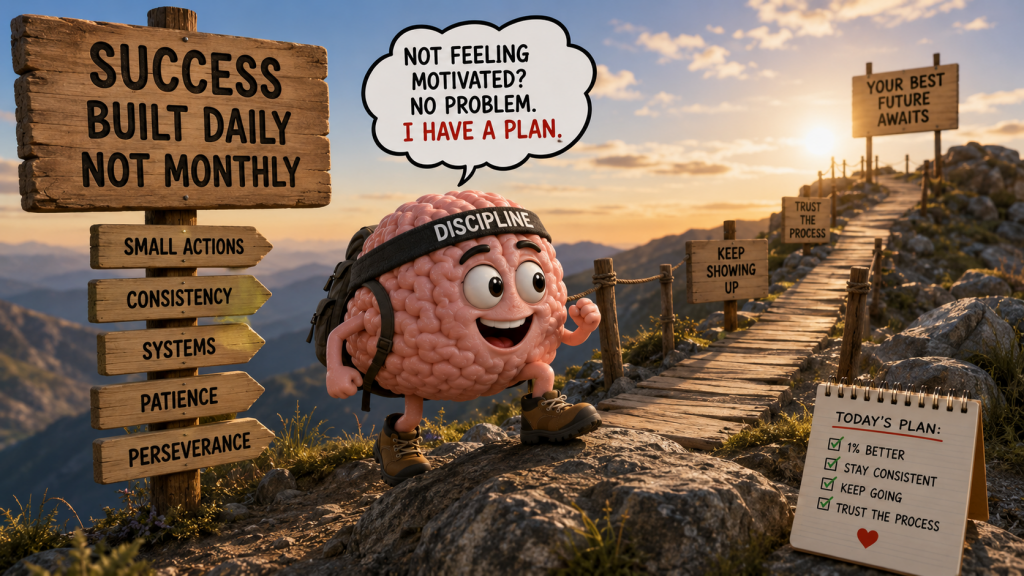
At the end of all of this, the message is simple:
Motivation is useful, but it is not enough.
It can help you start.
It can give you a spark.
It can make you feel excited about the future.
But it cannot carry the whole weight of your life.
That is why discipline over motivation matters. Discipline is what helps you keep going when the exciting feeling fades. Systems help you know what to do when your mood changes. Consistency helps small actions turn into real results.
That is the final principle.
Do not build your life on a feeling that comes and goes.
Build it on actions you can repeat.
This does not mean you should hate motivation. Motivation can be a gift. When it shows up, use it. Let it help you begin. Let it give you energy. Let it remind you what you want.
But do not make motivation the boss.
Make it a helper.
The boss should be your values, your systems, your habits, and your willingness to show up in small honest ways.
That is how people change.
Not by feeling strong every day.
Not by being excited every morning.
Not by making perfect plans and never slipping.
People change when they keep returning to the person they said they wanted to become.
They change by writing when it is messy.
They change by walking when it is short.
They change by saving when it is small.
They change by cleaning one corner.
They change by planning one day.
They change by choosing the next useful action instead of waiting for the perfect mood.
That is where growth becomes real.
A lot of people lose years waiting for a feeling. They wait to feel confident. They wait to feel ready. They wait to feel inspired. They wait to feel less scared. They wait to feel more organized. They wait to feel like the type of person who can finally do the thing.
But many times, you become that type of person by doing the thing.
Not perfectly.
Not all at once.
But one action at a time.
That is why the phrase discipline over motivation is so important for anyone trying to build a better life. It puts power back in your hands. It reminds you that you do not have to wait for your emotions to line up before you move.
You can move first.
And sometimes the feeling follows.
James Clear wrote:
“Motivation often increases after you begin. The lesson is not to wish you had more motivation, but to make starting as easy as possible.”
You can read that quote on James Clear’s motivational quotes page.
That line is powerful because it tells the truth. Starting is often the hardest part. Once you begin, even in a small way, the task usually feels less impossible.
The blank page is scarier than the first bad sentence.
The first step outside is harder than the walk.
The messy room feels worse before you pick up the first ten things.
The project feels heavier before you open the file.
Starting breaks the spell.
That is why the final principle is not “try to feel more motivated.”
The final principle is:
Make starting easier, then repeat the action long enough to become the person who does it.
That is the real path.
| Weak Plan | Stronger Final Principle |
|---|---|
| “I’ll do it when I feel motivated.” | “I’ll make the first step easy.” |
| “I need to change everything.” | “I’ll repeat one useful action.” |
| “I failed because I missed a day.” | “I’ll return quickly.” |
| “I need more confidence.” | “I’ll build proof through action.” |
| “I need a perfect plan.” | “I’ll use a simple system I can follow.” |
The goal is not to create a life with no hard days.
That life does not exist.
The goal is to create a way of living that can survive hard days.
That is what discipline does.
That is what systems do.
That is what consistency does.
They give your future a chance even when your feelings are tired, bored, scared, or distracted.
Final Thoughts
If you take nothing else from this article, take this:
You do not need to feel motivated to take the next small step.
That one idea can change a lot.
It can change how you write.
It can change how you exercise.
It can change how you clean.
It can change how you save money.
It can change how you build confidence.
It can change how you handle setbacks.
It can change how you see yourself.
Because the moment you stop waiting for motivation to save you, you start looking for the next action you can actually take.
That is a stronger way to live.
Motivation asks, “Do I feel ready?”
Discipline asks, “What can I do now?”
Motivation asks, “Am I excited?”
Discipline asks, “What did I say mattered?”
Motivation asks, “Is this easy today?”
Discipline asks, “What is the smallest honest version?”
That last question is important.
You do not always need to do the biggest version. You do not always need to push at full power. You do not always need to make the day look perfect.
Some days, the smallest honest version is enough.
If you planned to write 1,000 words and can only write 100, write 100.
If you planned to walk 30 minutes and can only walk five, walk five.
If you planned to clean the whole room and can only clear one surface, clear one surface.
If you planned to study for an hour and can only do 10 minutes, do 10 minutes.
If you planned to rebuild your whole life and today you can only make one better choice, make that one better choice.
That still counts.
It counts because it keeps the pattern alive.
It counts because it gives you proof.
It counts because it teaches your brain that you are someone who returns.
And returning is one of the most important skills you can build.
Anyone can start when they feel excited.
The real skill is returning after a bad day.
Returning after a missed habit.
Returning after a low mood.
Returning after embarrassment.
Returning after disappointment.
Returning after life interrupts you.
That is where discipline over motivation becomes real.
It is not about being perfect.
It is about not letting imperfection become an excuse to quit.
Octavia E. Butler said:
“First forget inspiration. Habit is more dependable. Habit will sustain you whether you’re inspired or not.”
You can find that quote listed on Goodreads’ Octavia Butler quote page.
That quote matters because it speaks to the heart of this whole topic. Inspiration is wonderful, but habit is what carries you through the ordinary days. And ordinary days are where most of your life happens.
Not the big launch day.
Not the perfect Monday.
Not the first day of January.
Not the day you feel unstoppable.
Most of your life happens on normal days.
That means your success has to work on normal days too.
It has to work when the kitchen is messy.
It has to work when you slept badly.
It has to work when your mood is flat.
It has to work when nobody notices.
It has to work when the goal feels far away.
That is why small systems matter.
That is why habits matter.
That is why consistency matters.
That is why discipline matters.
Here is the whole article in a simple table:
| Lesson | What It Means |
|---|---|
| Motivation is temporary | Do not depend on a feeling that changes often |
| Discipline wins | Keep promises in small realistic ways |
| Small actions matter | Make the first step easy enough to repeat |
| Consistency builds results | What you repeat shapes your future |
| Momentum builds confidence | Action gives your brain proof |
| Identity grows through repetition | Your habits cast votes for who you become |
| Systems protect progress | Structure helps when emotion is weak |
| Rest matters | Burnout is not a badge of honor |
| Environment shapes behavior | Make good choices easier and bad choices harder |
If you want a simple place to start, do not start with your whole life.
Start with one thing.
One habit.
One action.
One promise.
One small system.
Pick something that matters to you, then make it almost too easy to begin.
- Write 100 words.
- Walk for 10 minutes.
- Read 2 pages.
- Save $5.
- Clear one counter.
- Plan tomorrow’s top task.
- Put your phone in another room for 20 minutes.
- Stretch for 2 minutes.
- Drink one glass of water.
- Send one message you have been avoiding.
Do that small thing.
Then do it again.
Then return when you miss.
That is the boring part.
It is also the powerful part.
Real success usually does not look dramatic while it is happening. It looks like small actions repeated on normal days. It looks like coming back after you slip. It looks like doing the work without needing applause. It looks like choosing the future you want, even when the present mood is not helping.
That is not always exciting.
But it works.
The Fogg Behavior Model explains that behavior happens when motivation, ability, and a prompt come together. That is useful because it reminds us that when action is hard, we can make it easier. We can lower the step. We can create a prompt. We can design the day better.
That is much better than just saying, “I need more motivation.”
Maybe you do not need more motivation.
Maybe you need a smaller first step.
Maybe you need a clearer schedule.
Maybe you need a better environment.
Maybe you need a habit tied to something you already do.
Maybe you need more rest.
Maybe you need to stop trying to change everything at once.
Maybe you need to stop treating one bad day like proof that you cannot change.
Because you can change.
But change is usually built in a much quieter way than people expect.
Not by one emotional breakthrough.
Not by one perfect plan.
Not by one huge burst of motivation.
Change is built by returning to the small useful action again and again until your life starts to look different.
That is why discipline over motivation is not just a productivity idea.
It is a life idea.
It is a way of saying:
I will not wait for the perfect feeling before I take care of my future.
And that may be the most important lesson of all.
Takeaways: Discipline Over Motivation
- Motivation is temporary, but discipline gives you a way to keep going when the feeling fades.
- Discipline over motivation works because it turns success into a repeatable system instead of a random emotional event.
- Small daily actions matter because they are easier to repeat than huge, overwhelming goals.
- Consistency builds trust with yourself and helps you stop restarting every few weeks.
- Momentum grows from action, not from waiting until you feel fully ready.
- Your identity changes through repetition because every small action gives proof of who you are becoming.
- Burnout must be avoided because real discipline includes rest, recovery, and smart pacing.
- Systems make success easier by using schedules, habits, and environment design to reduce daily resistance.
FAQ:
Why is discipline over motivation important?
Discipline over motivation is important because motivation comes and goes, but discipline helps you keep taking action even when you do not feel inspired.
Motivation can help you start, but discipline helps you continue.
When you build discipline, you stop waiting for the perfect mood. You create habits, systems, and small actions that help you make progress even on tired, boring, or stressful days.
Is motivation bad?
No, motivation is not bad.
Motivation can be useful. It can give you energy, help you start, and remind you why your goal matters.
The problem is relying on motivation as your only plan.
Motivation is like a spark. It can help light the fire, but it cannot keep the fire burning by itself. That is why discipline, consistency, and systems matter more for long-term success.
How do small actions help build discipline?
Small actions help build discipline because they are easier to repeat.
A huge goal can feel scary, but a small step feels possible. Writing 100 words, walking for 10 minutes, cleaning one counter, or planning one task may not seem big at first, but those small actions build trust with yourself.
Over time, small repeated actions create momentum, confidence, and real progress.
How can I stay consistent when I do not feel motivated?
You can stay consistent by making the task smaller and easier to start.
Instead of waiting until you feel ready, do the smallest honest version of the task.
For example, if you do not feel like writing, write five sentences. If you do not feel like exercising, walk for five minutes. If you do not feel like cleaning, put away ten things.
The goal is not to be perfect.
The goal is to keep the pattern alive.
How do systems help with discipline?
Systems help with discipline by removing daily guesswork.
A system tells you what to do, when to do it, and how to make it easier.
For example, instead of saying, “I should write more,” a system says, “I write 300 words after coffee.” Instead of saying, “I need to exercise,” a system says, “I walk for 10 minutes after lunch.”
Systems make success easier because they help you act even when your mood changes.